I Reviewed the Nanoleaf Essentials LED Rope Light 3-Pack — And There’s One Thing They Don’t Put in the Box
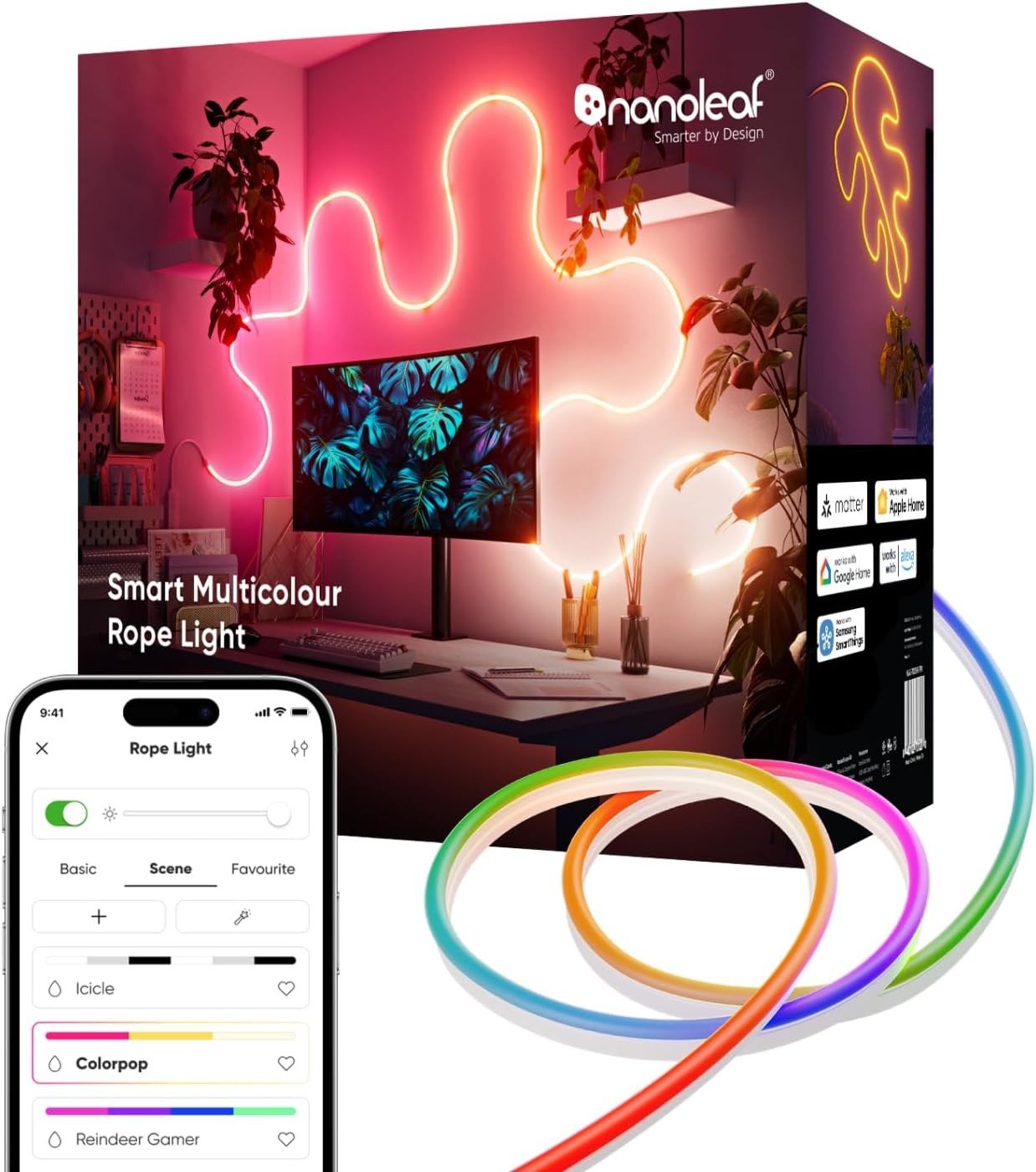
NANOLEAF ESSENTIALS LED ROPE LIGHT 3-PACK
Your lights are already on.
The room looks fine.
You’ve seen setups online that feel alive, layered, something that breathes color instead of just emitting it, and your current strip doesn’t do that.
So you search.
You land on Nanoleaf.
You see the 3-pack bundle.
You think: three runs of rope light, Matter-enabled, music sync, screen mirror, $69.99 each — this is exactly what I need.
That assumption is the thing worth examining before you buy.
The product is real.
The colors are genuinely beautiful.
The Matter integration is legitimate.
But what most buyers discover after installation is that this light has a structural logic — a specific operating condition — under which it becomes extraordinary.
And a different condition under which it becomes a frustrating, half-lit reminder that your wall just isn’t the right shape.
This review maps that gap. Precisely.
The Result Looks Fine. The Problem Isn’t.
You mount it.
You connect it.
The colors show.
You take the first photo and it looks exactly like the product page.
Then a week passes.
The adhesive on one clip starts to lift.
The rope sags two millimeters.
Not dramatically — just enough to change the way light diffuses against the wall.
The shape you planned is still there, but the glow isn’t landing the way it did on day one.
And you realize: the clips were never holding the tension.
They were holding the position, assuming the wall was perfectly flat, perfectly smooth, and that you’d screwed every single one of them in.
Most people don’t screw every clip.
That’s not an installation failure.
That’s what happens when a product markets itself as “DIY wall art” without clarifying that DIY here means drill gun, pencil planning, and 30 physical anchor points.
The output looks fine.
The problem is structural, and it’s invisible in every product photo you’ll ever see.
What You’re Actually Feeling but Not Naming
There’s a specific friction that brings people to this search.
It’s not “I want colorful lights.”
That’s too vague to spend $200+ on.
The real friction looks more like this: you’re spending 6–10 hours a week in a room that doesn’t respond to you.
The lighting is static.
The mood is static.
The space feels like a room and not an environment.
You want something that shifts when the music shifts.
That dims when you’re winding down without you touching anything.
That makes the room feel like it has a personality.
That’s the actual problem.
And this product solves it — but only above a specific threshold of setup investment and ecosystem readiness.
If you’re below that threshold, you don’t get a living environment.
You get a colorful strip that you control manually from your phone, which is only marginally better than what you already have.
The Hidden Mechanism Behind the Miss
The Nanoleaf Essentials LED Rope Light (ASIN: B0FC6L9XZ6) operates on Matter over WiFi with Bluetooth pairing.
It has 70 independent color zones across 5 meters, 420 LEDs, approximately 300 lumens of output, and supports screen mirroring via the Nanoleaf Desktop App and music sync via Rhythm Scenes.
Here is the mechanism most buyers miss:
Matter is a protocol, not a button.
To use Matter functionality — which is what makes this light actually smart and responsive within your ecosystem — you need a Matter-compatible hub with Thread border routing capability, iOS 16.5+ or Android 8.1+, and the latest Nanoleaf firmware installed before pairing.
Without that infrastructure, you get Bluetooth-only control.
Bluetooth-only means: slow response, no automation, no ecosystem integration, no voice reliability, no screen mirror.
You get 16 million colors controlled from a phone app that takes several seconds to connect.
Multiple independent reviewers documented this exact failure pattern.
The light paired fine.
Matter refused to connect.
Wi-Fi drops happened repeatedly.
And then — after a firmware update, or after switching to 2.4GHz, or after connecting through a compatible hub — everything worked exactly as advertised.
The product is not broken.
The gap between what people expect and what the infrastructure requires is where the disappointment happens.
The Threshold Where the Outcome Quietly Breaks
| Setup Variable | Below Threshold | Above Threshold |
|---|---|---|
| WiFi Band | 5GHz only in room | 2.4GHz available |
| Hub Type | No Matter hub | HomePod Mini / Echo 4th Gen / Nest Hub 2nd Gen |
| Firmware Status | Not updated before pair | Latest version installed |
| iOS/Android | Below 16.5 / 8.1 | Current OS version |
| Wall Surface | Textured / corner-heavy | Flat, smooth, continuous |
| Mounting Method | Adhesive clips only | Screws + clips combined |
Above that threshold: the light is genuinely exceptional.
Colors transition with precision.
Music sync responds in near-real-time.
Screen mirroring during gaming creates an immersive peripheral glow that is difficult to replicate at this price point.
Voice commands execute without delay.
Below that threshold: you own a beautiful LED rope that you manually control from your phone, that may sag from the wall in six to eight weeks, and that makes you wonder why you didn’t just buy a cheaper strip.
The threshold isn’t hidden in fine print.
It’s stated in the product listing.
But it’s written in technical language that most buyers scan past because they’re focused on the output, not the infrastructure.
Why Most Buyers Misread This Too Early
The 3-pack bundle framing creates a specific cognitive bias.
Three units suggests: get it for three rooms, or cover a large space continuously.
Neither of those uses is what this product was designed for.
Each Rope Light is a fixed 5-meter unit.
It cannot be trimmed.
It cannot be extended.
It cannot be connected to another Rope Light.
Three packs means three separate, independent, non-linked lighting zones — each requiring its own power source, its own pairing sequence, and its own placement planning.
If you’re imagining one continuous 15-meter run behind a couch, that’s not what this is.
Additionally: the light emits from the top side only.
It is not a full 360-degree diffuser.
This matters enormously for placement.
A rope tucked into a bookshelf where the glow faces the shelf surface produces almost no visible ambient effect.
A rope mounted so the diffuser faces the viewing angle produces exactly the clean, even glow you see in the product photos.
Most buyers discover the emission direction issue during or after installation.
Not before.
Who Is Actually Inside This Problem
The people for whom this product delivers genuine value share a consistent profile:
They already have at least one Matter-compatible hub in their home.
They are comfortable installing firmware before they pair.
They are willing to invest 30–45 minutes planning the physical layout on paper before mounting a single clip.
They are primarily using the rope for a single continuous flat surface — a desktop edge, a TV backdrop, a bed headboard, a smooth feature wall — where the entire 5 meters can be deployed without corners.
They’re not buying three packs to cover three rooms in one afternoon.
They’re buying three packs because they have three specific surfaces, planned separately, and they want color coherence across all three scenes.
That person gets a product that consistently earns 4+ stars and phrases like “once I got it working, I never want to turn it off.”
Where Wrong-Fit Begins
| Situation | What Actually Happens |
|---|---|
| Renting an apartment | Clips require screws for stability — adhesive alone fails over time — wall damage risk is real |
| No Matter hub in home | Bluetooth-only control, slow and limited, full feature set locked |
| Planning to trim/resize | Product cannot be trimmed or extended — this is a hard technical limit |
| Expecting 360° glow | Top-side emission only — placement facing away from viewer produces muted effect |
| Connecting multiple ropes | Each rope is independent — no native chaining — three packs = three separate devices |
| Installing on textured walls | Adhesive does not hold on rough surfaces — screws are required for any permanent mount |
| Expecting instant setup | Matter pairing requires firmware update, compatible hub, and correct OS version first |
Wrong-fit is not a character flaw.
It’s the natural result of a product that does one thing exceptionally well and markets that thing without fully mapping who needs it versus who assumes they need it.
The regret risk is highest for renters, for buyers without existing smart home infrastructure, and for anyone who expects this to install the way a basic RGBW strip does.
The One Situation Where This Product Becomes Logical
You have a flat, screw-safe surface.
You have a Matter hub.
You are building an environment — not just adding a light.
You want music to move the room.
You want the screen to bleed into the wall.
You want the light to change when your schedule changes, without you picking up your phone.
In that situation, the Nanoleaf Essentials LED Rope Light 3-Pack Bundle is a structurally sound purchase.
At $69.99 per unit, the per-zone cost is among the lowest in Matter-compatible addressable lighting.
The 70 zones produce genuinely smooth gradient transitions that cheaper strips cannot match.
The Nanoleaf app’s scene community adds longevity — you are not limited to the scenes you can create yourself.
The 3-pack bundle makes sense specifically when you have three distinct surfaces already scoped, each under 5 meters, each with a compatible power outlet nearby, and each in an ecosystem already built around Matter.
That’s a specific use case.
If you’re in it, the value is real and the performance follows.
What It Solves, What It Reduces, and What It Still Leaves to You
| Category | What the Product Does |
|---|---|
| Solves | Static, mood-dead ambient lighting with no responsiveness |
| Solves | Cross-ecosystem control (Alexa, Google Home, Apple HomeKit via Matter) |
| Solves | Visual coherence between screen content and room environment (Screen Mirror) |
| Solves | Manual scene switching — automations handle it via Matter schedules |
| Reduces | Color banding artifacts common in lower-density LED strips |
| Reduces | Ecosystem fragmentation — single app, multiple platforms |
| Reduces | Setup friction within a properly configured Matter environment |
| Still Leaves to You | Physical installation planning — the most failure-prone step |
| Still Leaves to You | Hub infrastructure if you don’t already own one |
| Still Leaves to You | Firmware update discipline — critical for pairing reliability |
| Still Leaves to You | Layout design — no auto-mapping, manual zone tracing in app |
The light does not replace planning.
It rewards it.
What you carry into the installation — your wall type, your hub situation, your OS version — determines whether you’re setting up a system or diagnosing a problem.
Final Compression
The Nanoleaf Essentials LED Rope Light 3-Pack is not a commodity strip.
It is not plug-and-play.
It is not for anyone who wants to put a light behind a couch in 15 minutes and be done.
It is a precision ambient lighting tool — beautiful in color quality, legitimate in smart home integration, and genuinely capable of producing the kind of environment-level responsiveness that most lighting products claim and few deliver.
The condition: your infrastructure must already support it.
If you have a Matter hub, flat mounting surfaces, and you’re willing to spend one session planning and one session installing — the output justifies every specification.
If you’re working from a raw WiFi router with no hub, textured walls, and a 5GHz-only setup — solve the infrastructure first.
The light will wait.
Buying it before your ecosystem is ready means you’ll own a beautiful object that performs below its capacity, and that’s not a product failure.
That’s a sequence problem.
Frequently Asked Questions
| Question | Answer |
|---|---|
| Can I connect multiple Nanoleaf Rope Lights together in one continuous run? | No. Each Rope Light is an independent unit. Three packs give you three separate devices, each requiring its own power source and pairing. They can be synced through the Nanoleaf app and Matter, but they are not physically linked. |
| Does the Nanoleaf Essentials Rope Light work without a Matter hub? | Yes, via Bluetooth only. But Bluetooth mode disables automations, voice reliability, screen mirror, and full ecosystem integration. The full feature set requires a Matter-compatible hub with Thread border routing support. |
| Can I trim the Rope Light to fit a shorter space? | No. It is a fixed 5-meter unit. Trimming it voids the warranty and damages the product. If 5 meters is too long for your space, this is not the right product. |
| What hub do I need for full Matter functionality? | Confirmed compatible hubs include: Apple HomePod Mini, Apple HomePod (2nd Gen), Apple TV 4K (2nd/3rd Gen), Google Nest Hub (2nd Gen), Google Nest Wifi Pro, Amazon Echo (4th Gen), and Samsung SmartThings Station. |
| The light keeps dropping WiFi during Matter setup — is it defective? | Not necessarily. The most common fix is: switch your router to broadcast 2.4GHz explicitly, update the Nanoleaf app to the latest version, and update the light’s firmware before attempting Matter pairing. Multiple reviewers reported that a firmware update resolved repeated drop issues completely. |
| Does the Rope Light glow in all directions or only one side? | Top-side emission only. It is not a 360-degree diffuser. The mounting direction relative to your viewing angle determines how visible the glow effect will be. |
| What is the actual brightness output? | Approximately 300 lumens. Sufficient for accent, mood, and gaming ambient purposes. Not designed as a primary light source. |
| Who should not buy this? | Renters who cannot use screws, buyers without an existing Matter hub, anyone expecting a plug-and-play experience similar to basic LED strips, and anyone planning to use 16 meters continuously in one uninterrupted run. |
<br>
Transparency Note:
This analysis is built on aggregated real-world experience.
It extracts what repeatedly holds, what breaks, and what users uncover only after living with the system—then shapes it into a clear model you can use immediately.
Think of it as structured experience, refined and presented so you don’t have to learn it the hard way.
“A quick note: Don’t believe the star ratings, but trust personal experience. This article is a compilation of collected experiences”