VIZIO MicMe Review: Two Jobs, One Box — and the Point Where One Quietly Loses
VIZIO MICME
The Result Looks Fine. The Problem Isn’t.
You pull the VIZIO MicMe SK210X-0805 out of the box and everything checks out immediately.
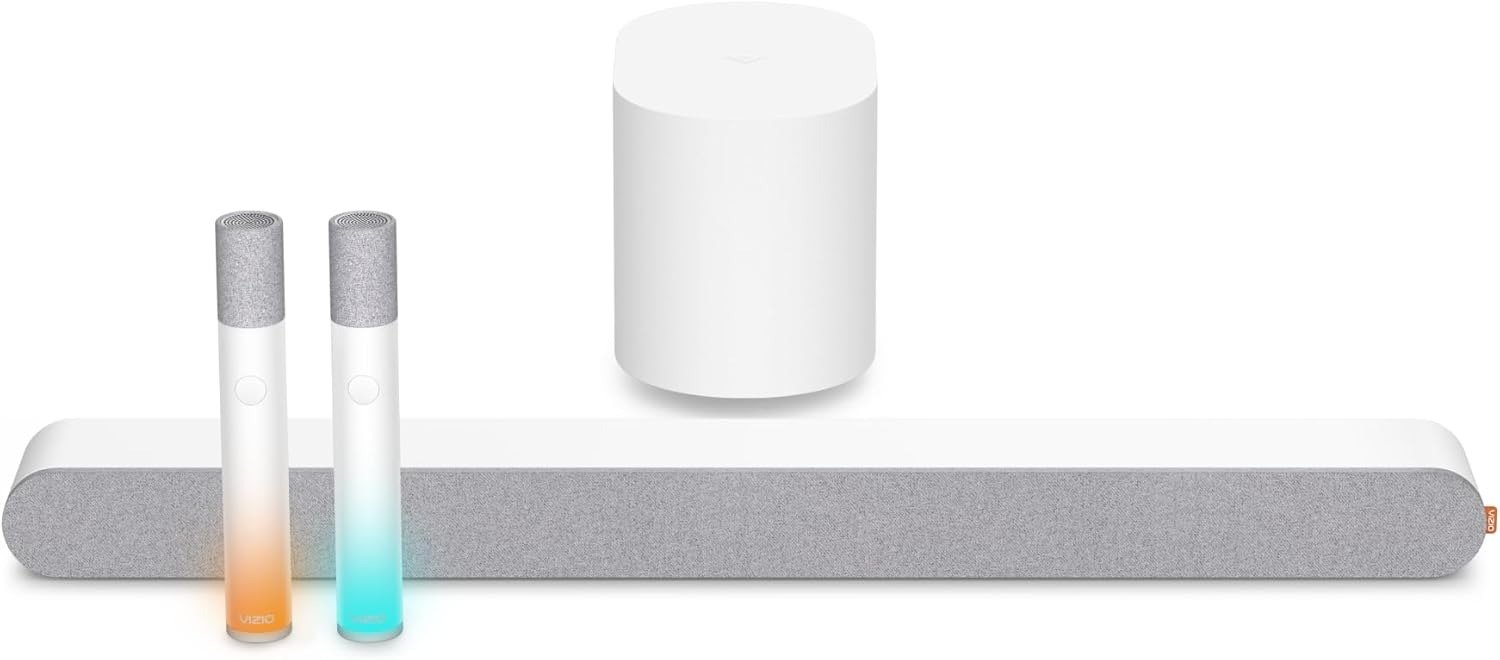
Two wireless microphones. A wireless subwoofer. Dolby Atmos. DTS:X. Six voice enhancement modes. LED mic lighting in nine colors. Karaoke app compatibility. HDMI eARC. Bluetooth. All of it under $200.
The setup confirms the impression. Mics connect automatically the moment they’re lifted off the charging dock. If you already own a VIZIO TV, the whole process is literally plug and play. Most buyers are running audio inside fifteen minutes.
And for the first night, possibly the first two weeks, the MicMe feels like a win with no asterisk.
Then something quieter happens — not a malfunction, not a defect. A structural limit surfaces. And it doesn’t announce itself. It just costs you in ways you don’t immediately name.
What You’re Actually Feeling but Not Naming
You’re not disappointed with the soundbar itself. As a TV audio upgrade, it genuinely delivers. CNN Underscored’s tester — someone who evaluates top-tier soundbars professionally — found the MicMe’s audio tuning clear and restrained, noting that it avoids the low-end overemphasis that even pricier competitors like the JBL Bar 1000 Mk2 fall into.
That’s real. That’s not marketing copy.
The friction shows up specifically when you’re using both functions at once — soundbar and karaoke — at the same time, at volume, with guests in the room. The bass that felt satisfying during a movie becomes a problem the moment a microphone is live. The subwoofer can overpower vocals during karaoke if not manually adjusted through the app.
That adjustment requires your phone. Mid-song. In front of people.
And then there’s the lag. Audio lag on the wireless mics becomes distracting during fast-paced karaoke songs. Not during slow ballads. Not during casual conversation. Specifically during tempo-driven songs — which is exactly when karaoke is most satisfying and most socially visible.
You feel it before you name it. You chalk it up to the track, the app, the room. But the pattern holds across sessions.
The Hidden Mechanism Behind the Miss
The VIZIO MicMe is not one device pretending to be two. It is genuinely two systems engineered into one chassis. But those two systems share the same signal path, the same subwoofer, and the same EQ logic — and they were not tuned with identical priorities.
The soundbar mode wants low-end presence. Movies and TV benefit from bass body. The subwoofer is calibrated to add weight.
The karaoke mode wants vocal clarity above everything. The moment a voice enters the signal path, the subwoofer’s tuning becomes adversarial to it. The low frequencies that made action sequences feel cinematic now physically compete with the human voice.
The MicMe has only two speaker drivers in the soundbar section with no dedicated center channel to precisely lock vocals and dialogue. On a premium soundbar, the center channel carries speech. Here, dialogue and vocals compete with the full signal mix.
Additionally, Dolby Atmos and DTS:X decoding are included, but immersive audio effects are constrained by the limited channel count. The spatial processing is upscaled — not delivered through overhead hardware. The 3D audio impression is real but virtual.
These aren’t flaws in the traditional sense. They’re structural trade-offs that the spec sheet doesn’t foreground.
The Threshold Where the Outcome Quietly Breaks
Here is the operating map you should have before you buy.
| Volume Level | Soundbar Performance | Karaoke Performance |
|---|---|---|
| Low (background TV) | ✅ Clear, balanced | ✅ Vocals sit above mix |
| Medium (comfortable room fill) | ✅ Full, warm, strong bass | ⚠️ Sub begins competing with vocal |
| High (social/party level) | ✅ Immersive, cinematic | ❌ Bass overpowers voice, lag becomes audible |
The threshold is medium-to-high volume, with fast-tempo songs, in party mode. Below that threshold, this system is genuinely good. Above it, the compromise announces itself at the worst moment.
| Feature | What the Spec Says | What It Actually Means |
|---|---|---|
| Dolby Atmos | ✅ Supported | ⚠️ Processed/upscaled — no overhead drivers |
| 6 Voice Enhancements | ✅ Included | ⚠️ Fixed presets, no granular fine-tuning |
| Wireless Mics | ✅ 2 included | ⚠️ Slight lag on fast-tempo songs |
| Soundbar Remote | ❌ Not included | App or TV remote only |
| Optical Input | ❌ Not included | eARC-only; older TVs face limitations |
| QuickFit Mounting | ✅ Available | VIZIO TV owners only |
Why Most Buyers Misread This Too Early
The dominant comparison buyers make is straightforward: a soundbar for ~$200, plus a separate karaoke machine. They run the math and the MicMe wins cleanly.
That comparison is not wrong. It’s just incomplete.
The assumption behind it is that a karaoke function inserted into a soundbar chassis will perform at the same level as a standalone karaoke system in that price range — while simultaneously performing at the same level as a standalone soundbar in that price range.
Neither of those holds.
In 2024, VIZIO transitioned their entire soundbar lineup to full-range woofers rather than woofer-tweeter combinations — a move that produced noticeably different sonic characteristics compared to their 2023 portfolio. This matters for buyers comparing the MicMe to older VIZIO impressions they’ve read or heard.
The second common misread: equating Dolby Atmos support with Dolby Atmos experience. The label is accurate. The spatial processing is upscaled rather than delivered through actual overhead drivers — which means the effect is subtle, not transformative, on this system.
Buyers who do not make this distinction before purchase frequently feel oversold on the audio spec, even when the rest of the system performs well.
Who Is Actually Inside This Problem
The MicMe’s real buyer has a specific profile. Understanding it prevents the wrong purchase in both directions.
This system is genuinely right for you if:
- You have a VIZIO TV and want one box that handles both daily TV audio and occasional karaoke without managing two separate systems.
- Your karaoke use is social and casual — family nights, holidays, guests who want fun without judgment.
- You are replacing flat TV speakers, not replacing a dedicated audio setup.
- The karaoke sessions tend toward relaxed participation rather than performance-level singing.
This system starts showing cracks if:
- You plan to use the karaoke function frequently, at high volume, with serious singers who will notice mic timing.
- The room is large enough that the subwoofer needs to work hard to fill it.
- Your TV doesn’t have HDMI eARC and you’re relying on optical or analog connection.
- You expected the soundbar half to behave like a dedicated audiophile purchase.
CNN’s reviewer found the MicMe additive for daily TV watching across a range of demanding content — but also noted it’s on the smaller side in terms of size and overall weight. The room matters. A smaller living room is where this system operates at its best.
Where Wrong-Fit Begins
The MicMe starts to become the wrong choice at a precise set of conditions.
| Scenario | Fit Assessment |
|---|---|
| Family casual karaoke, small room, VIZIO TV | ✅ Strong fit |
| Movie nights with good bass, TV upgrade | ✅ Strong fit |
| Party hosting with serious singers at volume | ❌ Wrong fit |
| Large open-plan room needing room-filling bass + vocal clarity | ❌ Wrong fit |
| Audiophile primary listening setup | ❌ Wrong fit |
| Non-VIZIO TV, no eARC port | ⚠️ Limited fit — connectivity gaps |
| Dedicated karaoke performers who need pro-level mic response | ❌ Wrong fit |
The specific wrong-fit buyer: someone who primarily wants a capable soundbar and sees the karaoke feature as a bonus. Without the karaoke use case, other soundbars in VIZIO’s own lineup at comparable price points — like the 5.1-channel 5SV510M-08 — offer more speaker channels and more immersive audio architecture for pure TV listening.
If you’re buying the MicMe primarily as a soundbar with karaoke as an afterthought, you’re likely overpaying for a feature you won’t use while under-buying on the audio hardware you actually wanted.
The One Situation Where This Product Becomes Logical
After everything above, the single clearest purchase case:
You have a small-to-medium living room. You own or are purchasing a VIZIO TV. Your household includes people — kids, guests, family — who light up at the idea of karaoke but don’t require professional-grade vocal performance. You want one device to handle the room’s audio needs without managing a separate system for music, TV, and occasional entertainment events.
In that scenario, no other product in this price range gives you what the MicMe delivers.
It transitions from a TV soundbar to a karaoke experience the moment you pick up a mic, integrates with major karaoke apps including access to over 85,000 songs via the MicMe Karaoke by Stingray app, and allows voice customization with six enhancement modes and nine LED mic colors — all controllable from the VIZIO app or your existing TV remote.
The wireless subwoofer adds real bass depth that most comparably priced soundbars skip. The mics feel substantial, not cheap. Users who pair it with a VIZIO TV consistently describe the setup as genuinely seamless.
This is the situation where the MicMe stops being a compromise and becomes the logical answer.
What It Solves, What It Reduces, and What It Still Leaves to You
What the VIZIO MicMe genuinely solves:
| Problem | Resolution |
|---|---|
| Flat TV speaker audio | Significant, immediate improvement |
| Separate karaoke system clutter | Eliminated — two mics + sub in one box |
| Bass presence in movie content | Real and noticeable improvement |
| Social entertainment friction | Karaoke ready in seconds, no mode switching |
| Connectivity with VIZIO TV ecosystem | Native, clean, remote-controlled |
What it reduces but does not eliminate:
- Vocal lag at speed — reduced by choosing slower-tempo songs and adjusting EQ through the app.
- Subwoofer-vocal competition — manageable through manual bass reduction, not auto-correcting.
- App dependency — reduced if you own a compatible VIZIO TV; fully app-dependent otherwise.
What remains on you:
No soundbar remote is included — a notable omission that buyers consistently flag. You will control this system from your phone or your TV remote. If neither is immediately accessible, the soundbar has no physical remote fallback.
Voice Enhancement presets are fixed and cannot be fine-tuned beyond selecting a mode. You get six options. You select one. The customization ends there.
If the karaoke sessions get intense, you will manually balance the mix. That is your responsibility, not the system’s automation.
Final Compression
The VIZIO MicMe SK210X-0805 earns its place in one specific living room: the one where a family wants to stop choosing between a good TV sound system and a karaoke setup, where the room is medium or smaller, and where the expectation is casual fun rather than vocal performance precision.
Below the volume and tempo threshold, this system is genuinely capable on both functions. Above that threshold, the shared signal path starts costing you in ways that matter most when an audience is watching.
The decision is simple if you’re honest about your use:
If your karaoke is occasional and social — and your room is modest — the MicMe at $199 gives you more functional value than any two-device alternative at the same budget.
If you need a soundbar that leads with pure audio quality, or a karaoke system that holds up under serious singers at volume, this is not the right purchase. A dedicated device for each job will serve you better.
Frequently Asked Questions
| Question | Answer |
|---|---|
| Does the VIZIO MicMe SK210X-0805 include a soundbar remote? | No. A dedicated soundbar remote is not included in the box. Control is handled via your existing TV remote through HDMI eARC, or through the free VIZIO mobile app — and buyers consistently flag this as one of the most notable omissions at this price point. |
| Does the Dolby Atmos on the MicMe deliver true overhead audio? | No. Dolby Atmos on this system is processed and upscaled rather than delivered through actual overhead drivers. The spatial effect is present but subtle — not comparable to a multi-channel system with height speakers. |
| Will the VIZIO MicMe work with a non-VIZIO TV? | Yes — it connects to non-VIZIO TVs via HDMI eARC. The QuickFit mounting and native TV remote integration, however, are exclusive to compatible VIZIO televisions. |
| Does the subwoofer overpower the microphone vocals during karaoke? | At higher volumes, yes. The subwoofer bass can overpower vocals during karaoke if not manually adjusted through the VIZIO app. Keeping the bass at moderate levels resolves most of this, but the adjustment is manual and not automatic. |
| Is there noticeable audio lag with the wireless microphones? | Audio lag on the wireless mics becomes distracting during fast-paced karaoke songs. Slower-tempo songs are largely unaffected. This is a hardware characteristic, not a pairing or setup issue. |
| What karaoke apps does the MicMe support? | Compatible apps include Kanto Karaoke, Stingray Karaoke, Smule, Party Tyme Karaoke, Yokee Karaoke, YouTube, and Apple Music. The dedicated MicMe Karaoke by Stingray app provides access to over 85,000 songs. |
| Who should not buy the VIZIO MicMe? | Anyone whose primary goal is a high-performance standalone soundbar for audiophile-level listening, or a professional-grade karaoke system for serious vocal performance at high volume. For pure soundbar performance, other options in VIZIO’s own lineup offer more channels and more immersive audio architecture at similar price points. |
Transparency Note:
This analysis is built on aggregated real-world experience. It extracts what repeatedly holds, what breaks, and what users uncover only after living with the system—then shapes it into a clear model you can use immediately. Think of it as structured experience, refined and presented so you don’t have to learn it the hard way.
“A quick note: Don’t believe the star ratings, but trust personal experience. This article is a compilation of collected experiences”