LG CINEBEAM Q HU710PB: THE PORTABLE 4K PROJECTOR THAT’S BRILLIANT — UNTIL THE ROOM ISN’T DARK ENOUGH
You bought a projector to escape the wall. To turn any room into a 100-inch cinema. You moved it around, pointed it at a fresh surface, and for a moment, that promise held.
Then you turned on a lamp.
Or the afternoon sun crept through the blinds. Or someone walked into the kitchen and flicked the overhead light.
And the image — the one that looked stunning in the dark — turned gray and flat, like watching a movie through fog.
That moment isn’t a flaw in your setup. It’s the exact point where the LG CineBeam Q HU710PB reveals what it is, what it isn’t, and — critically — who it was actually made for.
The Result Looks Fine. The Problem Isn’t.
The LG CineBeam Q is rated at 500 ANSI lumens, projects from 50 to 120 inches, runs on LG’s webOS, and delivers 4K via DLP with an RGB triple-laser engine.
On paper, those specs read like a complete package. In a dark room, that image genuinely stops people mid-sentence.
But the real problem isn’t what the spec sheet says. It’s what the spec sheet doesn’t say about when those numbers start to collapse.
In its Brightest picture profile with default settings, the CineBeam Q measured just 262.9 lumens — barely half its rated output — while achieving a contrast ratio of 1,048:1 in that same mode.
That gap between claimed and delivered brightness isn’t a deal-breaker. It is, however, the hidden variable that separates the people who love this projector from the ones who return it within two weeks.
What You’re Actually Feeling But Not Naming
There’s a specific frustration that shows up in portable projector ownership, and it doesn’t have a clean name yet.
It’s not “bad picture quality.” The picture quality on the CineBeam Q is genuinely exceptional for its class.
It’s not “wrong product.” The product is well-built, thoughtfully designed, and legitimately portable.
The friction is this: the experience works perfectly in exactly one lighting condition — and that condition is harder to maintain than you assumed when you bought it.
In a room with two overhead lights on, you can only comfortably watch content that relies on lots of bright visuals. Direct sunlight is entirely incompatible. This projector is ideal for dark or very dark rooms.
Most buyers understand this in theory before purchase. What they underestimate is how often their real viewing environment crosses that threshold — even when they intend to control the light.
Reviewers and owners consistently note that any significant ambient light washes out darker scenes, with recommendations to use blackout curtains or fully darkened rooms to preserve contrast.
The problem isn’t the projector. The problem is the gap between “dim room” in your head and “dim room” as the CineBeam Q requires it.
The Hidden Mechanism Behind the Miss
Here’s what’s actually happening when that image fades.
The CineBeam Q uses a single DLP chip with a 0.47″ DMD to reproduce 4K UHD resolution, powered by a 3-channel RGB laser light source that covers 154% of the DCI-P3 color gamut, with a dynamic contrast ratio of 450,000:1.
That color gamut figure is the key to understanding both the CineBeam Q’s genius and its limitation.
RGB laser projection creates colors with a purity and saturation that standard LED and lamp-based projectors cannot match. The image appears perceptually brighter than its lumen count suggests — because the reds are genuinely red, the blacks are genuinely deep, and the color contrast itself adds visual energy that raw brightness measurements don’t capture.
Due to the RGB laser light source’s ability to produce highly saturated colors, the on-screen image appears brighter than its measured lumen output. At 500 lumens, it delivers a vibrant-looking image on an 80-inch screen in a room with low ambient light — but is not the brightest portable projector available at this price point.
The mechanism behind the failure in bright rooms is the inverse of that same strength. Once ambient light exceeds a threshold — even modestly — it attacks contrast before it attacks color. The deep blacks that make the RGB laser’s colors pop simply become gray. And when the blacks go gray, the perceptual brightness advantage evaporates entirely, leaving you with a washed-out image that feels worse than the lumen number should suggest.
| Lighting Condition | Experience Level | Notes |
|---|---|---|
| Fully dark room | Excellent | Full contrast + color advantage |
| One dim lamp (far corner) | Good | Slight wash on darkest scenes |
| Two overhead lights on | Degraded | Dark content becomes flat |
| Afternoon sun through curtains | Poor | Image clearly faded |
| Direct daylight | Unusable | Completely washed out |
This isn’t a defect. It’s physics. But it’s physics that the marketing materials mention only in footnotes.
The Threshold Where the Outcome Quietly Breaks
There is a specific boundary. Call it the Ambient Light Collapse Threshold for the CineBeam Q.
With all shutters pulled but still having a decent amount of ambient light leaking in, the projector was bright enough to work on documents and view internet content in its menus — but viewing 4K movies in the same conditions resulted in a badly washed-out image where dark scenes were difficult to make out on screen. LG itself is clear that nighttime viewing presents the best conditions for this projector.
That boundary lives somewhere between “shutters closed, lights off” and “one overhead light on.” Cross it, and the experience degrades sharply. Stay below it, and the CineBeam Q produces image quality that genuinely has no peer at its price point in its weight class.
| Spec | CineBeam Q HU710PB |
|---|---|
| Price | $999 |
| Resolution | 4K UHD (3,840 × 2,160) |
| Brightness (rated) | 500 ANSI Lumens |
| Brightness (measured, Brightest mode) | ~263–483 lumens |
| Color Gamut | 154% DCI-P3 |
| Contrast Ratio | 450,000:1 (dynamic) |
| Light Engine | RGB Triple Laser |
| Throw Ratio | 1.2:1 |
| Screen Size | 50–120 inches |
| Weight | 3.3 lbs |
| Dimensions | 3.1 × 5.3 × 5.3 inches |
| Speaker | 3W built-in mono |
| Smart Platform | webOS (Gen 6) |
| Ports | 1× HDMI (eARC), 1× USB-C |
| HDR Support | HDR10, HLG |
| Input Lag | ~50–56ms |
| Light Engine Lifespan | 20,000 hours |
| Wireless | Wi-Fi, Bluetooth (Dual Audio), AirPlay 2, MiraCast |
The threshold isn’t announced. It’s discovered. And the discovery usually happens two weeks after unboxing.
Why Most Buyers Misread This Too Early
The comparison that kills the CineBeam Q’s reputation unfairly is the lumen comparison.
Buyers look at competing portable projectors — some rated at 700, 1,000, even 2,400 lumens — and read the CineBeam Q’s 500 as a clear loss. That comparison is correct in a well-lit room. It is wrong everywhere else.
Color performance in Filmmaker Mode is excellent, with grayscale and color Delta-E both averaging under 3 — the target threshold for professional accuracy. Coverage of the UHDA-P3 color gamut reaches 98.7%, while BT.2020 coverage measures 95%.
No portable competitor at this price matches those color accuracy numbers. The projectors with 1,000 to 2,400 lumens that appear to “beat” the CineBeam Q in brightness tests use LED or hybrid light engines that produce a noticeably narrower, less accurate color gamut.
The CineBeam Q’s smart system uses LG’s excellent webOS Gen 6 platform — unlike most projectors — and supports AirPlay 2 mirroring with video up to 4K/30Hz, as well as MiraCast wireless device mirroring. The HDMI port handles eARC for Dolby Atmos passthrough and HDR content up to 4K/60Hz.
The early comparison trap: buying based on lumens alone, in a category where lumens without color accuracy is a half-measure. Combining the wide color reproduction with a dynamic contrast ratio of 450,000:1 and effective Dynamic HDR Tonemapping results in class-leading HDR picture quality for its class.
| Feature | CineBeam Q HU710PB | Typical 1,000-Lumen LED Portable | Anker Nebula Cosmos 4K (2,400L) |
|---|---|---|---|
| Brightness (rated) | 500 ANSI | ~1,000 ANSI | 2,400 ANSI |
| Light Engine | RGB Triple Laser | LED / Single Laser | Laser |
| DCI-P3 Color Coverage | 154% | ~80–100% | ~100–110% |
| Color Accuracy (Delta-E) | Under 3 | Varies (often 5–8) | Varies |
| Weight | 3.3 lbs | 4–6 lbs | 9.9 lbs |
| Smart Platform | webOS (Netflix native) | Android TV / VIDAA | Android TV (no Netflix native) |
| Bright Room Performance | Poor | Moderate | Good |
| Dark Room Picture Quality | Outstanding | Good | Good |
The comparison only makes sense once you know which row matters most to your actual life.
Who Is Actually Inside This Problem
The CineBeam Q HU710PB is built for a specific human being, and that person has a specific relationship with their space.
They live in a bedroom, apartment, or small room where a large television either won’t fit or feels architecturally wrong. They watch at night, or they can blackout the room reliably. They move the projector between rooms, or between homes, or they take it to places where plugging in a 65-inch OLED is impossible.
Since the HU710PB can produce a massive picture from a compact chassis, it’s a great solution for an apartment, dorm room, or other small space. It’s designed to serve as a portable TV replacement, including internal smart features expected in flat-panel televisions.
They care about what the image looks like more than how loud it gets. They understand that a 3-watt speaker is a starting point, not a destination, and they already own a Bluetooth speaker or soundbar.
One Walmart reviewer compared it directly to the Nebula Capsule 3 and called the CineBeam Q “sooo much better in terms of resolution, brightness, ease of use and style” — while noting the internal speaker is not great and the top of the projector runs hot.
They also, critically, value setup speed. The CineBeam Q is easy to set up thanks to its autofocus and auto keystone correction features. With a 1.2 throw ratio, positioning the projector around 10.5 feet away proved optimal for a 110-inch screen.
That person exists. If you are that person, the CineBeam Q has no real competition at $999.

Where Wrong-Fit Begins
There is an equally specific human being for whom this projector will quietly fail — not dramatically, but in the slow accumulation of compromises that eventually make them wish they had chosen differently.
You will feel regret if:
- You watch in a living room with windows that you don’t fully control. The afternoon light, even filtered through standard curtains, crosses the Ambient Light Collapse Threshold regularly.
- You watch content in the morning or afternoon. The CineBeam Q’s performance window is essentially evening to night, in a room you can meaningfully darken.
- You want immersive audio from the unit itself. The built-in 3-watt speaker produces weak and tinny audio and is best switched off in favor of a Bluetooth speaker or headphones. This isn’t a minor caveat — it’s a consistent experience that requires an additional purchase to resolve.
- You game seriously. The projector takes just over 55ms to render images in its fastest setting — solid for an ultra-portable projector, but not as fast as serious gamers require. Many TVs now render images in 10ms or less.
- You rely on Max or Hulu natively. Max and Hulu are notably absent from the available streaming apps on webOS for the CineBeam Q. AirPlay and MiraCast can bridge this, but require your phone to stay active.
- You need a remote that works from across a dark room. The remote’s range is abysmal — the sensor is on the back of the projector, and more than six or seven feet from the back panel the projector doesn’t respond to remote button pushes at all. It also lacks a backlight, which is a notable inconvenience for a device that requires darkness to perform best.
The One Situation Where This Product Becomes Logical
After all of that — the threshold mapping, the constraint inventory, the wrong-fit profile — there is one clear situation where the LG CineBeam Q HU710PB becomes the obvious, non-negotiable choice.
You need 4K portable projection with professional color accuracy, in a controlled-light environment, at under $1,000, from a unit that weighs 3.3 pounds and sets itself up automatically.
The CineBeam Q offers an impressive blend of advanced technology, user-friendly features, and class-leading picture quality. Its 4K sharpness and wide-gamut RGB laser light engine make for an impressive image, and the inclusion of the polished webOS smart TV platform with all key streaming apps, including Netflix, makes it even more attractive.
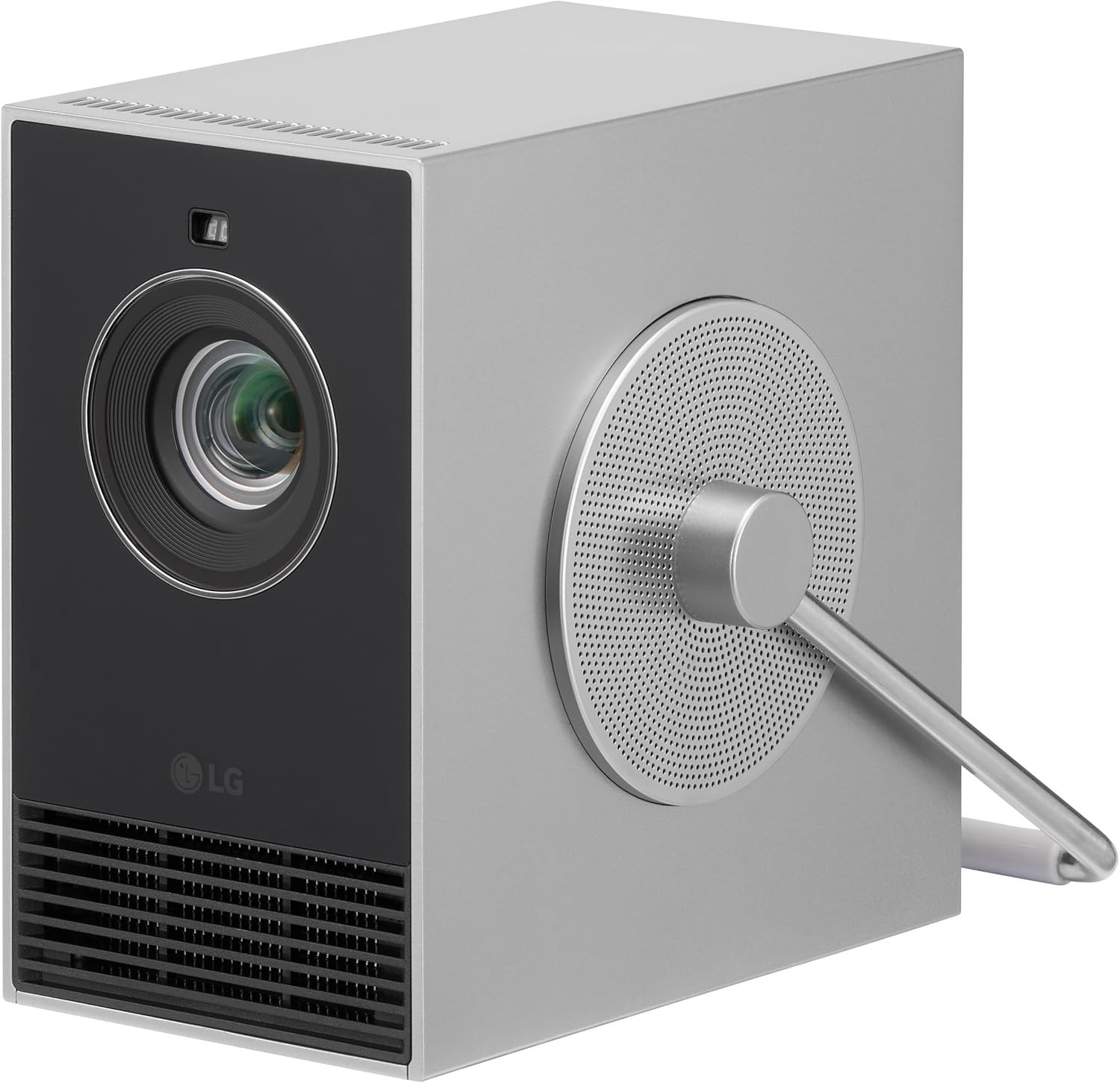
It has a unique form factor with a retro, rotating-handled design and is great for instances where space is limited or travel is involved. The handle doubles as a stand, adjustable to project images at different angles, making it suitable for both indoor and outdoor use.
The LG CineBeam Q HU710PB isn’t meant to compete with dedicated home theater projectors, but it excels among portable models — and earned an AVS Top Choice for 2024.
That’s not a marketing claim. That’s the consistent conclusion of every independent lab that measured it.
What It Solves, What It Reduces, and What It Still Leaves to You
What it solves completely:
The need for a large, sharp, color-accurate screen in a controlled-light space without permanent installation. The CineBeam Q eliminates the TV-size constraint, the mounting cost, and the room commitment — in one 3.3-pound object.
What it meaningfully reduces:
Setup friction. Auto keystone and auto focus mean point-and-watch in under a minute. No manual grid alignment. No guessing the throw distance.
What it reduces partially:
The ambient light problem. Blackout curtains, an evening schedule, or a basement location all help. But the underlying threshold doesn’t move — you work around it, not past it.
What it leaves entirely to you:
Audio. Budget for a Bluetooth speaker or soundbar. The 3-watt mono speaker is not the sound experience the image deserves.
App ecosystem gaps. Max and Hulu require a phone or a streaming stick. Plan for that workaround before you unbox.
Remote ergonomics in darkness. The lack of a backlit remote, combined with the rear-facing sensor, is a legitimate daily friction point in exactly the lighting condition the projector performs best in.
Where regret begins:
When you realize your room doesn’t get dark enough, or that you watch during the day more often than you thought, or that the 3W speaker was never going to fill your space the way you imagined.
Final Compression
The LG CineBeam Q HU710PB is not for everyone. It is precisely for someone.
That someone controls their light. They watch at night. They move their screen between spaces. They care about color more than volume. They understand that a 4K RGB laser engine in 3.3 pounds, at $999, with webOS built in, is not a compromised product — it’s a boundary-specific one.
The brightness threshold is real. Even in its Brightest picture profile, the CineBeam Q delivers around 263 lumens in measured testing — but pairs that with class-leading color gamut of 100% sRGB, AdobeRGB, and NTSC, plus 98% DCI-P3 coverage, making it a fundamentally different visual experience than higher-lumen competitors.
That difference is the entire point.
If your viewing environment is dark or darkable — and stays that way when you actually watch — the decision stops being complicated. The CineBeam Q HU710PB is the best picture quality per pound, per dollar, in portable projection available today.
If your environment isn’t dark enough, no amount of wanting it to be will change what the physics deliver.
Know which side of that line you’re on. Then act accordingly.
Frequently Asked Questions
| Question | Answer |
|---|---|
| Is 500 ANSI lumens enough for the LG CineBeam Q HU710PB? | In a fully dark or very dim room, 500 lumens from an RGB laser engine produces a visually stunning image that appears brighter than the number suggests, due to the projector’s exceptional color saturation and contrast. In rooms with significant ambient light, however, 500 lumens is not enough — the image washes out, especially in dark scenes. LG itself recommends nighttime or dark-room viewing as the ideal condition. |
| Does the LG CineBeam Q HU710PB have Netflix? | Yes. Netflix is natively available through LG’s webOS platform. Disney+, Prime Video, Apple TV+, and YouTube are also natively supported. Max and Hulu are currently absent from the native app lineup and require wireless casting via AirPlay 2 or MiraCast using a phone or tablet. |
| What is the real measured brightness of the CineBeam Q? | Independent lab testing found the CineBeam Q delivers approximately 263 to 483 lumens depending on testing methodology and picture mode — compared to its rated 500 ANSI lumens. The Projector Central review measured 483 lumens in Brightest mode, within a 4% margin of the spec. Tom’s Guide measured 262.9 lumens in the same mode using a different measurement protocol. |
| Can the LG CineBeam Q HU710PB be used outdoors? | Yes — at night or in shade, in a location where you can achieve relative darkness. Direct daylight or brightly lit outdoor spaces are not compatible with the 500-lumen brightness level. For evening backyard use on a dark night, the projector performs well. |
| How good is the built-in speaker? | The single 3-watt mono speaker is adequate for very close, casual use only. Across every major independent review and user report, the built-in speaker is consistently cited as the weakest point of the CineBeam Q. Pairing with a Bluetooth speaker or soundbar is strongly recommended for any serious viewing session. |
| Is the LG CineBeam Q HU710PB good for gaming? | Casual gaming is workable. The input lag measures approximately 50–56ms in Game Optimizer |
Transparency Note:
This analysis is built on aggregated real-world experience.
It extracts what repeatedly holds, what breaks, and what users uncover only after living with the system—then shapes it into a clear model you can use immediately.
Think of it as structured experience, refined and presented so you don’t have to learn it the hard way.
“A quick note: Don’t believe the star ratings, but trust personal experience. This article is a compilation of collected experiences”