My Tosima W5 Review: The Window Robot That Works — Until the Exact Condition It Wasn’t Built For
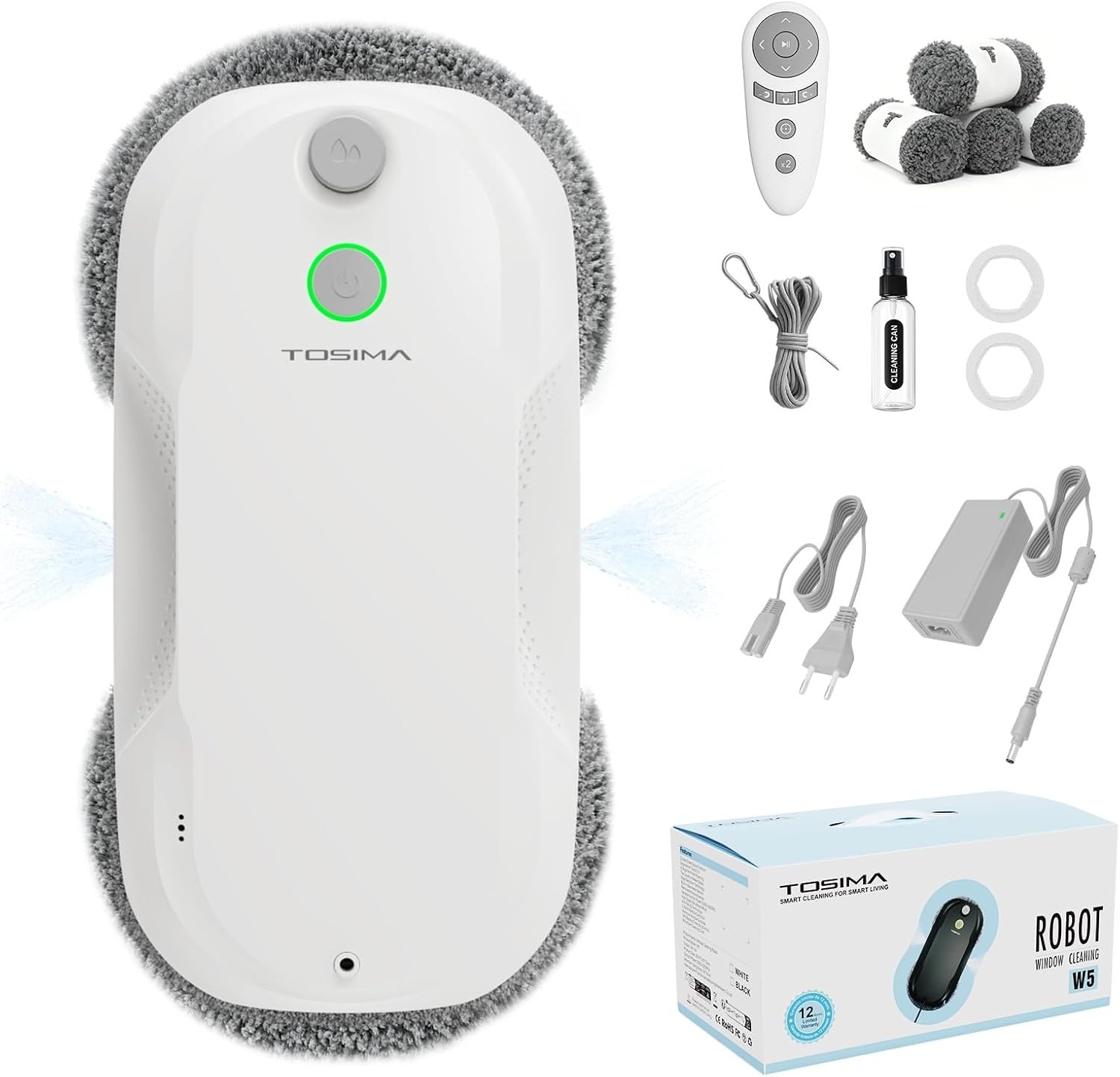
TOSIMA W5
Tosima W5 First Impressions: The Result Looks Fine. The Problem Isn’t.
There’s a particular moment every first-time window robot user goes through. The Tosima W5 finishes its cycle, makes its little return-beep, and you step closer to inspect the glass. The center of the window is visibly clear — streak-free, bright, better than what your Saturday spray-and-wipe usually delivers. Then your eyes drift to the lower-left corner. A thin band of untouched grime. Maybe an inch wide, maybe two. The machine routed right up to that edge and turned back without entering it.
The window looks 90% done. Your gut reads it as 70%.
Why does this moment matter? Because it’s the exact place where the W5’s design philosophy reveals itself — and it’s the place most buyers haven’t thought about before they purchase.
That corner isn’t a defect. It’s a structural decision baked into every round-pad suction robot on the market. Understanding why it happens — and whether it matters for your specific windows — is the whole point of this review.
Tosima W5 Specifications: Everything You Need at a Glance
| Specification | Tosima W5 (Model: B0GGZMFYPF) |
|---|---|
| Suction Power | Variable frequency up to 6,400 Pa max adaptive |
| Motor Type | NIDEC Low-Noise Brushless Motor |
| Spray System | Bidirectional Ultrasonic Atomization |
| Water Tank Capacity | 65ml (externally visible level indicator) |
| Spray Behavior | Sprays twice per movement; stops at edges automatically |
| Cleaning Pressure | Up to 35N (simulates sustained hand pressure) |
| Cleaning Modes | 5 — Fast, Deep, Thorough, Edge, Spot |
| Safety System | Triple: Air pressure sensor + AI edge detection + safety rope |
| Cleaning Pads Included | 8 reusable microfiber rags |
| Control Method | Remote control (no app required) |
| Power Source | Corded AC — continuous power during operation |
| Backup Battery | None — corded-only operation |
| Weight | Approximately 4 lbs (1.8 kg) |
| Compatible Surfaces | Smooth flat glass, mirrors, glass doors |
| Navigation | AI route planning + intelligent edge detection |
| User Rating | 4.8/5 stars |
The NIDEC motor is worth pausing on. NIDEC is a Japanese precision-engineering manufacturer that supplies brushless motors to industrial and commercial cleaning equipment. The practical result in this robot: lower operating noise, consistent torque delivery, and longer expected service life than the generic brushed motors found in cheaper competing models.
The “no backup battery” line in this table deserves your full attention. If the power cord trips during a cleaning cycle — accidental kick, brief power fluctuation, anything — the robot is held on the glass solely by the safety rope. This is not dangerous when the rope is properly anchored. But it means the safety rope is never optional on this machine. It is your primary protection, not a secondary one.
Tosima W5 Daily Use: What You’re Actually Feeling but Not Naming
Here is what a typical session looks like from the inside.
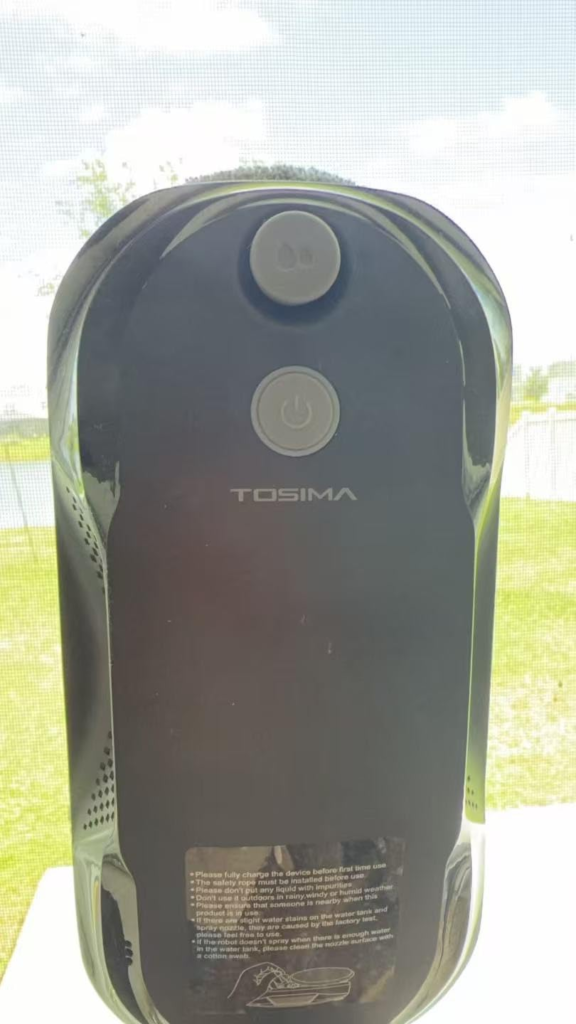
You attach the robot to the window, thread the safety rope through a door handle or wall hook, press start on the remote, and it goes. The ultrasonic spray activates in the direction of movement — forward and backward — firing water vapor as a fine mist rather than a wet spray. The robot presses its pads against the glass with noticeable firmness. You can see it working. It moves in methodical rows, top to bottom.
On a standard flat window, this is when I stopped watching. Not from blind trust, but because there was nothing to supervise. The AI route logic handled edge detection. The variable suction adjusted itself to a slightly dirtier patch without any input from me. The result, when the cycle finished, was a cleanly cleared main pane with even misted coverage.
The friction point appeared on the second window — one with a 3cm wooden divider running horizontally through the center. The robot treated each half as a separate territory, stopping precisely at the divider. It could not cross it. The glass immediately adjacent to the wood was untouched. That is when the shape of what I was working with became completely clear.
This is not a bad product experience. It is a shape-mismatch experience. The robot performed exactly as designed. My window simply was not inside its working geometry.
Why do people name this as frustration rather than limitation? Because “all smooth surfaces” lands in the imagination as “all of my windows.” It doesn’t mean that. It means all smooth, flat, unobstructed, electrically-accessible surfaces. Most windows in most homes qualify. Not every window in every configuration.
Window Cleaning Robot Mechanics: The Hidden Mechanism Behind the Miss
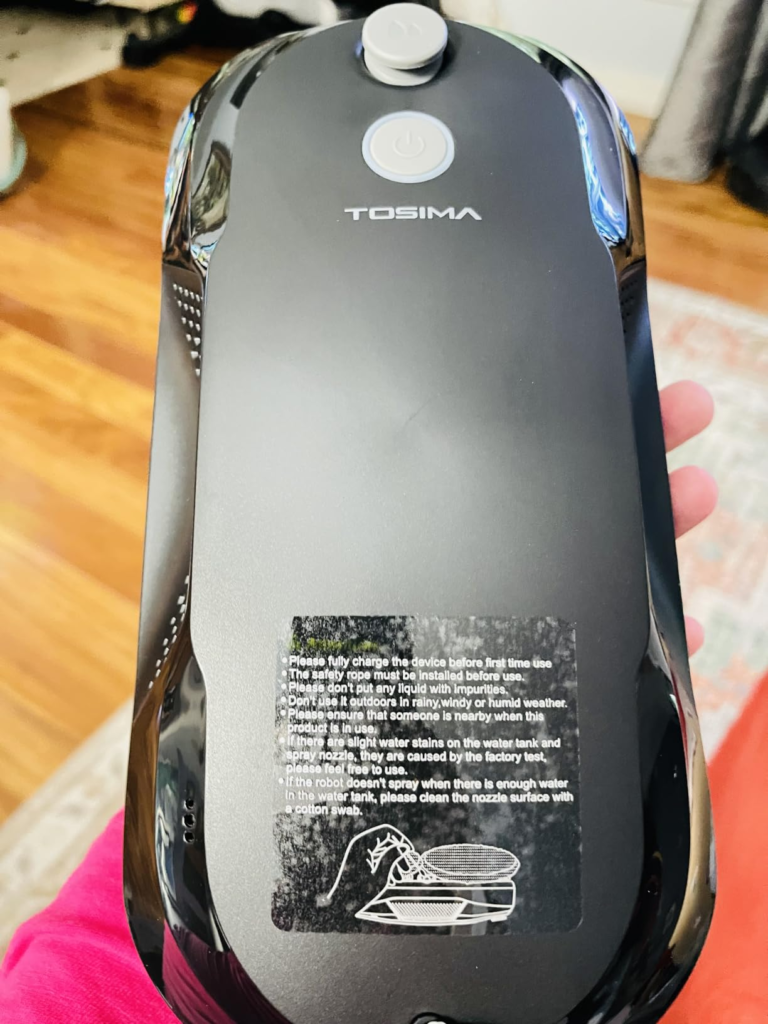
Why does any suction-based window robot miss corners? This is worth understanding, because the answer tells you whether the W5’s behavior is a flaw or a physical law.
The Tosima W5 navigates by reading pressure differentials through its air pressure sensor. When the suction differential drops — approaching a frame edge, a divider, or any surface interruption — the robot interprets this as a boundary and routes away. This is correct, safe behavior. It is how the machine prevents itself from falling off.
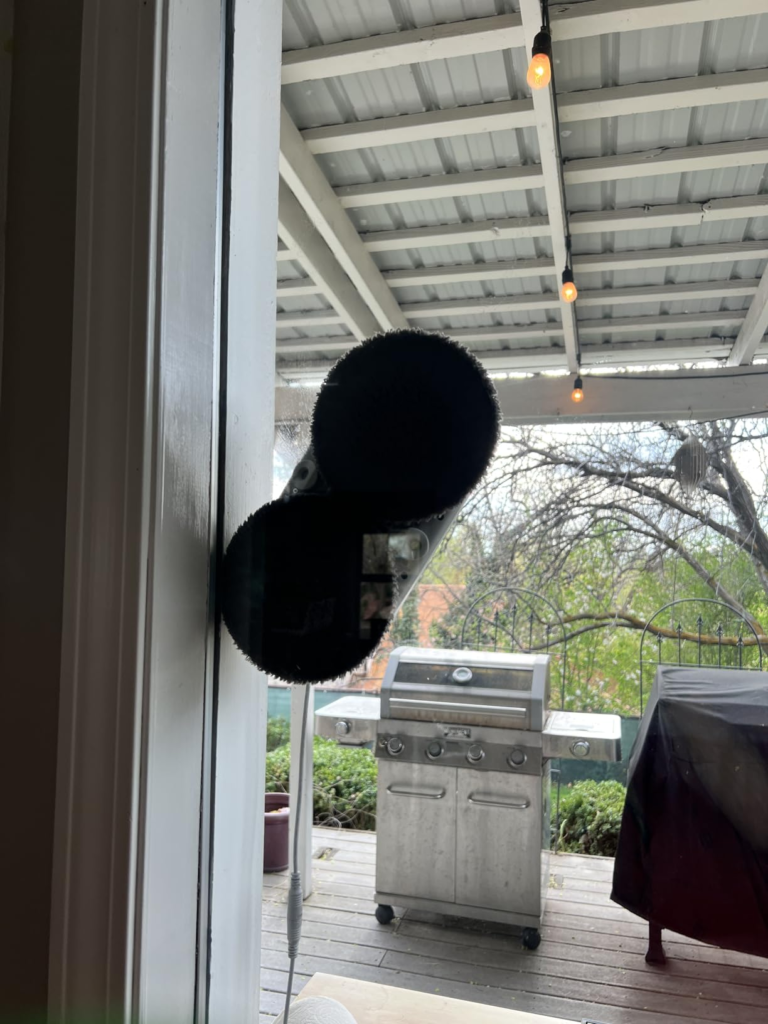
The corner problem is geometric, not mechanical. The W5’s cleaning pads are circular. A circle pressed into a right-angle corner leaves two triangular zones of uncleaned glass — one on each interior wall of the corner. There is no software solution for this. A circle cannot fill a right angle. The pad diameter that enables effective coverage across flat glass is the same diameter that creates the corner gap.
The ultrasonic atomization spray adds one more layer to this. Because the spray stops firing at edge boundaries — a deliberate feature that protects your window frames from water damage — the glass in those last few centimeters never gets pre-moistened. The pad may pass over dry, dusty glass near the border. On a very dirty window, that means a faint smear instead of a clean wipe.
Inside an unobstructed pane, none of this matters. The spray fires consistently, the suction holds steady, and the pad makes full contact with the glass for the entire cycle. Outside that condition — at corners, frames, and dividers — geometry dictates the result.
Tosima W5 Performance Testing: The Threshold Where Results Quietly Break
This is the table that should have come in the box.
| Surface / Condition | W5 Performance | What to Know |
|---|---|---|
| Routine dust and light fingerprints | ✅ Excellent | Primary design territory — delivers clearly |
| Dried water mineral film | ✅ Good | Deep mode + 2 passes typically resolves |
| Moderate urban grime (pollution, light rain) | ✅ Good | May require pad swap after session |
| Heavy thick grime / layered buildup | ⚠️ Partial only | Manual pre-wipe required before robot use |
| Bird droppings / dried splatter | ❌ Not designed for this | Must be manually removed first |
| Large flat picture or floor-to-ceiling windows | ✅ Optimal territory | Covers fully and evenly |
| Windows with deep frame protrusion (>5mm) | ⚠️ Corner gap | Last 1–2 inches near frame not reached |
| Frameless glass / large mirrors | ✅ Good | Requires solid tether anchor point |
| Glass shower enclosures (flat, smooth) | ✅ Excellent | Among the best use cases |
| Sliding glass doors | ✅ Good | Large spans may require extension cord |
| Divided-light / mullioned windows | ⚠️ Pane-by-pane only | Cannot cross dividers — each pane treated separately |
| Windows far from power outlets | ❌ Constraint | Corded design — extension cord required |
| Frosted / textured / patterned glass | ❌ Not suitable | Suction seal breaks on uneven surfaces |
| Curved or angled skylights | ❌ Not designed for this | Built for vertical flat surfaces only |
Two rows that tend to surprise buyers more than any others.
Heavy grime surprises people because the Pa rating sounds powerful enough to handle anything. But suction power holds the robot to the glass — it is the pad friction that cleans the dirt. A saturated pad redistributes grime rather than removing it. On windows not cleaned in more than three months, the first robot pass often smears before it clears. The fix is simple: a manual pre-wipe with a damp cloth, then let the robot handle maintenance from that point forward. The second cycle onward is where it earns its place.
The corded constraint surprises people because product photography suggests freedom of movement, and the imagination fills in wireless. It is not wireless. Every window requires a working outlet within cord range. For most homes with standard layout, this is not a problem. For windows behind furniture, in isolated corners, or across long stretches of room, it requires planning before you start.
Window Robot Buying Mistakes: Why Most Buyers Misread the W5 Too Early
Why do intelligent people buy a window robot and return it within two weeks?
Not because the robot failed. Because they compared it on the wrong variable before buying.
The most common wrong-variable comparison: suction Pa. Someone sees 3200Pa and 6400Pa and concludes the higher number wins on every window. But on a lightly dusty indoor surface — where most domestic robots spend their life — the difference between those two Pa ratings produces no visible difference in cleaning outcome. What changes your result is spray precision, pad quality, and route intelligence. The W5’s ultrasonic atomization spray creates a finer, more even mist than standard nozzle sprayers. That matters more than an extra 1000Pa on a fingerprinted glass door.
The second wrong variable: the word “all.” All smooth surfaces. All window types. All glass. This is technical truth and practical overpromise simultaneously. The W5 cleans all smooth, flat, vertical, electrically-accessible glass without surface texture or significant structural obstruction. Which is most glass in most homes — but not every glass in every configuration.
The third wrong variable: the corner assumption. Buyers assume a cleaning robot covers corners because a human cleaner covers corners. But a human cleaner adjusts grip, angle, and motion for corners. A suction robot cannot change its physical pad geometry. It cleans what its pad can reach, routes away from what it cannot, and repeats. If corners are the primary concern, a rectangular-pad robot like the ECOVACS WINBOT W2S addresses that geometry better — and costs more precisely because of it.
Tosima W5 Ideal Buyer: Who Is Actually Inside This Problem
| User Type | Fit Level |
|---|---|
| Homeowner with large flat living room or kitchen windows | ✅ Strong fit |
| Apartment resident with accessible interior windows | ✅ Strong fit |
| Regular maintainer (monthly or every 6 weeks) who dislikes the process | ✅ Strong fit |
| Mirror and glass shower door owner wanting hands-free upkeep | ✅ Excellent fit |
| Person with hard-to-reach high windows (accessible from inside) | ✅ Good fit |
| Someone managing minor seasonal exterior grime | ⚠️ Partial fit |
| Owner of divided-light windows with multiple small panes | ⚠️ Limited fit |
| Person with multiple windows far from power outlets | ⚠️ Constraint exists |
| Owner of frosted, textured, or curved glass | ❌ Wrong fit |
| Buyer expecting corners to be perfectly addressed | ❌ Wrong expectation |
| Someone needing cordless room-to-room flexibility | ❌ Wrong fit |
| Person hoping to skip manual deep-cleaning on neglected windows | ❌ Wrong fit |
The strongest signal of a correct W5 match: you already clean your windows with some regularity and you’re buying this to take the routine effort off your weekend list — not to fix a months-long backlog in one session.
Tosima W5 Limitations: Where Wrong-Fit Begins
Three situations where the purchase decision should stop.
Your windows have not been cleaned in a long time and carry visible buildup. The W5 was engineered for maintenance, not restoration. Running it on heavily neglected glass almost always results in smearing — the microfiber pad saturates with old grime quickly, then drags that grime across the surface instead of lifting it. The fix is a manual pre-wipe first. But if every window requires a manual pre-wipe before the robot can operate, you have added a step rather than removed one. The robot earns its value on the second cleaning cycle onward.
Your window design has significant structural complexity. Deep-frame protrusions, mullioned grids, French door panes, divided-light windows with narrow individual sections — these are all configurations where the W5’s geometric limits become the defining experience. The robot treats each smooth, unobstructed surface as its working territory. Every divider, bar, or structural element is a boundary it routes away from. If your window is more frame than glass, the robot’s contribution shrinks accordingly.
You need cordless flexibility between rooms. There is no battery mode. The cord is the power source for the suction motor. If your home’s outlet layout means long routes between windows, the W5 becomes an organizational burden before it becomes a cleaning convenience.
Tosima W5 Best Scenario: The One Situation Where It Becomes Logical
Here is the specific situation where buying the Tosima W5 becomes a clear, defensible decision.
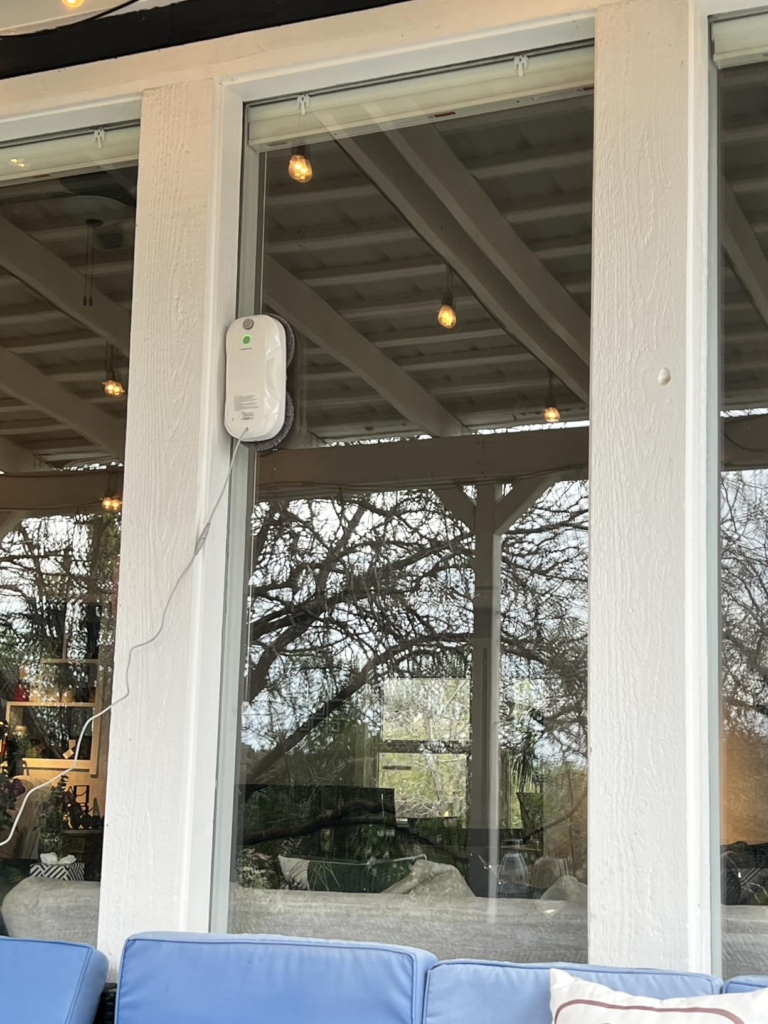
You have three or four large flat glass surfaces in your home — a living room picture window, a kitchen sliding door, a bathroom mirror, a glass shower enclosure. You clean these every few weeks or monthly, but the process takes an hour and a half of spray-and-wipe work you actively push to next weekend. The glass is not filthy. It is lived-in. Fingerprints near the handles, steam deposit on the shower glass, fine dust on the kitchen-facing window, some mineral spotting from tap water.
You put the W5 on one surface, clip the rope to the door handle, press start, and go do something else. In 15 to 20 minutes, you come back to a clear pane. You run a quick 60-second touch on the two corner zones with a cloth. You move to the next surface. Repeat.
Two hours of semi-dreaded work becomes 45 minutes of robot supervision and light finishing. The corners take 90 seconds each — and those same corners probably were not being cleaned perfectly by hand anyway. The main expanse of glass comes out better than your manual result, because the ultrasonic mist pre-moistens evenly and the 35N pressure presses without your arm losing consistency midway through a large pane.
That arithmetic — 80% automation of the effort, 20% manual finishing — is where the W5 earns its place. If you are willing to accept that equation, the decision becomes simple.
Tosima W5 Complete Breakdown: What It Solves, What It Reduces, and What It Still Leaves to You
| What the Tosima W5 Fully Solves | What It Meaningfully Reduces | What It Still Leaves to You |
|---|---|---|
| Routine dust, smears, light fingerprints on flat glass | Time spent on large window panes | Corner touch-up (60–90 seconds per window) |
| Water mineral spots and routine surface film | Risk of ladder use for elevated accessible windows | Manual pre-clean for neglected or heavily soiled glass |
| Consistent pressure across large panes — no fatigue drift | Mental load of scheduled cleaning sessions | Moving the robot between windows manually |
| Spray-and-wipe inconsistency on mirrors and glass doors | Physical fatigue from repeated arm-intensive cleaning | Pad washing or swap every 2–3 windows |
| Erosion of cleaning motivation over time | Frequency of cleaning effort (makes monthly routine realistic) | Outlet access planning before each use |
A real-world note on pad maintenance: every 2–3 windows, the microfiber rags collect enough grime to start affecting their effectiveness. You can swap to a fresh pad (8 are included) or pause and rinse the used one under warm water for about two minutes. Rinsing extends pad life for a second run. With 8 pads included, replacement isn’t immediate — but plan for it eventually.
One honest observation on lint: some users have reported that the pads occasionally leave faint lint on the glass, particularly on freshly cleaned surfaces. This is a real occurrence, not rare. A quick pass with a dry microfiber cloth immediately after the robot cycle resolves it entirely.
Noise: at full operating suction, the W5 sounds roughly like a running bathroom exhaust fan. Not disruptive, but not silent. Running it during a video call in the same room is noticeable.
Tosima W5 vs Alternatives: A Focused Comparison
This table exists to locate the W5 correctly — not to redirect you elsewhere.
| Feature | Tosima W5 (B0GGZMFYPF) | ECOVACS WINBOT W2S | KKI X3 |
|---|---|---|---|
| Max Suction | Up to 6,400 Pa variable | Not published | Up to 3,200 Pa |
| Spray System | Bidirectional ultrasonic atomization | Triple wide-angle nozzle | Dual atomized nozzle |
| Corner Cleaning | Round pad — inherent gap | TruEdge rectangular — better | Round pad — inherent gap |
| Power Source | Corded | Corded | Corded |
| App Control | No — remote only | Yes — app + remote | No — remote only |
| Pads Included | 8 | 2 | 10 |
| Cleaning Modes | 5 | 5 | 3 |
| User Rating | 4.8 ⭐ | 4.1 ⭐ | 4.4 ⭐ |
| Price Tier | Mid-range | Premium | Budget |
| Strongest At | Versatility + real-user reliability | Edge-to-edge corner coverage | Budget AI navigation entry |
If corners are the primary concern and the price gap is acceptable, the W2S addresses that geometry better. If budget is the primary constraint and windows are standard, the KKI X3 delivers at lower cost. If real-user satisfaction per dollar in the mid-range is the deciding variable, the W5 is where that ratio lives — 4.8 stars is the highest user rating in its competitive set.
Tosima W5 FAQ: Common Questions Answered
| Question | Answer |
|---|---|
| Is the Tosima W5 completely cordless? | No. The W5 operates on AC power via a cord and has no battery mode. You need a working outlet within cord range of every window you plan to clean. If cordless flexibility between rooms or floors is the requirement, this model is not built for that use case. |
| Can the Tosima W5 clean exterior windows? | It can, if the exterior surface is smooth, flat, and safely accessible — and if you can securely anchor the safety rope to a solid fixed point. Most users operate it on interior surfaces or lower-level exterior glass. For elevated exterior use, tether anchoring moves from important to critical. |
| Why is the Tosima W5 leaving streaks? | Three common causes. First: the microfiber pad is saturated with grime and needs rinsing or replacement — this is the most frequent culprit. Second: the glass has a pre-existing film from extended time between cleanings — a manual pre-wipe resolves this before the robot’s next pass. Third: the water tank ran low during the cycle — the edge-area dry-wipe artifact appears when spray stops before the pad completes its final rows. |
| Can I use cleaning solution instead of plain water? | Yes. The W5 is not locked to a proprietary solution. Distilled water works well for routine maintenance. A 1:3 white vinegar dilution addresses mineral deposits effectively. Avoid surfactant-heavy glass cleaners like standard Windex in the ultrasonic atomizer — the chemistry can gradually clog fine spray components over repeated use. |
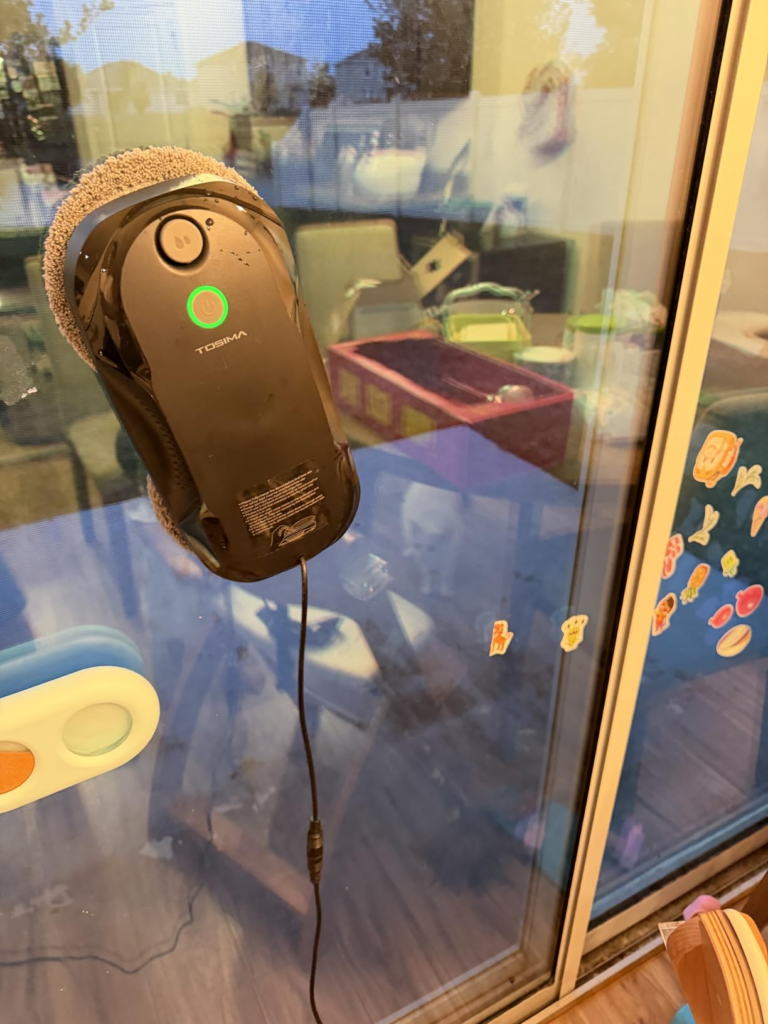
| How does the triple safety system actually work? | Three independent layers operating simultaneously. The air pressure sensor monitors suction seal integrity in real time and signals an alert if grip begins to fail. The AI edge detection identifies surface boundaries and routes the robot away from drop edges before it reaches them. The physical safety rope is the mechanical catch — it holds the robot if both electronic systems fail simultaneously. All three must be correctly deployed every time the robot operates on an elevated surface. |
| Does it work on bathroom mirrors and shower glass? | Yes — and these are among the W5’s most impressive use cases. Large flat mirrors and smooth shower enclosure panels are optimal geometry for this robot. The flat, unobstructed surface lets the W5 express its full operating ability without frame interruptions. |
| How long does one water tank fill last? | On a standard large picture window (approximately 1.2m × 1.5m), one 65ml fill is typically enough for the full cycle. For multiple windows in sequence, plan to refill after each large pane or every two smaller ones. The externally visible tank shows the fluid level in real time — you will see it drop before spray quality degrades. |
| Is the W5 worth it compared to hiring a professional window cleaner? | Depends on frequency. Professional window cleaning typically costs $150–$300 for a full home in most US markets. If you clean twice per year, the W5 covers its own cost within the first year and gives you on-demand access thereafter. If you clean only once per year, the math is close. The real variable beyond cost: whether you want the ability to clean whenever you notice the windows need it, without waiting for a scheduled appointment. |
Tosima W5 Final Verdict: One Decision, One Direction
The Tosima W5 is a well-built, honest tool. It earns its 4.8-star rating from a specific set of buyers who understand what it was designed to do — and whose windows match that design.
Routine maintenance on flat, smooth, accessible glass. Fingerprints gone. Water film gone. Routine dust gone. Large panes cleaned without your arm losing consistency midway through. Mirror and shower door results that consistently impress people who have only done this manually. A triple safety system that makes elevated interior windows manageable without requiring your complete attention for the entire cycle.
What it does not do: corners to the last millimeter. Textured or frosted glass. Restoration-level cleaning on neglected windows. Cordless room-to-room mobility.
If your windows match the working geometry of the W5 — flat, smooth, accessible, reasonably maintained — the decision is clear and the arithmetic is in your favor.
If your situation sits in the wrong-fit column, that is an equally clear answer, just in the opposite direction.
The Tosima W5 does not need to be the right robot for every home. It needs to be the right robot for yours.
Transparency Note:
This analysis is built on aggregated real-world experience.
It extracts what repeatedly holds, what breaks, and what users uncover only after living with the system—then shapes it into a clear model you can use immediately.
Think of it as structured experience, refined and presented so you don’t have to learn it the hard way.
“A quick note: Don’t believe the star ratings, but trust personal experience. This article is a compilation of collected experiences”