DYSON PURIFIER HOT+COOL HP2 DE-NOX REVIEW: THE AIR PROBLEM YOU CAN’T SMELL
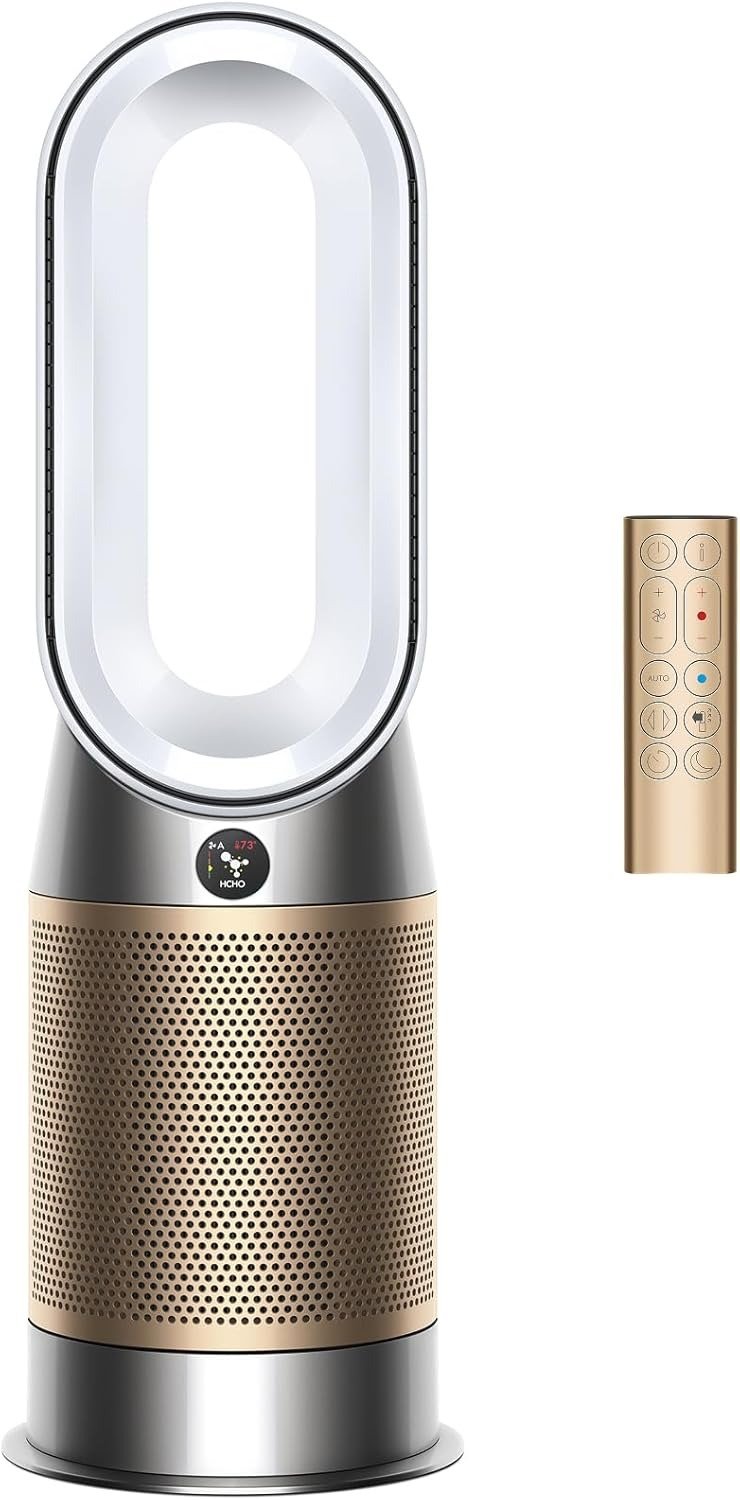
DYSON PURIFIER HOT+COOL HP2 DE-NOX
You wake up and your throat feels like sandpaper. You blame the pillow, or the wine, or “just allergies.” The room looks exactly the way it did before you fell asleep — nothing spilled, nothing dusty, nothing out of place. So you get up and move on, because nothing you can see is wrong.
Why does a spotless room still leave you reaching for water at 3 a.m.? That’s the trap. Air doesn’t ask permission to look guilty before it causes a problem. And that gap — between what a room looks like and what it actually contains — is the entire reason a purifier like the Dyson Purifier Hot+Cool HP2 De-NOx exists.
Here’s the full breakdown: what it does, what it quietly doesn’t, who it actually solves a problem for, and who’s about to pay $700–$950 for a feature they’ll never use.
Dyson Purifier Hot+Cool HP2 De-NOx Performance: The Result Looks Fine. The Problem Isn’t.
Here’s what nobody tells you when you’re shopping for an air purifier: a clean-looking room and clean air are two different claims.
You vacuum. You dust. The windows stay shut because the AC is running, or because it’s January and you’re not letting a single degree of heat escape. The room looks — and by most instinctive measures, feels — handled.
Meanwhile, the couch you bought four months ago is still quietly off-gassing. The gas burner you used for dinner left behind more than a smell. None of it shows up as a smudge you’d notice. It shows up as a scratchy throat you blame on something else, a kid who sneezes more indoors than outside, a heaviness in a closed-up room you’d never think to call “air quality.”
That gap between looks fine and is fine is exactly the space the HP2 De-NOx was built to close — not by trapping more dust, since plenty of purifiers do that, but by finally putting a number on the part of the air you were never able to check.
Formaldehyde and NO2 Symptoms: What You’re Actually Feeling but Not Naming
Before the mechanism, the feeling. Most people live with this for months before they ever connect it to “air.”
- The morning throat that isn’t quite a cold
- Eyes that sting a little when the kitchen’s been closed up after cooking
- A headache that shows up indoors and eases the second you step outside
- New furniture, flooring, or paint whose smell “should” be gone by now, but isn’t fully
- Kids who cough more at home than at school
None of these are dramatic, which is exactly why they get blamed on allergies, stress, or being tired. The EPA notes that nitrogen dioxide (NO2) — a byproduct of gas stoves, wood-burning stoves, and open flames — irritates the eyes, nose, and throat, and at higher or prolonged exposure can affect breathing, especially in kids and people with existing respiratory conditions. Formaldehyde, which off-gasses from pressed-wood furniture, some paints, and new textiles, causes similar irritation, and at sustained higher exposure, health agencies including the EPA associate it with increased cancer risk.
Neither gas has to reach an extreme concentration to make you feel chronically “off.” That’s the part a scented candle or an open window handles by luck, not by design.
How the HP2 De-NOx K-Carbon Filter Works: The Hidden Mechanism Behind the Miss
Here’s the detail most reviews skip: a standard HEPA filter is a mechanical trap. It’s built to catch physical particles — dust, pollen, pet dander, smoke — by forcing air through microscopic fibers. It’s exceptional at that job.
It’s also structurally incapable of catching a gas. Formaldehyde and NO2 aren’t particles you can sieve out — they’re molecules that pass straight through a filter built only to catch solids. That’s why a purifier can carry a flawless particle rating and still do nothing for the smell lingering after dinner, or the off-gassing coming off a new rug.
The HP2 De-NOx answers that gap in three parts:
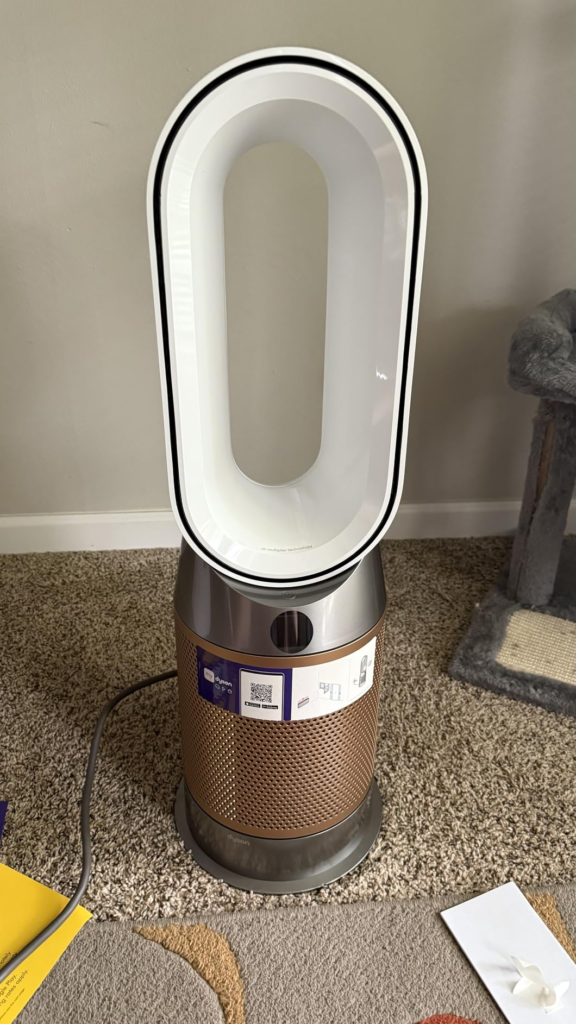
- A fully sealed HEPA H13 filter, rated to capture 99.97% of particles as small as 0.3 microns per Dyson’s testing, with the whole unit — not just the cartridge — sealed to that standard, so dirty air can’t sneak around the edges.
- A K-Carbon layer — activated carbon infused with potassium carbonate — purpose-built to adsorb roughly 50% more NO2 than a standard carbon filter, based on Dyson’s own third-party comparison testing.
- A permanent catalytic filter that breaks formaldehyde down at a molecular level instead of just trapping it, so it never fills up or needs replacing the way the HEPA+K-Carbon cartridge does.
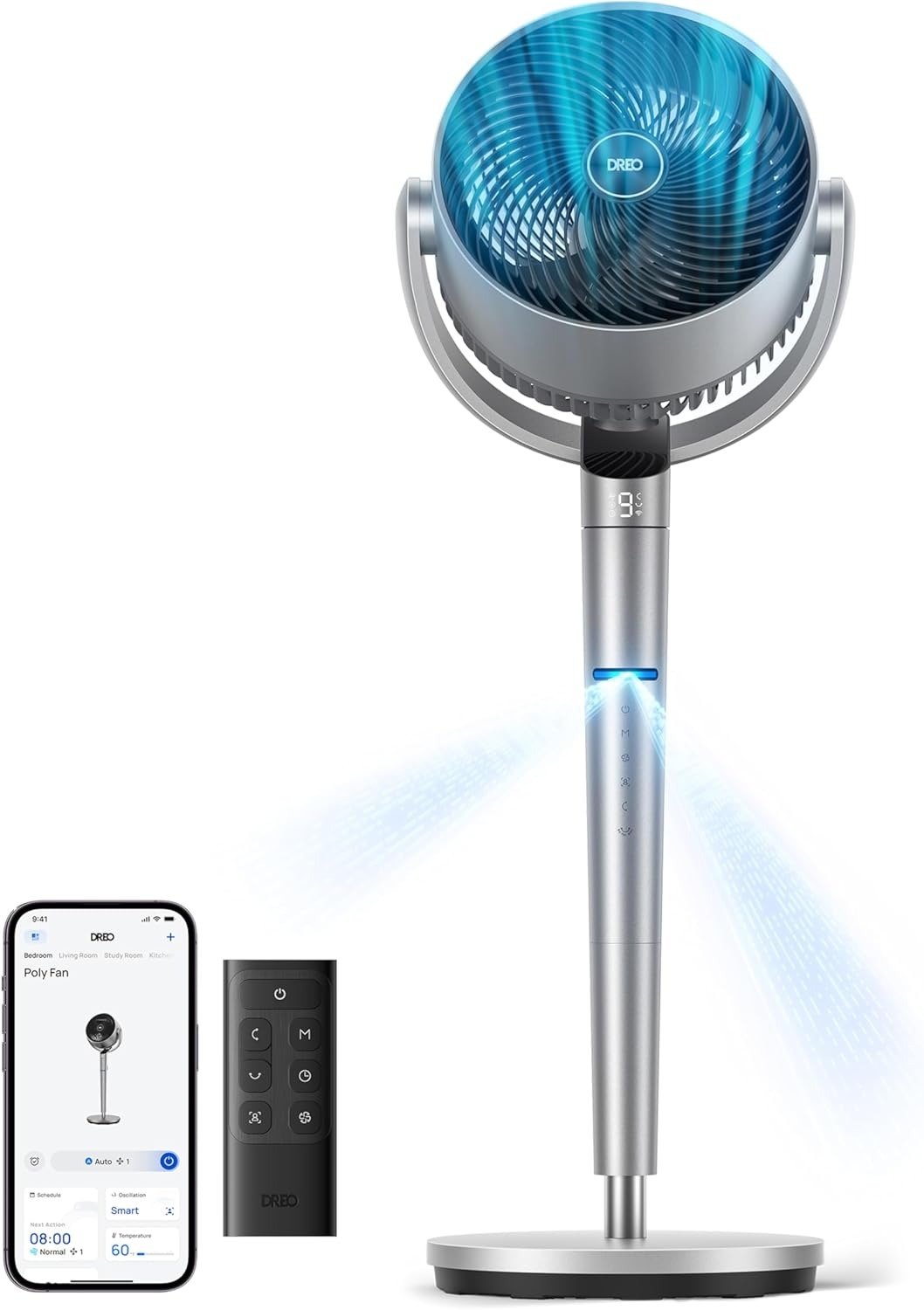
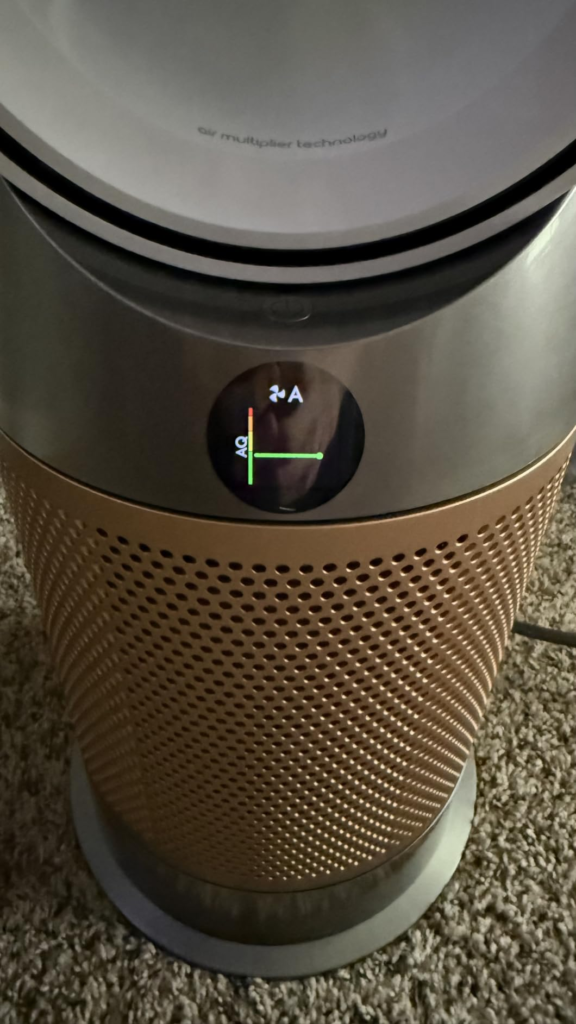
Four sensors feed a real-time algorithm reading PM2.5, PM10, VOCs, NO2, and formaldehyde every second, reported in plain numbers on the LCD or the MyDyson app. That’s the real innovation — not stronger airflow, but finally seeing the part of the air that used to be a guess.
| Spec | Detail |
|---|---|
| Filtration | Sealed 3-stage HEPA H13 + K-Carbon + permanent catalytic formaldehyde filter |
| Particle capture | 99.97% of particles down to 0.3 microns (Dyson-tested) |
| NO2 capture | ~50% more than standard activated carbon (Dyson-tested) |
| Room coverage | 81 m³ — roughly 300 sq ft at standard ceiling height |
| Noise | 63 dB at max; Night mode cuts perceived noise roughly in half |
| Oscillation | Up to 350° |
| Airflow settings | 10 speeds, plus Auto and Night modes |
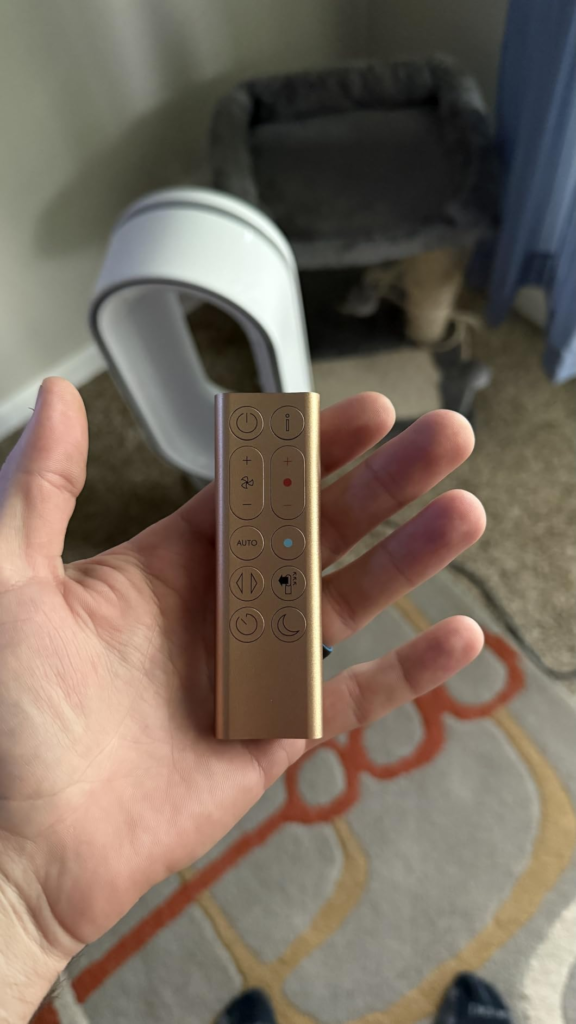
| Controls | Onboard LCD, magnetic remote, MyDyson app, compatible voice assistants |
| Filter life | HEPA+K-Carbon: ~12 months at 12 hrs/day use, varies with pollution level |
| Dimensions / weight | 30.1 in tall, ~9.8 in wide, ~12.2 lbs |
| Typical price | $700–$950 depending on finish, retailer, and promotions |
The Threshold Where “Good Enough” Air Quietly Breaks
There’s a specific point where this stops being theoretical, and it has a name: combustion.
Every time a gas stove, gas oven, wood-burning stove, or open flame runs in a closed room, it releases NO2. The EPA’s outdoor benchmark sits around 50 parts per billion averaged over a year — but that’s an outdoor number. Indoors, in a sealed kitchen with the exhaust fan off, concentrations from a single dinner can spike well past anything you’d meet outside, then slowly dilute over the following hours.
Formaldehyde follows a related but slower pattern: emissions run highest when a product is new, then taper off over months or years. If you’ve renovated, replaced flooring, or bought furniture in the last year or two, you’re statistically still living inside that curve, whether you can smell it anymore or not.
And here’s the part that makes this worse in modern homes, not better: why would sealing your house tighter — the exact move you’re told to make to save on heating and cooling — end up trapping more of this instead of less? Because that’s precisely what happens. Better insulation and shut windows are what let these gases build up instead of escaping. The upgrade that saves you money on utilities is the same one that raises your gas-phase exposure. Nobody designs a home to trap formaldehyde. It happens anyway, as a side effect of doing everything else right.
| Pollutant | Common Source | Caught by a basic HEPA purifier? | Caught by the HP2 De-NOx? |
|---|---|---|---|
| Dust, pollen, pet dander | Everyday household activity | Yes | Yes |
| Smoke particulate | Cooking, wildfire smoke, candles | Yes | Yes |
| VOC odors | Cleaning sprays, cologne, aerosols | Partially (basic carbon) | Yes (carbon + live sensing) |
| Formaldehyde | New furniture, flooring, paint, pressed wood | No | Yes (catalytic filter) |
| NO2 | Gas stoves, wood stoves, open flames, traffic | No | Yes (K-Carbon) |
Why Most Buyers Misread Dyson Reviews Too Early
If you’ve read even a handful of Dyson purifier reviews, you’ve probably hit the same wall I did: independent lab testing — HouseFresh among the more credible sources — has measured real-world particle CADR on earlier Dyson Hot+Cool models well below what a $700+ price usually buys. A basic purifier like the Levoit Core 300, at a fraction of the cost, can out-clean it on raw particles per dollar. That criticism is fair and real, and I’m not going to pretend otherwise.
Here’s where the comparison quietly goes wrong, though: it judges a four-function machine — heater, fan, particle purifier, and gas-phase purifier — on a single-function metric. That’s ranking a Swiss Army knife purely on how sharp its main blade is against a dedicated chef’s knife. Correct on paper. Missing the point of why someone bought it.
If your only goal is the cheapest path to cleaner particle air, a dedicated purifier wins, and it isn’t close. But that dedicated purifier won’t heat your bedroom in January, won’t cool you in July, won’t touch NO2 or formaldehyde at all, and won’t show you a single real-time number. Different tool, different job.
| What This Actually Delivers | The Honest Catch |
|---|---|
| Real-time NO2 and formaldehyde sensing | Weaker raw particle CADR-per-dollar than dedicated purifiers, per independent testing |
| 3-in-1: heater, fan, and purifier in one footprint | Heat only switches on via the remote, not the app (UL safety compliance) |
| Sealed HEPA H13 with no filter bypass | Combined filter cartridge is a specialty part, pricier than a basic HEPA swap |
| Meaningfully quieter Night mode | 63 dB at max is louder than dedicated quiet purifiers |
| App-based scheduling and air quality history | Coverage tops out near 300 sq ft — not built for open-concept great rooms |
Who Is Actually Inside This Problem: Should You Buy the HP2 De-NOx?
This isn’t for everyone, and it was never meant to be. You’re likely the person this was built for if:
- You cook with gas, and your kitchen doesn’t have a window you can crack every time
- You live near a busy road, a bus route, or anywhere exhaust realistically reaches your windows
- You’ve bought furniture, flooring, or done a renovation in the last year or two
- Someone in your home has asthma, allergies, or is a small child whose lungs are still developing
- You live somewhere small enough that one machine replacing a heater, a fan, and a purifier actually matters for your floor space
- You’d rather see a number than guess whether tonight’s air is fine
Where Wrong-Fit Begins: Who Should Skip the HP2 De-NOx
And you should probably keep looking if:
- You’re purifying an open-concept space over 350–400 sq ft — this unit will run constantly and still lose the coverage battle
- Your only priority is the lowest cost per unit of clean particle air — a dedicated budget purifier will beat it on that single metric
- You don’t cook with gas, don’t live near heavy traffic, and haven’t brought new furniture or flooring in recently — a standard (non-De-NOx) Dyson, or a cheaper purifier, may cover you fine
- You want full app control over the heater — Dyson requires the physical remote to turn heat on, by design, for safety compliance
- An annual filter replacement on a specialty combined cartridge is a dealbreaker, not a minor annoyance
| Buy the HP2 De-NOx if… | Skip it if… |
|---|---|
| You cook with gas or live near traffic | You have no real combustion sources nearby |
| You want heating, cooling, and purification in one unit | You already own separate appliances that work fine |
| Room is under ~300–350 sq ft | Your space is large and open-concept |
| You want live pollutant numbers, not guesses | You just want the cheapest clean air per dollar |
| A one-time filter cost is fine with you | Ongoing filter cost is a hard no |
The One Situation Where the HP2 De-NOx Becomes the Logical Choice
Strip away the marketing and the criticism, and the decision compresses to one question: do you have a real, ongoing gas-phase source in a space you can’t easily ventilate?
If yes — gas stove, tight urban apartment, recent renovation, a kid who reacts to closed-up rooms — this stops being a lifestyle purchase and becomes the direct, mechanical answer to something you’ve already been feeling. Not because Dyson makes the best purifier on the market on every metric. Because this is the one built to catch the specific thing a basic purifier structurally can’t.
What It Solves, What It Reduces, and What Still Depends on You
What it solves: the blind spot. You go from guessing whether tonight’s air is fine to reading it in real numbers, every second, on a screen in your hand.
What it reduces: your ongoing exposure to particles, odors, NO2, and formaldehyde — meaningfully, based on the filtration architecture, but not to zero, and not instantly. Gas-phase reduction happens as the unit continuously processes room air, not the moment you switch it on.
What still depends on you: replacing the HEPA+K-Carbon filter on schedule instead of ignoring the app reminder. Still cracking a window when you’re frying something. Not idling a car in an attached garage. Placing the unit somewhere air can actually circulate, not wedged behind a curtain. A purifier — any purifier — only cleans the air that reaches it.
| Cost to Own | Estimate |
|---|---|
| Unit price | $700–$950, varies by finish and retailer |
| Filter replacement | Roughly annual, specialty combined cartridge — check current pricing before buying |
| Catalytic formaldehyde filter | Permanent, no replacement cost |
| Warranty | Standard 2-year Dyson coverage |
Dyson Purifier Hot+Cool HP2 De-NOx FAQ
Does it cool a room like an air conditioner?
No. It’s a fan, not an AC — it moves air and creates a wind-chill effect, it doesn’t lower the room’s actual temperature.
Can I turn the heater on from the MyDyson app?
No. You can turn heat off from the app, but turning it on and adjusting it requires the physical remote — a UL safety compliance requirement, not an oversight.
How loud is it?
63 decibels at maximum fan speed, with Night mode cutting perceived noise roughly in half. Most owners describe it as comfortable for bedroom use once it’s past the initial ramp-up.
What size room is it actually good for?
Dyson rates coverage at 81 m³, which works out to roughly 300 sq ft at a standard ceiling height — a bedroom, home office, or mid-size living room. It’s not built for large open-concept spaces.
Does it need Wi-Fi to work?
No. The onboard LCD and remote work without an internet connection. Wi-Fi is only needed for app control, remote monitoring, scheduling, and voice assistant integration.
Is it safe around kids and pets?
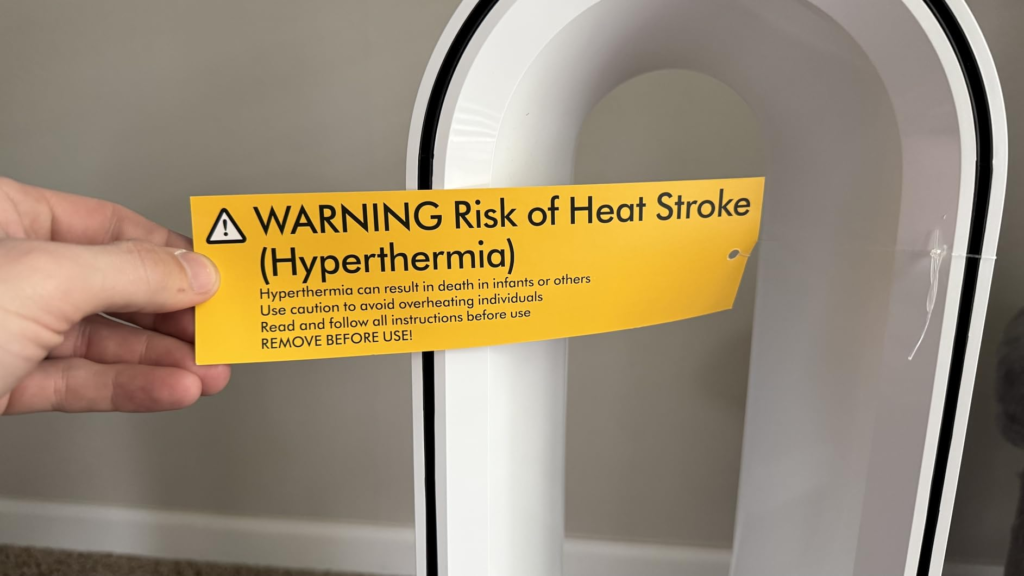
Yes. There are no exposed blades and no visible heating element, and the unit has automatic cut-out switches if it overheats or tips over.
Is it actually worth it over a cheaper purifier?
Depends what you’re solving for. If raw particle cleaning per dollar is your only concern, no — independent testing shows cheaper dedicated purifiers win on that metric alone. If you specifically need NO2 and formaldehyde monitoring plus heating and cooling in one footprint, there’s currently no cheaper way to get all of it in a single unit.
Final Compression
You don’t need to buy this because a review told you to. You need it if you read the symptom list above and quietly recognized more than one. If your kitchen runs on gas, your windows stay shut more months than not, and you’ve been explaining away a scratchy throat longer than you’d like to admit — the guessing was always going to be the expensive part. The unit is just the number.
If this is the air problem you’ve actually been living with, this is where the guessing stops:
Transparency Note:
This analysis is built on aggregated real-world experience. It extracts what repeatedly holds, what breaks, and what users uncover only after living with the system—then shapes it into a clear model you can use immediately. Think of it as structured experience, refined and presented so you don’t have to learn it the hard way.
“A quick note: Don’t believe the star ratings, but trust personal experience. This article is a compilation of collected experiences”