Marshall Willen II Review: The Sound Is Real. So Is the Ceiling You’ll Hit.
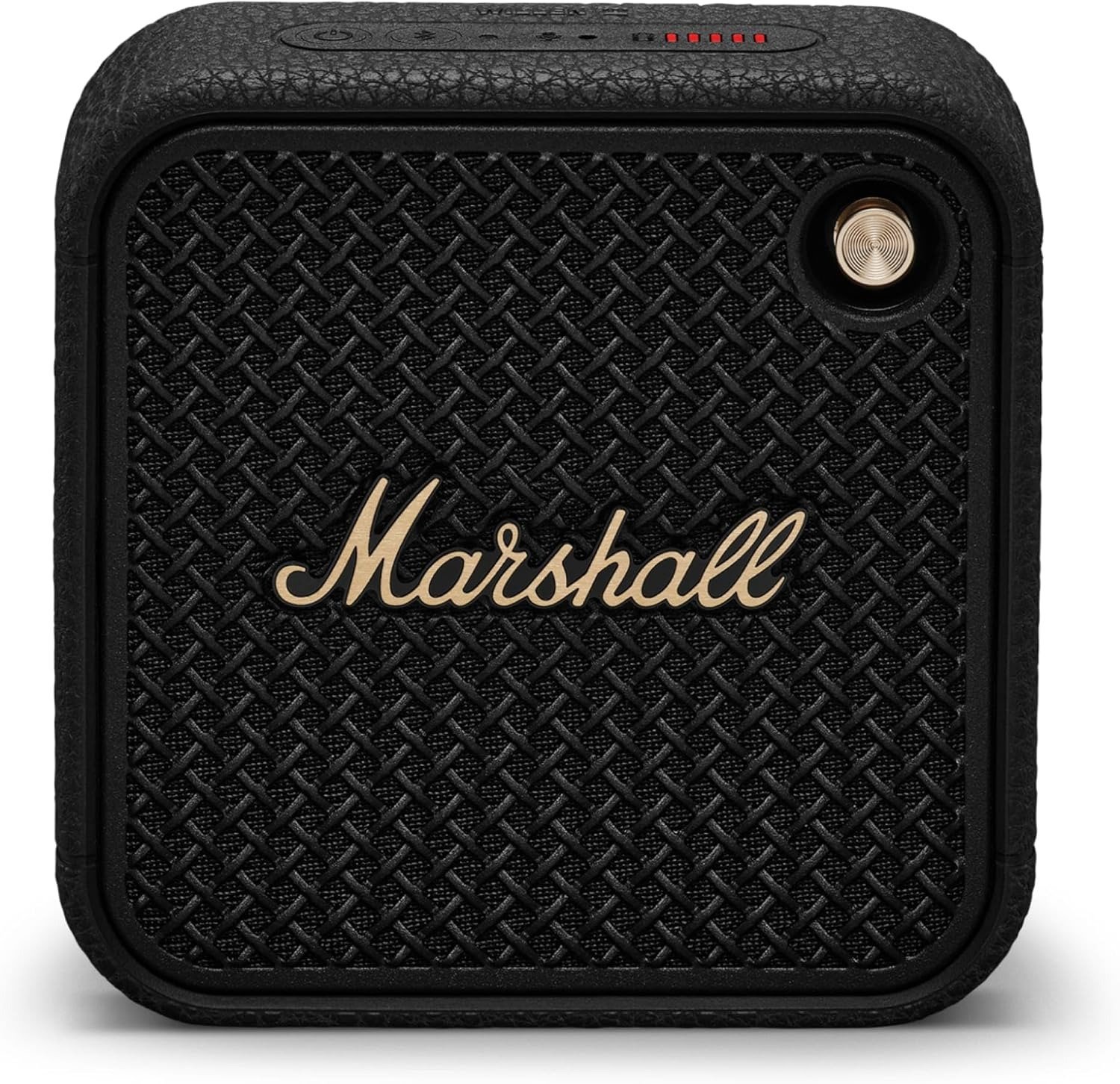
MARSHALL WILLEN II
The Result Looks Fine. The Problem Isn’t.
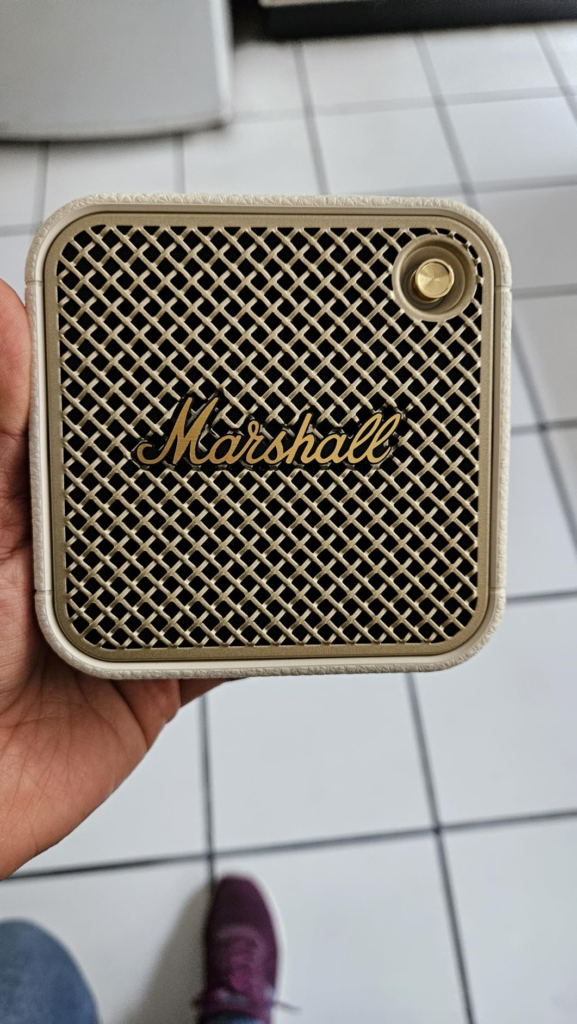
You unbox the Willen II. It sits in your palm. The metal grille, the brass logo, the textured tolex — it looks exactly like a Marshall should. You press play. The bass hits harder than a speaker this size has any right to produce. The mids are warm, the highs are clean. For about forty seconds, it sounds like you made a perfect decision.
Then a friend walks into the room and stands three feet to your left.
The sound doesn’t follow them. It doesn’t spread. It narrows, focuses, then thins out at the edges. Not because the speaker is broken — but because it was never designed to fill that gap. The Willen II is a mono unit with a single 2-inch full-range driver and two passive radiators, powered by a 38-watt Class-D amplifier. That 38W figure sounds like a lot. It isn’t what you think it is. The driver it feeds is 10W. The rest is headroom management — keeping the output stable and clean, not bigger or wider.
The speaker performs exactly as engineered. The gap between your expectation and its design is where the disappointment lives.
What You’re Actually Feeling but Not Naming
There’s a specific frustration that comes with the Willen II that most buyers don’t name correctly at the time of purchase.
It isn’t that the speaker sounds bad. It doesn’t. It isn’t that it’s too quiet for one person sitting close to it. For that use, it’s genuinely impressive. The friction is narrower than that: it’s the moment you try to use it socially and it refuses to behave like a social speaker.
You’ve placed it on a table at a small gathering. The person directly in front of it hears music. The person at the edge of the table hears something smaller. The person across the room hears presence, not detail. You turn it up. The bass stays controlled until around 80% volume, then it starts pushing against the driver’s limits — a faint strain enters the high end, and the low frequencies begin to flatten.
That friction — the gap between “playing loud” and “filling a space” — is the exact thing the spec sheet doesn’t warn you about. Mono dispersion in a small driver creates a listening sweet spot that’s roughly direct and narrow. Step outside it by a few feet or an angle, and the experience degrades meaningfully.
This is a one-listener speaker that convinces buyers it’s a group speaker. That’s the silent failure inside an otherwise competent product.
The Hidden Mechanism Behind the Miss
The Willen II uses a mono architecture by design. One driver, two passive radiators. The passive radiators extend the bass response downward by creating resonance — they move sympathetically with the main driver to generate low-frequency energy that a single driver this small couldn’t produce alone. This is why the bass hits. This is also why the soundstage doesn’t expand.
Stereo requires two channels, two drivers, spatial separation. Stack Mode — the feature that lets you connect two Willen units together — does not produce stereo. It amplifies mono. Two speakers playing the same signal in the same direction produces more volume, not width. Reviewers at SoundGuys tested this and confirmed: stacking two Willens does not produce stereo sound. More power, same wall.
The Marshall app gives you three EQ presets: Marshall (mid-forward, warm), Push (U-shaped, boosted bass and treble), and Voice (mid-boosted for podcasts and calls). There is no manual five-band EQ. There is no sleep timer. The speaker stays powered on in standby. These aren’t oversights — they’re deliberate simplifications in a product built for mobility and single-listener use, not for audiophiles who want to tune a room.
The amplifier rated at 38 watts is a Class-D design — efficient, not brute. The 10W driver rating is the acoustic ceiling. The difference in those numbers exists because Class-D amplifiers in portable speakers are often rated at peak rather than continuous output. What you hear in practice is a clean, controlled 10W signal with headroom built in to prevent clipping — not a 38W wall of sound.
Understanding this mechanism changes everything about how you evaluate the speaker.
The Threshold Where the Outcome Quietly Breaks
| Volume Level | Sound Quality | Bass Response | Dispersion |
|---|---|---|---|
| 30–60% | Clean, warm, punchy | Full, defined | Good in direct field |
| 60–80% | Strong, slightly compressed | Slightly flattened | Narrows |
| 80–100% | Strained highs | Bass pushes limits | Degraded at angles |
The break point is around 75–80% volume. Below that threshold, the Willen II operates in a zone where its engineering shines — tight bass, clear mids, no harshness. Above that line, it’s asking the 10W driver to do more than its frame allows. This isn’t a defect. Every speaker has a threshold. The Willen II’s threshold arrives earlier than the price tag implies.
The second threshold is spatial. At roughly 6–8 feet of direct listening distance, performance remains solid. Beyond that, and especially off-axis (sitting to the side rather than facing the speaker directly), the loss of resolution is noticeable.
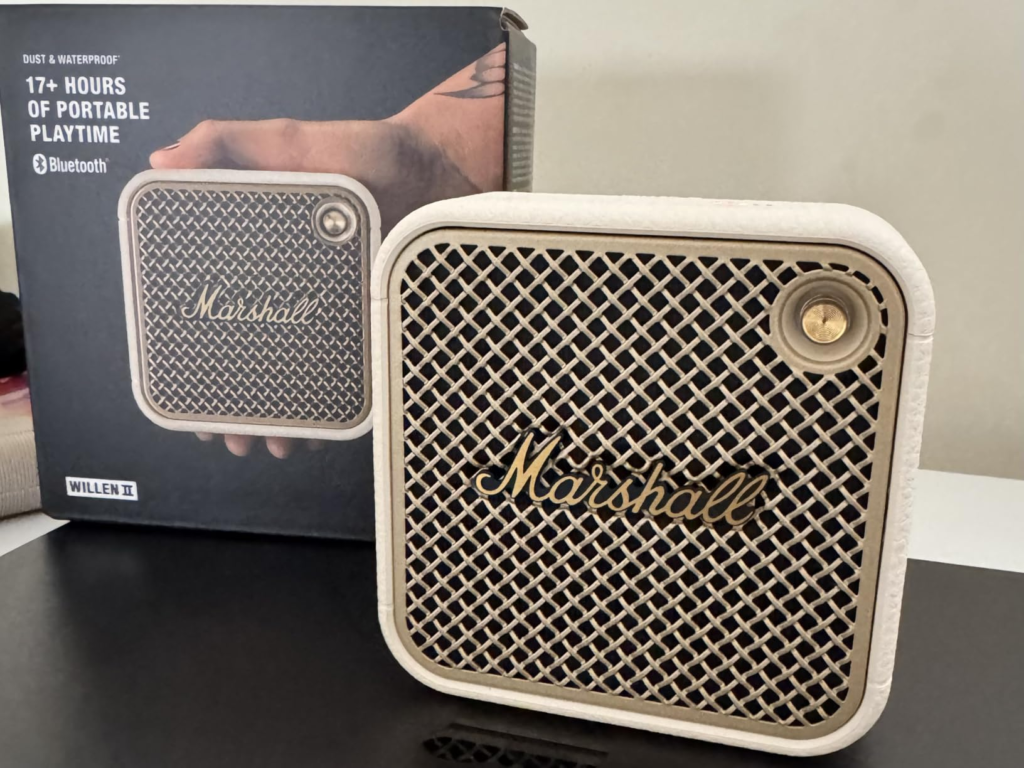
Battery life adds a third threshold. Marshall rates the Willen II at 17+ hours. In standardized real-world testing conditions — moderate to higher volume, mixed content — the original Willen (first generation) measured 11 hours and 4 minutes in independent lab conditions. The Willen II promises improvement, and 20 minutes of quick charging delivers approximately 5.5 hours of playback. But marketing hours and operational hours are not the same number, and if you’re planning a full-day outdoor session without access to power, plan for 12–14 realistic hours, not 17+.
Why Most Buyers Misread This Too Early
The first mistake is comparing the Willen II to larger speakers and concluding it punches above its weight class in all dimensions. It doesn’t. It punches above its weight class in one dimension: bass output relative to physical size, at close range, in a direct listening position.
The second mistake is reading the 38W amplifier spec as an output power figure equivalent to what a 38W bookshelf speaker delivers. It isn’t. Portable speaker amplifier ratings and home audio amplifier ratings don’t translate the same way. The 10W driver rating is the honest acoustic number.
The third mistake is assuming Stack Mode converts the product into a stereo system. It does not. It converts it into a louder mono system. That has specific value — outdoor coverage, more volume for larger spaces — but it’s a different value proposition than stereo imaging, and buying two Willen IIs expecting stereo is a decision you’ll regret within the first listening session.
The fourth mistake is the price comparison trap. At ~$119.99 list price (frequently discounted to $84–$99), the Willen II costs significantly more than a JBL Clip 5 (~$59.99) or a JBL Go 4 (~$49.95). Both competitors have IP67 ratings. The JBL Clip 5 has a built-in carabiner. The Willen II’s premium is real — but it’s paid for in build quality, brand identity, bass character, and aesthetic, not in stereo performance or raw loudness at range.
If your comparison metric is volume-per-dollar, you will feel robbed. If your comparison metric is sound character and build durability in a palm-sized form, the price holds.
Who Is Actually Inside This Problem
| Listener Profile | Willen II Fit |
|---|---|
| Solo listener, desk or bedside | Strong fit |
| Hiker or cyclist needing backpack audio | Strong fit |
| Pool or outdoor personal use | Strong fit — IP67 certified |
| Traveler wanting compact daily audio | Strong fit |
| Marshall aesthetic buyer | Strong fit |
| Small group (2–3 people, close together) | Acceptable fit with placement awareness |
| Party or gathering host (5+ people) | Wrong fit |
| Stereo listener who won’t compromise | Wrong fit |
| Bass-first listener expecting floor-movement | Wrong fit |
| Budget buyer prioritizing volume per dollar | Wrong fit |
The Willen II serves a listener who moves alone or with one close companion, who values build quality and sound character over raw spread, and who will use this speaker within 3–6 feet for most of its life.
That listener exists in very large numbers. The problem is that the product’s marketing — and the sheer quality of its close-field sound — convinces a second group of listeners to buy it before they’ve understood the boundaries.
Where Wrong-Fit Begins
Wrong fit begins the moment someone expects this speaker to serve a room.
A room has multiple listening angles, distances beyond 8 feet, and at least two people who aren’t sitting directly in front of the driver. The Willen II cannot serve that environment without significant degradation of the experience. More volume doesn’t fix mono dispersion — it amplifies the problem by revealing more harshness at the driver’s edge.
Wrong fit also begins when a buyer compares the Willen II directly to the Marshall Emberton III and decides the smaller form factor is worth the sacrifice. The Emberton III has True Stereophonic — a processing mode that creates a wider virtual soundstage from a larger enclosure. The difference in listening experience between the two, in any shared or social setting, is immediately apparent. If you’re choosing between them and social listening is part of your use case even occasionally, the size difference isn’t the most important variable.
Wrong fit begins for the buyer who hears “Marshall sound” and assumes the full Marshall experience scales down infinitely. It doesn’t. The Willen II is faithful to the brand’s tonal DNA — warm, mid-forward, bass-present — but within hard physical constraints that the brand name alone cannot override.
The One Situation Where This Product Becomes Logical
There is one listener for whom the Marshall Willen II is not just good but specifically correct.
That person is mobile, often alone or with one close companion. They want a speaker that survives their actual life — water, dust, drops, being clipped to a bag or bike handlebar. They want real bass, not the shallow thud of a cheap micro-speaker. They want to take a call through the same device without pulling out earbuds. They want something that looks like it belongs with their other gear, not a piece of plastic with a logo stamp.
For that person: the Willen II delivers on every requirement. IP67 means actual waterproof — submerged in one meter of water for thirty minutes without damage. The rubber fastening strap attaches to backpacks, handlebars, or tent poles with genuine utility. The 5-LED battery indicator gives real status without an app. The built-in microphone handles calls clearly. The USB-C charging is standard and fast. The quick-charge function restores 5.5 hours of playback in 20 minutes — which is genuinely useful when you forgot to charge overnight.
The sound, within its correct operating range, is the best in its size class for that listener’s use pattern. The bass has warmth and definition that cheaper alternatives cannot replicate. The Marshall EQ preset favors a mid-forward, warm tuning that makes rock, jazz, and vocal music particularly satisfying. The Push preset broadens the frequency curve for electronic or beat-heavy content. The Voice preset elevates dialogue intelligibility for podcasts and audiobooks.
This is not a speaker that rewards everyone. It is a speaker that rewards its specific user with unusual consistency.
What It Solves, What It Reduces, and What It Still Leaves to You
| Category | What the Willen II Does |
|---|---|
| Solves | Personal portable audio with real bass at close range |
| Solves | Durability in outdoor, water-adjacent, or rough environments |
| Solves | Battery anxiety on day trips with quick-charge recovery |
| Solves | Call handling without switching devices |
| Solves | Backpack and bike attachment without extra hardware |
| Reduces | Compromise between size and sound character |
| Reduces | Setup friction — pairs fast, controls are physical and intuitive |
| Leaves to you | Stereo imaging — it will never produce it |
| Leaves to you | Volume for groups — it will never fill a room |
| Leaves to you | EQ flexibility beyond three presets |
| Leaves to you | Managing the gap between marketing battery hours and real hours |
The Willen II does not pretend to be what it isn’t — if you read the spec sheet carefully. The mono architecture is disclosed. The driver size is disclosed. The claim that resonates falsely is the battery figure, and the claim that creates the most purchase regret is the implied social versatility of a speaker that performs best for one person at a time.
Buy it knowing those two gaps exist, and it performs exactly as promised. Buy it expecting a social speaker with Marshall’s name on it, and you’ll be disappointed before the end of the first week.
Final Compression
The Marshall Willen II is a precision instrument for a specific lifestyle, not a universal portable speaker.
Its genuine strengths — bass warmth at close range, IP67 build, fast charging, physical simplicity, tactile controls, and the Marshall tonal character — are real and consistent. Its genuine limits — mono architecture, narrow sweet spot, real battery performance below marketing claims, restricted EQ, no stereo even in Stack Mode — are equally real and equally consistent.
The decision is not complex once you locate yourself correctly.
You are the right buyer if: you listen alone or with one person nearby, you move through outdoor or active environments, you want character and durability over volume and spread, and you’ve accepted that “Marshall sound” in this size is a near-field experience, not a room experience.
You are the wrong buyer if: you need the speaker to serve more than two people, if social gathering audio is any part of your use case, if stereo is non-negotiable, or if you’re comparing total acoustic performance per dollar rather than acoustic character per physical inch.
If your situation matches the first description, the Willen II doesn’t require further deliberation.
Frequently Asked Questions
| Question | Answer |
|---|---|
| Does the Marshall Willen II produce stereo sound? | No. The Willen II is a mono speaker. Its Stack Mode — which connects two Willen units together — increases volume but does not produce stereo. Both speakers play the same signal. If stereo is a requirement, consider the Marshall Emberton III, which includes True Stereophonic processing. |
| How many hours does the battery actually last in real use? | Marshall rates the Willen II at 17+ hours at moderate volume. Independent real-world testing on the original Willen yielded approximately 11 hours under standardized conditions. For the Willen II, realistic expectations at moderate-to-high volume sit between 12–14 hours. The quick-charge function adds approximately 5.5 hours in 20 minutes, which is genuinely reliable. |
| Is the Willen II loud enough for outdoor use? | For personal outdoor listening — hiking, cycling, poolside for one or two people — yes, it’s adequate and performs well. For outdoor gatherings of five or more people in an open space, it will not fill the environment satisfactorily. The sweet spot is direct-field listening within 6–8 feet. |
| What does the 38W amplifier figure actually mean? | The 38W rating refers to the Class-D amplifier’s peak capacity, not continuous acoustic output. The driver itself is rated at 10W. The larger amplifier figure represents headroom and efficiency — it keeps the signal clean and prevents clipping rather than delivering 38W of room-filling power. The honest acoustic ceiling is the 10W driver. |
| Is the IP67 rating genuinely reliable? | Yes. IP67 means dust-tight and submersion-resistant in up to one meter of water for thirty minutes. Multiple real-user accounts confirm pool and rain use without damage. It is one of the Willen II’s most reliable and genuinely useful features. |
| How does the Willen II compare to the JBL Clip 5? | The JBL Clip 5 (~$59.99) has a built-in carabiner, IP67 rating, and similar portability. The Willen II (~$99–$119) wins on bass character, build quality feel, and tonal warmth. The JBL wins on price and attachment convenience. If sound character and brand identity matter to you, the Willen II premium is defensible. If maximum value per dollar is the metric, the Clip 5 is the logical choice. |
| Should I buy two Willen IIs for stereo? | No. Two Willen IIs in Stack Mode produce louder mono, not stereo. The investment doubles the cost and the volume without adding stereo imaging. If stereo is the goal, that budget is better directed toward a single speaker that natively produces a wider soundstage. |
| Who should not buy the Marshall Willen II? | Anyone who plans to use the speaker as background audio for a social gathering, anyone expecting stereo imaging, anyone prioritizing maximum volume-per-dollar, and anyone who will feel the product’s limitations acutely in a group setting. The Willen II rewards solo listeners and penalizes buyers who misread its use case. |
Transparency Note:
This analysis is built on aggregated real-world experience. It extracts what repeatedly holds, what breaks, and what users uncover only after living with the system—then shapes it into a clear model you can use immediately. Think of it as structured experience, refined and presented so you don’t have to learn it the hard way.
“A quick note: Don’t believe the star ratings, but trust personal experience. This article is a compilation of collected experiences”