The Hisense M2 Pro Stops Looking Like a Smart Buy the Moment You Expect It to Behave Like a Bright TV
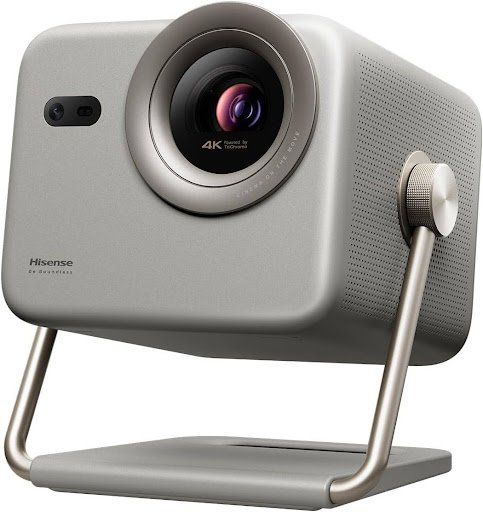
HISENSE M2 PRO
A lot of projector disappointment starts with a lie that sounds reasonable.
You bring home a compact 4K laser box. You see 1300 ANSI lumens, triple laser color, Dolby Vision, optical zoom, and a screen size that can stretch from 65 to 200 inches. On paper, it feels like cheating. Smaller box. Bigger image. Cleaner room. More drama for less money than a giant premium TV. Then real life walks in with a window, an off-white wall, a lamp in the corner, and a living room that does not care about marketing language.
What pulled me toward the Hisense M2 Pro is not the usual projector fantasy. It is something more specific: this is one of the few small lifestyle projectors that combines triple-laser color, optical zoom at 1.0–1.3:1, very accurate color out of the box, broad HDR support, and unusually strong gaming support for the class. That mix is rare. It is also exactly why people can misjudge it. They see versatility and assume universality. That is where the decision goes wrong.
The Result Looks Fine. The Problem Isn’t.
The first trap is visual politeness.
The M2 Pro can throw a picture that looks sharp, colorful, and immediately impressive. Reviewers consistently praise how easy it is to set up and how clean the image looks. Owners coming from cheap portable projectors describe it as a huge jump. That first impression is real. The danger is that a projector can look “good enough” in the first ten minutes while quietly failing at the exact thing you bought it for: replacing friction, not creating a prettier version of it.
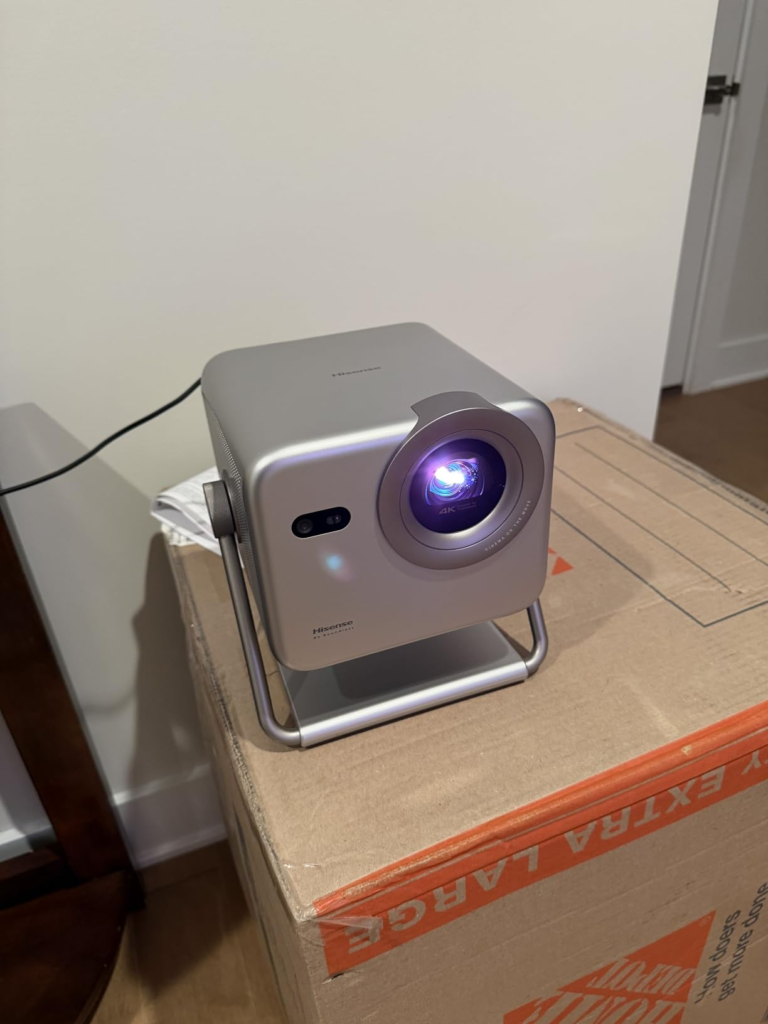
If you place it on a coffee table, let the automatic adjustments lock in, and throw a film onto a proper screen in a dim room, the room changes character fast. The wall stops behaving like a wall. The space loosens. The furniture suddenly feels arranged around an event, not just around a device. That is the M2 Pro at its best: not merely bigger, but less intrusive than a large black panel dominating the room all day. At 3.9 kg / 8.6 lb, with a compact chassis and a portable form factor, it is built for exactly that kind of flexible placement.
But the weakness arrives just as quietly. RTINGS found it bright enough for a typical living room with the lights down, yet not quite enough to look good with a few lights on, and noted that blacks rise in very dark scenes. That means the image can still look attractive while shadow depth and overall punch begin to flatten the moment the room stops cooperating. The result is not disaster. It is erosion. And erosion is what tricks buyers.
What You’re Actually Feeling but Not Naming
What most people call “I need a better projector” is often something narrower.
It is not always brightness. Not really. It is often one of three things:
- the image feels large but not grounded
- setup keeps interrupting the mood
- the room never quite becomes cinematic enough to justify the ritual
That third one matters most. Because a projector is not judged only by picture quality. It is judged by whether it makes you want to use it again on a random Tuesday night instead of saving it for the weekend and quietly defaulting back to the TV.
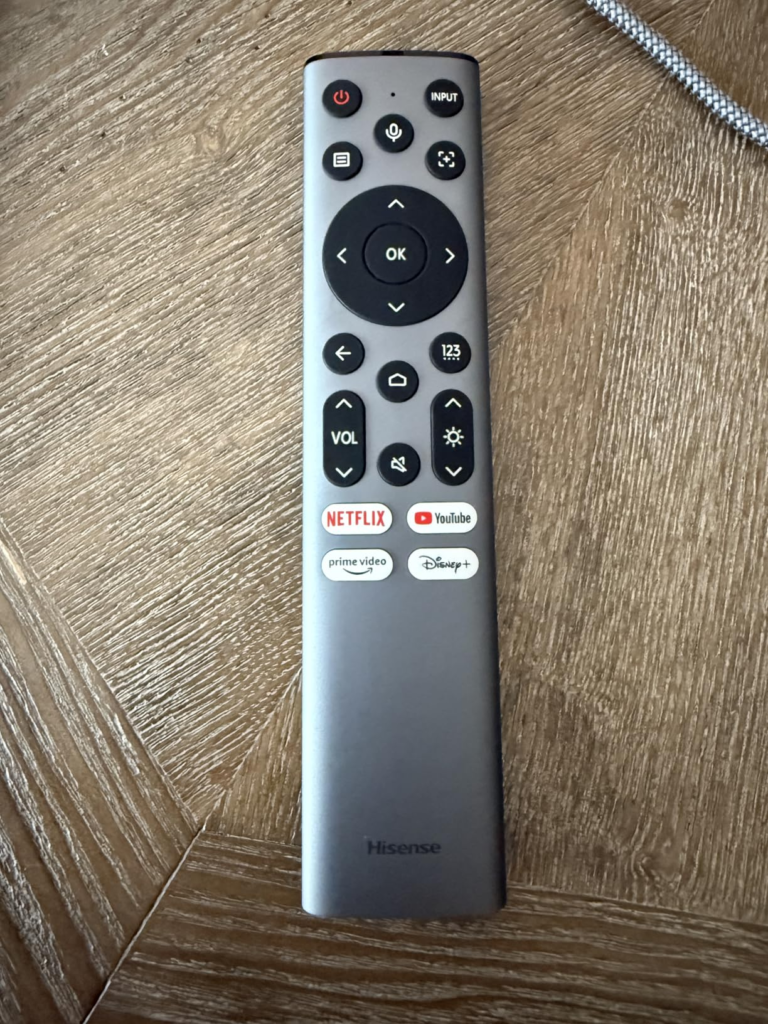
The M2 Pro is designed to attack that reluctance. Hisense built in automatic focus, keystone correction, screen fit, obstacle avoidance, and even wall-color adaptation. What that really means in human terms is simple: less fiddling, fewer crooked starts, fewer moments where the machine reminds you it is a machine. That reduction in setup drag is a meaningful part of the product, not a side note.
Still, there is another feeling that buyers do not name early enough: ambient-light resentment. You think you are buying freedom. What you are actually buying is a different negotiation with the room. Owners repeatedly mention that the unit becomes far more satisfying with blackout curtains or a proper screen, and one owner specifically noted that a cheap gray screen reduced laser speckle but also dimmed the already limited brightness. That is the emotional tax here. Not that the projector is weak, but that the environment still gets a vote.
The Hidden Mechanism Behind the Miss
The hidden variable is not “Is the projector good?”
It is this: how much room forgiveness do you need before the image stops feeling premium?
The M2 Pro’s strongest technical story is easy to see. It uses an RGB triple-laser light source, covers 110% of BT.2020 according to Hisense, supports Dolby Vision, HDR10, HDR10+, and HLG, and delivers color performance that RTINGS called amazing out of the box with an exceptional color gamut. That is why the picture can look rich, alive, and expensive even when the chassis is small.
The weaker part is just as important. RTINGS also flags that it is not very bright relative to stronger room-fighting projectors, and that very dark scenes show lifted blacks. What Hi-Fi, meanwhile, praises the M2 Pro’s brightness for the class and its easy setup, but still frames it as a flexible “home cinema in a box” rather than an all-conditions display replacement. Put differently: this projector wins by balancing portability, color, and ease. It does not win by brute-forcing daylight.
That is why the optical zoom matters more than it first appears. This is not just a convenience feature. It is one of the product’s clearest signs of maturity. Hisense says the 1.0–1.3 throw ratio lets you resize from the same position while preserving 4K sharpness, unlike digital zoom systems that degrade detail. In actual-room terms, that means less furniture compromise, less awkward reshuffling, and a cleaner chance of placing the projector where the room wants it rather than where the spec sheet bullies you.
| What the hardware does well | Why it matters in the room |
|---|---|
| Triple-laser color | The image feels vivid instead of washed into pastel fog |
| Optical zoom | You can fit the screen to the room without softening the picture |
| Auto adjustment tools | Setup friction drops before it turns into annoyance |
| Compact 8.6 lb body | The projector can live with your space instead of claiming it permanently |
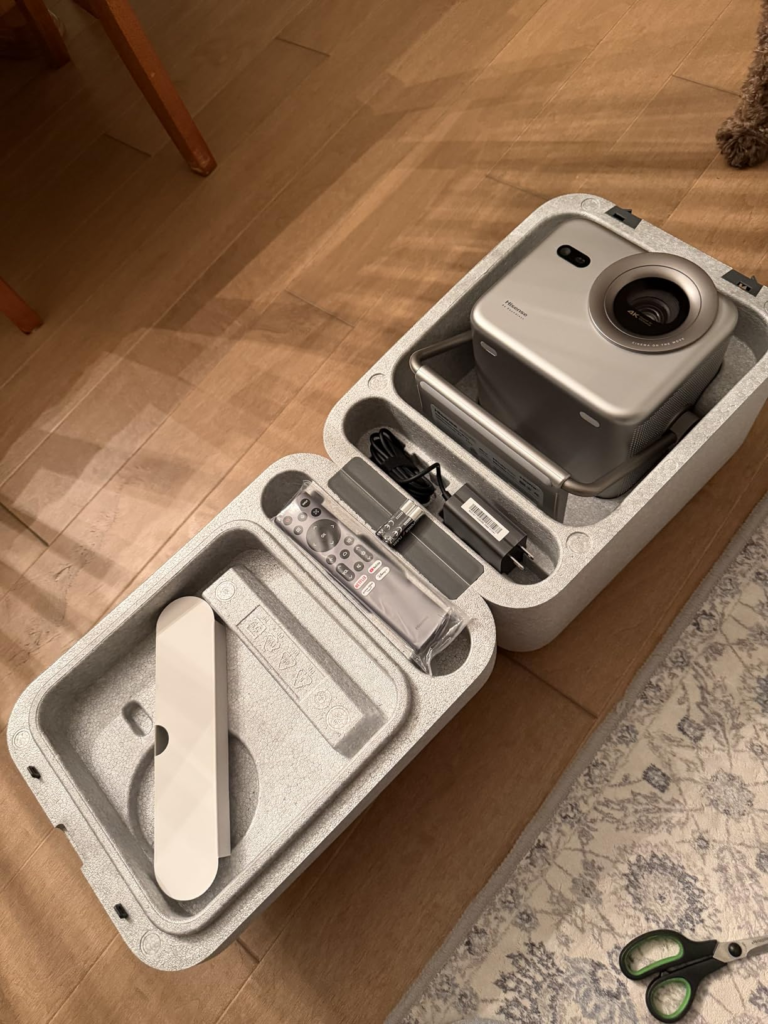
| Built-in 2 x 10W speakers | A quick movie night feels complete even before you add external audio |
The table sounds clinical. The lived version is simpler: the M2 Pro does not just throw a picture. It reduces the number of tiny excuses that usually kill projector ownership after the honeymoon.
The Threshold Where the Outcome Quietly Breaks
Here is the threshold I would actually name:
The M2 Pro stops feeling like a luxury shortcut and starts feeling like a compromise the moment you need it to overpower the room instead of cooperate with it.
That is the line. Not the brand. Not the price. Not the resolution. The line is whether your room obeys.
If your use case looks like this, you are on the strong side of the threshold:
| Condition | Outcome tendency |
|---|---|
| Evening viewing | Strong |
| Controlled lighting | Strong |
| Proper screen or decent wall | Strong, with a screen preferred |
| 90–120 inch target | Usually the sweet spot |
| Film, streaming, casual gaming | Strong fit |
| Frequent moving room to room | Strong fit |
If your use case looks like this, you are pressing the wrong side of the threshold:
| Condition | Risk |
|---|---|
| Daytime use with light spilling in | Picture loses authority |
| Constantly lit living room | Contrast and depth soften |
| Expecting OLED-like blacks | You will notice the ceiling fast |
| Bad wall texture or wrong surface | Speckle or color inconsistency can bother you |
| Buying it to avoid any room prep | The room still matters |
This is where a lot of “mixed reviews” are born. Not from a confused product, but from confused thresholds. The same projector can feel like a clever steal in one home and like a politely expensive lesson in another.
Why Most Buyers Misread This Too Early
Because they compare the wrong things first.
They compare raw specs. They compare size. They compare claimed brightness. They compare the fantasy of a 200-inch screen against the reality of whatever wall happens to be empty. That is feature-led judgment, and it hides the only question that matters: When does the viewing experience stop feeling effortless?
The M2 Pro invites early overconfidence because it is unusually well-equipped for a compact lifestyle projector. RTINGS notes that it is far better for gaming than several peers thanks to high refresh rate support and lower input lag, with support listed up to 240Hz at 1080p and strong performance at higher resolutions as well. Projector Reviews reports input lag as low as 28ms at 1080p/120fps in game mode and highlights ALLM plus dedicated gaming presets. That kind of spec sheet breadth makes people assume it is a no-asterisk product. It is not. It is a highly capable product with a very clear asterisk: brightness remains contextual.
And there is another misread. People often think portability is about travel. Sometimes it is. More often, it is domestic freedom. Shelf one night. coffee table the next. Bedroom ceiling once in a while. Backyard movie when the weather behaves. What Hi-Fi explicitly frames the M2 Pro as a quick, easy option for the odd movie night rather than a permanent lounge fixture. That matters because the value is not only in where it goes, but in the fact that it does not have to stay there.
Who Is Actually Inside This Problem
The best buyer for the Hisense M2 Pro is not “someone who wants a projector.”
It is someone who wants a large, genuinely cinematic image without dedicating the room to a projector full-time, and who is willing to give the room basic cooperation when it matters. That person usually recognizes at least three irritations:
- a big TV feels physically dominant even when it is off
- cheap portable projectors feel flimsy, flat, or disposable
- traditional projectors often ask for too much commitment
That is the core fit.
I would also include buyers who care about color more than showroom brightness, and buyers who want one device to cover films, streaming, and casual gaming without collapsing into toy-like behavior. The M2 Pro’s strong out-of-box color accuracy, wide gamut, broad HDR format support, gaming refresh options, and built-in stereo system all point to that exact middle ground: serious enough to feel premium, flexible enough to remain usable.
It also fits a specific style of room. Put it on a low media console or coffee table with a clean front wall, soft indirect lighting behind the seating, and a proper screen that disappears when not in use, and the space shifts from “TV area” to “intentional cinema corner.” The product’s visual advantage is not only what it projects. It is what it lets the room avoid becoming when the show is over.
Where Wrong-Fit Begins
Wrong-fit begins where impatience becomes part of the plan.
If you want a display that shrugs off daylight, keeps deep blacks in hard scenes, and asks almost nothing from the room, this is not the cleanest answer. RTINGS is unusually clear on the trade-off: the M2 Pro is very good for movies, but not very bright, and black levels in very dark content are not its strongest point. Owner feedback also suggests that surface choice matters more than some buyers expect, especially when laser speckle enters the picture.
Wrong-fit also begins if your taste runs toward absolute audio immersion with no add-ons. The built-in 20W stereo system is good for a compact unit and is praised by Projector Reviews as loud enough for a small to medium room, but it is still a convenience system, not a replacement for a real home-theater sound setup if soundstage depth is central to your enjoyment.
And wrong-fit begins the moment you hear “portable” and translate it as “frictionless in every environment.” Portable does not mean invincible. Portable means the compromise moved. It got smaller, smarter, better dressed. It did not vanish.
The One Situation Where This Product Becomes Logical
The M2 Pro becomes genuinely logical when your real problem is this:
You want one compact projector that can create a premium-feeling 4K movie night in a controlled room, stay flexible enough for casual relocation, and avoid the plastic, washed-out feel of lower-tier portable models.
That is the moment the decision stops being vague.
In that situation, the product is not attractive because it does everything. It is attractive because it solves the right cluster of problems at once:
| What it fixes | How it fixes it |
|---|---|
| Portable projectors that look cheap | Triple-laser color and strong out-of-box accuracy lift image quality |
| Room placement frustration | Optical zoom plus auto adjustment tools reduce setup friction |
| Weak streaming convenience | VIDAA OS with major app support keeps it self-contained |
| Casual gaming lag worries | High refresh support and low-latency game mode make it more credible |
| Living-room aesthetic fatigue | It can leave the room visually cleaner than a giant permanent TV |
That is where the M2 Pro stops being a gadget and starts being a coherent answer. Not universal. Coherent.
What It Solves, What It Reduces, and What It Still Leaves to You
What it solves is the stale choice between ugly convenience and beautiful inconvenience.
It gives you a compact projector with serious color, practical setup intelligence, broad HDR support, and enough built-in competence that using it does not feel like apologizing for buying portable. That is not a small thing. It is the whole reason this model matters.
What it reduces is chore friction. Less aiming. Less adjustment. Less regret over where the furniture sits. Less sense that you need a dedicated theater just to justify the purchase. It also reduces the fear that “portable” automatically means dim, tinny, and temporary-feeling. The M2 Pro has enough image integrity and enough physical polish to avoid that trap.
What it still leaves to you is the room.
You still need to respect light. You still need to think about surface quality. You still need to decide whether built-in audio is enough for your standards. And if your taste is shaped by inky OLED blacks or by a display that can punch through daylight without flinching, you need to face that before checkout, not after the return window starts ticking.
Final Compression
The Hisense M2 Pro is not the projector for people who want the room to surrender.
It is the projector for people who can give the room a little discipline and want the reward to feel far larger than the hardware sitting on the table. Its best traits are not loud. They are cumulative: color that looks expensive, setup that does not irritate, portability that feels grown-up, gaming support that is better than expected, and a form factor that lets the room breathe when the movie is over. Its limit is just as clear: once ambient light and deep-black expectations start pushing hard, the charm thins.
So this is the clean decision line I would use.
If your break point starts where room flexibility, cinematic scale, and credible picture quality matter more than brute brightness, the M2 Pro becomes a rational next step. If what you really want is a projector that fights the room for you, this is where the decision should stop.
Transparency Note:
This analysis is built on aggregated real-world experience.
It extracts what repeatedly holds, what breaks, and what users uncover only after living with the system—then shapes it into a clear model you can use immediately.
Think of it as structured experience, refined and presented so you don’t have to learn it the hard way.
“A quick note: Don’t believe the star ratings, but trust personal experience. This article is a compilation of collected experiences”