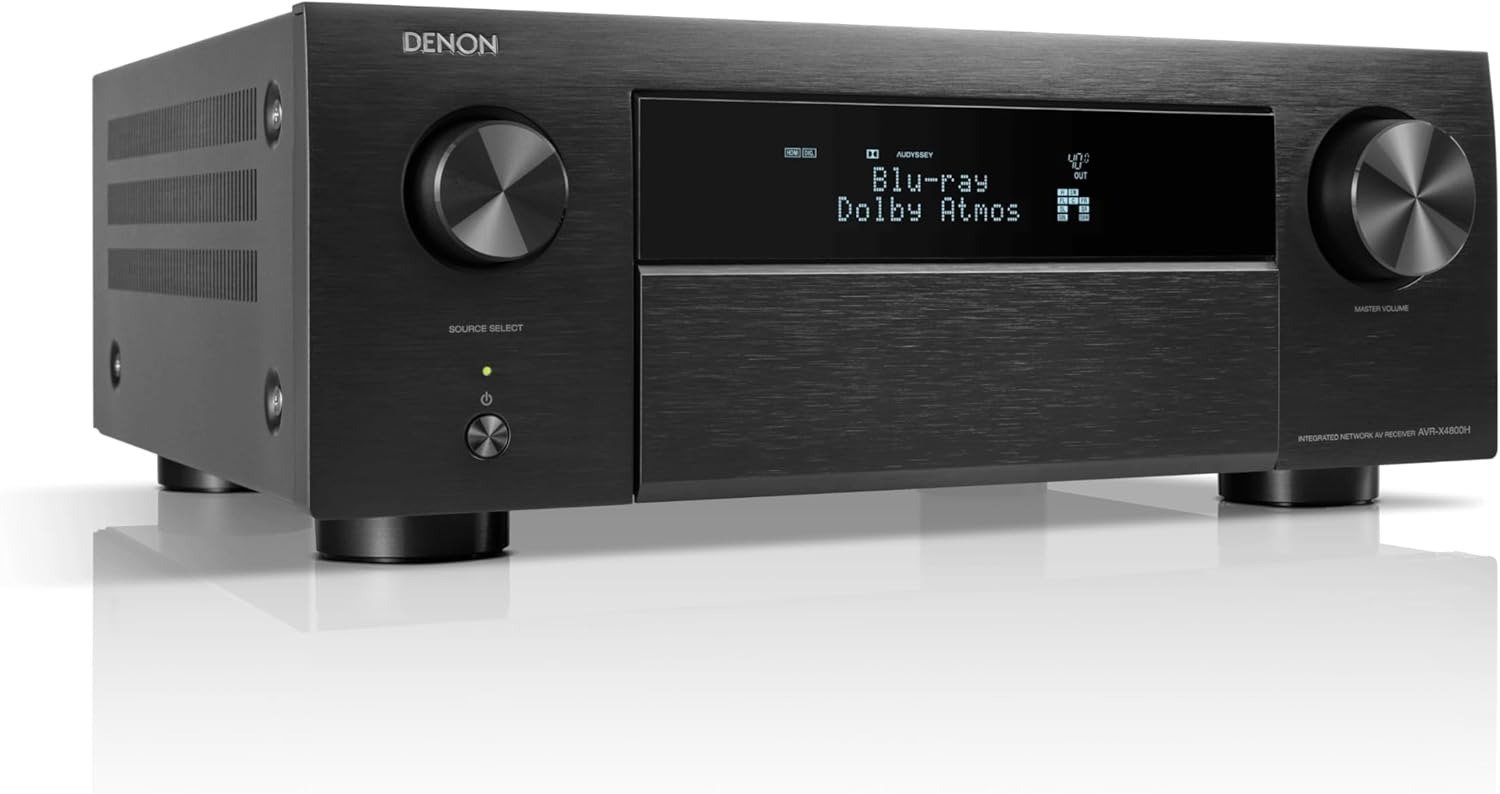
Denon AVR-A1H Review: The Point Where “Good Enough” Home Theater Quietly Stops Being Good Enough
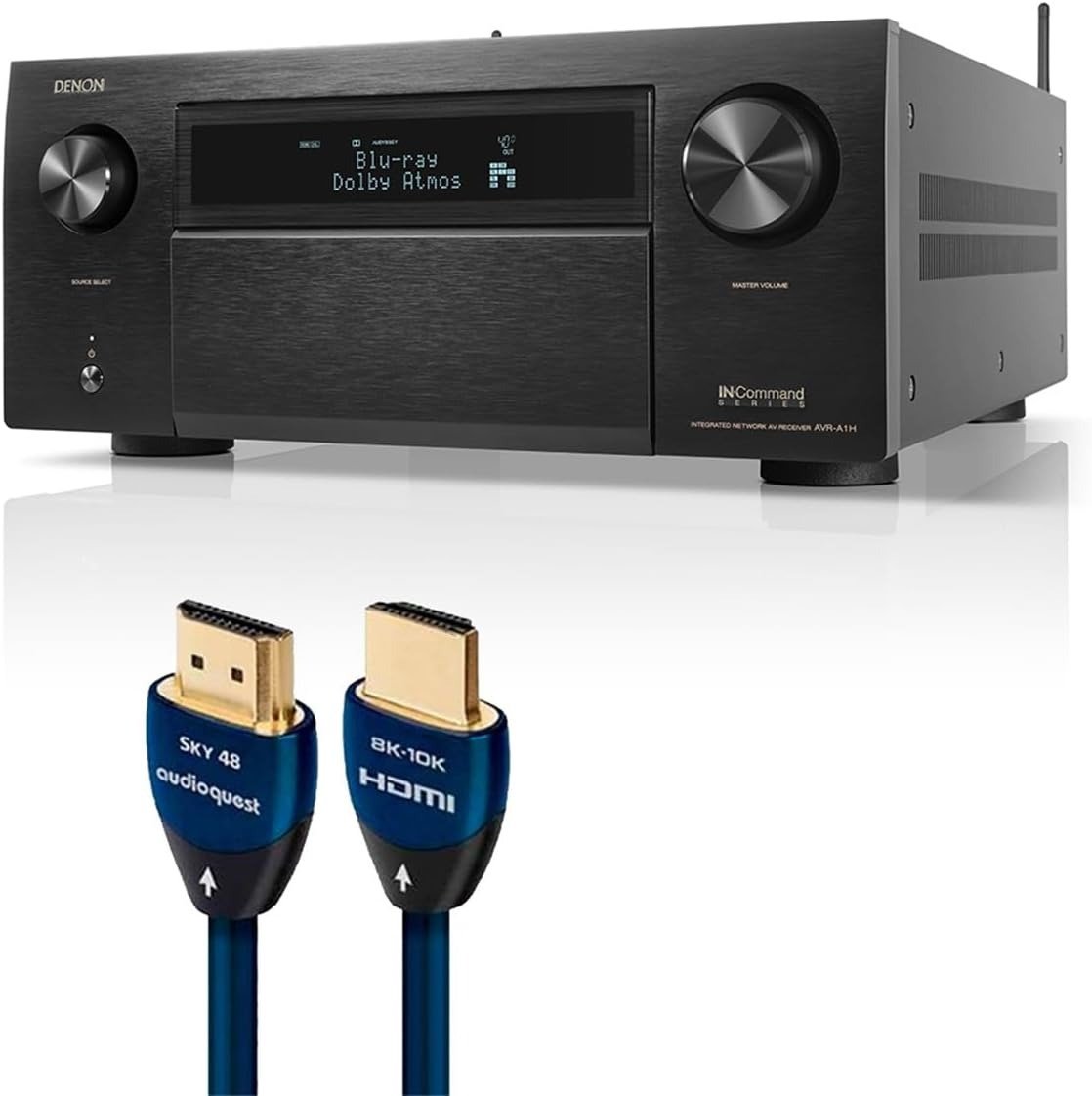
DENON AVR-A1H
The Result Looks Fine. The Problem Isn’t.
A weak theater rarely announces itself with silence.
It announces itself with compromise.
The bass lands late.
Dialogue stays clean until the room gets busy, then thins out.
Height effects are technically there, but they hang above the screen like decoration instead of locking into space.
You can live with that for a long time, because the result looks impressive from the couch.
It just does not feel settled.
That is the trap I kept seeing around the Denon AVR-A1H.
People talk about it as if it is a luxury monster—15 amplified channels, four independent subwoofer outputs, support for layouts up to 9.4.6, seven HDMI inputs, three outputs, and a 70.5-pound chassis that is almost absurd by modern receiver standards.
All true.
But that still misses the real point.
This machine is not fundamentally about excess.
It is about what happens when a theater gets complex enough that ordinary receiver logic starts leaking control.
I came away from the research with one conclusion that matters more than the spec sheet: the AVR-A1H is not impressive because it is large.
It is impressive because it keeps the system in one body longer than most receivers can without turning the whole room into a negotiation between missing channels, external amp workarounds, and setup fatigue.
That is why specialist reviewers treated it less like a novelty and more like the return of the “super receiver.”
What You’re Actually Feeling but Not Naming
Most buyers do not say, “My system has crossed a control threshold.”
They say simpler things.
It sounds good, but not fully glued together.
It gets loud, but not fully convincing.
It has plenty of features, but still feels like work.
That last part matters.
A theater can fail before it sounds bad.
It can fail by becoming burdensome—too many boxes, too many routing decisions, too many calibration compromises, too much low-grade dread every time you add another pair of speakers or a second sub and realize the “easy” setup is no longer easy.
The psychological appeal of the A1H is not status.
It is relief.
Not cheap emotional relief.
Structural relief.
One chassis.
Fifteen onboard amps.
Four independent subwoofer outputs.
Audyssey MultEQ XT32 included.
Dirac Live available if you want to go further and pay for it.
It promises a kind of compression the high-end market usually denies you: fewer moving parts, fewer failure points, fewer reasons to second-guess the system you just built.
That is why owners and dealers keep circling the same language around it: weight, build, flexibility, ease, headroom.
Not because those words are poetic, but because they describe the same sensation from different angles.
The unit feels overbuilt because it is.
Denon says it uses the largest transformer the company has put into an AVR, and the published specs back up the scale of the thing: 900W power consumption, 17 speaker terminals, 17.4-channel pre-outs, and four independent sub outputs.
You are not just buying wattage.
You are buying less fragility.
The Hidden Mechanism Behind the Miss
The usual buying mistake in this category is simple: people shop receivers by headline features instead of system load.
They compare logos.
Atmos, check.
8K, check.
HDMI 2.1, check.
Room correction, check.
Then they assume the remaining differences are luxury fluff.
They are not.
The hidden variable is coordination under complexity.
Once you move beyond a straightforward room, the receiver is no longer just decoding formats.
It is managing amplifier allocation, subwoofer integration, channel layout flexibility, room correction, heat, routing, and the ugly reality that “150 watts per channel” is a standardized two-channel rating, not a fantasy promise that all 15 channels get 150 watts at once.
That caveat is not a flaw unique to Denon; it is the normal truth of AVR marketing.
The real question is whether the platform underneath the rating still has the power supply, processing, and connection architecture to stay composed when the room stops being simple.
That is where the A1H separates itself.
Denon built it around 15 amplification channels, up to 9.4.6 speaker support, 17.4-channel pre-outs, four independent subwoofer outputs, dual-core 1GHz DSP, and high-end room-correction flexibility.
Reviewers who spent real time with it did not just call it “powerful.”
They kept returning to control, balance, clarity, and the sense that this receiver behaves more like a serious platform than a feature pile.
Sound & Vision went unusually far, calling it probably the best-performing AV receiver that reviewer had used in 25 years of trials.
The Threshold Where the Outcome Quietly Breaks
This is the threshold that matters:
The moment your theater asks more from the receiver than “play everything” and starts asking it to hold a complex room together.
Below that line, many AVRs can look interchangeable.
Above it, they stop being interchangeable very fast.
Here is the break point in plain language:
| Threshold signal | What it usually means |
|---|---|
| You want more than 11 powered channels without turning the rack into a side project | The AVR category is thinning out fast |
| You are running multiple subs and actually care how they integrate | Independent sub control stops being optional |
| You want immersive layouts like 9.4.6, not just the badge on the box | Channel count becomes a structural issue |
| You hate the idea of separate processor + amp stacks unless they are truly necessary | An all-in-one flagship starts making sense |
| You want serious room correction, but also a usable baseline out of the box | Audyssey included, Dirac optional becomes meaningful |
That is the threshold the A1H is built for.
Not everybody reaches it.
Most do not.
But once you do, the cheaper path often becomes fake economy: save on the receiver, then bleed time, rack space, cabling, upgrade money, and patience trying to patch back what the original purchase could not comfortably carry.
Why Most Buyers Misread This Too Early
Because they ask the wrong first question.
They ask, “Is this receiver overkill?”
The better question is, “Overkill for what room?”
If you are never going past 7.x.x or 9.x.x.
If you do not care about wides.
If your subwoofer strategy is basically “plug it in and hope.”
If you are not trying to simplify a genuinely ambitious system.
Then yes, the A1H is too much.
Brutally too much.
Even enthusiasts say this out loud.
In owner discussions, people repeatedly note that if you are absolutely sure you will never go beyond 11 channels, spending A1H money becomes hard to justify, and some critics bluntly argue that 15 channels are unnecessary for many rooms.
That criticism is not unfair.
It is the wrong-fit warning label this category desperately needs.
But the opposite mistake is just as expensive: treating the A1H like a vanity product when it is actually a consolidation product.
AVForums called it expensive in absolute terms but a bargain relative to its real competition.
That sentence only sounds exaggerated until you price out separate processing, external amplification, and the extra friction that comes with both.
Suddenly the A1H stops looking like indulgence and starts looking like containment.
Who Is Actually Inside This Problem
You are inside this problem if your theater is already moving toward one of these realities:
You are building around a projector or premium display and do not want the receiver to become the limiting link in a multi-sub, high-channel-count room.
You want an immersive layout that is meaningfully beyond the usual enthusiast setup—something like 9.4.6—or you want the flexibility to get there without rebuilding your electronics chain.
Denon explicitly supports up to 9.4.6 here, and the A1H includes 15 power amps plus 17.4 pre-outs if you need even more routing flexibility.
You care less about owning “the flagship” and more about not revisiting this decision in six months because your system outgrew the receiver faster than expected.
You value room correction, but you also value not being forced into a processor-plus-amps stack immediately.
The A1H ships with Audyssey MultEQ XT32 and supports Dirac Live as a paid upgrade.
That is not a minor detail.
It means the floor is already high, and the ceiling is still open.
And maybe the most revealing signal of all: you are tired of reading products by their badge count and starting to evaluate them by how much uncertainty they remove from a real room.
Where Wrong-Fit Begins
Wrong fit begins long before disappointment.
It begins when the room is modest and the ego is not.
It begins when you buy future-proofing you will never actually use.
It begins when you pay flagship money to solve a mid-tier problem.
The Denon AVR-A1H is wrong for you if your theater is staying simple, your speakers are efficient, your layout is conventional, and your real itch is just to “buy something amazing.”
This receiver is also wrong if you expect the price to include every advanced correction path; Dirac Live still sits behind an extra license fee, and reviewers were clear that the full multi-sub implementation gets expensive fast.
It is wrong if you want small, cool-running, and easy to hide.
It weighs 70.5 pounds and draws serious power.
That is not personality.
That is logistics.
You need the physical space, the ventilation, and the honesty to admit whether you are building around a flagship or merely admiring one.
It is also wrong if you want the comfort of pretending that all high-end AVRs are frictionless.
They are not.
Some owner chatter points to real-world quirks around advanced setups, including eARC/console edge cases.
None of that overturns the product’s reputation, but it does reinforce the adult truth of this tier: complexity never disappears completely; the best gear simply manages it better.
The One Situation Where This Product Becomes Logical
The A1H becomes logical the moment your room is complex enough that a normal receiver would force you into piecemeal correction.
That is the situation.
Not “I want the best.”
Not “I love premium gear.”
Not “I might add speakers one day.”
I mean this: you are building or already running a serious immersive theater, you want genuine channel-count freedom, you care about multi-sub control, you do not want a spaghetti bowl of half-measures, and you would rather pay once for a receiver that behaves like a platform than buy cheaper and then spend the next year compensating.
At that point, the A1H stops being extravagant and starts being clean.
Denon’s current U.S. list price is $7,199, which is a large number until you remember what serious separates cost once the processor, amplification, integration, and room-correction ambitions all show up at the same time.
Reviewers and sellers alike keep framing the A1H as unusually strong value within that specific class, not across the entire AVR market.
That distinction matters. A lot.
What It Solves, What It Reduces, and What It Still Leaves to You
Here is the cleanest way I can say it after pulling together the technical data, the specialist reviews, and the owner sentiment.
| What the AVR-A1H solves | What it reduces | What it still leaves to you |
|---|---|---|
| Channel-count ceiling anxiety | Rack clutter and external-amp urgency | Speaker selection still matters more than receiver prestige |
| Weak multi-sub flexibility | Setup compromise in ambitious rooms | Room acoustics do not disappear because you bought a flagship |
| The jump from “receiver” to “processor + amps” too early | Upgrade churn | Dirac can add meaningful cost if you go all the way |
| High-end theater in one box | Decision noise | You still need honest installation, ventilation, and calibration |
That pattern showed up everywhere I looked.
The praise was consistent: build, flexibility, refinement, authority, composure.
Crutchfield customer feedback highlighted excellent sound, a functional display, modern UI, and the unusually complete feature set.
Sound & Vision praised both sonic performance and the included usability of Audyssey XT32 versus Dirac’s more expensive ladder.
AVForums emphasized how much engineering and channel count Denon squeezed into one chassis relative to its class.
So no, the A1H does not solve everything.
It does something more useful.
It removes a cluster of expensive, annoying, system-level problems before they spread.
Final Compression
Most people looking at the Denon AVR-A1H are asking whether it is worth the money.
I think that is one question too early.
The real question is whether your room has already crossed the threshold where ordinary AVR buying logic starts lying to you.
If it has not, walk away cleanly.
This is too much receiver, too much weight, too much spend, too much machine.
If it has, the picture changes fast.
Then the A1H is no longer “the giant Denon.”
It is the box that keeps a serious theater from breaking into little compromises.
And once you see it that way, the decision gets quieter.
If this is the threshold you are actually inside, becomes the logical next step.
Transparency Note:
This analysis is not based on quick personal impressions.
It is derived from documented system behavior, verified user patterns, and the physical constraints of storage capacity.
The goal is to translate complex technical behavior into a realistic performance model that helps you make a clear decision.
“A quick note: Don’t believe the star ratings, but trust personal experience. This article is a compilation of collected experiences”