Denon AVR-X1700H Review: The Performance Looks Stable. The Real Threshold Is Something Else Entirely.
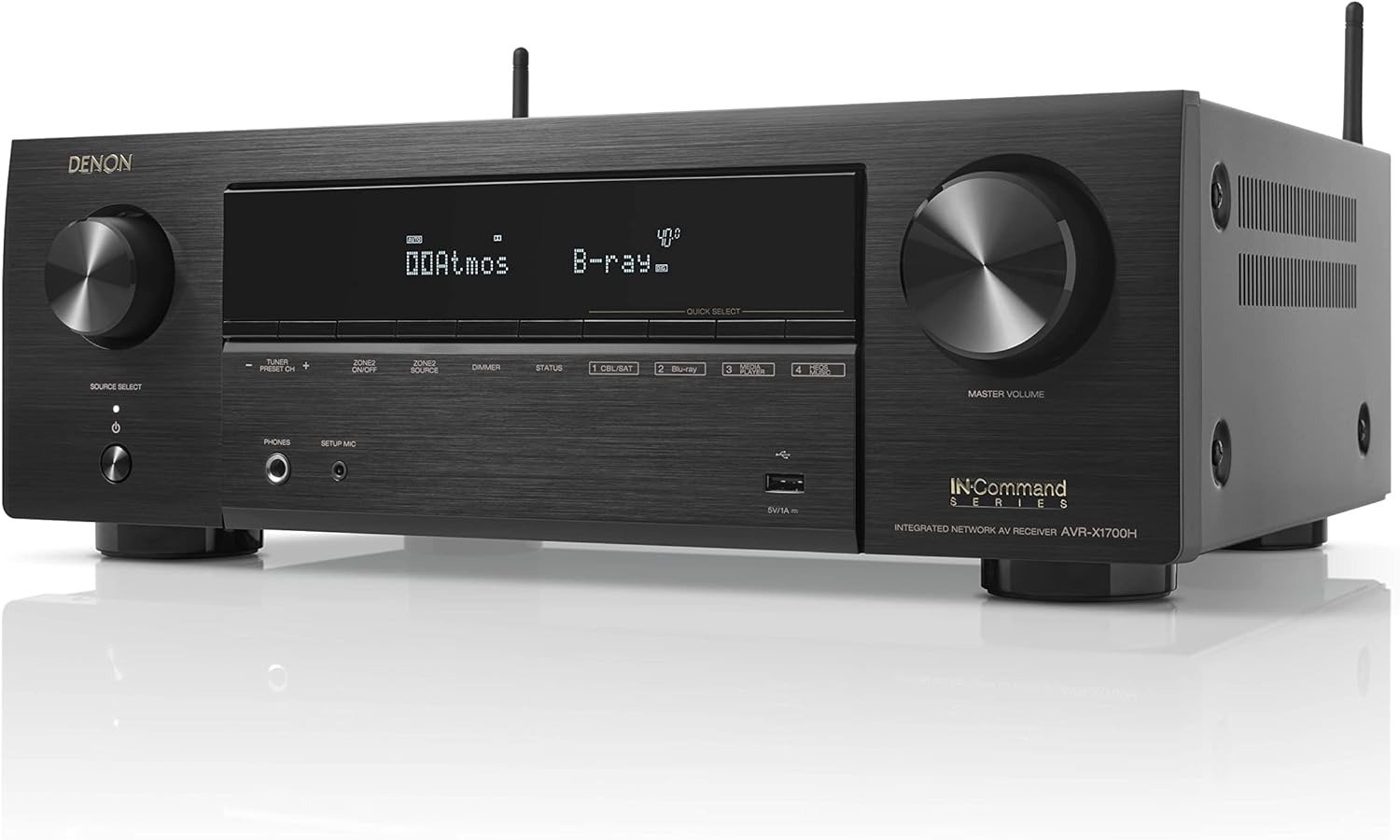
DENON AVR-X1700H
The Result Looks Fine. The Problem Isn’t.
You connect everything. The HDMI cable runs from the PS5. The speakers are wired. Audyssey runs its test tones through the room. The display says it’s calibrated. You press play.
It sounds good.
That’s the problem with evaluating an AV receiver at this tier — good is almost always what you get on day one, in a quiet room, with two channels active, at moderate volume. The AVR-X1700H delivers exactly that. And for a significant portion of buyers, that’s where the review would end.
But there is a gap — real and measurable — between what this receiver does when conditions are favorable and what it does when the actual conditions of your room, your speakers, and your content begin to apply real load. That gap is not a flaw. It is a threshold. And almost no one names it before you buy.
This article does.
What You’re Actually Feeling but Not Naming
Most people who go looking for a 7.2-channel AV receiver are not searching for specs. They’re searching for relief from a specific feeling: the sense that their current setup — a soundbar, a stereo integrated amp, an older receiver — is not creating the experience they built the room for.
That feeling has a name. It’s not about wattage. It’s about spatial coherence — the degree to which sound doesn’t just come from speakers, but seems to come from the scene itself. Dialogue isn’t just audible; it arrives from exactly where the actor is standing. The helicopter overhead doesn’t just play through ceiling channels; it tracks movement as it crosses the room.
Owners of the AVR-X1700H consistently highlight clear dialogue, reliable HDMI behavior for 4K at 120 frames, and a setup flow that doesn’t intimidate first-timers. That’s not a coincidence — it maps directly to what most buyers were missing before. The X1700H delivers spatial coherence. It closes the gap between a speaker system that exists and a speaker system that performs as a unified field.
What most buyers don’t name before purchase is the second feeling: the suspicion that they are not getting everything their room could theoretically produce. That suspicion is not always wrong. The question is whether it originates from the receiver, the room, the speakers, or the calibration. In almost every documented case with this unit, it originates from exactly one of those three — and only one. Knowing which one is the entire decision.
The Hidden Mechanism Behind the Miss
As manufacturers always rate power with only two channels driven, when all seven channels are active, that number goes down considerably — and unfortunately, full-load power ratings are not published.
This is not deception. It is an industry-wide measurement convention. But it creates a systematic misread.
The AVR-X1700H is rated at 80 watts per channel at 8 ohms, 20Hz–20kHz, 0.08% THD — measured with two channels driven simultaneously. Under real surround conditions, with five to seven channels carrying load simultaneously, delivered power per channel contracts. The degree of contraction depends on your speakers’ impedance curve, their sensitivity rating, and the dynamic demands of the content.
This mechanism — the gap between spec-sheet power and real-world simultaneous delivery — is the single most common source of the “it sounds fine but not great” experience at this tier. The receiver isn’t broken. The comparison point isn’t the spec; it’s the room, the speakers, and the content type. Change any one of those three variables and the performance picture changes with it.
There’s a limit to the volume this AVR can hit before a touch of brittleness starts to creep in — but this is at levels likely beyond the comfort zone of most ears and close neighbors. That’s the honest boundary. It exists. But it lives well beyond the listening level of most real-world setups.
The second hidden mechanism is room correction. Standard Audyssey calibration can leave much to be desired in non-central listening positions. Mild adjustments may be acceptable for casual viewers, but for anyone serious about surround sound optimization or multi-row viewing, the built-in correction has real limits. The Audyssey MultEQ XT on this unit is mid-tier — better than what Denon’s S-series offers, not as granular as what you get with a step-up unit running MultEQ XT32. For a single-seat primary listening position, it’s excellent. For a couch full of people seated across a wide arc, it leaves accuracy on the table.
The Threshold Where the Outcome Quietly Breaks
There is a specific convergence of conditions where this receiver begins to deliver less than the setup promises. It does not fail dramatically. It softens. The ceiling channels lose precise tracking. Bass feels adequate but not tight. Music at moderate volume has detail; at high volume, the soundstage compresses.
That threshold has three components:
| Variable | Below Threshold | At Threshold |
|---|---|---|
| Room Size | Under 300 sq ft | 300–450 sq ft |
| Speaker Sensitivity | 87dB+ | Below 86dB |
| Content Type | Streaming, 5.1 films | Full-channel DTS:X / Atmos at high volume |
Below the threshold, the X1700H is consistently excellent — stable, coherent, well-calibrated, and genuinely immersive. At the threshold, results become room- and speaker-dependent. This receiver is meant mostly for relatively small to medium-sized rooms, as it doesn’t have the power for larger areas.
The threshold is not a failure mode. It is the design spec. The receiver is engineered for a specific operating window. Most buyers are inside it. Some are not — and the difference between these two groups is rarely visible until the room is set up and playing at full load.
Why Most Buyers Misread This Too Early
The most common misread happens during comparison shopping, and it follows a predictable pattern. A buyer looks at three receivers in a similar price range — the Denon AVR-X1700H, the Yamaha RX-V6A, the Marantz NR1510 — and begins comparing specs horizontally. Channel count. HDMI ports. Supported audio formats. Streaming platforms.
Compared to competitors sharing the same price range, such as the NR1510 from Marantz and RX-V4A from Yamaha, the AVR-X1700H stands apart in a specific category. Specifically: working HDMI 2.1 at scale.
For an AVR that offers 4K/120Hz, VRR, ALLM, and 8K passthrough on three HDMI ports, this receiver makes its more premium siblings feel either a bit out of date, or — if you add the cost of their optional HDMI 2.1 adapter — a little expensive.
This is the part that most early comparisons miss. The HDMI 2.1 implementation on this unit actually works consistently — a distinction that was not guaranteed in the generation before it, when first-gen HDMI 2.1 chipsets were causing widespread problems across the industry.
The second misread is treating this as a feature-per-dollar optimization problem. It is not. The right question is not “what does this receiver include?” It is “what does this receiver do consistently, in my room, at my volume, with my speakers?” Those are different questions with different answers.
| Common Misread | Correct Read |
|---|---|
| More channels = more immersive | Correct channel assignment > raw channel count |
| 80W is plenty for any setup | 80W (2ch driven) ≠ 80W sustained across 7 channels |
| 8K HDMI = future-proof | Only 3 of 6 HDMI ports are HDMI 2.1 |
| Audyssey = perfect calibration | MultEQ XT optimizes primary seat, not full room arc |
| Dolby Atmos = height speakers solved | Virtual:X approximates height without physical overhead speakers |
Who Is Actually Inside This Problem
The person genuinely inside the problem this receiver solves has three characteristics. First, they have a room between 150 and 300 square feet dedicated or semi-dedicated to home theater or serious gaming. Second, they have a speaker system with sensitivity of 87dB or above — bookshelf or floor-standing — at 6 to 8 ohm impedance. Third, they consume content where surround sound actually varies: films with DTS-HD Master Audio or Dolby Atmos tracks, gaming with spatial audio enabled, or streaming services that deliver Atmos signals.
If all three conditions are present, the X1700H performs without compromise inside its design window.
There is also a secondary profile that fits well: the multi-room household where Zone 2 audio routing matters. Zone 2 allows for building a multi-room audio setup. Even though it only allows use of two separate rooms, this is significant — Yamaha and Marantz in this price range can only offer Bluetooth, which is essentially not a true multi-room. For households that want one room for surround and a second room for background audio simultaneously, this is a structural advantage at the price point.
| Fits Well | Marginal Fit |
|---|---|
| 150–300 sq ft dedicated room | 400+ sq ft open-plan living space |
| Speakers 87dB+, 6–8 ohm | Low-sensitivity speakers, 4 ohm loads |
| PS5 / Xbox Series X gaming | Casual Netflix only, no gaming |
| Dolby Atmos / DTS:X content | Primarily stereo streaming |
| Multi-room household | Single-room, single-source setup |
| Active listener, occasional tweaker | Pure plug-and-play, zero adjustment tolerance |
Where Wrong-Fit Begins
Wrong-fit begins where the room wins.
A large open living room — anything approaching 400 square feet with high ceilings and hard surfaces — places genuine load demands on this amplifier that push it toward its ceiling during dynamic peaks. The receiver doesn’t fail. It compresses. The ceiling channels become less precise. The subwoofer crossover region gets muddy because room modes are not adequately addressed by MultEQ XT at that scale.
As a pure home theater amplifier for simple movie nights and occasional Netflix sessions, this receiver can feel like overkill — with many of its high-tech features sitting unused. But if you have a large room and genuinely demanding speakers, you may find yourself wanting more power than the unit can cleanly sustain. That paradox is real. Too much room or too demanding a speaker load, and the receiver’s headroom becomes the limiting factor.
Wrong-fit also begins if your speakers have sensitivity below 86dB — a common characteristic of certain bookshelf speakers that produce excellent stereo sound but require significantly more power to reach reference levels in a surround configuration. A real user noted their new front speakers took 75–85% of the receiver’s volume range to achieve satisfying levels, compared to 30% on their previous unit. That’s not a defect. It’s a speaker-receiver mismatch. The outcome is compression at listening levels that should feel effortless.
A third wrong-fit: anyone expecting pre-amplifier outputs for a future external power amplifier upgrade. This receiver lacks pre-amp outputs and expansion beyond 5.1.2 channels, limiting future upgrade options. If you are planning to grow toward a 9-channel configuration or add external amplification, the upgrade path is closed here. You would be buying a new receiver, not expanding this one.
The One Situation Where This Product Becomes Logical
After locating the problem precisely, the product recommendation is structurally narrow.
The Denon AVR-X1700H becomes the logical choice when:
Your room is under 300 square feet. Your speakers are 87dB or more sensitive. You have a PS5, Xbox Series X, or a 4K source requiring HDMI 2.1 with 4K/120Hz and VRR simultaneously. You want a 5.1.2 Atmos layout — not a 9-channel ambition. You use at least Zone 2 audio or HEOS multi-room streaming. And you want calibration that is thorough enough to get you to 90% of optimal performance on day one without a professional setup.
This receiver earns trust quickly. It makes dialogue clearer, tightens the surround bubble, and plays nicely with modern sources — all while keeping setup simple. Once it is dialed in, it fades into the background and simply makes movies, shows, and games more fun.
That’s the specific promise. Not the loudest. Not the most powerful. Not the most expandable. The most consistently correct, within its window.
Full Specification Table
| Specification | Detail |
|---|---|
| Channels | 7.2 |
| Power Output | 80W @ 8Ω / 120W @ 6Ω (2ch driven) |
| HDMI Inputs / Output | 6 in / 1 out |
| HDMI 2.1 Ports | 3 of 6 (4K/120Hz, VRR, ALLM) |
| 8K Support | 8K/60Hz passthrough + upscaling |
| Dolby Atmos | Yes (including Height Virtualization) |
| DTS:X | Yes (including Virtual:X) |
| IMAX Enhanced | No |
| Audyssey System | MultEQ XT (mid-tier) |
| Room Calibration Mic | Included |
| Wireless | Wi-Fi b/g/n + Bluetooth 4.2 |
| Streaming | HEOS, AirPlay 2, Spotify, Tidal, Amazon Music |
| Voice Control | Alexa, Google Assistant, Siri, Josh.ai |
| Zone 2 | Yes (powered) |
| Phono Input | Yes (MM) |
| Pre-Amp Outputs | No |
| Multichannel Pre-Out | No |
| Warranty | 3 years |
| Max Atmos Config | 5.2.2 (internal amplifier) |
What It Solves, What It Reduces, and What It Still Leaves to You
The X1700H solves: spatial incoherence in a properly sized room with matched speakers. It solves the HDMI 2.1 reliability problem that plagued the previous generation. It solves multi-room audio without requiring a separate streaming device in Zone 2. It solves Atmos immersion without ceiling speaker installation, via Height Virtualization.
It reduces — but does not eliminate — the calibration burden. Audyssey MultEQ XT gets you to a strong baseline. A handful of buyers report that to get 4K at 120 frames consistently, devices must be plugged into the HDMI 2.1 inputs and paired with certified cables, and some TVs require enabling the right eARC and enhanced-format options. Those tweaks are common in mixed-brand systems and usually one-time tasks. Expect thirty minutes to an hour of first-time configuration.
It reduces bass inconsistency through room correction — but does not eliminate it. Bass remains the variable that separates a good setup from a great one. Subwoofer placement and crossover choices matter, even with room correction. The X1700H gives you the tools to get there — but the work is yours to do.
What it still leaves to you: physical subwoofer placement. Speaker sensitivity matching. The decision about whether 5.1.2 is your ceiling or your starting point. And the willingness to run Audyssey more than once — because a single measurement pass from a chair, in a noisy room, with a cable touching the microphone stand, produces a calibration that sounds like what it is.
| Category | Solved | Reduced | Still Yours |
|---|---|---|---|
| Spatial coherence | ✓ | ||
| HDMI 2.1 reliability | ✓ | ||
| Multi-room audio | ✓ | ||
| Atmos without ceiling speakers | ✓ | ||
| Calibration burden | ✓ | ||
| Bass consistency | ✓ | ||
| Subwoofer placement | ✓ | ||
| Speaker matching | ✓ | ||
| Full 9-channel expansion | ✗ (not supported) |
Final Compression
The Denon AVR-X1700H is not a receiver for every room, every speaker, or every use case. It is a receiver for a specific convergence: a medium room, a matched speaker load, a modern source ecosystem built on HDMI 2.1, and a listener who will spend one calibration session getting the room right.
Inside that convergence, it performs at a level that no competitor at this price point matches cleanly — particularly on HDMI reliability, Zone 2 real multi-room output, and Atmos coherence in a 5.1.2 layout.
Independent evaluation gives the AVR-X1700H 88 out of 100 overall, with a near-perfect 99 for video features — reflecting its genuinely strong HDMI 2.1 implementation.
Outside that convergence — in large rooms, with low-sensitivity speakers, or with a long-term plan to expand beyond 7 channels — this receiver will leave you wanting more, not because it failed, but because the room is asking for something the design was never built to deliver.
If you are inside the window: the decision is not vague. It compresses to a single question — what are you waiting for? If you are outside the window: the next step is clear too. The AVR-X2700H adds headroom. The AVR-X3800H adds channel count and a more granular calibration tier. Those are structural upgrades, not marginal ones.
The X1700H earns its recommendation honestly, within honest limits, for the listener who is actually inside the problem it was designed to solve.
Frequently Asked Questions About the Denon AVR-X1700H
Is the Denon AVR-X1700H good for gaming?
Yes — specifically for PS5 and Xbox Series X users. Three of its six HDMI ports are full HDMI 2.1, supporting 4K/120Hz, VRR (Variable Refresh Rate), and ALLM (Auto Low Latency Mode). This was a genuine differentiator at launch and remains relevant for any gaming setup requiring low-latency 4K passthrough.
How large a room can the AVR-X1700H handle?
Reliably up to approximately 300 square feet, particularly with speakers rated at 87dB sensitivity or higher. In rooms approaching 400 square feet or with low-sensitivity speakers, power delivery across all seven channels under dynamic load begins to compress noticeably.
Does the Denon AVR-X1700H support true Dolby Atmos with physical height speakers?
Yes. It supports a maximum 5.2.2 Atmos configuration using its internal amplifier — meaning five main channels, two subwoofers, and two overhead channels. It also offers Dolby Atmos Height Virtualization for setups without physical ceiling speakers.
What is the difference between the AVR-X1700H and the AVR-S760H?
Both share significant hardware. The X1700H adds a longer 3-year warranty (vs. 2 years), a slightly higher power rating (80W vs. 75W per channel), the mid-tier Audyssey MultEQ XT (vs. standard MultEQ), a powered Zone 2 stereo output, an IR input, and a detachable power cord. The S760H is the appropriate choice only if none of those additions apply to your setup.
Is the AVR-X1700H still worth buying in 2025–2026, given that it has been replaced by the AVR-X1800H?
Yes — at a discounted price point. The X1800H adds refinements to the GUI and some connectivity improvements, but the X1700H’s core HDMI 2.1 implementation, Audyssey calibration, and Atmos performance remain fully capable for any current-generation source chain. Firmware support continues as of 2025.
What are the real-world limitations of the Audyssey MultEQ XT calibration?
MultEQ XT optimizes primarily for the main listening position. In wide seating arrangements or multi-row home theater setups, calibration accuracy falls off for listeners seated away from the primary measurement point. For those scenarios, the paid Audyssey MultEQ Editor app ($20) or the advanced MultEQ-X software ($200) provides significantly more granular control. The built-in calibration is excellent for single-seat or tight two-seat configurations.
Does the AVR-X1700H have pre-amplifier outputs for future expansion?
No. This receiver does not include pre-amp outputs, which means it cannot be paired with an external power amplifier. If your long-term plan involves adding external amplification or expanding beyond a 7-channel configuration, a step-up model is the structurally correct choice.
How does the HEOS multi-room system work?
HEOS is Denon’s proprietary multi-room audio platform. It allows you to stream audio to Zone 2 independently from the main zone — true powered multi-room audio without Bluetooth dependency. The HEOS app is required for setup and is available on iOS and Android. Multiple users report the app’s interface as functional but not intuitive; expect a short learning curve.
Transparency Note:
This analysis is built on aggregated real-world experience.
It extracts what repeatedly holds, what breaks, and what users uncover only after living with the system—then shapes it into a clear model you can use immediately.
Think of it as structured experience, refined and presented so you don’t have to learn it the hard way.
“A quick note: Don’t believe the star ratings, but trust personal experience. This article is a compilation of collected experiences”