Creative Pebble X Plus Review: Why Your Desk Setup Sounds Fine Until It Doesn’t
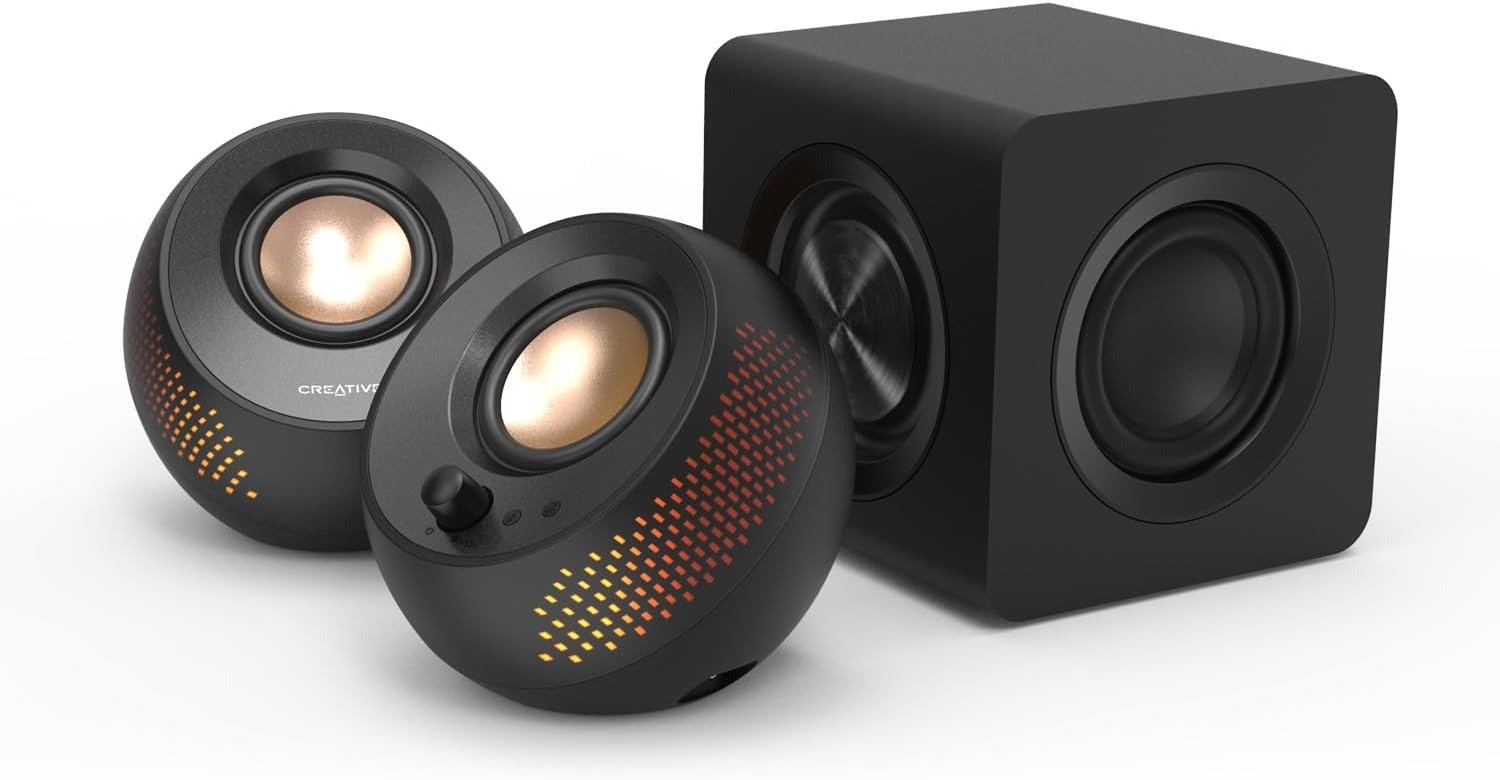
CREATIVE PEBBLE X PLUS
I went deep into how the Creative Pebble X Plus actually performs once you get past the spec sheet — cross-referencing lab measurements, owner reports, and independent testing across PC, PlayStation, and phone — because a $120 desktop speaker either earns that price in daily use or it doesn’t, and the marketing copy won’t tell you which. Here’s what the evidence actually shows.
| Spec | Detail |
|---|---|
| Configuration | 2.1 channel: two satellites + one powered subwoofer |
| Satellite driver | 2.75″ full-range, angled 45° toward the listener |
| Subwoofer driver | 3.5″ flat-cap driver + dual passive radiators, walls up to 15mm thick |
| Power, USB-C bus only | 15W RMS total (out of the box) |
| Power, with 30W+ PD adapter (sold separately) | 30W RMS / 60W peak |
| Frequency response | 45Hz – 20kHz, 93dB signal-to-noise ratio |
| Connectivity | USB-C audio, dedicated USB-C PD port, Bluetooth 5.3 (SBC), 3.5mm AUX-in, 3.5mm headphone-out, 3.5mm mic-in |
| Lighting | Up to 16.8 million colors, six presets, app or button control |
| Device support | Windows, macOS, PS4/PS5 and Switch/Switch 2 (firmware-dependent), any Bluetooth source |
| Typical street price | Roughly $120–130; launched at $129.99; check current pricing before buying |
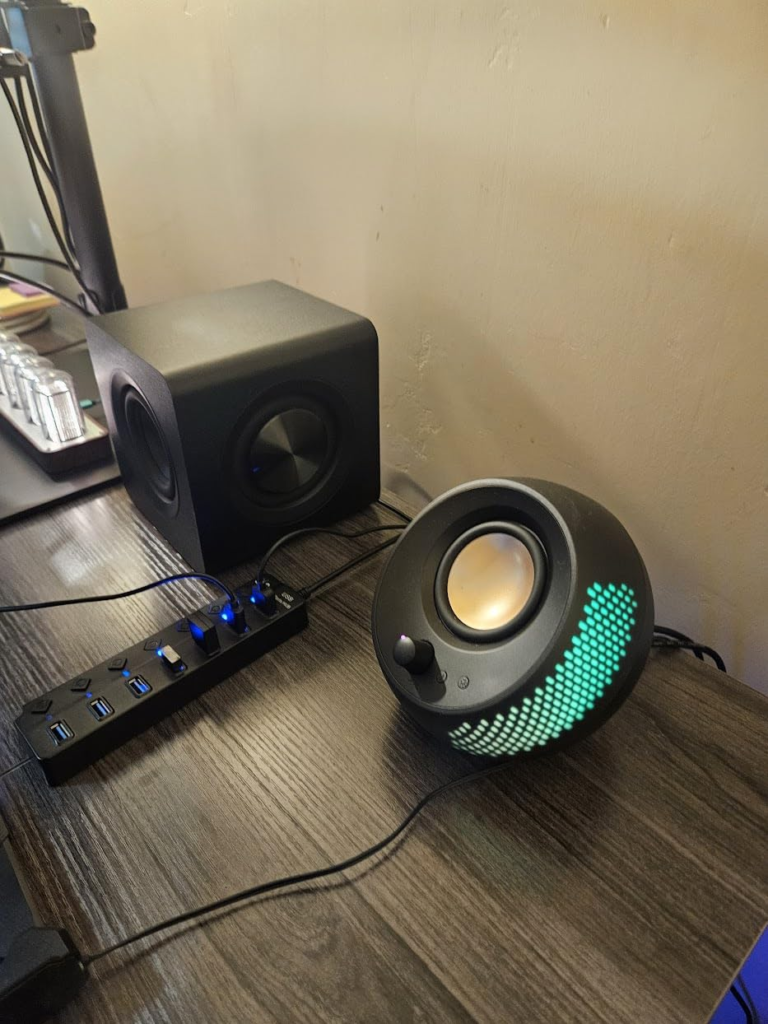
The Result Looks Fine. The Problem Isn’t.
The volume bar is full. The speaker icon shows audio is playing. Nothing is broken, technically. And yet the explosion in the game doesn’t land, the bassline in the song feels like it’s coming from a phone propped against a glass, and the movie dialogue is clear while everything underneath it is just absent. This is the exact gap that catches most desktop audio buyers off guard: a system can be functioning perfectly and still be failing to deliver the part of the sound you actually came for. It isn’t a defect. It’s a category limitation that the “it works” indicator was never built to flag.
Most people arrive at this point through a basic two-speaker setup — laptop speakers, a starter 2.0 pair, or even a budget system that advertises “bass boost” through passive radiators alone. Independent lab testing on Creative’s own entry-level Pebble X confirmed exactly that pattern: even with radiators tuned for low end, the bottom octave stayed thin enough to be unsatisfying on anything bass-driven. The hardware reports success. The listening experience disagrees.
What You’re Actually Feeling but Not Naming
The vague sense that “these speakers just aren’t doing it” is almost never about overall volume or clarity — vocals and dialogue usually sound fine. What’s missing has a name: low-end weight, the part of the frequency range below roughly 100Hz that you feel as much as hear. Gunfire that ticks instead of thumping. Footsteps that register as a sound effect rather than a physical event. A kick drum that reads as a click. None of that is a flaw in the recording; it’s the floor of what a small full-range driver can physically move.
There’s a second, quieter friction most buyers don’t articulate either: confusing “louder” with “fuller.” Turning up a thin-sounding system just makes the thinness louder. More volume doesn’t add the missing octave back in — it just makes its absence harder to ignore.
The Hidden Mechanism Behind the Miss
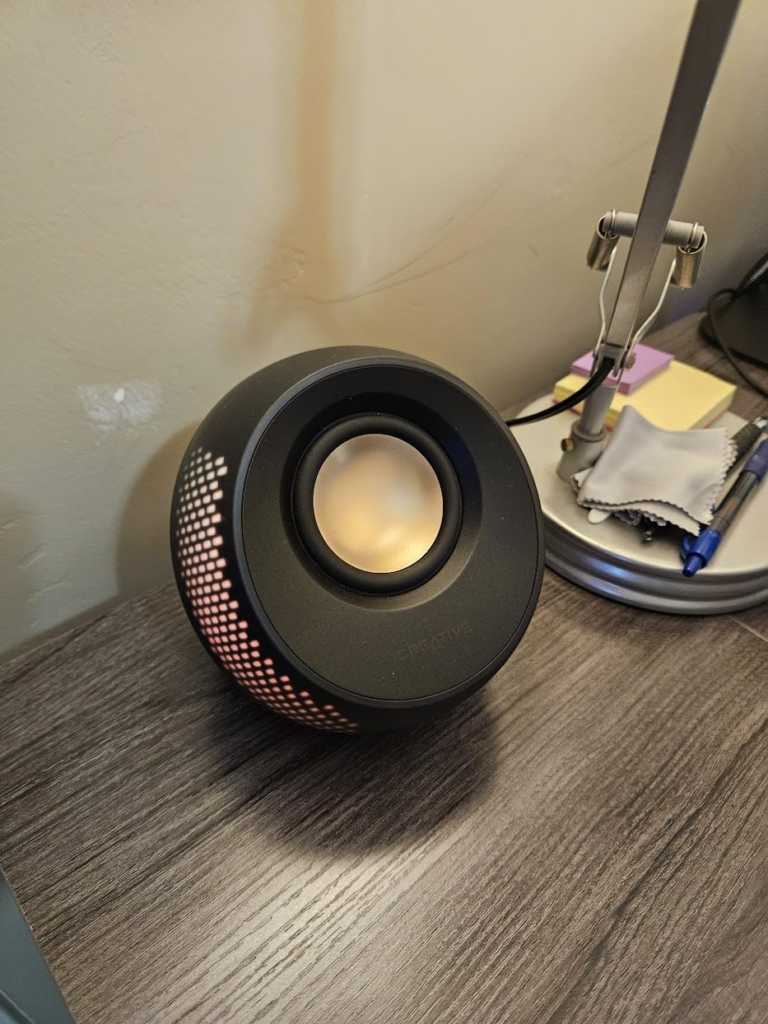
The physical reason is straightforward once it’s named: a 2.75-inch driver, no matter how well it’s tuned, cannot displace enough air to reproduce sub-100Hz content with real authority. Passive radiators help at the margins — they resonate at a tuned frequency without needing their own power — but they can’t deliver punch, only a bit of added presence. That’s the structural ceiling every 2.0 system runs into, Pebble or otherwise.
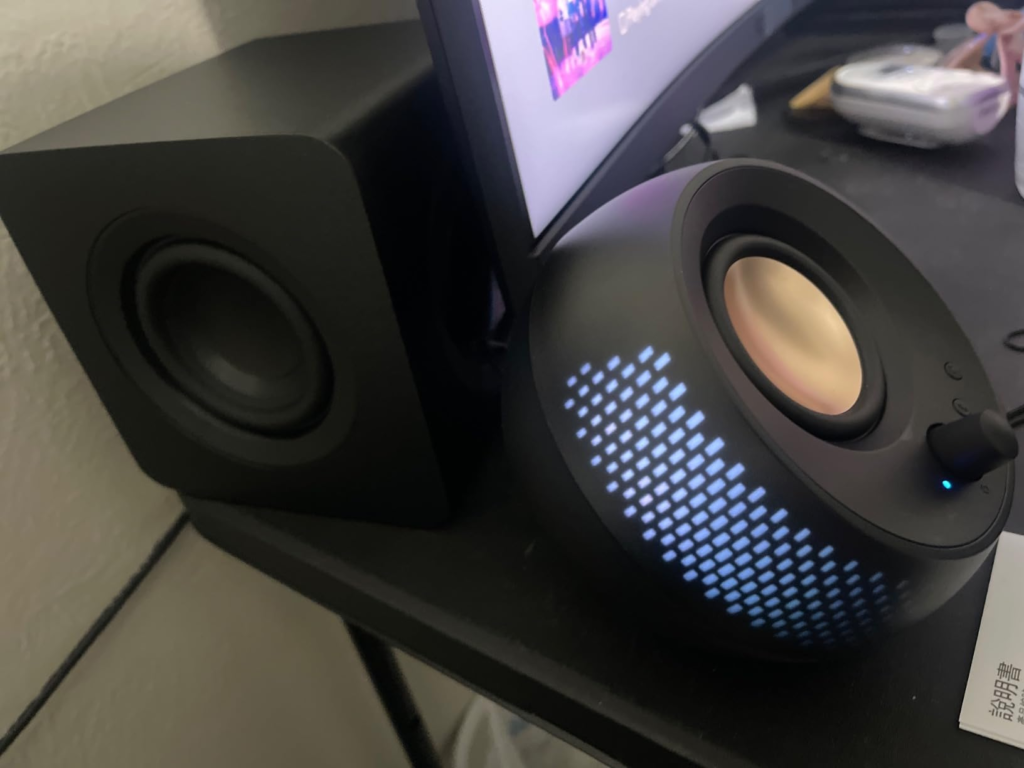
The Pebble X Plus addresses this with an actual powered subwoofer: a 3.5-inch driver in its own enclosure, walls reinforced up to 15mm to control resonance, paired with two side-firing passive radiators for extra reinforcement. That’s a fundamentally different mechanism than a passive radiator bolted to a satellite, which is why the bass character changes so noticeably between the entry Pebble X and the X Plus.
But there’s a second mechanism almost every independent reviewer flagged, and it’s the one buyers run into most often: out of the box, running on plain USB-C bus power, the system is capped at 15W RMS. The advertised 30W RMS / 60W peak figure only activates once you connect a separately purchased 30W-or-higher USB-C PD adapter to the dedicated power port on the main speaker. Lab testing at TechPowerUp described that adapter as functionally mandatory once you’ve heard the difference; testers at APH Networks and PCWorld independently arrived at the same conclusion. None of that is disclosed loudly on the box.
| USB-C bus power only (default) | USB-C + 30W PD adapter (separate purchase) | |
|---|---|---|
| RMS power | 15W total | 30W total |
| Peak power | ~30W | 60W |
| Subwoofer behavior | Present, noticeably restrained | Full authority — what most reviews are describing |
| RGB brightness | Standard | Increased |
| Realistic use case | Background or passive listening | Active music, gaming, movies |
The Threshold Where the Outcome Quietly Breaks
The break point isn’t subtle once you can name it: it’s the moment your content actually demands sub-100Hz energy — bass-forward music genres, cinematic low-frequency effects, gunfire- and explosion-heavy games — while you’re running either a sub-less 2.0 system, or an X Plus that’s still on bare USB power without the adapter. Below that threshold, the system is technically functional and emotionally flat. Cross it, and the same content suddenly has weight.
It’s worth being precise about where the threshold sits even after you cross it, though. The Pebble X Plus’s frequency response bottoms out at 45Hz, not the 20Hz floor of human hearing. Independent measurement at APH Networks confirmed the lowest octave of bass — the part responsible for true sub-bass rumble in EDM or the deepest film LFE — is still missing. What you gain is real, controlled low-end punch at a desktop scale. What you don’t gain is home-theater chest-thump. That’s an honest boundary, not a flaw to apologize for.
Why Most Buyers Misread This Too Early
The most common mistake happens inside Creative’s own product line, not against outside competitors. Buyers compare the X Plus to the cheaper Pebble Pro and conclude the Pro must simply be “better” because professional reviews consistently praise its tonal balance and accuracy. They’re not wrong about the Pro — they’re applying the wrong yardstick. The Pro and the X Plus aren’t trying to win the same contest. One optimizes for accuracy with no subwoofer at all; the other optimizes for low-end impact and accepts a treble trade-off to get there. Reviewing both side by side, one outlet summarized it cleanly: the Pro is the more balanced speaker, the X Plus is the more fun one. Judging the X Plus by the Pro’s strengths is judging a hatchback for not towing as well as a pickup.
The second misread is the spec-sheet trap already covered above: people see “30W RMS” on the listing, get 15W RMS out of the box, and feel shortchanged — when the gap is a documented, fixable setup step, not a broken promise. A small number of buyers also benchmark this against older AC-powered 2.1 systems in the same price range (the Logitech Z623 class is the usual comparison) and expect equivalent room-filling volume from a USB-powered desk speaker — a different category making a different trade-off: less floor-shaking headroom, in exchange for Bluetooth, RGB, and a footprint that fits next to a monitor instead of under a desk.
| Model | Channels | Subwoofer | Tonal character | Built for |
|---|---|---|---|---|
| Pebble Pro | 2.0 | No | Balanced, mid-forward, the most accurate of the lineup | Buyers who rank accuracy above impact |
| Pebble X | 2.0 | No (passive radiators only) | Thin low end even with radiators | Tight desks, light bass needs, lowest entry price |
| Pebble X Plus | 2.1 | Yes, powered | Bass-forward; vocals clear; treble recedes | Real low-end on a budget |
| Pebble Nova | 2.0, premium tier | No | Most balanced overall, priciest by a wide margin | Buyers ready to pay roughly double for refinement |
Who Is Actually Inside This Problem
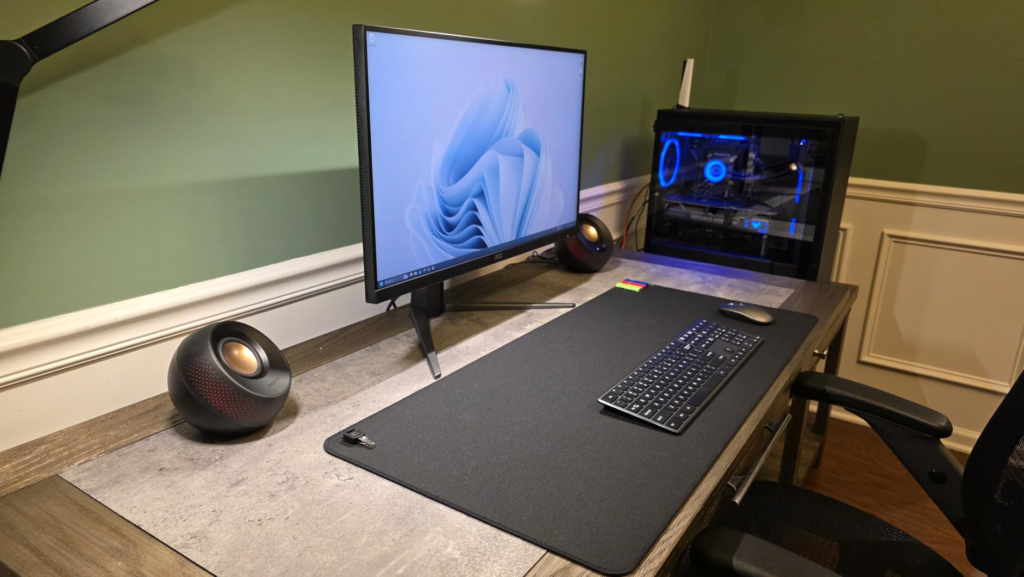
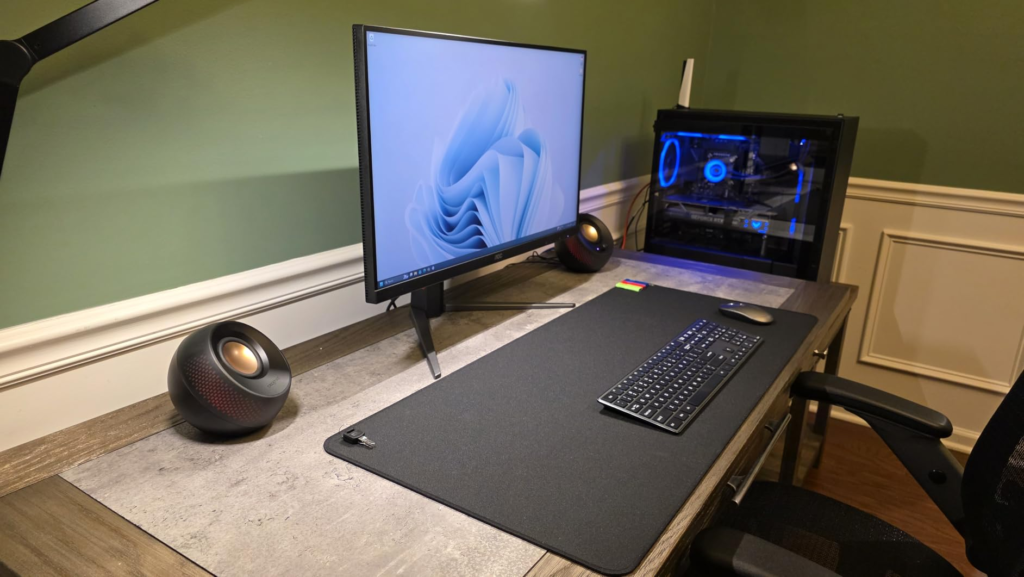
The true fit is specific, and worth naming plainly: someone listening at a desk, not across a room, whose content regularly leans on bass — gaming, hip-hop, EDM, action and sci-fi movies, soundtrack-driven titles — who’s currently running thin-sounding built-in or basic 2.0 speakers and wants real low-end without buying a bulky AC-powered tower system that eats floor space and ignores their phone. It also fits people who want one box serving PC, console, and Bluetooth duty at once: the system supports PS4 and PS5 (with the right firmware level) and Switch or Switch 2 (with the right OS version), alongside any phone or tablet over Bluetooth. If ambient RGB lighting on the desk is a welcome bonus rather than a requirement, that’s a fit signal too — not a dealbreaker either way, but a tell.
Budget matters here as a fit signal, not just a constraint. At roughly $120, this sits well under the next nearest subwoofer-equipped competitor in the same conversation, the Klipsch ProMedia 2.1, which costs about the same or more and skips Bluetooth entirely. For the desk-bound, bass-wanting, budget-conscious buyer, that combination is genuinely hard to match.
Where Wrong-Fit Begins
Wrong fit isn’t about the product failing — it’s about the use case asking for something this category was never built to deliver. Five patterns show up consistently across independent testing and owner reports.
If tonal accuracy and microdetail matter more to you than impact, multiple independent tests agree the cheaper Pebble Pro is the better-reviewed choice for exactly that priority, and the premium Pebble Nova is the answer if budget stretches further. If you’re expecting to fill a living room from across the couch, testing at headphonecheck specifically found reduced output when running off a PS5 or a phone via USB-C, even with the adapter attached — this is a near-field desktop system at heart, not a room-filling one. If you’re not planning to budget for the separate PD adapter, you should expect the quieter, thinner 15W experience to be your daily reality, not the 30W one described in most reviews. If real EQ control matters to you, know that Creative’s marketing describes a fuller Acoustic Engine suite (surround, smart volume, dialogue boost, genre presets), but several independent testers — including hands-on reviews at PCWorld and Tom’s Guide — found the companion app on PC mainly useful for lighting, with audio adjustment either absent or inconsistent depending on platform and app version. And if you run an ultra-wide monitor, the fixed 1.2-meter cable between satellites is a hard physical limit on how far apart you can place them.
| You’re likely the right fit if… | You’re likely the wrong fit if… |
|---|---|
| You listen at your desk, not across a room | You’re trying to fill a living room from a distance |
| Your content leans bass-heavy (gaming, hip-hop, EDM, action films) | Tonal accuracy and detail matter more to you than impact |
| You’re comfortable spending $10–30 extra on a PD adapter | You assumed the box’s 30W spec was the out-of-the-box default |
| You want one system for PC, console, and phone | You’re running an ultra-wide monitor needing wide speaker spacing |
| Ambient RGB is a nice bonus, not a requirement | You need dependable in-app EQ control, not just lighting control |
The One Situation Where This Product Becomes Logical
Strip away the comparisons and the spec confusion, and the decision narrows to one clear condition: if you’re listening at a desk, your content actually needs low-end weight, and you’re willing to spend a little more once on a proper PD adapter, the Pebble X Plus is the most cost-effective way into a real 2.1 system with a powered subwoofer that exists at this price right now. It isn’t the most accurate-sounding speaker Creative makes, and it was never trying to be. It’s the cheapest legitimate route to bass that a passive-radiator 2.0 system structurally cannot deliver — and it undercuts the nearest sub-equipped alternative in the category while adding Bluetooth, console support, and a footprint that actually fits a desk.
What It Solves, What It Reduces, and What It Still Leaves to You
What it solves: the flat, low-end-starved sound of basic desktop audio, replaced with a genuine powered subwoofer instead of a passive-radiator approximation. What it reduces: the need to choose between a bulky AC-powered tower system and giving up on real bass altogether, plus the inconvenience of separate boxes for PC, console, and phone audio. What it still leaves to you: budgeting for the PD adapter as a real line item, not an afterthought; giving the subwoofer a few minutes of placement attention rather than shoving it wherever it lands; and accepting that more bass means less treble sparkle than Creative’s pricier, more balanced models — a trade, not a flaw.
| Reported friction | What’s actually going on |
|---|---|
| “Sounds quiet or weak out of the box” | Running on 15W bus power only; the 30W+ PD adapter is required for full output |
| “Bass feels uneven, too boomy or too thin” | Subwoofer placement against or away from hard surfaces changes the output significantly; centering it with the side radiators clear of obstructions evens it out |
| “App won’t recognize the speakers on PC” | Reported inconsistently across testers; lighting control is reliable, audio adjustment is the weak link |
| “Volume jumps oddly near maximum” | The digital volume control uses coarse steps near the top of the dial — a hardware quirk, not a defect |
| “Quieter on PS5 or phone than on PC” | Console and mobile playback paths don’t always receive the same power delivery as a PC-plus-PD-adapter setup |
Frequently Asked Questions
| Question | Answer |
|---|---|
| Do I really need a separate power adapter for this to sound right? | Yes. Out of the box on USB-C bus power, the system is limited to 15W RMS. A 30W-or-higher USB-C PD adapter, bought separately, unlocks the full 30W RMS / 60W peak that most reviews are actually describing. |
| What’s the real difference between the Pebble X and the Pebble X Plus? | The X Plus adds a powered subwoofer; the standard X relies on passive radiators alone and tests noticeably thinner on bass. Note that the sub-less Pebble X can’t have a subwoofer added later — its satellites don’t have the connector for one. |
| Does it work with a PS5 or Nintendo Switch? | Yes, over USB-C, provided the console is on the required firmware or OS version. Creative has released at least one firmware update specifically to fix PS5 and Switch playback and mute/unmute issues, so keeping the speaker’s firmware current matters. |
| Can I adjust the EQ from the app? | Officially, Creative advertises a fuller audio suite (surround, smart volume, dialogue boost, genre presets) through its companion app. In practice, several independent testers found the app’s audio controls inconsistent or inaccessible on PC, with lighting customization being the most reliable function. |
| Does Bluetooth audio quality suffer compared to wired? | Bluetooth 5.3 here carries audio over the SBC codec, according to hands-on testing, with no aptX or AAC support reported. That’s fine for casual, everyday listening; it’s a real, if minor, limitation for anyone chasing the highest possible wireless fidelity. |
| Will this fill a living room or work well from across a room? | No. Every independent test points the same way: this is a near-field, desk-scale system. Output drops further when run from a console or phone instead of a PC with the PD adapter, so distance listening isn’t the use case it’s built for. |
Final Compression
If your audio problem is specifically a desk-bound system that’s missing low-end weight — not a need to fill a room, not a demand for studio-grade accuracy — the decision stops being complicated. Budget for the PD adapter alongside it, give the subwoofer a sensible spot away from awkward boundary surfaces, and the Pebble X Plus does exactly what it’s built to do at a price few real 2.1 systems can match.
If that’s the condition you’re actually in, here’s the listing: [Creative Pebble X Plus on Amazon]
Transparency Note:
This analysis is built on aggregated real-world experience.
It extracts what repeatedly holds, what breaks, and what users uncover only after living with the system—then shapes it into a clear model you can use immediately.
Think of it as structured experience, refined and presented so you don’t have to learn it the hard way.
“A quick note: Don’t believe the star ratings, but trust personal experience. This article is a compilation of collected experiences”