Sony SRS-XB23 Review: THE POINT WHERE GREAT SOUND QUIETLY BECOMES AVERAGE
You pair it in under ten seconds, and for the first hour it sounds better than a speaker in this price range has any right to sound. Then you carry it to a real backyard gathering, or you walk twenty feet away across open grass, and something shifts. Nothing distorts. Nothing breaks. It just gets smaller. That gap — between the speaker you heard at home and the speaker you needed outside — is what this Sony SRS-XB23 review actually maps.
The Result Looks Fine. The Problem Isn’t.
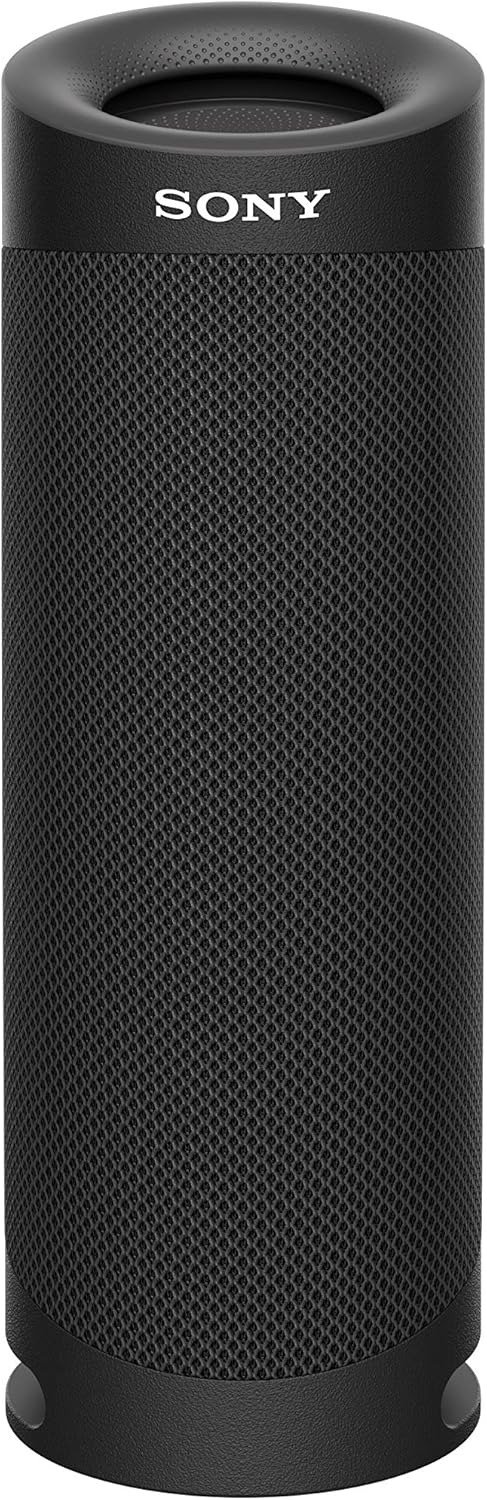
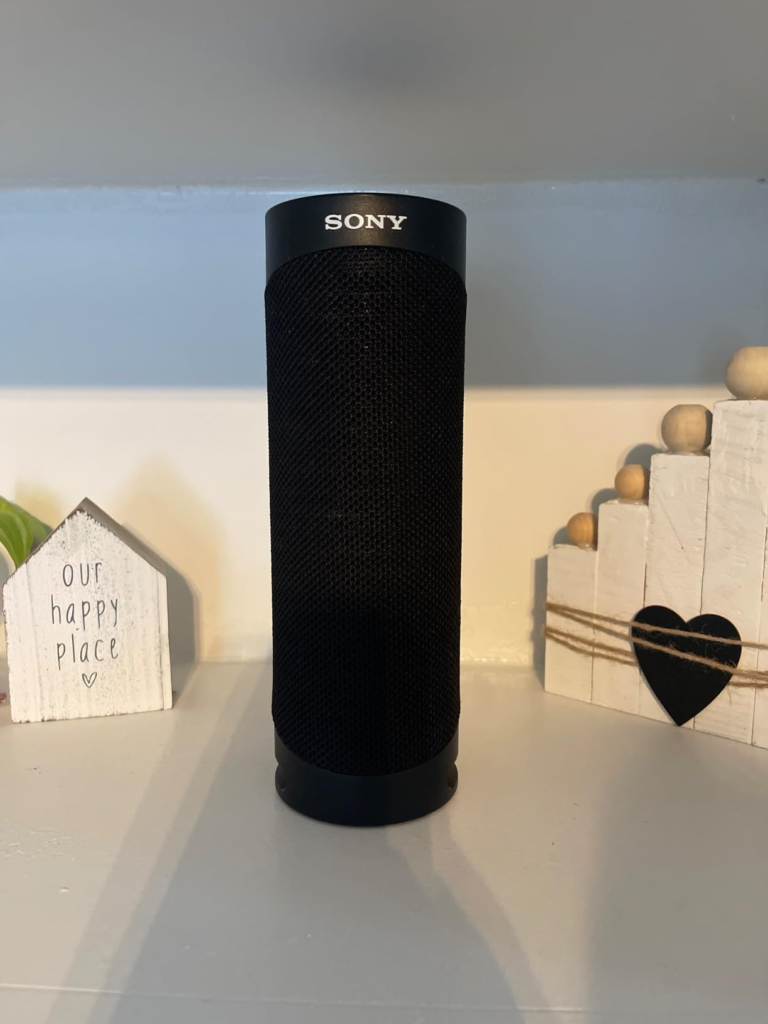
On paper, the case looks closed: Sony’s name, Extra Bass branding, a tested IP67 rating that’s dust-tight and rated for submersion, even saltwater exposure, all wrapped in a 580-gram cylinder built to survive daily knocks. The speaker stands about 21.8 cm tall with a 7.6 cm diameter, is waterproof, dustproof, salt-water resistant, washable, and shock-tested for everyday use. Most buyers stop reading there and assume “loud party speaker” is implied.
It isn’t. Independent lab testing measured its maximum output at roughly 84.9 decibels — strong for a bedroom or a quiet patio, well short of what a true outdoor party speaker pushes at full volume. That’s not a flaw. It’s a category the spec sheet never named out loud, and it’s the real subject of this review: not whether the SRS-XB23 is good, but exactly where “good” quietly stops.
What You’re Actually Feeling but Not Naming
If you already own one, parts of this will feel familiar even if you never put words to it. The speaker that filled your kitchen disappointingly fails to fill your patio. It ships with Extra Bass active as the default setting, but toggle it off while exploring the Sony Music Center app — easy to do by accident — and the sound loses noticeable power and presence. Even with the right settings, some listeners found the tone underwhelming straight out of the box: one test described it as sounding too flat at first, getting noticeably tamer as the volume increased, before any EQ adjustment.
None of that means the unit is defective. It means the factory state isn’t the speaker’s best state, and most buyers never discover that until something already feels off.
The Hidden Mechanism Behind the Miss
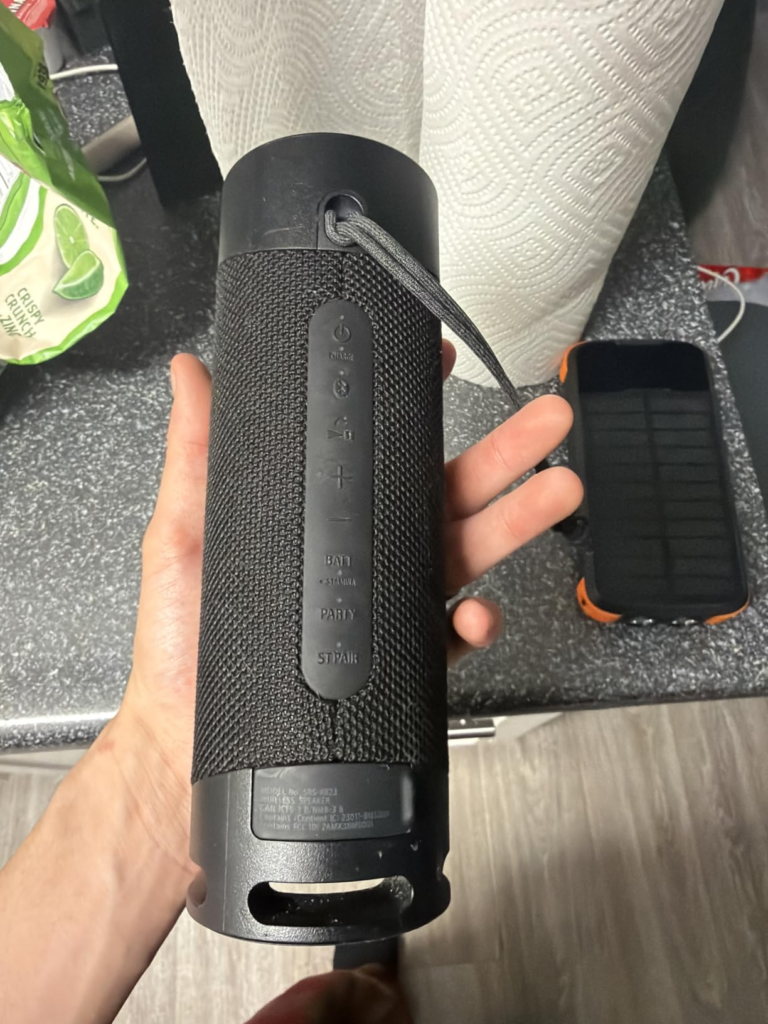
Here’s the part most reviews skip. The SRS-XB23 runs two 4-watt drivers inside Sony’s X-Balanced Speaker Unit, paired with passive radiators repositioned to the top and bottom of the cylinder in this generation. Lab measurement put its usable frequency response at roughly 71.3 Hz to 7.0 kHz — a narrow window, by design. In plain terms: true sub-bass rumble below ~70 Hz isn’t reproduced, and the extreme treble sparkle audiophile speakers chase isn’t there either. What’s left is a deliberately centered midrange-and-upper-bass signature, which is exactly why it reads as balanced and likeable at moderate volume.
That same design choice sets the ceiling. Small drivers in a small enclosure have a physical limit no app setting can engineer around.
| What Sony Built | The Number | What It Actually Means |
|---|---|---|
| Drivers | 2 × 4W, X-Balanced unit | Tuned for clarity, not raw output |
| Frequency response | ~71.3 Hz – 7.0 kHz | No true sub-bass, no extreme treble |
| Max output | ~84.9 dB | Strong for a room, modest for a crowd |
| Water/dust rating | IP67 | Submersible, dust-tight, saltwater safe |
| Weight | 580 g / 1.3 lb | Backpack-pocket, cup-holder portable |
| Charging port | USB-C | Faster and more universal than micro-USB |
The Threshold Where the Outcome Quietly Breaks
Every speaker this size has a point where the sound profile changes character. For the SRS-XB23, that point shows up in two places at once: distance and duration.
On a desk, in a bedroom, on a patio at conversational range, it stays full and controlled. Push it across an open lawn or ask it to cover an actual crowd, and the bass that felt rich up close starts to thin — one listening test specifically noted the bass running out of steam at higher volume, leaving the overall sound thinner than expected. The same pattern shows up in runtime. Sony’s headline 12-hour battery figure is itself an average measured at 50% volume, and running with Extra Bass engaged — the default — pulls that down to roughly 10 hours, with sustained loud, outdoor use cutting it further.
| Condition | Runtime | What Changes It |
|---|---|---|
| Extra Bass off, moderate volume | ~12 hours | Sony’s own tested baseline |
| Extra Bass on (default state) | ~10 hours | What most owners actually get |
| Loud, sustained outdoor use | Noticeably less | Volume and bass mode both drain faster |
| Full recharge, USB-C | ~4 hours rated, closer to 2 in real-world testing | Charging speed beat the spec in at least one test |
Why Most Buyers Misread This Too Early
Three buying mistakes show up repeatedly in reviews and owner feedback. First, reading “Extra Bass” as a synonym for “club bass” — it’s a tuning philosophy, not a power class. Second, comparing only the spec sheet against bigger Sony models without asking whether that extra headroom is actually needed: Sony’s own comparison notes that the larger SRS-XB33 can get slightly louder with fewer compression artifacts and a longer-lasting battery — a different shopping brief, not automatically a better one. Third, judging loudness in isolation against rivals like the JBL Flip 6, while ignoring that the two are simply tuned for different goals: one for push, the other for balance.
Buyers who chase “which one is loudest” as the only question usually end up disappointed with whichever speaker they land on, because loudness was never the right metric for their actual room.
Who Is Actually Inside This Problem
The reviews that praise this speaker almost all describe the same scene: a bedroom, an apartment, a desk, a backyard, a cup holder on a hiking trail, a backpack on a work trip. One long-term owner put it plainly — excellent bass for its size, perfect for an apartment or bedroom, but not something they’d push hard outdoors. If that’s your listening environment — solo or small-group, mostly indoor with occasional outdoor use, durability and portability mattering more than maximum volume — you’re inside the use case this speaker was actually built for.
Where Wrong-Fit Begins
The boundary runs just as clearly the other way. Sony’s own cheaper SRS-XB13 trades away stereo separation, real maximum volume, and call-quality for a lower price — fine for the tightest budget, frustrating for anyone expecting the XB23’s fuller sound. At the other end, if your real plan is a yard full of people, a beach competing with wind and waves, or hours of sustained max-volume outdoor play, you’re already past this model’s design brief.
| Model | Best For | Trade-off |
|---|---|---|
| Sony SRS-XB13 | Tightest budget, smallest bag | Mono only, low max volume, weak mic |
| Sony SRS-XB23 — this review | Personal space, indoor, light outdoor | Real ceiling on volume and crowd-scale bass |
| Sony SRS-XB33 | Bigger gatherings, longer runtime | Larger, heavier, noticeably pricier |
It’s also worth stating plainly: a small share of owners report units that wouldn’t power on or stopped charging correctly. Best Buy’s aggregated review summary notes a small number of users mentioned charging-port issues against an otherwise strongly positive consensus — the kind of early-failure pattern common to most lithium-battery speakers at this price, not a defect unique to this one. It’s a reason to register the warranty, not a reason to skip the speaker.
The One Situation Where This Product Becomes Logical
If you recognized your own listening pattern in the sections above — personal space, real durability, no babysitting required near a pool or a beach towel — the SRS-XB23 stops being one option among many and becomes the one that actually matches how you’ll use it. It has settled into a consistent 4.6-star average across thousands of owner ratings, which at this price point reflects exactly the reliability this review has been describing rather than a fluke.
What It Solves, What It Reduces, and What It Still Leaves to You
| It Solves | It Reduces | It Still Leaves to You |
|---|---|---|
| Tinny phone-speaker sound | Anxiety near pools, rain, sand | Tuning the app EQ for its best sound |
| Fragile, non-waterproof speakers | Constant cable-hunting (long runtime) | Knowing your real volume needs first |
| Bulky, hard-to-carry party speakers | Risk from drops and daily knocks | Choosing the XB33 if the plan is a real crowd |
None of this makes the SRS-XB23 flawless. It makes it honest about what it is: a personal-scale speaker with genuinely tested durability and a balanced tuning — not a substitute for an outdoor PA system.
Sony SRS-XB23 Review: Quick Answers
Is it loud enough for an outdoor party?
For a small group on a patio, yes. For a real crowd or an open beach, that’s SRS-XB33 or SRS-XB43 territory, not this one.
Does Extra Bass mode hurt the battery much?
Some. Runtime drops from roughly 12 hours to roughly 10 with it on, and faster still at high volume outdoors.
Is it actually safe to submerge or wash?
Yes — it carries a genuine IP67 rating, meaning dust-tight construction and rated protection against temporary submersion, including saltwater.
Is it worth it over the cheaper SRS-XB13?
For most listeners, yes. The XB13 trades away stereo separation, real volume headroom, and call quality to hit a lower price point.
Does it need the Sony Music Center app to sound its best?
Not to function, but yes to sound its best — the app’s EQ is where the slightly flat factory tuning gets corrected.
Final Compression
The Sony SRS-XB23 isn’t a party speaker wearing a personal-speaker price tag, and it was never built to be one. It’s a durable, well-tuned companion for the room you’re actually in, the bag you’re actually carrying, and the volume you’ll actually use most days — right up to the threshold this review just mapped for you. If that’s the speaker you’ve been describing to yourself, this is where the decision stops being vague:
Transparency Note:
This analysis is built on aggregated real-world experience.
It extracts what repeatedly holds, what breaks, and what users uncover only after living with the system—then shapes it into a clear model you can use immediately.
Think of it as structured experience, refined and presented so you don’t have to learn it the hard way.
“A quick note: Don’t believe the star ratings, but trust personal experience. This article is a compilation of collected experiences”