Creative Stage SE Review: The Desk Speaker That Works — Until It Doesn’t
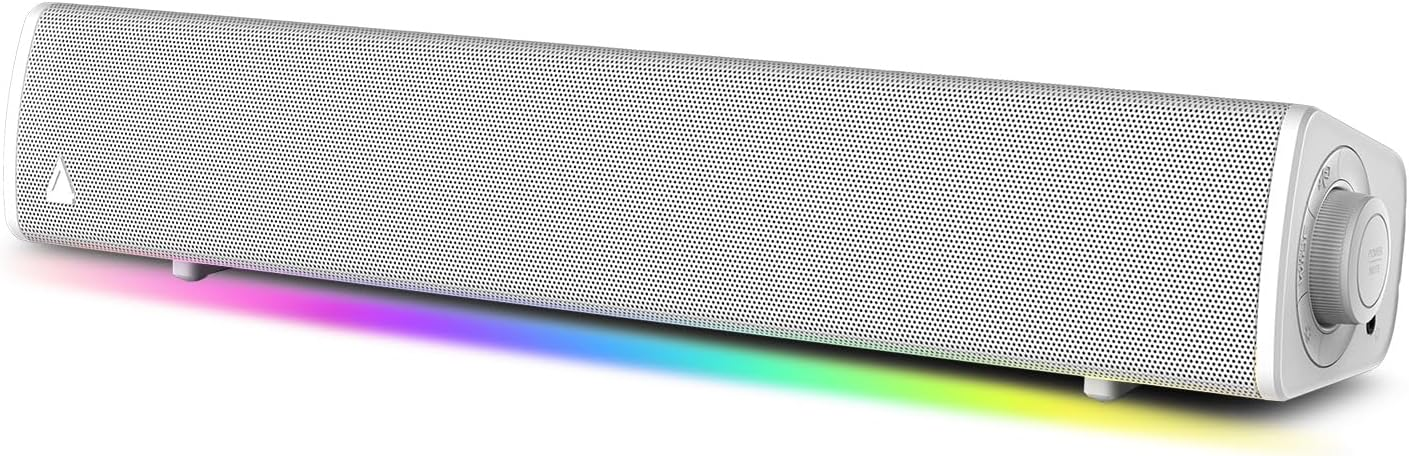
CREATIVE STAGE SE
The Result Looks Fine. The Problem Isn’t.
You plug it in. Audio improves immediately. Compared to what was there before — built-in monitor speakers, a pair of $15 USB sticks, or nothing at all — the Creative Stage SE sounds like a genuine upgrade. Voices come through with weight. The desk feels less dead.
So you leave it there. You assume the problem is solved.
It isn’t. The problem just became quieter.
What the Stage SE delivers is a real and measurable improvement over zero. What it conceals is a ceiling — one that doesn’t announce itself until you’ve already arranged your setup around it, routed your cables through it, and stopped looking for alternatives.
The question isn’t whether this soundbar sounds better than laptop speakers. It does. The question is whether it sounds good enough for the specific way you actually use your desk — and that’s a different calculation entirely.
What You’re Actually Feeling but Not Naming
You’re not unhappy with the sound. You’re mildly unsatisfied in a way you can’t quite locate.
It shows up like this:
At 50% volume, the midrange goes thin. The Stage SE sounds best when audio is played at higher volumes — at least 50% — because at lower levels the midrange tends to be more recessed.
You push the volume past where you intended to sit. The room fills, but the detail you expected doesn’t arrive with it.
You turn on Clear Dialog for a call. The voice sharpens. It works, but it sacrifices some of the limited bass to do so. You now have clarity at the cost of body. You didn’t expect that trade.
You try Surround mode for a game. It does separate tones and widen the soundstage somewhat — but the audio is still coming from a small speaker in front of you. The label suggests more than the physics delivers.
The mids are a mixed bag: vocals sound clear, but instruments and background can feel a tad smeared during music playback.
None of these are catastrophic failures. All of them are friction. Accumulated friction that you feel every session but never quite name.
The Hidden Mechanism Behind the Miss
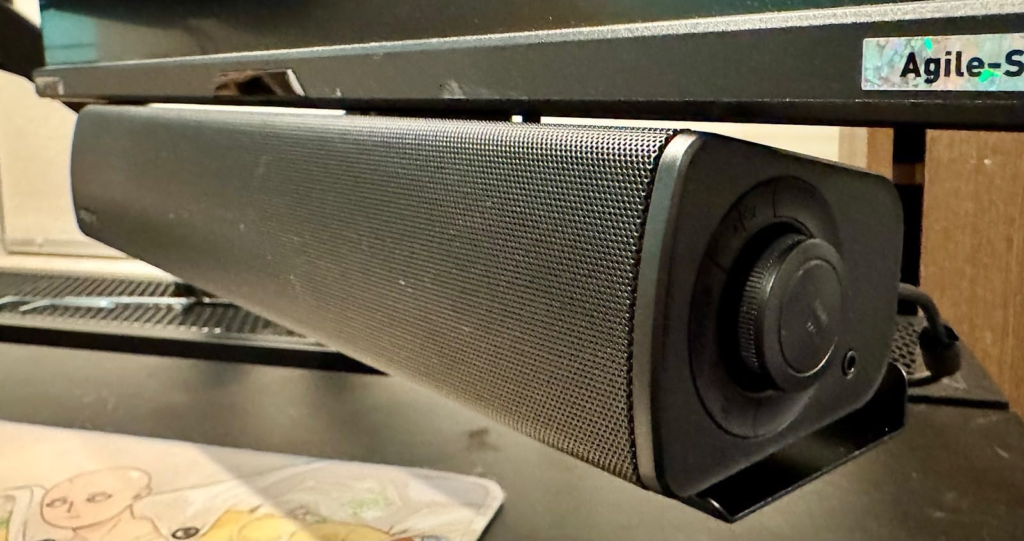
The Stage SE runs on what Creative calls racetrack drivers — elongated oval drivers that allow more surface area in a slim enclosure. Combined with oversized radiators, the design aims to reproduce clearer and punchier audio, even without a subwoofer.
That last clause is the mechanism. Even without a subwoofer is not a reassurance — it’s a constraint operating inside a promise. The radiators extend low-end response, but they cannot generate pressure the way a dedicated subwoofer driver does. The 48W peak power figure refers to headroom, not bass depth.
The result: punchy at mid-bass frequencies, adequate at lower bass, genuinely limited below 60Hz. Bass is punchy without feeling overpowering — which is another way of saying it doesn’t reach deep enough to overwhelm anything.
This is not hidden in the product listing. It’s hidden in how the listing is read. Forty-eight watts sounds like force. In a subwoofer-free 2.0 bar sitting 7cm tall, it’s headroom that prevents distortion at volume — not the physical rumble your body registers.
The mechanism isn’t broken. It’s just not what most buyers picture when they read the spec.
The Threshold Where the Outcome Quietly Breaks
There is a specific point where the Stage SE stops delivering what you imagined when you ordered it.
That threshold is not price. It is use pattern.
| Use Pattern | Stage SE Performance |
|---|---|
| Background music at desk | Solid — warm, adequate, no fatigue |
| Voice calls, dialogue-heavy content | Good with Clear Dialog on |
| Gaming (casual, single-player) | Acceptable — Surround adds modest width |
| Gaming (competitive, positional audio) | Insufficient — soundstage is narrow |
| Music listening as primary activity | Starts to reveal smeared mids at complexity |
| Content at night or low volumes | Noticeably recessed — requires 80–90% volume for body |
| TV or console in a living room | Wrong product entirely — no optical, no HDMI ARC |
The Stage SE is specifically designed for use with laptops and PCs — and the absence of optical and 3.5mm ports is understandable given that context. But buyers frequently purchase it for broader setups that quietly fall outside this range.
The threshold is this: if your listening happens below 50% volume, in a room larger than a small bedroom, or through a source that doesn’t connect via USB or Bluetooth — the Stage SE breaks down before it ever gets started.
Why Most Buyers Misread This Too Early
The comparison that kills the Stage SE is the one made at the point of purchase.
Against built-in monitor speakers: it wins easily. Against a $15 USB speaker bar: it wins on power and finish. Against the Stage Air V2: it delivers 48W peak power compared to the Air V2’s 20W, offering a meaningfully stronger signal.
These comparisons are all accurate. They are also all irrelevant to the question of whether this is the right product for you.
The misread is what Stuart Charles at Home Studio Basics identified after testing the full Stage lineup: the key question is whether it represents a true upgrade in price-to-performance — and the controls available matter significantly if the soundbar is to be a genuinely feasible option for your money.
Most buyers judge by the box. Compact form, 48W, Sound Blaster branding, Bluetooth 5.3, sub-$80. The spec sheet reads like a complete product. And it is — for a narrow slice of use.
The feature-led judgment skips the operating conditions. It skips the volume threshold. It skips the connectivity ceiling. It skips the fact that it lacks many features of higher-tier Creative soundbars — no microphone, no Creative App integration, no optical or 3.5mm input.
By the time those gaps surface, the return window is closed.
Who Is Actually Inside This Problem
The Stage SE is the right product for a specific person operating inside specific conditions:
| Buyer Profile | Fit |
|---|---|
| PC or laptop user, monitors in front, USB available | ✅ Core use case |
| Small desk, small room (bedroom, study, home office) | ✅ Optimal environment |
| Primarily dialogue: videos, calls, podcasts, light gaming | ✅ Strong performance zone |
| Upgrading from built-in monitor audio or basic USB speakers | ✅ Clear and honest improvement |
| Wants Bluetooth for phone audio in the same setup | ✅ Bluetooth 5.3 handles this well |
| Needs no optical, no ARC, no 3.5mm | ✅ No loss at this price |
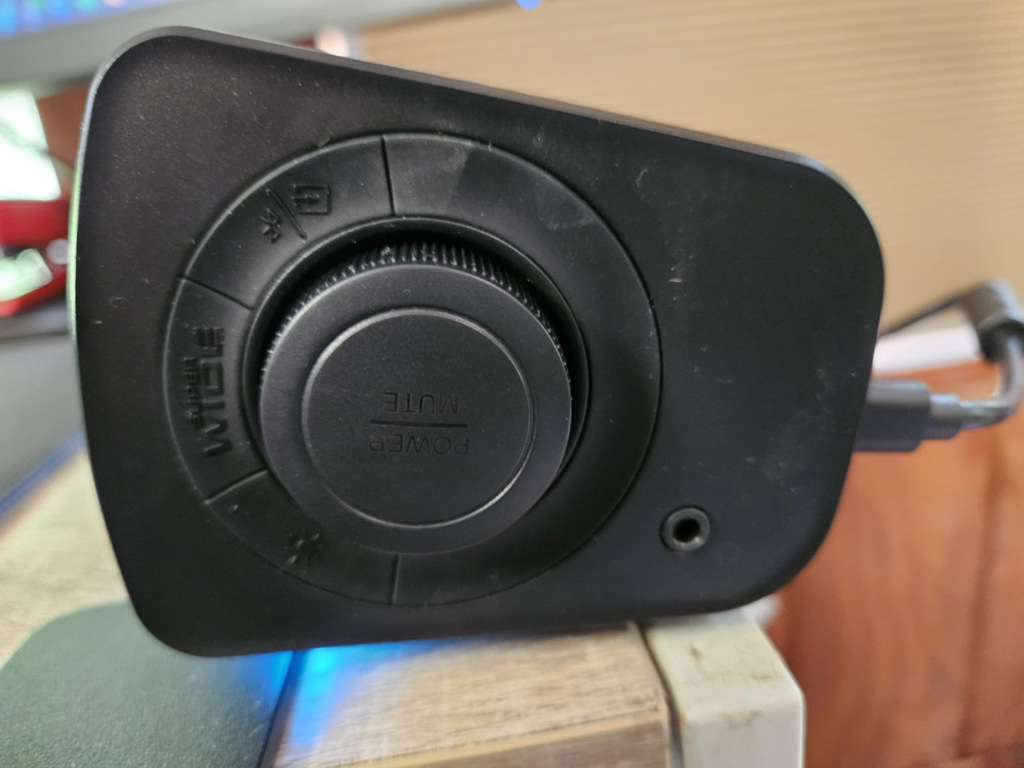
The Stage SE powers up via a power adapter and connects to your computer with a single USB cable or wirelessly with Bluetooth 5.3. Its small footprint allows for flexible placement under the monitor and is well suited for smaller rooms.
That profile is real. It fits millions of desk setups. But it is narrower than the product’s marketing implies — and substantially narrower than most buyers assume at checkout.
Where Wrong-Fit Begins
The regret scenario is consistent across reviews and user feedback:
| Wrong-Fit Condition | Why It Hurts |
|---|---|
| Connecting to TV via HDMI or Optical | No such port exists on this unit |
| Using in a medium-to-large room | 48W fills a small room — it strains in a larger one |
| Music as primary, complex genre listening | Smeared mids and limited low-end become audible friction |
| Expecting subwoofer-level bass in a 2.0 bar | The radiators compensate partially — not fully |
| Needing visible EQ status | No display — settings reset and must be re-dialed each session |
| Mounting above monitor | The USB cable is shorter than the power cable — reaching from above a monitor may require a USB extender |
| Wanting aggressive bass for EDM or action films | Punchy mid-bass, not deep impact — this is a ceiling, not a flaw |
One user noted: the Stage SE could use better bass, and the lack of any visual indicator for EQ or sound mode means having to reset and re-dial settings every time — a recurring annoyance with no elegant workaround.
If any condition in that table is your primary use case, this is where the purchase stops making sense.
The One Situation Where This Product Becomes Logical
After those conditions are cleared: one buyer profile finds the Stage SE to be a structurally sound decision.
You sit at a desk. A monitor sits in front of you. You run a PC or a laptop. Your previous audio source was built-in or a cheap plastic bar. You watch content, work through calls, game casually. The room is small. You want to hear better — not perform at audiophile level.
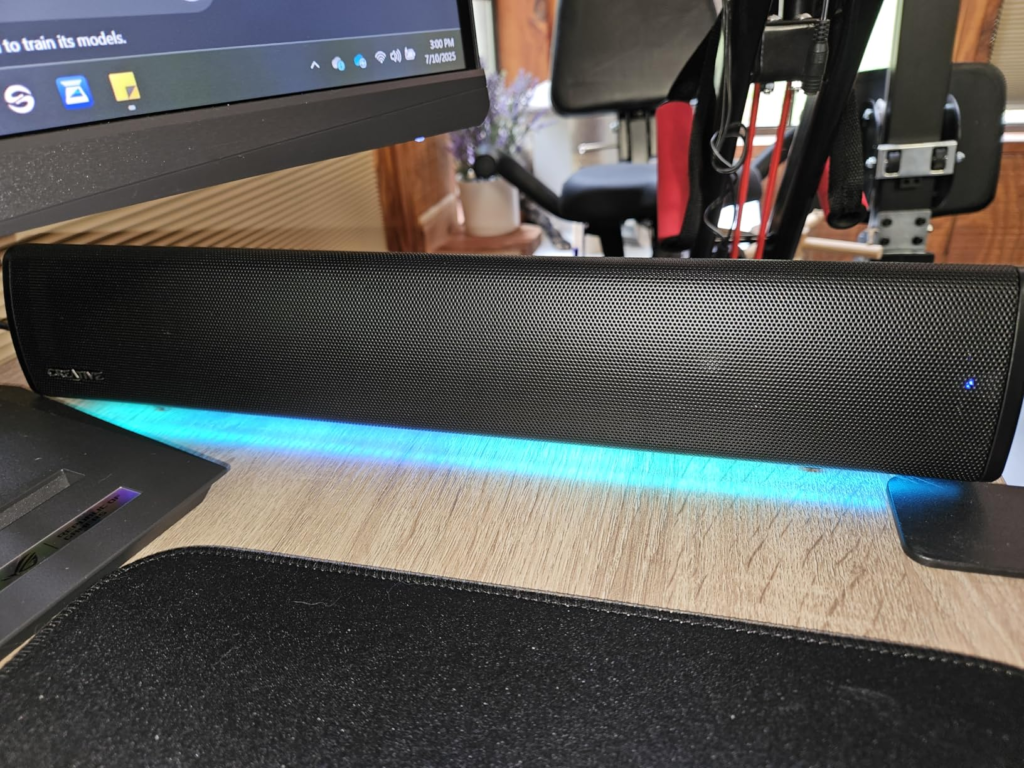
The Stage SE sits at 41cm wide, 7cm tall, and 11cm deep — low enough to fit under most monitors. It doesn’t compete for desk space. It connects without drivers that matter. At its price point, it is exceptional value for money for a compact soundbar that enhances PC audio without requiring dedicated space or complex routing.
In this exact situation, the Stage SE is not a compromise. It is the logical choice — specifically because its constraints (no optical, no subwoofer, USB + BT only) are irrelevant to your setup, and its strengths (vocal clarity, compact footprint, 48W headroom, Bluetooth 5.3, Sound Blaster processing) are directly relevant.
The logic holds tightly — but only inside this profile.
What It Solves, What It Reduces, and What It Still Leaves to You
| Category | Verdict |
|---|---|
| Solves | Built-in monitor speaker fatigue, flat dialogue, no-audio laptop setup, desk cable clutter |
| Meaningfully improves | Voice clarity (with Clear Dialog), volume headroom, Bluetooth convenience |
| Partially addresses | Mid-bass body, surround width (Surround mode widens but doesn’t truly expand) |
| Does not solve | Deep sub-bass, audiophile-grade midrange separation, TV connectivity |
| Still requires you | Volume management (must run 80–90% for full body), EQ re-dialing after power cycles, USB extender if placed above monitor |
| Should not expect | Room-filling power in spaces larger than a small bedroom |
This soundbar is compact and affordable, not without minor audio and design niggles — but you will struggle to find a better budget soundbar specifically for PC use.
That sentence holds. It also defines the ceiling. “Best at this price for PC” is a real title. It is not “best soundbar” — and collapsing that distinction is how regret starts.
Final Compression
The Creative Stage SE Review verdict is this: it is a precisely scoped product that performs well inside that scope and breaks down predictably outside it.
The 48W is real. The Sound Blaster processing is functional. The form factor is genuinely useful for under-monitor placement. The Bluetooth 5.3 is clean. The price-to-performance ratio, within the right use case, is difficult to beat.
The threshold is the desk. If you are a PC user in a small room upgrading from silence or built-in speakers — this decision stops being vague the moment you understand what it is and isn’t designed for.
If your use starts at that threshold, this is the logical next step.
If your use starts somewhere else — a living room, a TV, a music-first setup, a larger room — the Stage SE will quietly underdeliver in ways the spec sheet never mentioned. And that gap tends to compound over time, not resolve itself.
Frequently Asked Questions
| Question | Answer |
|---|---|
| Does the Creative Stage SE require drivers to work? | No. It connects via USB as a generic audio device and works immediately. Creative offers an optional driver download that unlocks SuperWide technology on Windows, but the soundbar functions without it. |
| Can the Creative Stage SE connect to a TV? | Not natively. It has no optical or HDMI ARC port. It can connect to a TV via Bluetooth, but for a permanent wired TV setup, this is the wrong product. |
| Is 48W peak power loud enough for a bedroom? | Yes — for a small-to-medium bedroom it is more than adequate. Reviewers consistently note the unit performs best above 50% volume. In larger rooms, the output starts to thin. |
| Does the Stage SE have good bass without a subwoofer? | It delivers mid-bass body and warmth — enough to feel like a real improvement over flat laptop audio. It does not deliver deep sub-bass. If bass pressure at low frequencies is a priority, a 2.1 system with a dedicated subwoofer is the correct category. |
| What is the difference between Clear Dialog and Surround modes? | Clear Dialog processes vocal frequencies forward and increases intelligibility. Surround widens the stereo image slightly. Using Clear Dialog at the cost of some bass, and Surround with a modest width increase — neither transforms the listening experience, but both are genuinely functional within their modest scope. |
| Can I wall-mount the Creative Stage SE? | No. Unlike the Stage V2, the Stage SE has no wall-mount option. It is designed to sit flat on a desk surface under your monitor. |
| Who should not buy the Creative Stage SE? | Anyone primarily using a TV, anyone in a room larger than a small bedroom, anyone who wants deep bass, anyone who needs optical or aux input, or anyone whose primary use is critical music listening in complex genres. The Stage SE was not designed for those conditions and will not compensate for them. |
Transparency Note:
This analysis is built on aggregated real-world experience.
It extracts what repeatedly holds, what breaks, and what users uncover only after living with the system—then shapes it into a clear model you can use immediately.
Think of it as structured experience, refined and presented so you don’t have to learn it the hard way.
“A quick note: Don’t believe the star ratings, but trust personal experience. This article is a compilation of collected experiences”