BREWISTA SMART SCALE III REVIEW: I TESTED THE PRECISION CEILING MOST BUYERS NEVER REACH
The Result Looks Fine. The Problem Isn’t.
You follow the recipe. You pour carefully. You count the seconds.
And some mornings the cup is exactly what you were chasing — bright, balanced, clean on the finish. Other mornings it’s flat. Or heavy. Or almost right but not quite, in a way you can’t locate precisely enough to correct.
You adjust the grind. Then the water temperature. Then the pour timing. The cup shifts, but not predictably. It is better sometimes and worse other times, and the pattern doesn’t reveal a clear cause.
What you rarely question is the measurement itself — because the scale appears to work. It shows numbers. It shows “18g.” It shows “300g.” Everything looks correct.
This is the starting condition of a very specific problem, and it is the exact problem the Brewista Smart Scale III was built to address. Not for everyone. Not under all conditions. But for the right setup, with a clear-eyed understanding of what it actually resolves and what it does not touch.
What You’re Actually Feeling but Not Naming
There is a particular kind of brewing frustration that does not identify itself as measurement error. It identifies itself as inconsistency.
Same recipe. Different results. You adjust one variable and something else shifts. You go back to the original and it doesn’t reproduce. You start doubting your technique, your grinder, your water — all of which may be fine.
What is happening underneath is structurally simpler. Your current scale, whether it is a repurposed kitchen scale or an entry-level coffee scale with 1g display increments, is not returning the same number twice for the same physical input.
Temperature fluctuations from hot brewing vessels shift the load cell reading mid-pour. At 1g resolution, a measured dose of “18g” could be anywhere between 17.5g and 18.5g before the display registers a change — a window that sounds tight on paper but is chemically significant.
At a 15:1 brew ratio, a 1g error in dose corresponds to a 15g error in water. That is a 5% shift in brew strength before you have poured a single drop. At the level of specialty brewing, 5% is not marginal. It is the gap between a cup that opens and one that doesn’t.
The frustration you have been calling inconsistency has a structural name: measurement resolution failure. And it does not close until the measurement layer actually resolves it.
The Hidden Mechanism Behind the Miss
The load cell inside a precision scale is sensitive to two things it should not be sensitive to: temperature and vibration.
When a hot brewing vessel sits on the platform, the thermal gradient between the base and the air creates a drift in the reading that is real but invisible on a low-resolution scale. You do not see it because the increment is too coarse to surface it — but it shifts your actual weight by 0.3–0.8g during extraction.
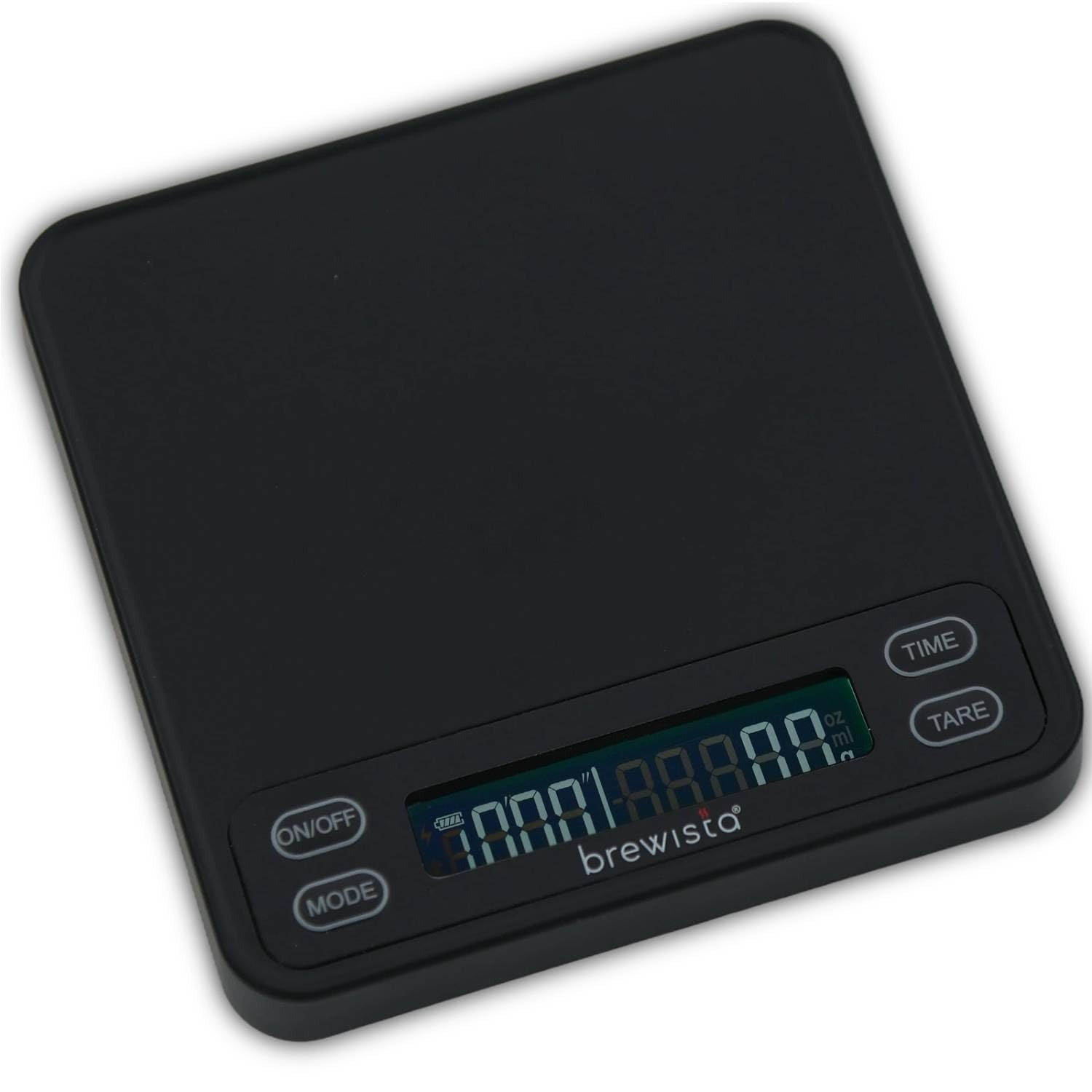
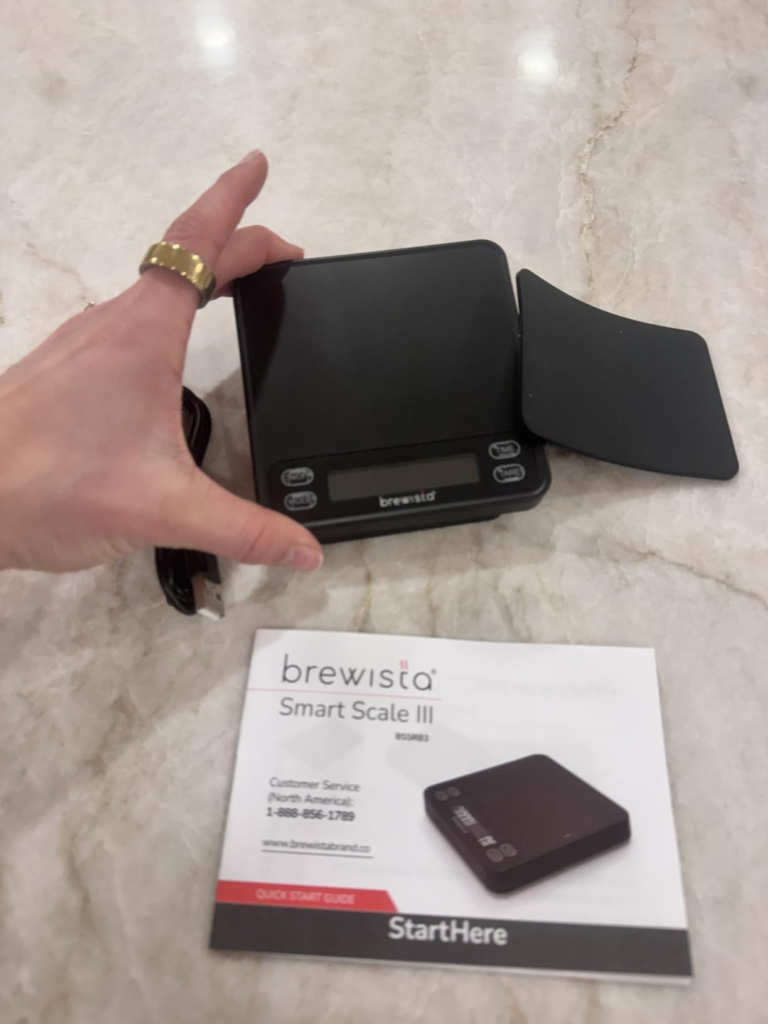
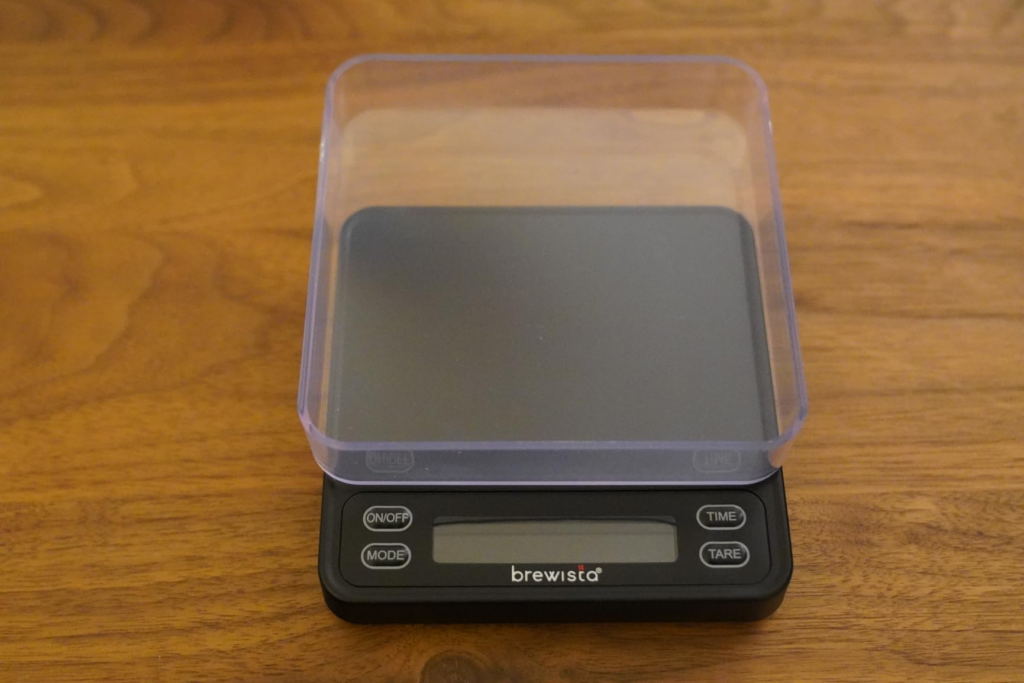
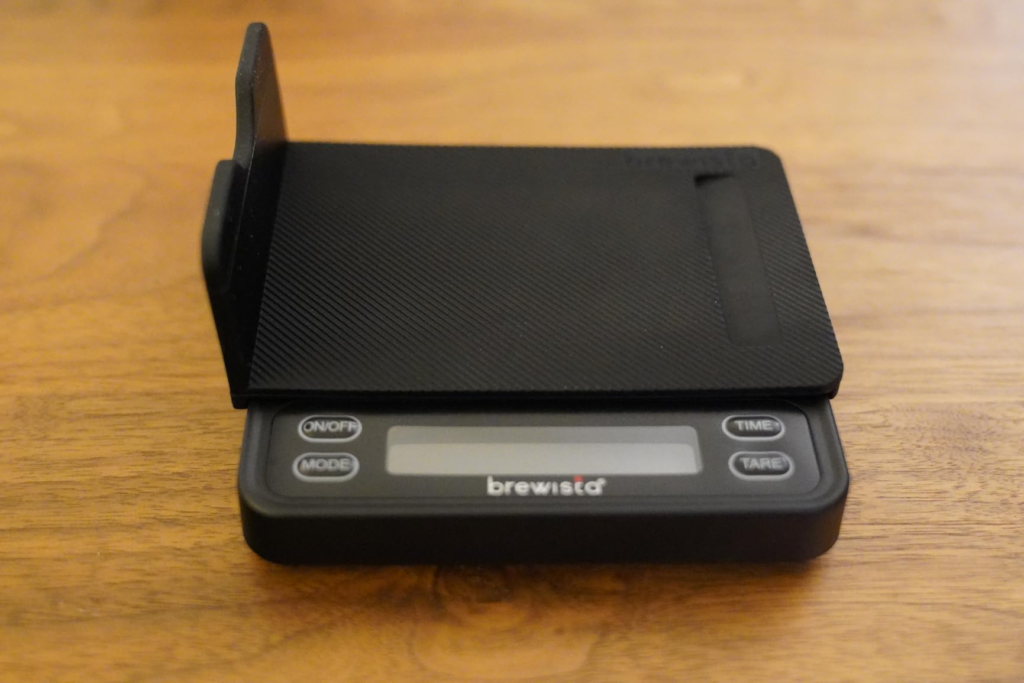
The silicone pad included with the Brewista Smart Scale III is solving exactly this. It is not a scratch protector. It is a thermal buffer between the vessel and the weighing platform, stabilizing the load cell’s reference environment during the brew. Without it, the reading you see during the bloom is not the same reading you would see without heat stress applied.
The second mechanism is response latency. Entry-level scales sample at 2–4 readings per second. The Smart Scale III samples at approximately 20ms intervals — roughly 50 readings per second — which is the threshold where your pour control and the scale’s feedback are actually synchronized in real time. Below that rate, you are chasing a number that is already behind. Above it, you are responding to live data.
The third mechanism is the minimum registration threshold. The Smart Scale III registers from 0.5g and displays in 0.1g increments from that point onward. This matters at the exact moment when bloom precision is most important: pouring a 30–40g bloom dose over 18–20g of coffee grounds. The scale is tracking from the first half-gram, not from the first full gram.
| Mechanism | Entry-Level Scale | Brewista Smart Scale III |
|---|---|---|
| Resolution | 0.5–1g increments | 0.1g increments |
| Minimum registration | 1g+ | 0.5g |
| Thermal stability | Unaddressed | Silicone pad thermal buffer |
| Response rate | ~2–4 Hz (250–500ms) | ~50 Hz (~20ms) |
| Pour-over modes | None or single | M1 (manual) + M5 (auto-tare / auto-timer) |
| Water resistance | Unrated | Nano-coating (splash resistant) |
| Charging | AA/AAA or fixed cable | USB-C rechargeable |
| Battery per charge | N/A or variable | 10–12 hours |
The Threshold Where the Outcome Quietly Breaks
Precision in brewing has a threshold below which improvement is real and above which the marginal return drops sharply.
The Smart Scale III was designed to sit exactly at that inflection point, not above it.
At a 15:1 brew ratio with 20g of coffee and 300g of water, here is what measurement precision actually costs you at different resolution levels:
| Scale Resolution | Possible Dose Error | Corresponding Water Variance | Estimated Extraction Shift |
|---|---|---|---|
| ±1g (1g display) | ±1g | ±15g | ~5% strength variance |
| ±0.5g (0.5g display) | ±0.5g | ±7.5g | ~2.5% strength variance |
| ±0.1g (0.1g display) | ±0.1g | ±1.5g | ~0.5% strength variance |
That 0.5% residual at 0.1g resolution is effectively the floor of what home brewing measurement can control. Below it, other variables — grind particle distribution, mineral content of water, pour angle — account for the remaining variance. Above it, the scale itself is the primary source of noise.
The five modes on the Smart Scale III are structured around this precision logic. Each one eliminates a different layer of manual intervention:
| Mode | Name | Auto Function | Best Suited For |
|---|---|---|---|
| M1 | Manual Pour-Over | None — user tares and starts timer manually | Experienced brewers with fixed, repeatable routines |
| M2 | Espresso — Auto Tare / Manual Timer | Auto-zeros on cup placement; timer manual | Espresso workflows where timing needs human control |
| M3 | Espresso — Auto Tare / First-Drop Timer | Auto-zeros; timer starts on first coffee drop | Precise shot capture from first extraction drop |
| M4 | Auto Tare Only | Auto-zeros; no timer | Dosing-only workflows; no timing required |
| M5 | Immediate Auto | Auto-tares and auto-timer starts on cup placement | Single-cup pour-over with minimal button interaction |
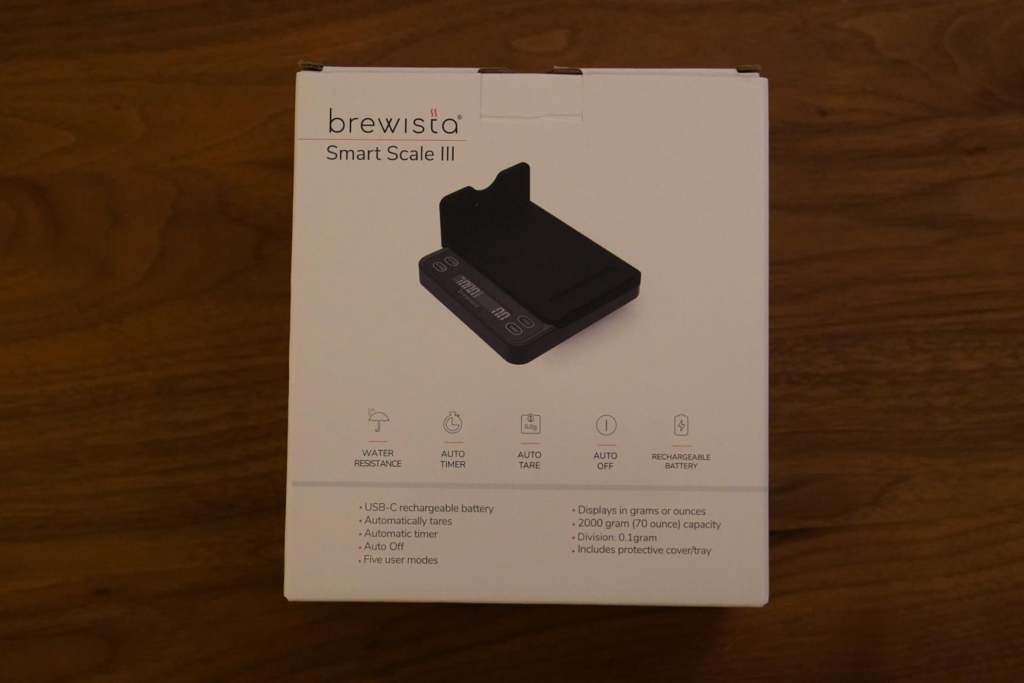
The auto-on detection — the scale wakes when something is placed on the platform and powers down when idle — removes a small friction point that compounds over 500 morning brews. These details are not features. They are workflow architecture.
Why Most Buyers Misread This Too Early
The scale market has a clarity problem. The first data point a buyer encounters is resolution (“0.1g”) followed by price.
The Smart Scale III at ~$85 sits next to a kitchen scale at ~$25 also showing “0.1g” on the spec sheet. The obvious conclusion — identical precision, different price — is structurally wrong in three ways.
First, response speed. A kitchen scale showing 0.1g at 1–2 samples per second delivers a reading that lags 0.5–1 second behind the actual weight on the platform. During a pour-over, you are typically adding 10–15g of water in 8–10 seconds. At 1Hz, the number you are reacting to is already 10–15% behind physical reality. At 20ms, the feedback is effectively live. The resolution displayed is identical. The brewing experience is categorically different.
Second, thermal stability. Kitchen scales are not engineered for the heat-producing processes of active brewing. The load cell responds to the thermal gradient from a hot vessel and produces a drift that can range from 0.3g to nearly 1g during extraction — invisible, unaddressed, and completely absent from the spec sheet.
Third, mode logic and automation depth. The five-mode system is not complexity for its own sake. M5’s immediate auto-timer — which starts the moment liquid contacts the cup — closes the gap between “I pressed start” and “the extraction began,” which for espresso represents a 0.5–1.5 second timing inaccuracy per shot.
Multiply that across a dial-in session and you are working with unreliable extraction data.
The buyer who stops at the spec comparison is solving the wrong problem.
Who Is Actually Inside This Problem
This scale fits one specific type of brewer cleanly: someone who has moved past intuition and is working toward reproducibility.
Not the casual drinker who brews by feel, and not the competitor building data-logged brew histories. The brewer in between — who has a recipe, knows the variables, and still cannot reliably repeat a good result.
| Brewer Profile | Fit Level | Reason |
|---|---|---|
| V60 / Kalita Wave home brewer (single cup) | Strong fit | Platform accommodates small to medium servers; 0.1g / 20ms matches pour-over precision requirements |
| AeroPress user | Strong fit | Platform footprint and compact form are directly suited |
| Flair / lever espresso home brewer | Strong fit | Espresso modes handle dose-in and yield-out; profile fits tight drip clearances |
| Hario or single-cup pour-over drip | Strong fit | M5 auto-timer reduces button management during active pour |
| Semi-automatic espresso home setup | Good fit | Compact footprint fits most drip trays; nano-coating handles casual drip splash |
| High-volume café espresso bar | Marginal fit | Nano-coating is splash resistant, not waterproof; commercial volume is hard on this scale daily |
The brewer who is inside this problem is brewing 1–3 cups per day, has already learned a recipe, and has exhausted the obvious variables. The measurement layer is the one they haven’t treated precisely yet.
Where Wrong-Fit Begins
Not every buyer who arrives at this scale belongs here. Some will feel the mismatch quickly — not because the product fails but because it solves a different problem than the one they have.
| Situation | Why It’s Wrong Fit |
|---|---|
| Brewing with a large Chemex (8-cup) or oversized server | The 105mm platform will not comfortably accommodate large brewers. The Brewista X Series, with its wider weighing surface, is the correct choice here. |
| Needing Bluetooth and app-based data logging | No Bluetooth. No app. No shot history. For competition prep or systematic recipe logging, the Acaia Pearl S is the appropriate instrument. |
| Expecting fully waterproof for drip tray submersion | Nano-coating handles splash and drip, not submersion or continuous moisture exposure. Dry it promptly. Do not leave it sitting in active runoff. |
| Wanting real-time flow rate on the display | The Smart Scale III does not display flow rate. Timemore Black Mirror or MHW-3BOMBER models with dedicated flow rate modes serve this need better. |
| Primary workflow involves 3L+ batch brewing | 2,000g capacity handles the weight, but the platform size restricts vessel options for batch-scale setups. |
The clearest signal for wrong fit: if your pour-over brewer or server is wider than 105mm, resolve that first before evaluating precision level.
The One Situation Where This Product Becomes Logical
After removing the wrong-fit cases, the remaining use case is specific and clean.
You brew single or double cups with a V60, AeroPress, Kalita Wave, or lever espresso setup. You are already using a recipe. You are already dialing variables. You still cannot reliably repeat a good result. The Brewista Smart Scale III is the logical next instrument.
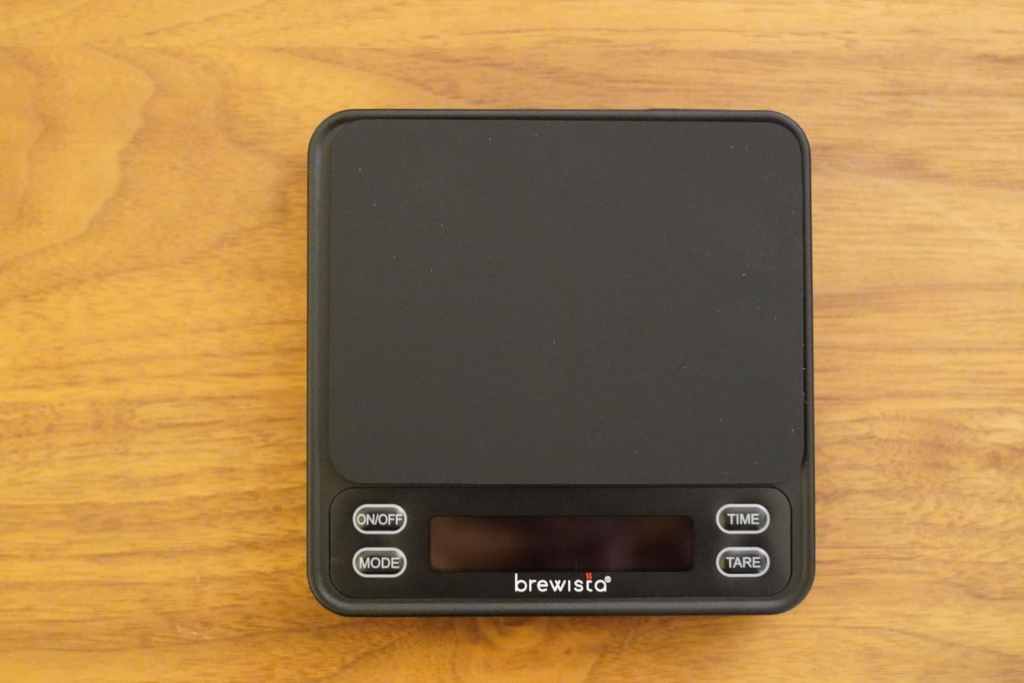
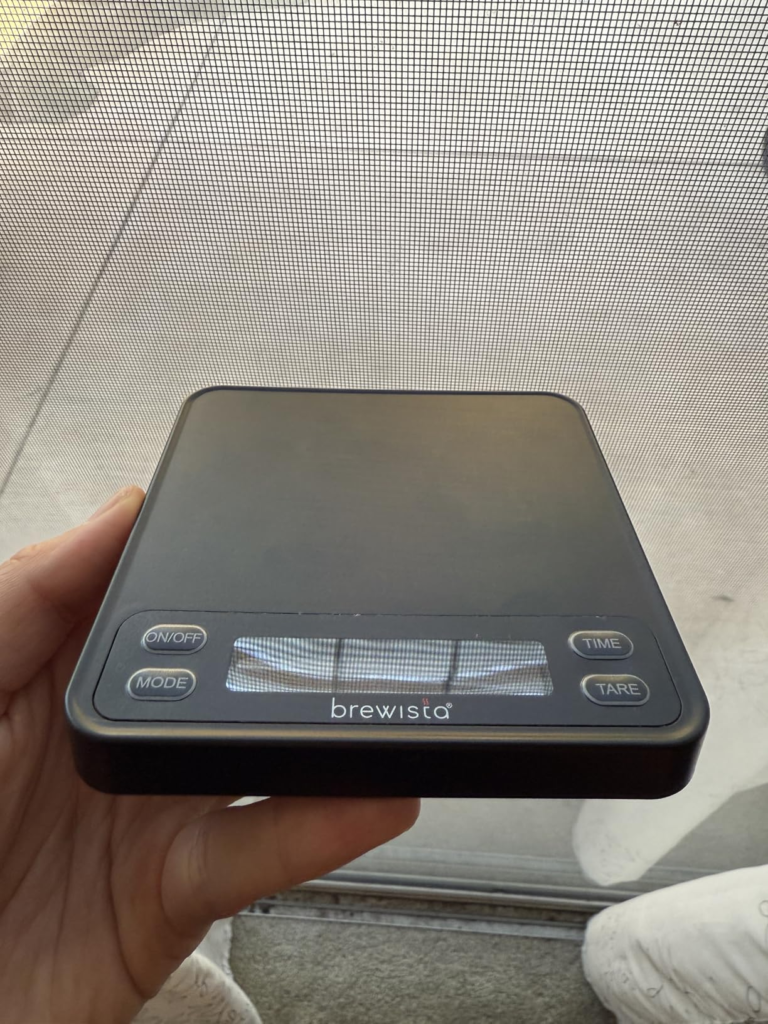
It is a single-cup precision scale, not a generalist. The 105mm footprint, 20ms response, 0.1g resolution from 0.5g minimum registration, and the five-mode automation system were designed around a specific workflow.
It delivers that workflow without requiring Bluetooth, without requiring a phone, and without requiring half the price of an Acaia Pearl S to access the same functional precision.
| Brewista Smart Scale III | Acaia Pearl S | Standard Kitchen/Entry Scale | |
|---|---|---|---|
| Resolution | 0.1g | 0.1g | 1g |
| Response speed | ~20ms | ~20ms | ~500–1,000ms |
| Minimum registration | 0.5g | 0.1g | 1g |
| Bluetooth / App | No | Yes (Acaia app) | No |
| Water resistance | Nano-coating (splash) | IPX5 (rinse-tolerant) | None |
| Flow rate display | No | Yes (via app) | No |
| Platform size | ~105mm × 105mm | ~155mm × 135mm | Variable |
| Battery per charge | 10–12 hours | 20–30 hours | AA/AAA or N/A |
| Price range | ~$85 USD | ~$250+ USD | ~$20–35 USD |
| Primary use | Single-cup espresso + pour-over | Competition + data logging | General kitchen use |
For the home brewer who needs Acaia-level accuracy without Acaia-level pricing and has no use for Bluetooth data logging, this is not a compromise. It is the correct purchase.
What It Solves, What It Reduces, and What It Still Leaves to You
| Category | Detail |
|---|---|
| What it closes | Measurement drift from insufficient resolution. Thermal interference from hot vessels on the platform. Response lag between pour action and scale feedback. Mode automation for hands-free bloom timing and shot tracking. |
| What it improves | Brew reproducibility across sessions at the same recipe. Dose-to-yield consistency for espresso. Morning workflow friction with auto-on activation and auto-off power management. |
| What it does not fix | Grind particle uniformity. Water mineral content. Kettle temperature variance. Technique inconsistencies in pour speed or angle. |
| What remains on you | Choosing which mode fits your workflow. Keeping the scale dry during and after extraction. Charging via USB-C every few days at standard home brewing frequency. Reading the manual once before assuming the modes are intuitive — they are logical, but they are not self-explanatory. |
One thing worth stating precisely: the Smart Scale III will not make an unclear recipe reproducible. It makes a clear recipe reliable. The sequence matters. Define your parameters first — dose, ratio, water temperature, grind setting — and then apply measurement precision to that foundation.
Applied to an undefined process, even a 0.1g scale is noise management without signal.
Final Compression
The Brewista Smart Scale III is a single-cup brewing precision instrument built for the home brewer who has exhausted other variables and still cannot reproduce a consistent result.
It is not the right scale for large pour-over setups, Bluetooth-dependent data workflows, or environments that demand fully waterproof protection.
For those cases, the Brewista X Series (wider platform), the Acaia Pearl S (app + IPX5), or the Acaia Lunar (fully waterproof espresso) are more appropriate fits.
For the home brewer with a V60, an AeroPress, or a lever espresso setup — who already has a recipe and still cannot repeat it reliably — the Smart Scale III closes the measurement variable that has been the noise in the system without asking for an unreasonable price to do it.
At approximately $85, it delivers the response speed and resolution that matter at the cup level. If you are inside that threshold, this is the decision that stops being vague.
Frequently Asked Questions
| Question | Answer |
|---|---|
| Is the Brewista Smart Scale III waterproof? | No. It carries a water-repellent nano-coating that handles splash and drip from active brewing, but it is not rated for submersion or rinsing under running water. Dry it promptly after contact with liquid and avoid leaving it sitting in active drip tray runoff. Users who need a fully waterproof espresso scale should look at the Acaia Lunar, which is fully submersible. |
| How does the Brewista Smart Scale III compare to the Acaia Pearl S? | Both deliver 0.1g resolution and approximately 20ms response speed — functionally equivalent in precision and feedback rate. The Acaia Pearl S adds Bluetooth and iOS/Android app connectivity for brew logging and data analysis, IPX5 water resistance, a larger platform, and 20–30 hours of battery life. It costs roughly three times more. For home brewing without competition-level data logging requirements, the Smart Scale III covers the same functional precision at a substantially lower price. |
| Will it fit under my espresso machine? | The Smart Scale III has a 105mm × 105mm footprint and a low-profile design built for espresso machine drip trays. It fits comfortably under most machines. The variable is the clearance between the drip tray surface and the portafilter — measure yours before purchasing if the clearance is tight. It is designed to accommodate standard cups, not oversized mugs, within that clearance. |
| Can I use it for pour-over coffee? | Yes, with a platform-size caveat. The scale accommodates V60-style servers, AeroPress, Kalita Wave, and smaller carafes cleanly. Large pour-over brewers — Chemex 8-cup, 700ml+ glass servers — may extend beyond the 105mm platform. For large pour-over setups, the Brewista X Series with its wider surface is the more appropriate scale. |
| What are the five modes, and which one should I start with? | M1 is fully manual pour-over: you tare and start the timer independently. M2 is espresso with auto-tare on cup placement and manual timer. M3 is espresso with auto-tare and automatic timer triggered on first extraction drop. M4 is auto-tare only, with no timer. M5 is the immediate mode: auto-tares and auto-starts the timer the moment a cup is placed on the platform. For most single-cup pour-over users starting out, M5 removes the most friction. For experienced brewers who want full control, M1 is the cleaner choice. |
| What is the battery life, and how often will I need to charge it? | Approximately 10–12 hours of active use per USB-C charge. At a typical home brewing rhythm of 2–3 brew sessions per day — each lasting 5–10 minutes — this translates to charging every 3–5 days. The battery indicator is visible on the LCD display, so you are not caught off guard. |
| Does it register below 1g? | Yes. The Smart Scale III registers from 0.5g and measures in 0.1g |
Transparency Note:
This analysis is built on aggregated real-world experience.
It extracts what repeatedly holds, what breaks, and what users uncover only after living with the system—then shapes it into a clear model you can use immediately.
Think of it as structured experience, refined and presented so you don’t have to learn it the hard way.
“A quick note: Don’t believe the star ratings, but trust personal experience. This article is a compilation of collected experiences”