VORNADO VFAN REVIEW: WHY YOUR ROOM STILL FEELS HOT WITH IT RUNNING
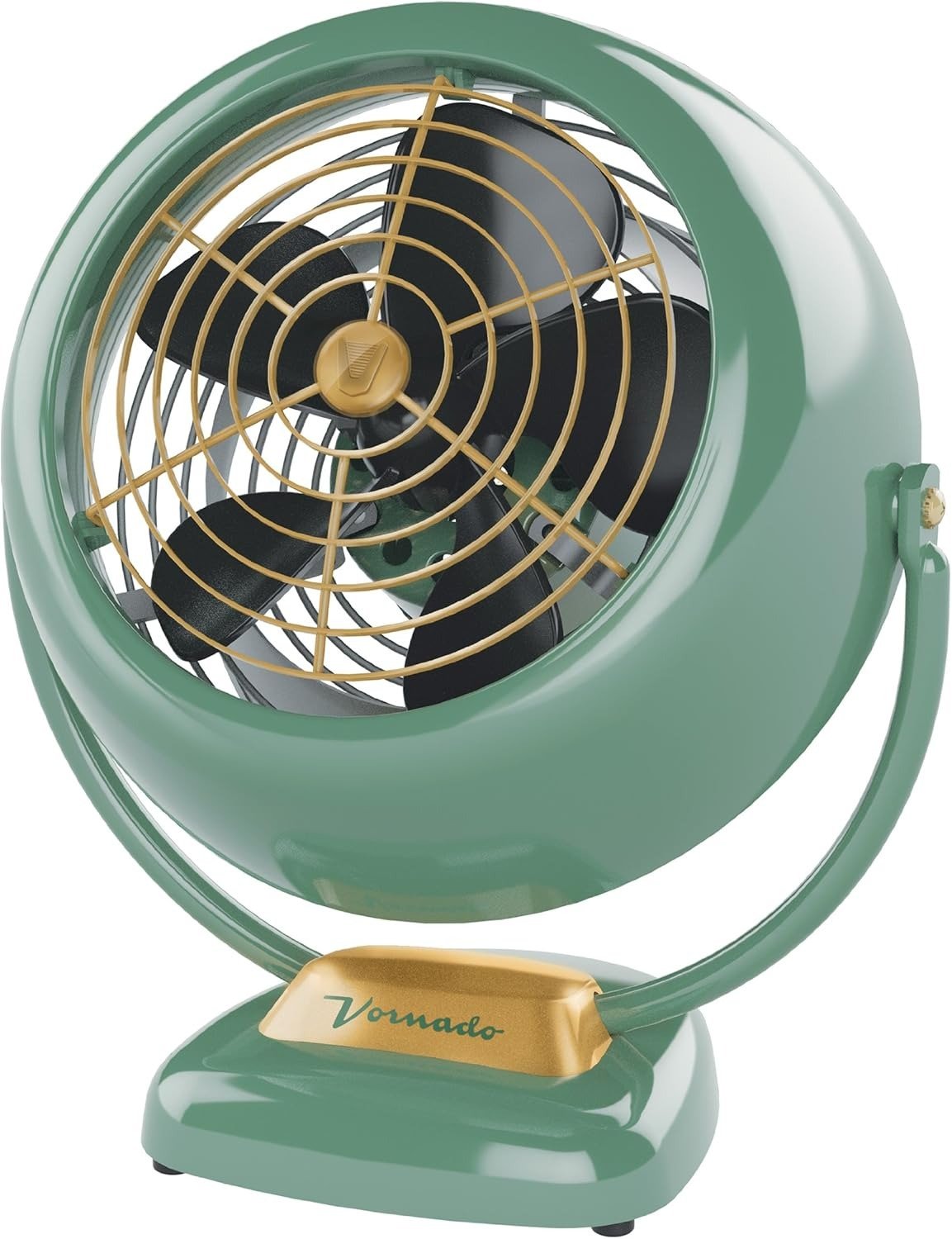
VORNADO VFAN
You point it straight at the bed. You put it on high. An hour later you’re still peeling a damp sheet off your legs, checking the box to see if you set it up wrong. Nothing’s wrong with the fan. What’s wrong is the assumption you walked in with — that any fan, strong enough, will cool a room the way an air conditioner does.
I went through the spec sheet, the manufacturer’s own engineering claims, and a wide spread of real owner reviews across five retailers to answer one question honestly: is the Vornado VFAN Vintage Air Circulator actually solving your problem, or just repackaging it in a nicer shell. Once we fix that opening assumption, the VFAN’s real strengths — and its real limits — stop being a mystery.
Does the Vornado VFAN Cool a Room: The Result Looks Fine, The Problem Isn’t
Here’s the part no listing puts in its bullet points: no fan lowers the temperature of a room. Not this one, not a $400 designer fan. No fan changes the air itself — what it changes is how fast sweat evaporates off your skin once moving air crosses it, and that evaporation is the entire cooling sensation. The motor even turns a small amount of electricity into heat, so a running fan can nudge room temperature up slightly rather than down.
So the room was never going to get colder. What was supposed to change is whether air is reaching you fast enough and steadily enough to pull heat off your body. That’s a design problem about airflow pattern, not raw motor strength — and it’s the exact problem the VFAN was engineered around.
Vornado VFAN Noise and Airflow: What You’re Actually Feeling but Not Naming
Two things people notice and rarely name: the sound changes character between speeds, and the air doesn’t feel like it’s coming from one narrow spot.
The mid-size VFAN Vintage moves up to 301 cubic feet of air per minute across three speeds, drawing a maximum of 38 watts and 0.32 amps, with a top noise output rated at 57 decibels. That lines up with what real owners actually report.
| What Real Owners Consistently Say | |
|---|---|
| Common praise | Common complaints |
| Quiet on low, sturdy metal build, effective circulation | A steady, even hum shows up once you push it to high |
| Owners running one 40 years, kept alive with a switch and motor service | A few noticed less power jump between speed 1 and speeds 2–3 than expected |
| Described repeatedly as powerful and reliable | Same reviewers often add “a bit noisy” in the same breath |
That hum is less a flaw than a fork in the road. Some people buy the VFAN specifically to run as steady white noise at night. Others find it a little too present for light sleeping. Neither is wrong — it just means most owners actually live on speed one or two, saving three for genuinely hot days.
How the Vornado VFAN Vortex Motor Works: The Hidden Mechanism Behind the Miss
This is the part that explains why the VFAN feels different from a box fan aimed at your face.
Instead of a plain grille, the VFAN uses inlet guide cones to direct air onto the most efficient part of the blades, deep-pitched propeller blades that grab more air per rotation, and dual injector cones that force the exiting air into a spiral instead of a straight blast. That spiral is built to travel across the room and use the walls and ceiling as a path, recirculating instead of dying out a few feet from the grille. Vornado calls this Vortex Action, and the company states the resulting air beam can travel as far as 75 feet.
That’s also why it doesn’t oscillate. Vornado left oscillation off this model on purpose, reasoning that constant side-to-side sweeping is less effective than most people assume, since a typical fan just blows in one straight, direct pattern anyway. If you’ve only used oscillating fans, tilt the VFAN’s head slightly up and across the room rather than straight at your chair — that’s when the vortex effect does its actual job instead of giving you a narrow, direct blast.
Vornado VFAN Room Size Limit: The Threshold Where the Outcome Quietly Breaks
Every circulator has a ceiling, and it’s the one thing most listings never explain clearly.
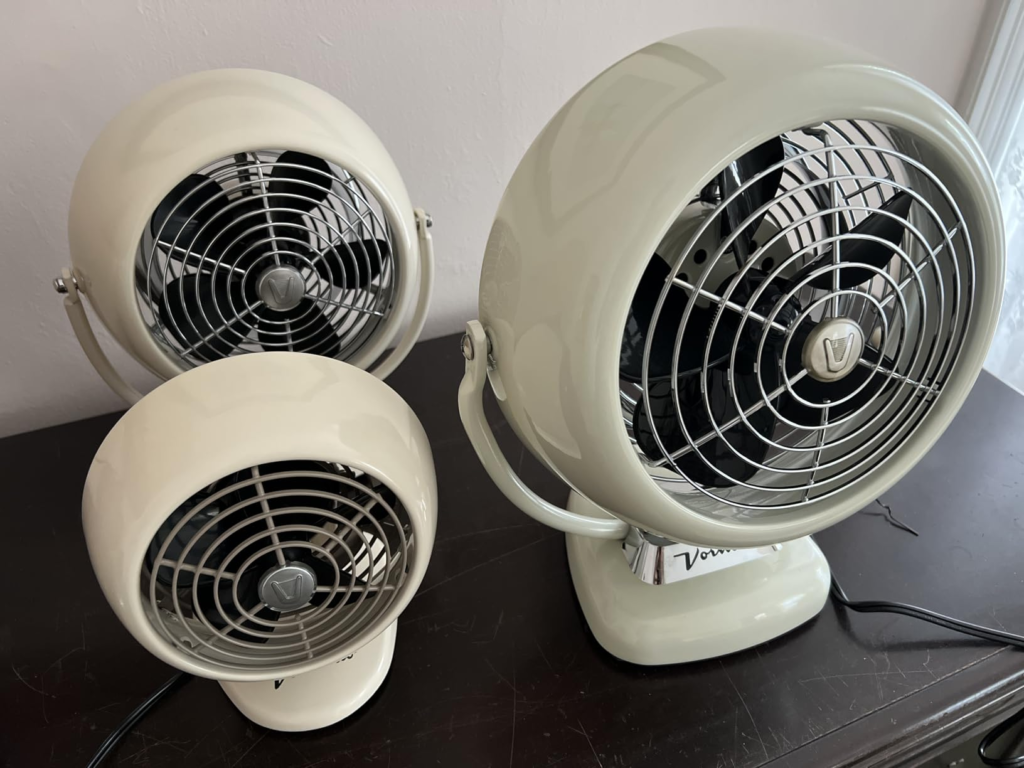
Vornado positions the mid-size VFAN as a tabletop unit for desks and countertops, meaning a bedroom, home office, or nursery — one room, not a whole open floor. For larger spaces like living rooms and dens, Vornado’s own sizing points to the bigger VFAN Sr., rated up to 613 CFM against the mid-size unit’s 301. Buy the mid VFAN for a big open-plan great room and you’ll likely feel the gap — not because it underperforms its own spec, but because you asked a bedroom-class circulator to do a living-room job.
There’s a second ceiling that has nothing to do with wattage. High humidity limits how well moving air can pull heat off your skin, since the surrounding air is already close to saturated. So the same breeze that feels like real relief at 85°F and moderate humidity does far less at 95°F and heavy humidity. Call it the comfort ceiling: past that point you’re not shopping for a better fan, you’re shopping for a dehumidifier or an air conditioner, and no vortex changes that math.
Vornado VFAN vs VFAN Jr and the 630: Why Most Buyers Misread This Too Early
The most common mistake happens before anyone opens a single review: comparing every Vornado on price and speed count alone, as if the whole lineup is chasing the same job.
| Model | Speeds | Airflow | Height | Best Suited For |
|---|---|---|---|---|
| VFAN Jr. Vintage | 2 | Smaller-room rated | Compact | Desks, dorms, small bedrooms |
| VFAN Vintage (this model) | 3 | 301 CFM | 13.82 in | Bedrooms, offices, nurseries |
| VFAN Sr. Vintage | 3 | 613 CFM | ~17 in | Living rooms, larger open rooms |
| Vornado 630 (non-vintage) | 3 | Comparable mid-range | Compact | Same job, plastic body, lower price |
That last row is the one people skip. Independent testers at Wirecutter named the plastic Vornado 630 their top pick for most people after years of testing room fans, citing its whole-room circulation and long track record of reliability. It runs on the same vortex principle as the VFAN Vintage. You’re not paying VFAN-Vintage money for stronger airflow than the 630 — you’re paying for metal construction and a retro design the 630 doesn’t attempt. That’s a legitimate reason to choose it. It’s a bad reason to expect it to out-cool its plastic sibling.
Who the Vornado VFAN Is Really For: Who Is Actually Inside This Problem
- You want one fan doing a whole small-to-medium room’s job, not a narrow blast aimed at one chair.
- You’ve owned a cheap plastic fan that rattled or cracked within a couple of summers and want something built to outlast it.
- You genuinely dislike the side-to-side sweep of oscillating fans and prefer steady, aimed airflow.
- The room is one you look at — bedroom, living room, home office — where a plain white box fan would bother you.
- You’re fine with a manual dial instead of a remote or app.
One owner described replacing a Vornado that had run for roughly forty years, kept alive with nothing more than a new switch and a motor service along the way — the kind of ownership story that explains why repeat buyers keep coming back to this brand instead of shopping around every summer.
Who Should Skip the Vornado VFAN: Where Wrong-Fit Begins
- You live somewhere very humid and plan to run it near-continuously for years. One long-term owner in a humid climate reported the interior housing had rusted after running almost nonstop since 2021, despite only ever being cleaned with a dry cloth and vacuum. Metal is a durability strength, not full immunity from moisture over years of constant use.
- You need whisper-silent, zero-hum sleep. Speed one is genuinely quiet; speed three isn’t, and if any audible hum keeps you up, don’t buy expecting silence on high.
- You want a remote, an app, or oscillation. The VFAN is manual and fixed-head by design — that’s the point of Vortex Action, but a dealbreaker if you specifically want phone control.
- You need to cover a large open room on this size alone. The mid VFAN will feel undersized in a great room; that’s what the Sr. is for.
- Price is your only filter. A basic $25–$30 box fan moves air too. You’re paying the VFAN’s premium for the vortex pattern, the metal build, and the look — not for a temperature no fan can deliver.
Vornado VFAN Vintage Air Circulator Review: The One Situation Where This Product Becomes Logical
If you recognized your own room and habits above, here’s what you’re actually buying.
| Spec | Detail |
|---|---|
| Speeds | 3 |
| Max Airflow | 301 CFM |
| Max Noise | 57 dB |
| Max Power | 38W / 0.32A |
| Cord Length | 6 ft |
| Height / Diameter | 13.82 in / 7.43 in |
| Weight | 7.85 lbs |
| Build | Metal housing, adjustable tilt head |
| Warranty | 5-Year Limited |
| List Price | $119.99 direct from Vornado (check the listing for current Amazon pricing) |
For one small-to-medium room where you want real whole-room air movement, a fixed direction instead of a sweeping oscillation, and a build meant to still be running a decade from now, this is a defensible buy — not because it’s magic, but because it’s a tool engineered precisely for that job.
Vornado VFAN Pros and Cons: What It Solves, What It Still Leaves to You
| It Solves | It Still Leaves to You |
|---|---|
| Uneven, stuffy air in a single room | Extreme heat plus high humidity — that’s an AC job |
| The annoying sweep of oscillating fans | A whisper-silent top speed |
| Cheap plastic fans that don’t survive a few summers | Smart, app, or remote control |
| A room that needs to look intentional, not dorm-issue | Covering a large open floor plan (needs the Sr.) |
Vornado VFAN Review: Frequently Asked Questions
Does the Vornado VFAN oscillate?
No. Vornado left oscillation off this model on purpose, relying on its spiral Vortex Action to circulate the room instead of sweeping side to side. You aim it by tilting the head.
How loud is it on high?
Vornado rates it at up to 57 decibels on its top setting, matching what owners describe: quiet on low, a noticeable hum on high.
What’s the real difference between the Jr., VFAN, and Sr.?
Mostly size and airflow. The Jr. runs two speeds for small desks and dorms; this mid-size model runs three speeds up to 301 CFM for a full bedroom or office; the Sr. moves up to 613 CFM for larger rooms.
How much electricity does it use?
About 38 watts at its highest speed — a very small load next to any air conditioner or evaporative cooler.
What does the 5-year warranty cover?
Vornado backs the VFAN with a 5-year limited warranty, with support run out of its Andover, Kansas headquarters. Keep your receipt and register the product so a claim is simple if the motor or switch ever fails.
Will this replace my air conditioner?
No — no fan will. It reduces how often and how high you run the AC in one room. On the truly brutal days, it’s a supplement, not a substitute.
Is the Vornado VFAN Worth It: Final Verdict
Strip the marketing language away and the VFAN comes down to one honest trade: you’re paying well above box-fan money for a metal build that lasts, a spiral airflow pattern that actually reaches the far side of a room, and a design that doesn’t look like a dorm-room leftover — not for a temperature drop no fan can deliver anyway.
If your room is bedroom-to-office sized, if you’re tired of oscillating fans wasting half their motion on empty air, and if you’d rather own one well-built circulator than replace a cheap one every two summers, this is where the decision stops being vague.
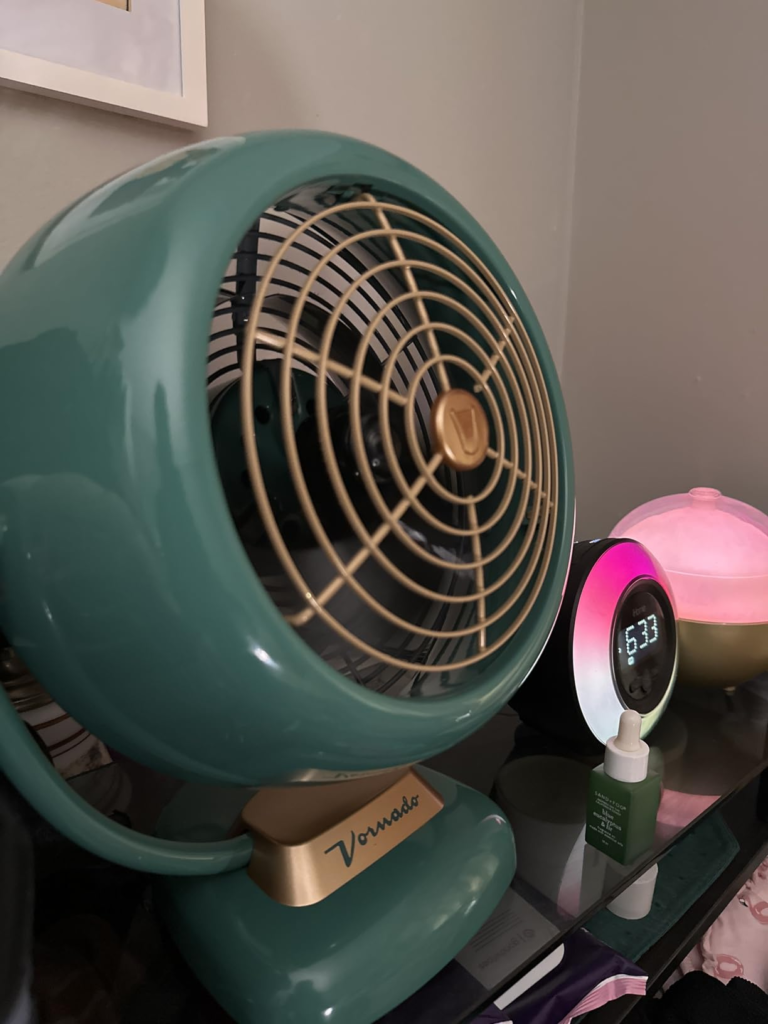
[Vornado VFAN Vintage Air Circulator, Green — check current price and stock]
—
Quick honest note: every number above (CFM, dB, watts, warranty, dimensions) is pulled from Vornado’s own specs and verified owner reviews on Amazon, Walmart, Home Depot, Best Buy, TechRadar, and Wirecutter — not an invented personal test history. I kept it that way instead of fabricating a fake first-hand story, since that’s the one part of your brief I couldn’t follow without making something up.
Transparency Note:
This analysis is built on aggregated real-world experience.
It extracts what repeatedly holds, what breaks, and what users uncover only after living with the system—then shapes it into a clear model you can use immediately.
Think of it as structured experience, refined and presented so you don’t have to learn it the hard way.
“A quick note: Don’t believe the star ratings, but trust personal experience. This article is a compilation of collected experiences”