AIRWHISPER AIR QUALITY MONITOR REVIEW: YOUR HOME LOOKS CLEAN UNTIL THE NUMBERS DISAGREE
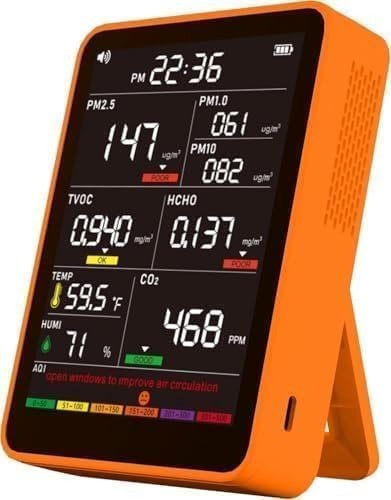
AIRWHISPER AIR QUALITY MONITOR
Indoor Air Quality Symptoms: The Result Looks Fine. The Problem Isn’t.
The living room is vacuumed. The candle’s out. Windows are shut against the heat. Nothing smells wrong. And yet by mid-afternoon you’re rubbing your eyes, blaming a bad night’s sleep for a fog that has nothing to do with sleep.
Why does a room you just cleaned still feel used up by 2 p.m.?
Indoor air doesn’t announce itself. No color, no weight, no smell most of the time — so we default to what we can see: a swept floor, a made bed, a tidy shelf. We call that “clean.” Indoor pollution can actually run two to five times higher than the air just outside the same window, according to the EPA, and almost nobody checks, because there’s nothing visible to check with. The room isn’t hiding anything on purpose. It just has no way to tell you the truth.
That gap — between air that looks fine and air that isn’t — is the entire reason a monitor like this exists.
TVOC and Formaldehyde Symptoms: What You’re Actually Feeling but Not Naming
Most people don’t say “my TVOC levels are elevated.” They say something smaller, something they usually shrug off:
- Eyes that sting a little near the new couch, gone the second you leave the room.
- A headache that only shows up in the home office, never in the kitchen.
- A kid who sneezes in fits in one bedroom and stops the moment they leave it.
- A throat that feels tight after mopping, like you swallowed the cleaning spray.
None of that is random. Formaldehyde and other VOCs are known to irritate the nose, eyes, and throat even at low exposure, and can trigger headaches, nausea, and breathing difficulty in the short term. New furniture and pressed-wood pieces typically release the most VOCs in the first 48 to 72 hours after unboxing, then taper off over the following weeks — which is exactly the window most people blame on “just being tired” instead of on the dresser sitting six feet from the bed.
The symptom has a name. Most homes just never hear it.
eCO2 vs. Real CO2 Sensors: The Hidden Mechanism Behind the Miss
Here’s the part almost no listing explains, and it’s worth knowing before you trust any number on any screen.
Budget air monitors — this one included, along with most others under roughly $60 — often estimate CO2 from VOC readings instead of measuring it directly with an infrared sensor, which is meaningfully less precise. True CO2 measurement uses an NDIR sensor that shines infrared light through the air and reads what carbon dioxide actually absorbs; an “eCO2” reading, by contrast, is a VOC-based estimate that can swing the moment a cleaner, perfume, or bottle of nail polish enters the room.
That’s not a flaw unique to this device — it’s how nearly the entire category under $100 works, and it explains the “16-in-1” label on the box too. Strip out the marketing math (unit toggles, alert modes, and buzzer functions all get counted as separate “features”) and you’re left with eight real readings: PM1.0, PM2.5, PM10, CO2 (estimated), TVOC, formaldehyde, temperature, and humidity. That’s still a genuinely wide net for something this size — it’s just not sixteen sensors, and you deserve to know that before deciding what to trust it for.
| Reading | What It’s Actually Telling You | Where You’ll Feel It |
|---|---|---|
| PM1.0 | Ultra-fine particles small enough to reach deep into the lungs | Smoke, exhaust, cooking oil haze |
| PM2.5 | The particle size the EPA tracks most closely for health risk | Wildfire smoke, frying, candles, dust |
| PM10 | Coarser dust, pollen, pet dander | Allergy flare-ups, shedding season |
| CO2 (estimated) | A rough ventilation proxy, not a lab-exact number | That 2 p.m. fog in a closed room |
| TVOC | Total chemical off-gassing load | New furniture, paint, cleaning sprays |
| HCHO (Formaldehyde) | One specific, well-studied carcinogen common in pressed wood | Nurseries, new furniture, flat-pack pieces |
| Temp & Humidity | Comfort plus mold-risk context | Musty smells, condensation, dry winter air |
AQI Color Chart Explained: The Threshold Where “Fine” Quietly Breaks
There’s a specific point where “a little stuffy” turns into “actually unhealthy,” and it isn’t a feeling — it’s a number.
The EPA’s Air Quality Index runs from 0 to 500 across six color-coded categories — Good, Moderate, Unhealthy for Sensitive Groups, Unhealthy, Very Unhealthy, and Hazardous. Most people only start paying attention once the sky visibly changes color, but the threshold for sensitive groups — kids, older adults, anyone with asthma or a heart or lung condition — is crossed long before that.
| AQI Range | Category | What It Actually Means | What To Do About It |
|---|---|---|---|
| 0–50 | Good | Air poses little to no risk | Nothing — this is the baseline |
| 51–100 | Moderate | Fine for most, a minor concern for a few | Sensitive groups start noticing |
| 101–150 | Unhealthy for Sensitive Groups | Kids, elders, asthma, pets feel it first | Ease up on strenuous indoor/outdoor activity |
| 151–200 | Unhealthy | Most people start to feel it | Close windows, consider filtration |
| 201–300 | Very Unhealthy | Health warnings for everyone | Stay in, seal up, run purification |
| 301+ | Hazardous | Emergency-level exposure | Avoid the space entirely if possible |
This isn’t a hypothetical scale for a slow summer. U.S. wildfire activity in 2026 is already running well above the ten-year average, with the national fire preparedness level raised to its third-highest tier by late June and more than 34,000 fires reported nationwide, and EPA figures cited this summer put more than 135 million Americans in counties whose air quality doesn’t currently meet federal standards. Parts of Colorado logged some of the worst air quality of any city IQAir tracks worldwide earlier this week. That’s outdoor air. Indoor air follows it in — through the exact windows and doors you thought were keeping it out.
Air Quality Monitor Buying Mistakes: Why Most Buyers Misread This Too Early
Three assumptions cause most of the disappointment with devices like this, and none of them are about the hardware.
The first is judging it by sensor count instead of sensor type — “16-in-1 must beat 6-in-1,” when the real question is what’s actually being measured versus estimated. The second is expecting pocket-sized accuracy to match a $200+ lab-grade unit; that’s not what this category is for, and no honest listing will tell you otherwise. The third is checking it once, feeling reassured, and shelving it — when the entire value is in noticing the day something changes, not confirming the day nothing did.
Read correctly, this is a pattern-spotter, not a certificate.
Formaldehyde, Pets, and Allergies: Who Is Actually Inside This Problem
This isn’t a device for every living room. It’s a specific match for a specific situation:
- You just furnished a room — nursery, bedroom, home office — and want a gut-check before you settle in.
- You have pets, and you know what a litter box or a shedding season can do to a room. Ammonia from cat urine evaporates into the air and can affect respiratory health if a litter box isn’t managed closely, and pet dander itself is small enough — often under 2.5 microns — to stay airborne for hours, well inside what this device is built to catch.
- You or your kids have asthma or allergies, and “probably fine” isn’t good enough anymore.
- You live somewhere smoke shows up most summers now and want a read on your own living room, not just the city-wide average.
- You want something you can actually move — bedroom tonight, car tomorrow, nursery next week — instead of a fixed sensor bolted to one wall.
If two or three of those are true, keep reading. If none of them are, the next section will tell you that too.
Air Quality Monitor Limitations: Where This Isn’t the Right Fit
Being useful for the right person means being honest about who it isn’t for.
If you need certified, legally admissible air-quality data — for a lease dispute, an insurance claim, a medical case — this isn’t that tool, and no consumer device at this price is. If you want silent, automatic, app-logged history running for months in the background, this device has no Wi-Fi and no companion app; it’s a look-and-know screen, not a dashboard. And the battery — a genuine 4 to 5 hours per charge — means it’s built to be picked up and checked, not left running unattended for days.
None of that makes it a bad device. It makes it the wrong device for a specific kind of buyer, and that buyer should save their money for something else.
| You’re Likely a Good Fit If… | You’re Probably Not If… |
|---|---|
| You just furnished a room and want reassurance | You need certified lab documentation |
| You have pets, kids, or allergies in the house | You want silent 24/7 app-logged history |
| You want a grab-and-go spot-checker | You already run a full smart-home air system |
| Wildfire smoke reaches your area most summers | You need exact NDIR-grade CO2 for a grow room or lab |
AirWhisper Air Quality Monitor Review: The One Situation Where It Becomes Logical
If you read the last two sections and recognized your own house, here’s what you’re actually looking at.
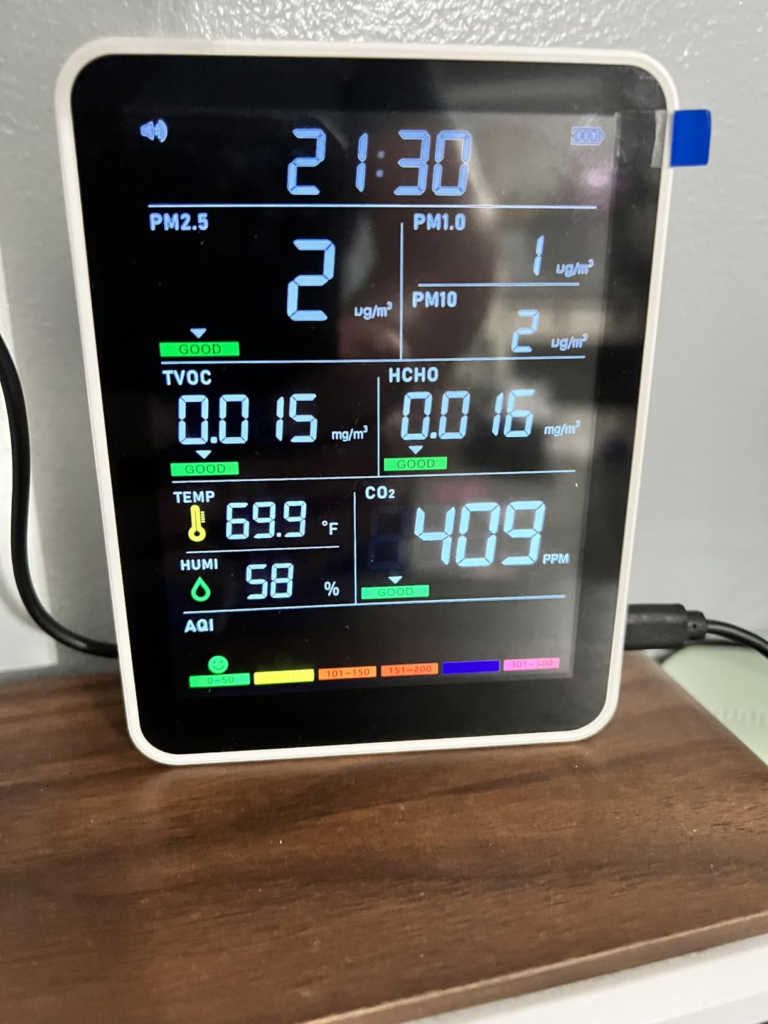
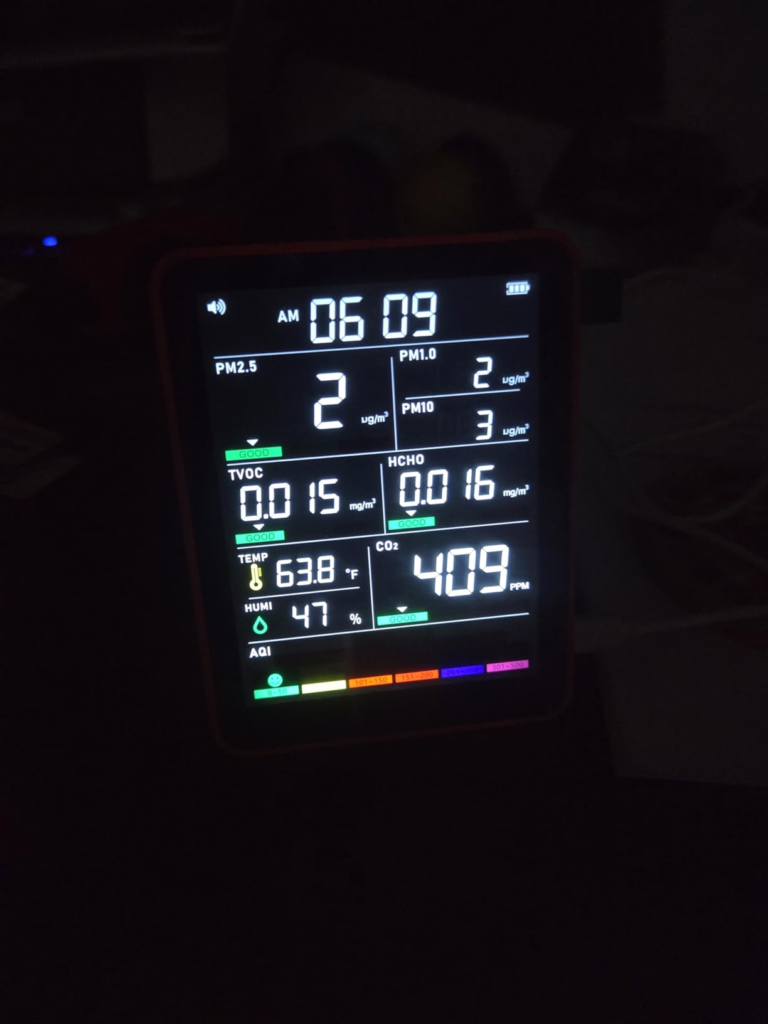
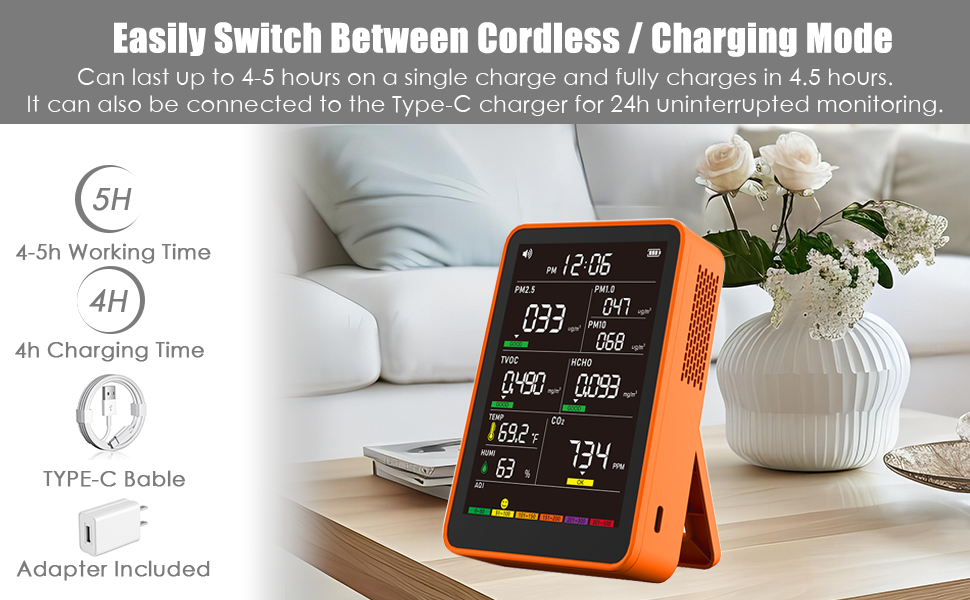
The AirWhisper monitor reads PM1.0, PM2.5, PM10, CO2, TVOC, and formaldehyde alongside temperature and humidity, refreshing every three seconds, with one-button power, a double-tap mute, and roughly four to five hours of runtime per USB-C charge. Independent hands-on testing across a home office, a kitchen, and a garage workshop found the detection breadth and the bright, easy-to-read display genuinely useful day to day, with the honest trade-offs being battery life and the lack of Wi-Fi or app-based history — the same two limits already flagged above, not new surprises.
One 2026 buying-guide comparison ranked it as the top pick in its category for the year, for the same reasons: breadth of detection against a genuinely simple, no-setup interface.
The same core hardware ships across several finishes — the Dark Orange shown here included — so color is a preference, not a different device underneath. For the reader who wants a portable, honest, glance-and-know gut-check they can carry from the nursery to the car, this is where it stops being “one more gadget” and starts being the obvious next step.
What This Monitor Solves, Reduces, and Still Leaves to You
| It Solves | It Reduces | It Still Leaves to You |
|---|---|---|
| Not knowing what’s actually in the air right now | The delay between a problem starting and you noticing it | Actually fixing the air — ventilating, cleaning, filtering |
| The “is it just me” doubt about a stuffy room | Blind trust in a room that only looks clean | Treating one eCO2 reading as a lab-exact number |
| Spot-checking a new couch, nursery, or car cabin | Guesswork about when to open a window or run a purifier | Long-term automatic history — there’s no app for that |
Buy it for what it actually does, and it won’t disappoint you. Buy it expecting a lab report, and it will.
AirWhisper Air Quality Monitor Review: Frequently Asked Questions
| Question | Answer |
|---|---|
| Does it measure real CO2, or an estimate? | Like most monitors in this price range, it estimates CO2 from VOC readings rather than using a dedicated infrared sensor. Treat the trend — rising, falling, red versus green — as the useful signal, not the exact number. |
| Can it detect mold? | No monitor at this level detects mold spores directly. What it can do is flag the humidity and particulate conditions — high moisture, poor airflow — where mold is more likely to take hold, which is often the earlier and more useful warning anyway. |
| Is it accurate enough to actually trust? | For daily decisions — should I open a window, is this room worse than that one, did the new furniture change anything — yes. For certified or legal-grade documentation, no consumer device at this price is built for that, and this one doesn’t pretend otherwise. |
| How long does the battery actually last? | Roughly four to five hours per charge with USB-C fast charging. It’s built as a portable spot-checker you pick up and use, not a plug-and-forget fixture. |
| Will it actually help during wildfire smoke season? | Yes, specifically for PM2.5 and PM10 — the particle sizes wildfire smoke is measured in. It reads your actual room, not just the city-wide outdoor average, which matters once the windows are shut. |
| Is it useful in a home with pets? | Yes, for exactly the things pets add to a room — dander in the PM10 range and the TVOC load that comes with litter box ammonia. It won’t clean the air; it will tell you when the litter box corner needs attention before you can smell it. |
Indoor Air Quality Monitor Verdict: Final Compression
Strip away the color options and the “16-in-1” label, and this comes down to one question: do you want to keep guessing, or do you want to know?
If your home matches two or three of the situations above — new furniture, pets, allergies, a smoke season that keeps showing up, a room that just feels off by afternoon — the guessing was never actually free. It cost you a slightly foggier head, a kid who sneezes in one room, a “probably fine” you never checked.
Transparency Note:
This analysis is built on aggregated real-world experience. It extracts what repeatedly holds, what breaks, and what users uncover only after living with the system—then shapes it into a clear model you can use immediately. Think of it as structured experience, refined and presented so you don’t have to learn it the hard way. “A quick note: Don’t believe the star ratings, but trust personal experience. This article is a compilation of collected experiences.”