Dreo DR-HTF007S Review: I’VE HEARD QUIETER FANS. I’VE NEVER SLEPT BETTER WITH ONE.
DREO DR-HTF007S
You didn’t buy the wrong fan last summer. You bought the right category with the wrong calibration. The tower fan you returned wasn’t too loud in the way you think — it was too loud at the exact moment that mattered, which is somewhere between 11 PM and 2 AM when you’ve already committed to the room temperature. That’s not a comfort problem. That’s a threshold problem. And it’s the only thing worth understanding before you decide whether the Dreo DR-HTF007S belongs in your bedroom or your donation pile.
The Result Looks Fine. The Problem Isn’t.
You set the fan up. It runs. The room feels less stagnant. You fall asleep.
Then something shifts around 1 AM — not dramatically, just a persistent awareness. A motor hum that sits slightly too high in the frequency range. A blade flutter on speed 3 that you only notice in silence. You don’t wake up. But you don’t stay fully under, either. By morning you’ve blamed the heat, your mattress, the neighbors. The fan never gets named.
That’s the problem with most tower fans in the $40–$90 range. They pass the awake test. They fail the sleeping test. And because you can’t trace the failure directly to one variable, you spend next summer buying another $60 machine with different branding and the same outcome.
The DR-HTF007S was built for exactly this failure pattern — not because it adds smart features on top of an average motor, but because it starts with a noise floor architecture that most fans in its price range treat as optional.
What You’re Actually Feeling but Not Naming
The irritation isn’t the fan. The irritation is the inconsistency.
A fan that stays at a predictable 28–31 dB across its lower two speed settings becomes background noise within minutes. Your auditory system stops monitoring it. For sleep-supportive white noise masking, the ideal range is 40–55 dB at the sleeping position — enough to mask most bedroom intrusions without being disruptively loud itself. But what breaks sleep isn’t loudness alone — it’s variation. A motor that fluctuates, a blade that clips on the housing, a cooling cycle that causes an audible speed shift — these are the sounds that keep your brain in light-sleep surveillance mode instead of dropping deeper.
Most sleep experts recommend a background noise level of 20–30 dB for optimal rest. A fan that measures 30 dB at 3 feet away is acceptable; 40 dB at the same distance is disruptive.
The DR-HTF007S runs its Sleep Mode differently from most fans that simply relabel a low-speed setting. In Sleep Mode, fan speed decreases every 30 minutes, dropping by a maximum of two levels and remaining constant at level 1 — which means it self-calibrates downward as your body cools, rather than staying at a fixed output your room might not need at 3 AM. That’s not a feature. That’s a mechanism that removes the decision entirely.
The Hidden Mechanism Behind the Miss
Most people evaluate tower fans by testing speed 4 in a warm room at 6 PM and calling it a verdict.
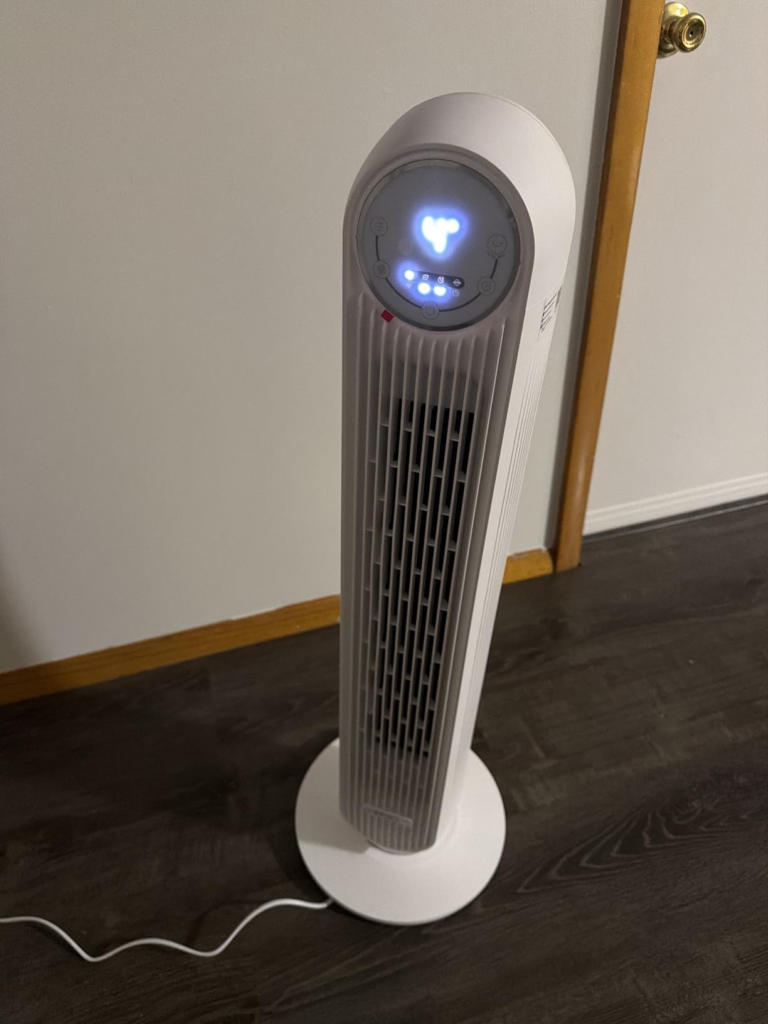
Speed 4 isn’t where a bedroom fan lives. Speed 1 and Speed 2 are where it lives — for 6 to 8 hours, every night, adjacent to someone who’s trying to stay asleep. The Dreo DR-HTF007S uses an algorithmic impeller design paired with what Dreo calls the Coandă effect — a fluid dynamics principle where airflow naturally adheres to a curved surface, which produces smoother, less turbulent air delivery instead of the choppy blade-cut pattern that traditional fans generate at low speeds.
The noise-dampening design leverages the Conada effect — a principle related to vortex flow and pressure distribution — to ensure smooth, non-turbulent airflow. Operating at just 28 dB on its lowest setting, the DR-HTF007 is whisper-quiet. Even on higher settings, the noise level remains within a comfortable range, rarely exceeding 48 dB.
Independent lab measurements put the actual real-world figure slightly above the manufacturer spec. Tested units measured approximately 31 dB — slightly above the manufacturer’s value of 28 dB. Nevertheless, the fan is pleasantly quiet, with no humming or background noise.
Three decibels above spec. Still inside the sleep-safe threshold. That’s not underdelivery — that’s a brand that gives you an honest margin.
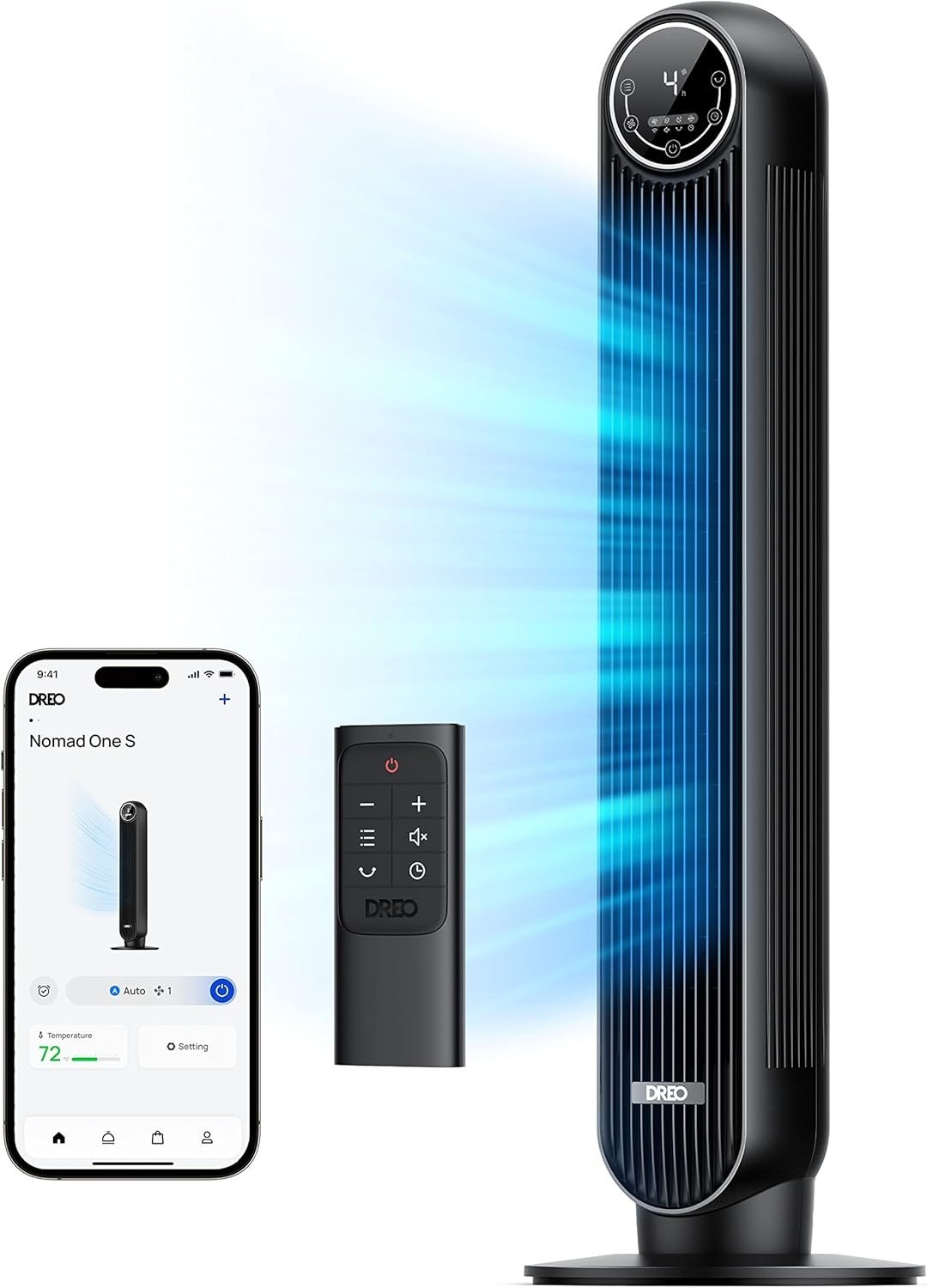
The “S” variant adds the one layer most bedroom users eventually want: a smart tower fan indicated by the “S” in the model number has WiFi connectivity, allowing control via a smartphone app or voice assistants like Alexa. This matters less for the novelty and more for the specific scenario where you’re already in bed, the fan is too fast, and reaching the remote means moving the arm that woke your partner last week. One app tap. Done.
The Threshold Where the Outcome Quietly Breaks
Here is the exact line where the DR-HTF007S stops working for you:
Room size above 350–400 square feet with no supplemental cooling.
While this fan is not an air conditioner replacement, it significantly enhances room comfort when used alone or alongside a cooling system. For optimal results, pairing the Dreo tower fan with your home’s AC unit allows for faster, more energy-efficient cooling, helping distribute conditioned air evenly throughout the space and reducing hot spots.
A 36-inch tower fan with a 42-watt motor and 1,408 CFM airflow capacity is a circulation tool. It moves existing air efficiently. It doesn’t manufacture cooler air. In a sealed 500-square-foot room at 85°F with no AC, this fan makes you feel slightly less miserable. It does not solve the room.
The threshold table is simple:
| Room Size | AC Present? | DR-HTF007S Result |
|---|---|---|
| Under 200 sq ft | No | Strong — primary cooling sufficient |
| 200–350 sq ft | No | Good — noticeable comfort improvement |
| 350–500 sq ft | No | Marginal — circulation only, not cooling |
| Any size | Yes | Excellent — dramatically reduces AC runtime |
| 500+ sq ft | Yes | Adequate as zone fan, not whole-room |
This is the boundary that most five-star reviews skip. If you’re in the right room, this fan over-delivers for its price. If you’re in the wrong room expecting it to do what a window unit does, no amount of Coandă effect fixes the mismatch.
Why Most Buyers Misread This Too Early
The comparison that sinks most people is the Dyson AM07 versus this fan at roughly $300 versus $80.
Budget-conscious buyers often achieve similar sleep quality with carefully selected traditional tower fans like the Dreo positioned strategically away from the bed. Light sleepers should target fans operating at 38 dB or lower on the quietest setting — comparable to a quiet library or whispered conversation, noticeable if you focus on it, but easily ignorable once you relax into sleep.
The Dyson is quieter by 3–5 dB on its lowest setting. It is also $220 more expensive. For most people sleeping in a normally insulated room, that delta is inaudible in practice. The comparison only makes sense if you are in the rare category of acute sound sensitivity — chronic light sleepers, shift workers, people recovering from illness — where every decibel is genuinely functional.
The other misleading comparison is any fan that markets “5 speeds” against this unit’s 4. Speed granularity matters only if the jump between Speed 1 and Speed 2 creates an unwanted noise step. On the DR-HTF007S, that jump is narrow enough that the distinction is operational, not disruptive.
The feature that routinely gets dismissed as gimmick but turns out to matter most: Auto Mode, where the fan reads ambient temperature and self-adjusts speed. In Auto Mode, fan speed adjusts to the ambient temperature. In a room that drops 4°F between midnight and 5 AM — which is typical in most climates — a fan that slows itself down as the room cools is one that stops waking you up when the air changes.
Who Is Actually Inside This Problem
You are a match for the DR-HTF007S if any of the following are true:
| Profile | Fit |
|---|---|
| Bedroom 150–350 sq ft, light AC use | Strong fit |
| Works from home, needs daytime office quiet | Strong fit |
| Already owns AC, wants to reduce runtime | Strong fit |
| Light sleeper who’s returned 2+ fans | Strong fit |
| Uses Alexa or Google Home ecosystem | Strong fit (S variant) |
| Shares a bedroom, one person runs hot | Strong fit |
| Parent who monitors sleep via baby monitor | Strong fit (display auto-off, auto-mute) |
The “S” designation specifically matters if you are already inside a smart home setup. The WiFi integration via the Dreo app connects to Alexa and Google Assistant natively. If your home has neither and you have no interest in building that infrastructure, the base DR-HTF007 (no S) saves you the connectivity overhead without meaningful performance loss — same motor, same noise floor, same Sleep Mode logic.
Where Wrong-Fit Begins
Before you commit, these are the situations where you will regret this purchase:
You are cooling a large, open-plan living room without AC. The DR-HTF007S will circulate air in a large room. It will not make a large room comfortable in August. The 90° oscillation and 25 ft/s velocity are real. They do not replace refrigerant.
You need app integration with HomeKit (Apple). Skip if you need a fan with advanced smart home integration such as voice control beyond Alexa and Google — this model is more suited for medium-sized spaces without full ecosystem parity. The Dreo app works well within its ecosystem. It does not natively integrate with Apple HomeKit as of current firmware.
You find button-beep sounds disruptive. The beeping sounds from the buttons are quite loud relative to the fan’s otherwise quiet profile. If you’re adjusting settings in a silent room at midnight, the touch panel feedback is audible. The remote solves this — but it’s worth knowing.
You are expecting a fan that runs silent at Speed 4. It doesn’t. Speed 4 reaches the upper end of its noise range. It can be a bit noisy at the highest speed. Speed 4 is not a sleep setting. It is a “the room is genuinely hot and I need maximum airflow right now” setting. If you intend to sleep on Speed 4, every night, this is not your fan.
The One Situation Where This Product Becomes Logical
You need consistent, quiet airflow for sleep or desk work, in a room under 350 square feet, at a price that doesn’t require you to justify it to yourself or anyone else.
The Dreo DR-HTF007S handles that situation completely. It runs at 28–31 dB on the two speeds where you’ll actually use it. It self-reduces through the night. It oscillates 90° across the room without audible motor strain. It draws 42 watts — less than a standard light bulb — for 8 hours on a timer you set once and don’t touch again. The WiFi integration means you never need to sit up for a speed adjustment at 3 AM.
There is no equivalent fan in this price range that matches this noise floor with this airflow output. The closest competitors either sacrifice noise for power or sacrifice power for price. The DR-HTF007S lands inside the narrow intersection where both are handled.
What It Solves, What It Reduces, and What It Still Leaves to You
| Category | Reality |
|---|---|
| Solves | Nighttime fan noise disrupting sleep at low-to-mid speeds |
| Solves | Manual 2 AM speed adjustments via app or remote |
| Solves | Stagnant air in rooms with running AC (distribution) |
| Solves | Over-engineered controls on a simple appliance |
| Reduces | AC runtime in correctly sized rooms (energy cost) |
| Reduces | Perceived room temperature by 2–4°F via convective cooling |
| Reduces | Dust accumulation effort (removable rear grille + impeller) |
| Leaves to you | Actual temperature reduction in large, hot rooms without AC |
| Leaves to you | Apple HomeKit integration |
| Leaves to you | Absolute silence — it is 28–31 dB, not zero |
Do not buy this expecting an air conditioner. Do not buy this expecting complete silence. Buy this expecting a well-built, correctly engineered bedroom fan that does precisely what it says and doesn’t introduce new problems while solving the original one.
Final Compression
The decision isn’t whether this fan is good. It is. The decision is whether your room and your sleep pattern are inside the boundary where it performs correctly.
If you sleep in a room under 350 square feet, run AC or live in a mild climate, and have returned or resented a fan in the past two years — the DR-HTF007S is the logical next step. Not because it’s the most sophisticated fan available, but because it sits at the exact intersection of quiet enough, powerful enough, and priced for the reality of what a bedroom fan actually needs to do.
If that description fits your situation, the decision is already made. You’re just waiting to confirm it.
Frequently Asked Questions
| Question | Answer |
|---|---|
| What is the real-world noise level of the Dreo DR-HTF007S? | Independent tests measured approximately 31 dB on the lowest setting — slightly above Dreo’s claimed 28 dB, but within the sleep-safe threshold and free of humming or mechanical noise. Speed 4 approaches 48 dB, which is not a sleep setting. |
| What is the difference between the DR-HTF007 and the DR-HTF007S? | The “S” variant adds WiFi connectivity, enabling control through the Dreo app and voice assistants (Alexa, Google Home). The motor, airflow, noise profile, modes, and speeds are identical. Choose the S if you use smart home devices; skip it if you don’t. |
| Can the Dreo DR-HTF007S cool a large room without AC? | It circulates air effectively in rooms up to approximately 350 square feet. In rooms larger than that without supplemental cooling, it reduces stuffiness but does not lower air temperature in any meaningful way. It excels when paired with existing AC to distribute conditioned air. |
| Does the display light stay on during sleep? | No. The display auto-shuts off in Sleep Mode, and the fan auto-mutes button sounds. The room stays dark and quiet once Sleep Mode activates. |
| Does it work with Apple HomeKit? | Not natively. The Dreo app integrates with Alexa and Google Home. Apple HomeKit compatibility is not currently supported on this model. |
| How difficult is it to clean? | The rear grille and impeller wheel are removable without tools. Routine cleaning takes under five minutes. Dreo recommends hand washing the removable parts. |
| Is the Sleep Mode automatic or manually triggered? | It must be manually selected. Once active, it automatically reduces fan speed every 30 minutes by up to two levels and holds at Speed 1 for the rest of the cycle. |
| Is the 8-hour timer a countdown or a clock-based scheduler? | It is a countdown timer, not a clock scheduler. You set the number of hours at time of activation, not a specific off-time. The app allows more precise scheduling if needed. |
Transparency Note:
This analysis is built on aggregated real-world experience. It extracts what repeatedly holds, what breaks, and what users uncover only after living with the system—then shapes it into a clear model you can use immediately. Think of it as structured experience, refined and presented so you don’t have to learn it the hard way.
“A quick note: Don’t believe the star ratings, but trust personal experience. This article is a compilation of collected experiences”