YOUR DOORBELL CAN LOOK SHARP AND STILL MISS THE ONLY THING YOU NEEDED TO SEE
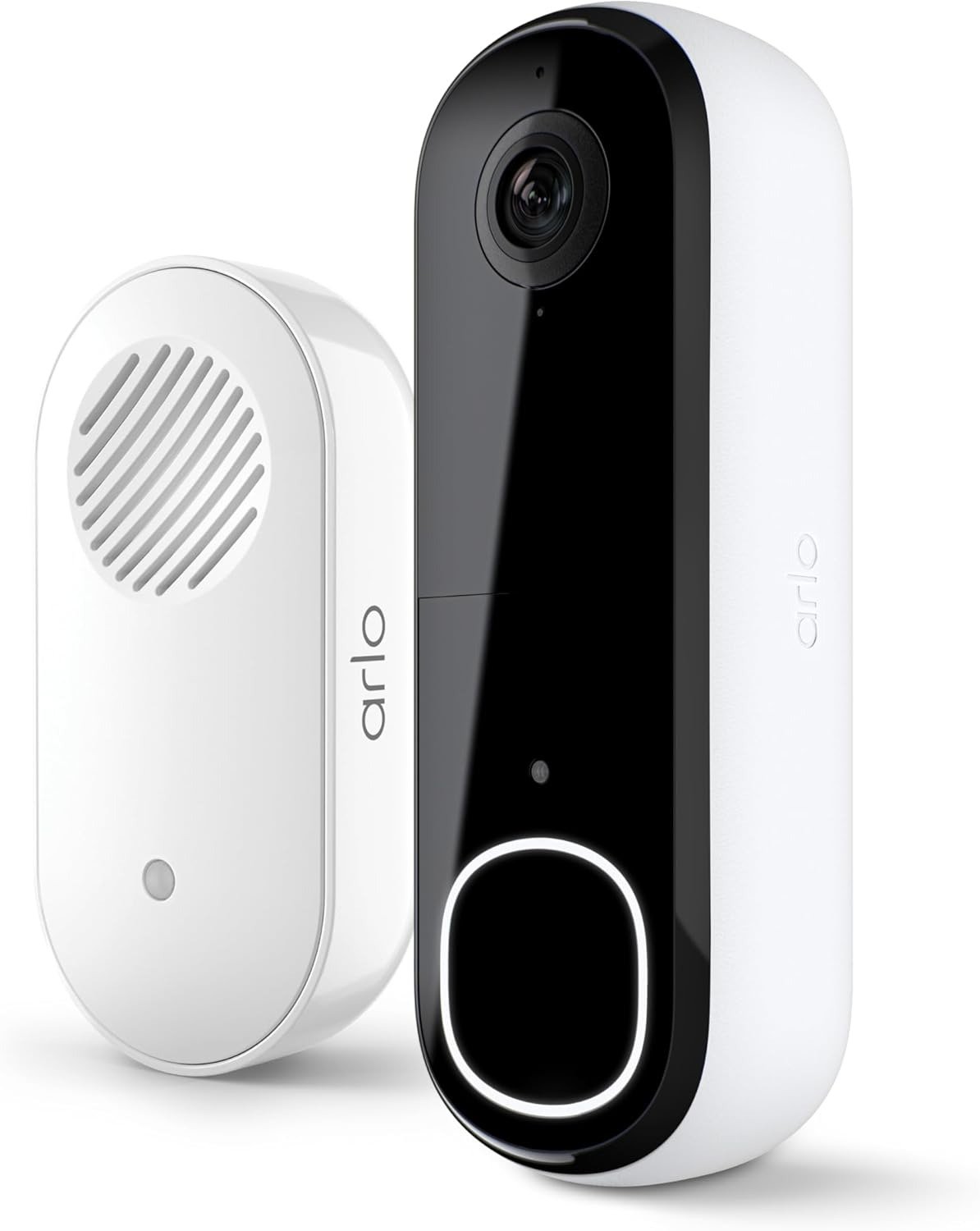
ARLO VIDEO DOORBELL 2K
The Result Looks Fine. The Problem Isn’t.
A lot of front-door cameras fail in a very polite way.
They give you a clean face shot. A neat notification. A little rush of reassurance on your phone. Then the package disappears from the bottom edge of the frame, the visitor stands too close to the lens, or the moment you needed to identify turns into a blur of “probably.” That is the trick. The footage looks acceptable right up until the exact second acceptability stops being useful.
That is why the Arlo Video Doorbell 2K caught my attention. Not because it screams spec-sheet dominance, but because its square 1:1-style framing and 180-degree view are built around the front-door problem people actually live with: the zone between a face, a box on the ground, and a body standing too near the lens. Arlo’s official specs put it at up to 1944 x 1944 resolution, 180-degree diagonal field of view, full-duplex 2-way audio, and direct Wi-Fi connection with wired or battery setup. WIRED, after testing current doorbells, called it a close second in its 2026 roundup and specifically praised the crisp HDR image, quick alerts, and unusually wide field of view.
I have seen this pattern too many times: people shop for a “video doorbell,” but what they really need is not a button with a camera. They need a front-door witness.
What You’re Actually Feeling but Not Naming
The irritation usually does not arrive as fear first. It arrives as friction.
A courier drops something low and fast. A guest steps into the dead zone under the lens. A child reaches for a package and you catch only the top of a head. A doorbell clip shows movement, but not enough context to settle your nerves. You replay it once, twice, three times, and the feeling is always the same: the camera saw activity, but it did not settle the question.
That feeling has a name, and most buyers never name it.
I call it the front-step gap: the strip of uncertainty between “motion detected” and “I know what actually happened.” It is where regret starts. Not because the device is broken, but because the framing was chosen for a marketing thumbnail, not a real porch.
Arlo leans hard into that exact problem. The company describes the second-generation doorbell as designed to catch the blind spots other doorbells miss, with head-to-toe coverage and visibility for packages on the ground. In testing and large-scale customer feedback, the same pattern shows up again and again: people praise the video quality, simple installation, broad view, and activity zones, while the main complaints cluster around battery life, app friction, and notification behavior. Best Buy’s review base currently shows a 4.4/5 average from 629 reviews, with video quality rated 4.7/5, the mobile app 4.6/5, and 88% saying they would recommend it to a friend.
That is a useful pattern. It tells me this doorbell usually satisfies the visual side of the job. The pressure point is not image clarity. It is how much maintenance tolerance you have for the system around it.
The Hidden Mechanism Behind the Miss
Most people think a doorbell camera fails because of weak resolution.
That is only half true.
The real miss is usually a three-part mechanism: framing, distance, and timing.
Framing decides whether you see a visitor’s whole posture or just a face pushed against the lens. Distance decides whether the camera catches the package zone or crops it out. Timing decides whether the alert reaches you fast enough to matter while the person is still at the door. Resolution helps, yes. But if the geometry is wrong, extra pixels just make the wrong crop look sharper.
That is why Arlo’s numbers matter in context rather than in isolation. The 2K version records up to 1944 x 1944, uses a 180-degree diagonal field of view, offers 12x digital zoom, black-and-white night vision, and a PIR motion detection range listed at about 10 feet on Arlo’s US product page. Arlo’s UK technical sheet adds 2.4 GHz Wi-Fi, noise reduction with echo cancellation, an 80 dB siren, a 4-to-6-month claimed battery range, and 2 Mbps minimum home upload speed.
That combination tells you what this product is trying to do. It is not trying to be a tiny wall-mounted cinema camera. It is trying to reduce uncertainty in a very tight vertical slice of space: doorstep, threshold, parcel zone, near-face interaction.
And that changes the decision.
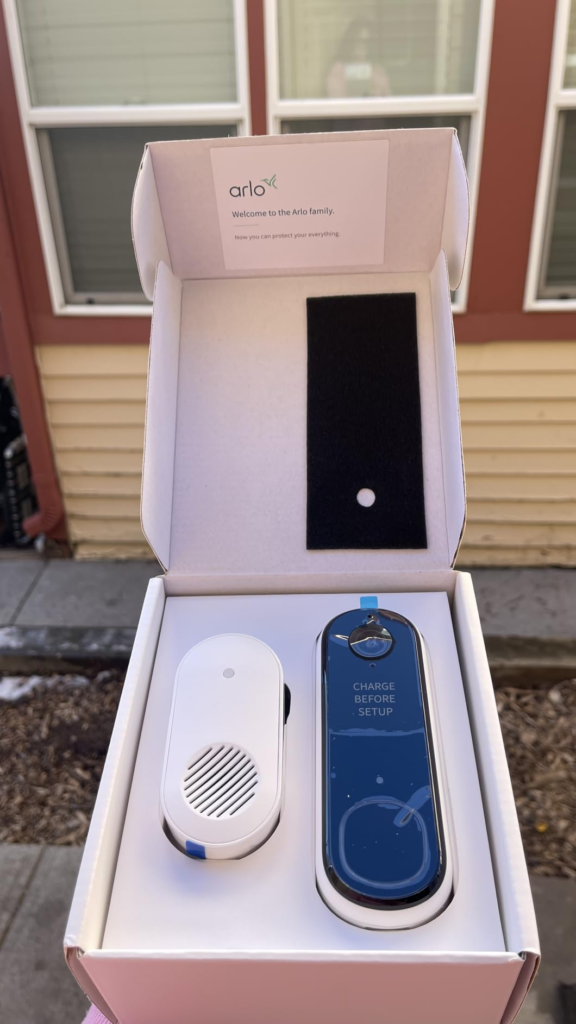
The Threshold Where the Outcome Quietly Breaks
Here is the threshold that matters:
A video doorbell stops being “good enough” the moment your risk lives below the chest line.
That sounds dramatic until you picture normal life. Packages sit low. Children move low. Pets move low. Delivery drivers often stand close, lean down, turn away, and leave fast. If your camera is strongest at face height but weaker at the lower half of the scene, the footage will feel fine during casual checks and strangely incomplete when you actually need it.
This is where the Arlo model becomes logical. The square-format approach, head-to-toe view, and package visibility are not decorative perks. They are threshold tools. Even Arlo’s own positioning is explicit here: the point is to see a person from head to toe or a package on the ground, not merely catch a generic doorway snapshot. TechHive also found that as a doorbell, the unit works exceptionally well in the basic interaction loop, noting the illuminated button, audible chime behavior, and immediate push-notification/video-call flow when pressed.
Once you see the threshold clearly, the shopping logic gets simpler.
You are not asking, “Is 2K better than 1080p?”
You are asking, “Does my front-door uncertainty start at the lower part of the frame?”
If yes, the decision moves.
Why Most Buyers Misread This Too Early
They compare the wrong things too soon.
They compare branding before fit. Subscription price before failure cost. Resolution before framing. And they often compare from the sofa, not from the porch. That is the trap. A doorbell camera is judged like a gadget when it should be judged like a checkpoint.
I have noticed the same lazy buying pattern across this category:
A polished app is mistaken for total reliability.
A popular badge is mistaken for the best porch geometry.
A lower monthly fee is mistaken for the cheaper long-term decision.
But the hidden cost is usually not the subscription. It is the missed moment. One undetected package edge. One visitor cropped too tightly. One alert that lands late enough to become a replay instead of a response.
Arlo does come with a tradeoff here, and it matters. Some of its more valuable functions are gated behind Arlo Secure, including cloud recording, advanced AI detection, and custom detection zones. Arlo’s subscription pages say these plans enable cloud video recording, advanced AI detection, and custom zones, while Amazon’s bundle page lists people, package, and vehicle recognition plus 30-day cloud storage as paid-plan features after the trial. Security.org, after testing the platform in 2026, said those extras made the experience better but also noted the one-camera plan starts at $7.99 per month, above Ring’s entry pricing.
So no, this is not the right buy for somebody who wants the category’s most stripped-down, lowest-commitment ownership model.
It is the right buy for somebody who hates blind spots more than subscriptions.
Who Is Actually Inside This Problem
You are inside this problem if your front door is one of these three things:
A package zone.
A high-turnover entry point.
A nice-looking porch with weak visual control.
That covers more homes than people admit.
If couriers stack boxes low against the door, you are inside it. If guests, service people, food delivery, or building staff move through the entry constantly, you are inside it. If your house or apartment entrance is visible, stylish, and exposed enough that you care how it feels as well as how it functions, you are inside it too.
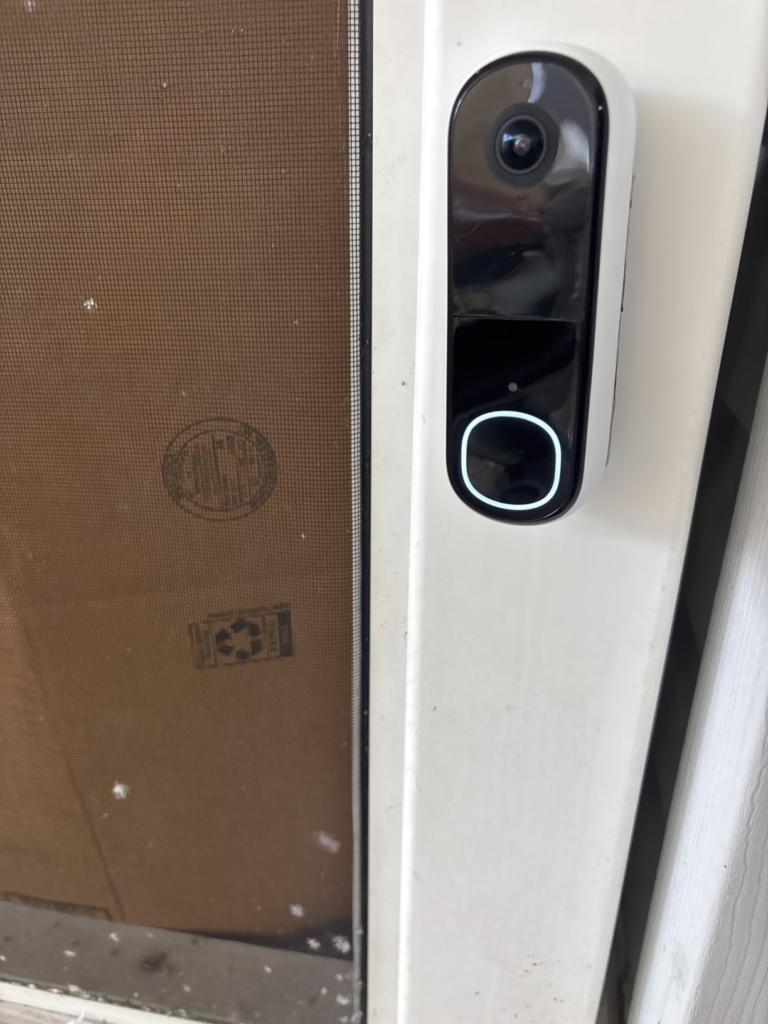
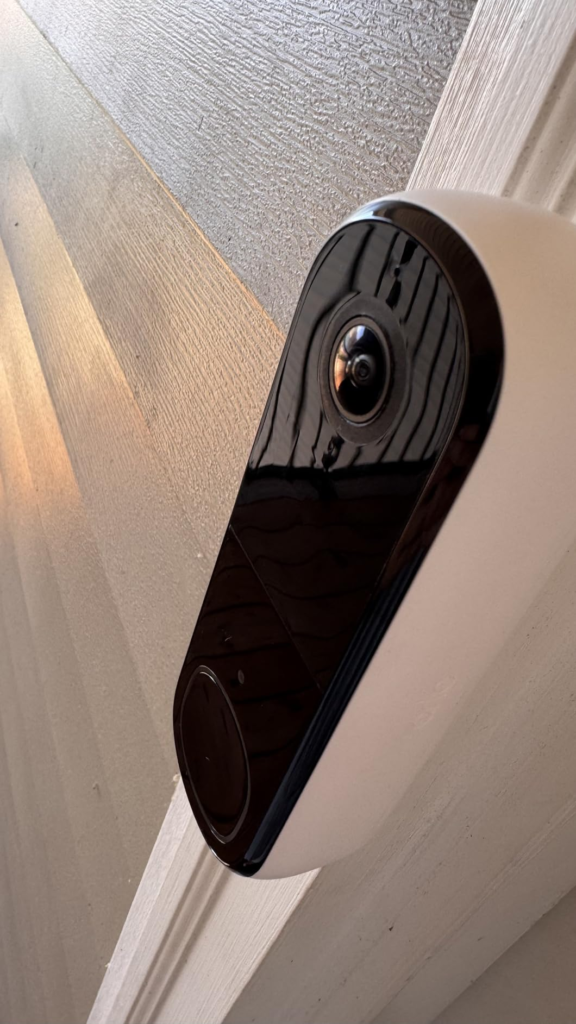
This is also where the Arlo design earns more credit than product photos usually show. Mounted cleanly on the latch side trim, kept vertical, and paired with a neutral finish around the frame, it does not shout “security device” the way bulkier units often do. It reads more like a narrow architectural detail than a plastic add-on. The space changes subtly: the doorway feels less decorative, more intentional. Not militarized. Just watched in a calm, expensive-looking way.
And yes, that matters. Because front-door tech lives in the one place where utility and presentation touch the same wall.
Where Wrong-Fit Begins
This is where I would stop pretending the product fits everyone.
Wrong fit begins if you want a no-subscription-first experience and you expect the full smart layer without recurring cost. Wrong fit begins if your Wi-Fi at the entry is weak, unstable, or dependent on a crowded network edge, because this unit relies on 2.4 GHz Wi-Fi and Arlo’s own documentation recommends at least 2 Mbps upload speed for operation. Wrong fit also begins if you are deeply battery-averse and know you will resent periodic charging more than you will appreciate installation flexibility. Arlo’s technical sheet claims 4 to 6 months of battery life, but large review sets still surface battery life as one of the recurring complaints, which tells me real-world variance is meaningful.
There is another wrong fit that buyers rarely confess: some people do not want information. They want emotional sedation. They want a doorbell that makes them feel secure without asking them to think about zones, alerts, app behavior, or ecosystem choices. This is not really that kind of product.
Arlo is better for the buyer who wants clearer evidence, cleaner framing, and a tighter grip on what the doorway is doing.
The One Situation Where This Product Becomes Logical
This product becomes logical when your problem is not “I need a smart doorbell.”
It becomes logical when your problem is:
I am tired of footage that looks fine until the most important detail sits just outside the useful part of the frame.
That is the use case. That is the line.
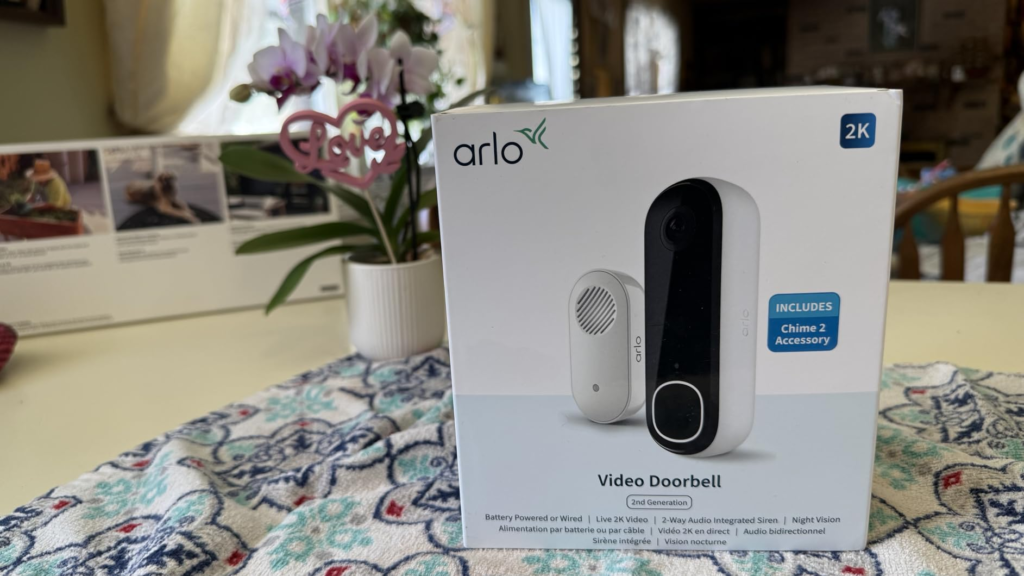
In that situation, the Arlo Video Doorbell 2K earns its place because the product stack matches the problem stack: 2K square-format video, broad 180-degree coverage, direct video-call alerts when someone presses the button, 2-way audio, motion detection, optional wired or battery installation, and a chime bundle for audible in-home alerts. Official Arlo materials and Amazon’s bundle page also point to person, package, and vehicle recognition through the paid Secure layer, while third-party testing highlights fast alerts and very good image quality as the practical payoff.
That is not magic. It is alignment.
And once alignment shows up, persuasion becomes easy because the product no longer needs hype. It only needs accuracy.
If this is the condition you are actually dealing with, this is the logical next step.
What It Solves, What It Reduces, and What It Still Leaves to You
What it solves is visual ambiguity at the door.
What it reduces is the stupid kind of second-guessing: Was there a package? How close was that person? Did the camera cut off the only relevant angle? It also reduces the lag between a press and a response, because Arlo’s video-call behavior is built around answering the door as an event, not merely logging it later.
What it still leaves to you is system discipline.
You still have to decide whether to wire it or recharge it. You still have to place it correctly. You still have to judge whether Arlo Secure is worth the monthly cost for your household. You still have to make sure the Wi-Fi at the entrance is real, not theoretical.
Here is the cleanest way I would frame it after looking at the specs, the reviews, the testing, and the user pattern:
| What matters | What Arlo does well | What you still need to accept |
|---|---|---|
| Porch coverage | Head-to-toe framing, package visibility, 180° view | Placement still matters |
| Visual detail | Up to 1944 x 1944 2K, HDR praised in testing | It is not a 4K forensic camera |
| Response flow | Fast alerts, video-call behavior, 2-way audio | App experience still shapes daily feel |
| Installation | Wired or battery, direct Wi-Fi setup | Battery users inherit recharge duty |
| Smart filtering | AI detection and custom zones available | Best features lean on subscription |
The underlying facts in that table are consistent across Arlo’s official specifications, Amazon’s product listing, and third-party testing/review coverage.
Final Compression
The lazy decision is to buy a doorbell camera because the category feels familiar.
The smarter decision is to buy one because you understand exactly where your current doorway coverage breaks.
After digging through the official specs, retailer feedback, independent testing, and the way real users describe the product, I do not see the Arlo Video Doorbell 2K as a universal winner. I see it as something better: a very precise answer to a very common front-door mistake.
If your break point starts at the bottom of the frame, if packages matter as much as faces, if you want a cleaner-looking device that still feels serious, and if you can tolerate the subscription logic that unlocks the full system, then this stops being a vague “maybe” product.
It becomes the correction.
And once you notice that your front door was never under-watched in general—only under-watched in the exact place where consequences begin—it gets very hard to go back to a camera that merely looks fine.
Transparency Note:
This analysis is built on aggregated real-world experience.
It extracts what repeatedly holds, what breaks, and what users uncover only after living with the system—then shapes it into a clear model you can use immediately.
Think of it as structured experience, refined and presented so you don’t have to learn it the hard way.
“A quick note: Don’t believe the star ratings, but trust personal experience. This article is a compilation of collected experiences”