YOUR ROBOT SAYS THE FLOOR IS CLEAN. YOUR FEET KNOW IT ISN’T.
You run the robot. You watch it map, navigate, dock, wash its own mop pads with hot water, dry them with
heated air. The app confirms: cleaning complete. The floor looks fine. And then you walk across it in socks, and something feels off — a faint stickiness near the kitchen, a faint grittiness under the dining table, a circular smear where the mop passed. Nothing dramatic. Nothing that would show up in a photo. Just a persistent low-grade gap between what the machine reported and what your floor actually became.
That gap is not a malfunction. It is a threshold. And understanding exactly where it sits — and why — is the difference between buying a machine that quietly earns its place in your home and buying one that quietly disappoints you on a schedule.
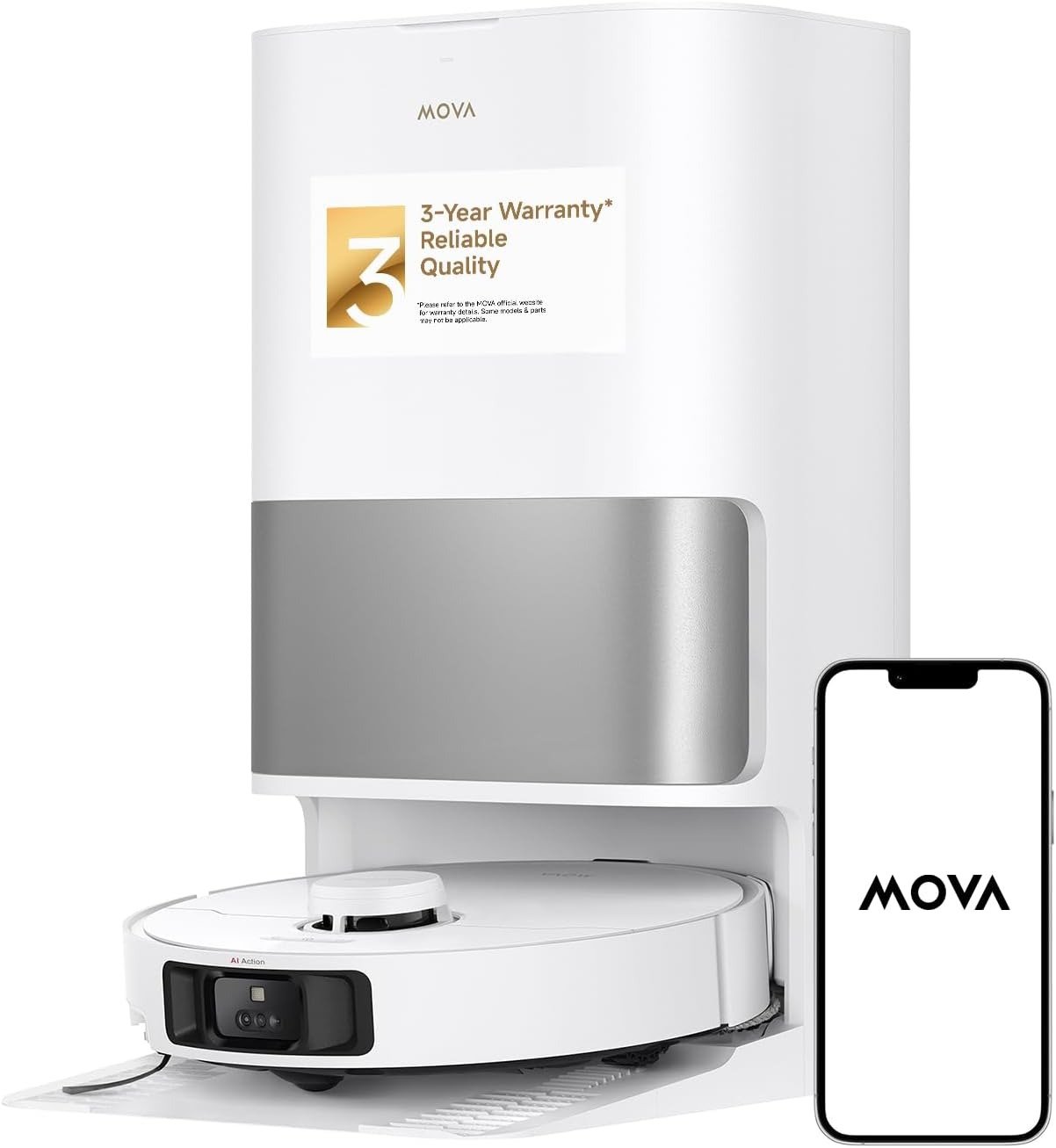
The MOVA P10 Pro Ultra is one of the most aggressively capable mid-range robot vacuums available right now. It swept three simultaneous awards at mid-2025’s most rigorous independent evaluation — Best Mid-Level, Best Value, and Fan Favorite Vacuum Wars . At around $499–$599, it delivers 13,000 Pa of suction, AI-powered 360° obstacle avoidance, and a fully automated dock that empties, refills, washes mop pads in hot water, and heat-dries them Vacuum Wars . On paper, it matches machines that cost $1,200.
But paper is not your floor.
The Result Looks Fine. The Problem Isn’t.
The P10 Pro Ultra cleans. Genuinely, measurably, impressively. But several thousand owners have now discovered the same quiet inconsistency: the machine performs its routine perfectly, reports success accurately, and still leaves a floor that requires a second look — or a second pass.
On hardwood floors, the mop tends to leave circular marks that require manual touch-up afterward. Users who expected mopping to eliminate that step found themselves adding it back. Best Buy
In controlled testing, dried-on stain mopping scored 73% — against an industry average of 93%. Techtracker That is not a catastrophic gap. But it is a structural one. It means a class of mess — the dried coffee ring, the overnight spill that wasn’t caught immediately, the sticky film from cooking — falls outside what this machine resolves reliably.
The vacuum side tells a different story. Airflow testing reached 20 CFM against an industry average of 16.4 CFM. Suction measured 1.08 kPa, nearly doubling some competitor models. Techtracker Only about 4% of long hair ended up tangled on the brush during independent testing, compared to 38% on average for other robots. Robot Vacuum Reviews
So the machine is strong where it promises strength. The gap is specific. And it shows up at a very specific intersection of surface type, mess age, and owner expectation.
What You’re Actually Feeling but Not Naming
The friction most owners experience isn’t “the vacuum doesn’t work.” It’s something more precise and harder to articulate.
It’s running a daily cleaning cycle and still wiping the kitchen counter and noticing the floor underneath feels slightly tacky. It’s watching the app say “mopping complete” and then noticing a faint film in the same patch where yesterday’s coffee spilled. It’s setting it to vacuum before guests arrive and then, an hour later, doing a quick pass yourself anyway — not because the robot failed dramatically, but because you’re not entirely sure it succeeded.
In real-world testing, navigation felt like a step below flagship models. The robot clearly saw many obstacles and marked them correctly on the map, but didn’t always respond appropriately in real time — struggling with tall narrow objects and occasionally snagging edges of thin rugs before correcting. TechGearLab
The cleaning path on carpets ran in irregular squiggles rather than tight grids, which sometimes dragged larger debris around before eventually picking it up. TechGearLab
None of this is a disaster. But all of it adds up to a machine that requires occasional supervision — not constant attention, but not true hands-off either.
The Hidden Mechanism Behind the Miss
Here is what the spec sheet doesn’t explain.
The MOVA P10 Pro Ultra is hardware-identical to the Dreame L40 Ultra in other global markets. The identical hardware sells as the Dreame L40 Ultra internationally, which explains the shared DNA with Dreame’s well-regarded lineup. Robot Vacuum Reviews The sensor suite — LiDAR, RGB camera, 3D structured-light — is genuine and capable. The dock automation is real. The feature set is not inflated.
What creates the gap is not missing hardware. It is a mechanical mopping constraint that no marketing language will volunteer.
The mop pads spin. They press. They extend toward edges. But the P10 Pro Ultra cannot drop off its mop pads at the dock mid-run. The hardware apparently supports this feature, but MOVA hasn’t enabled it through software updates. Robot Vacuum Reviews This means that when the robot moves from hard floor to carpet and back, the pads lift 10.5mm — but they never leave the robot. They stay attached, cooling slightly, picking up whatever transfer the carpet left, and then returning to the hard floor with slightly reduced pressure and slightly compromised cleanliness.
On fresh spills and light daily maintenance, this doesn’t matter. On dried residue, on sticky surfaces, on any mess that requires consistent downward pressure from a clean, hot pad — it starts to matter. The pad that re-contacts the floor after a carpet transition is not the same pad that left the dock.
This is the hidden mechanism. Not a defect. A design boundary.
The Threshold Where the Outcome Quietly Breaks
Call this the Three-Condition Threshold: the point at which the P10 Pro Ultra’s result starts diverging from the expectation of “clean.”
| Condition | Below Threshold | Above Threshold |
|---|---|---|
| Mess age | Fresh spills, daily dust | Dried-on stains, 12+ hour residue |
| Floor coverage | Mostly hard floors with occasional rugs | Large carpet areas that interrupt mopping mid-run |
| Owner expectation | Maintenance cleaning between manual sessions | Full replacement of manual mopping entirely |
The P10 Pro Ultra won’t replace a deep manual clean for thick carpets or heavily soiled grout. For maintenance cleaning that keeps floors consistently presentable with minimal effort, it delivers. Robot Vacuum Reviews
That distinction is load-bearing. It is not a flaw in the machine. It is the machine’s actual job description — which is not identical to what the marketing suggests, and not identical to what most buyers assume when they read “13,000 Pa suction + hot water mop washing.”
The threshold is: maintenance cleaning at high automation. Below that expectation: impressive. Above it: gap.
Why Most Buyers Misread This Too Early
The comparison trap looks like this: buyer reads “13,000 Pa,” compares to a Roborock at 10,000 Pa, concludes the MOVA is more powerful, and assigns the victory. Or buyer reads “hot water mop washing” and concludes that the mop arrives at the floor clean every pass.
Both conclusions are structurally correct and operationally incomplete.
In terms of raw vacuuming performance, independent users note it is roughly comparable to well-established robots — the real improvements are in efficiency and navigation intelligence, not brute power. Best Buy
The feature comparison that actually matters isn’t suction number versus suction number. It is: does this machine’s automation loop close the right gap in your specific home?
| What You’re Comparing | What You Should Ask Instead |
|---|---|
| 13,000 Pa vs 10,000 Pa | Does airflow reach the mess type I have? |
| Hot water mop washing | How often does the pad return to the floor clean? |
| 70 obstacle types recognized | How does it behave when it fails to recognize one? |
| 4.6 stars on Amazon | What did the 15% of complaints have in common? |
| “Best Value” award | Best value for which use profile? |
Analyzing approximately 200 unique complaints across Amazon reviews and Reddit threads revealed that customer support issues accounted for 21% of complaints, navigation and mapping problems for roughly 16%, and hardware defects for approximately 15%. Vacuum Wars The majority of navigation complaints resolved with remapping or firmware patches. The support complaints did not resolve as cleanly.
MOVA is a sub-brand of Dreame Technology, launched recently in the North American market. The hardware lineage is credible. The warranty infrastructure is still maturing.
Who Is Actually Inside This Problem
The MOVA P10 Pro Ultra delivers its best result for a specific owner profile. That profile is not “anyone who wants a robot vacuum.” It is tighter than that.
This machine fits your situation if:
- Your home is primarily hard floors — hardwood, tile, LVP — with rugs in specific zones rather than wall-to-wall carpet throughout
- Your pet situation involves daily shedding from one or two animals, not three large dogs
- You clean frequently enough that floors never accumulate more than 24–48 hours of residue before the robot runs again
- You want to reduce your cleaning workload significantly, not eliminate it entirely
- Your budget is $500–$600 and the alternative you’re considering costs $800–$1,200
It is one of the best robot vacuum mop combos available in its price range — possibly the best in terms of value. It offers top-tier cleaning performance, smart obstacle avoidance, an excellent app, and a feature-rich automated dock normally found in much more expensive models. Vacuum Wars
Reddit users with multiple large dogs report strong results specifically when adding the optional TriCut anti-tangle brush, which handles heavy shedding more reliably than the stock brush. RedditRecs
Where Wrong-Fit Begins
The machine starts to disappoint when the owner profile shifts outside that window.
| Wrong-Fit Signal | Why It Matters |
|---|---|
| You have thick, high-pile carpet in most rooms | Carpet deep-clean performance lags flagship competitors; suction numbers don’t overcome pile density |
| You cook daily and need mopping to handle grease and dried residue | Dried-stain mopping tests at 73% vs 93% industry average |
| You have 3+ large pets with heavy shedding | Stock brush tangles faster; TriCut brush is a paid addition, not included |
| You want the robot to run completely unattended without pre-clearing | Real-time obstacle avoidance has gap between recognition and response |
| You need enterprise-grade customer support | MOVA’s support infrastructure is still scaling; resolution delays are the most common complaint category |
| You want mop-pad-drop functionality for pure vacuuming runs | Software feature not yet enabled despite hardware support |
It is not a robot you can feel comfortable running completely unattended without a quick pre-clean first. TechGearLab That is a meaningful constraint for buyers who specifically want zero-intervention operation.
The regret point for wrong-fit buyers arrives around week three. The first two weeks feel like a genuine upgrade. By week three, the edge cases accumulate — the stuck cord, the circular mop marks on the hardwood, the map reset after a firmware update, the dried spill that needed a manual follow-up. None of it is catastrophic. All of it compounds.
The One Situation Where This Product Becomes Logical
If your home is mostly hard floors, you have one or two pets, you cook regularly but clean up fresh spills before they dry, and you are paying $800–$1,200 for a competitor that delivers the same cleaning result with a more established brand name — the MOVA P10 Pro Ultra is the structurally correct decision.
If you can find it at $500 or below, it is arguably the best value in robot vacuum-mops available. It competes with models costing hundreds more, with only minor trade-offs in deep carpet performance and brand support infrastructure. Robot Vacuum Reviews
The dock automation is not a marketing claim. The all-in-one station automatically empties the bin, refills the water tank, adds cleaning solution, washes and heat-dries the mop pads, and self-cleans its washboard. Vacuum Wars That is a genuine hands-off maintenance loop. Users report replacing the dust bag approximately every 6–8 weeks depending on home size and pets. MyCleanity
The obstacle avoidance is real. The RGB camera and 3D structured-light sensor recognize up to 70 obstacle types, including in low-light conditions. Vacuum Wars
The app is genuinely well-built. Room labels are customizable, cleaning preferences can be set per room — higher suction for carpet, extra mopping passes in the kitchen — and 32 levels of water flow adjustment give meaningful control over the mopping intensity. Robot Vacuum Reviews
For that owner profile, in that price band, nothing in the market closes the same automation loop at this cost.
What It Solves, What It Reduces, and What It Still Leaves to You
What it solves completely:
| Task | Result |
|---|---|
| Daily hard floor dust and debris | Handled consistently without intervention |
| Pet hair pickup on hard floors | Strong — 4% brush tangle rate vs 38% industry average |
| Routine mopping of fresh spills | Effective — pads wash in 140°F water, dry with heated air |
| Corner and edge cleaning | Extended side brush reaches ~4 cm beyond standard reach |
| Multi-room scheduling and no-go zones | Reliable through the app |
| Self-maintenance of dock and pads | Genuine — 45–60 day hands-off cycle between dust bag changes |
What it reduces but doesn’t eliminate:
| Task | Remaining Gap |
|---|---|
| Dried stain removal | 73% effectiveness — periodic manual follow-up needed |
| Deep carpet cleaning | Adequate for maintenance, falls behind flagship models for embedded debris |
| Obstacle avoidance in cluttered spaces | Recognizes more than it avoids in real-time |
| Pet hair on thick carpet | Works; works better with the paid TriCut brush |
What it still leaves entirely to you:
- Manual spot treatment for dried-on messes older than 12–24 hours
- Pre-clearing loose cables and very low-profile obstacles before unattended runs
- Remapping after significant furniture changes or firmware updates
- Direct customer support engagement if hardware issues emerge
The battery delivers an estimated 2,157 square feet per charge — more than double the industry average of 1,015 square feet. Techtracker For most homes, one full charge covers the entire floor plan with charge to spare.
Final Compression
The MOVA P10 Pro Ultra is not a machine for everyone who wants a robot vacuum. It is a machine for a specific owner: mostly hard floors, one or two pets, maintenance-level cleaning expectations, and a $500–$600 budget where the alternative costs $800 or more.
For that owner, it delivers an automation loop that genuinely reduces cleaning workload — not to zero, but to the margin where the manual effort left is shorter than the time saved.
For the wrong owner — heavy carpet, dried-stain mopping expectation, zero-intervention requirement, or a home where pre-clearing obstacles isn’t practical — the gap between reported result and actual floor condition will compound across weeks until the purchase feels wrong.
The machine hasn’t changed. The fit was wrong from the start.
| Decision Factor | Clear Signal |
|---|---|
| Primarily hard floors + pets | Strong fit |
| Mostly carpet + pets | Poor fit |
| Fresh-spill maintenance | Strong fit |
| Dried-stain elimination | Poor fit |
| Budget $500–$600 | Strong fit |
| Expecting full mopping replacement | Poor fit |
| Comfortable with occasional manual passes | Strong fit |
| Requiring fully hands-off operation | Poor fit |
If your home and habits sit in the left column, the logical next step is to verify the current Amazon price — it fluctuates between $499 and $599, with periodic discounts. At $499, the decision closes itself. At $599, it still holds if your floor profile matches. Above that, wait for a sale or reconsider your fit.
If your home sits in the right column, no review — including this one — will make the machine perform differently inside your walls.
Transparency Note:
This analysis is built on aggregated real-world experience.
It extracts what repeatedly holds, what breaks, and what users uncover only after living with the system—then shapes it into a clear model you can use immediately.
Think of it as structured experience, refined and presented so you don’t have to learn it the hard way.
“A quick note: Don’t believe the star ratings, but trust personal experience. This article is a compilation of collected experiences”