I Reviewed the AeroPress Premium Coffee Maker: The $150 Ritual That Works — But Only for One Type of Coffee Person
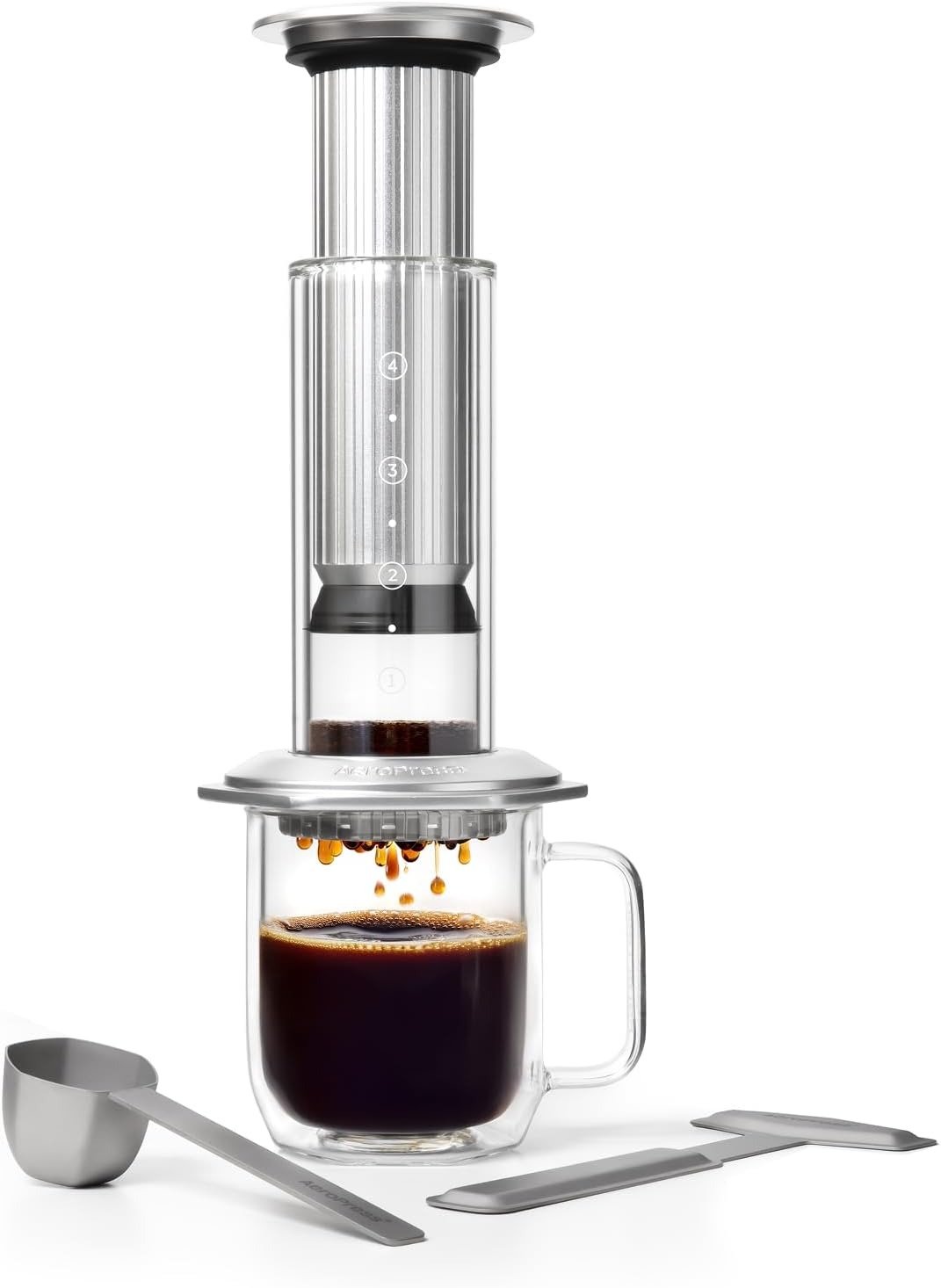
AEROPRESS PREMIUM
The Coffee Tastes Great. That’s Not Actually the Problem.
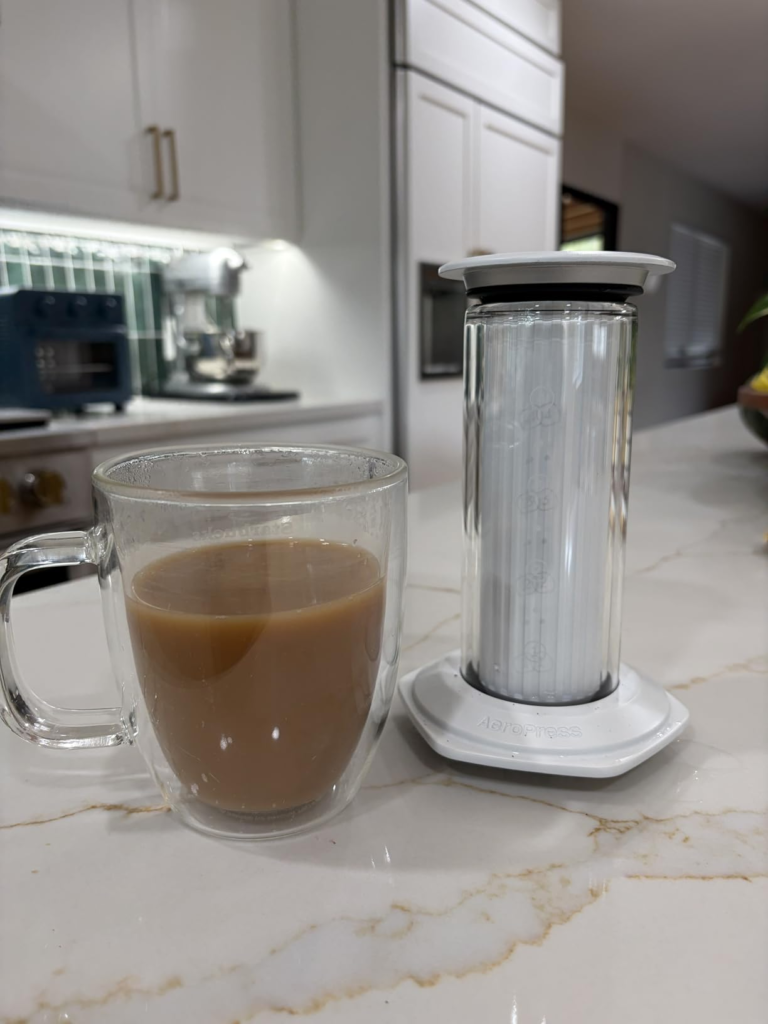
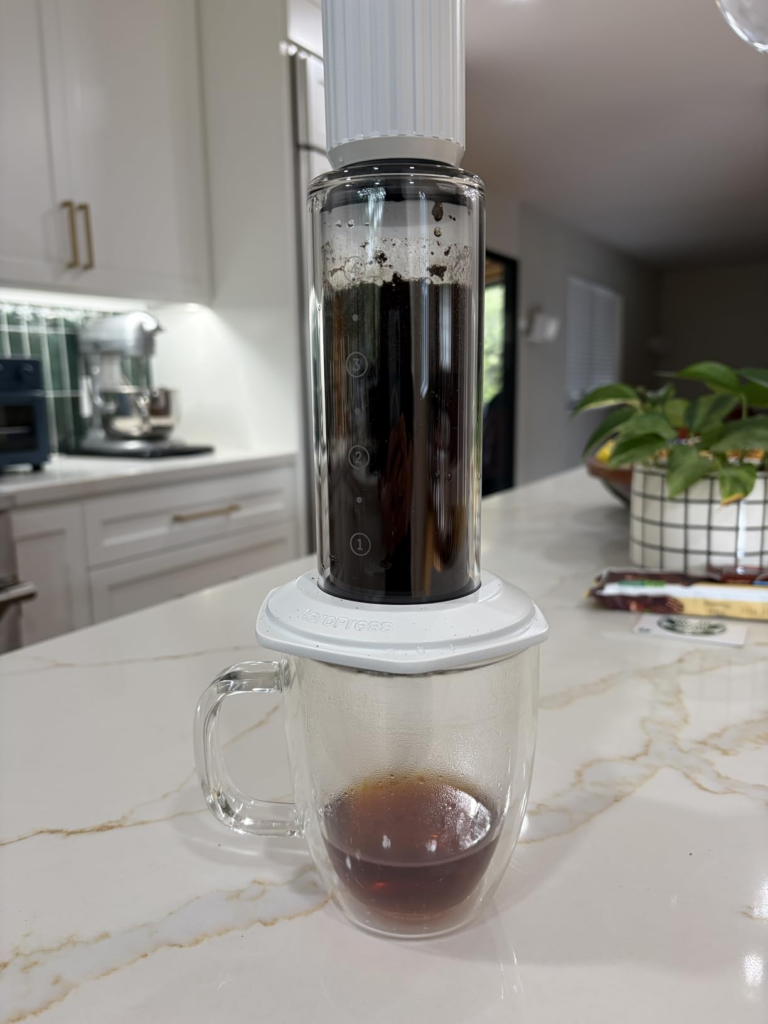
You pour the water. You see it bloom through the glass. The aluminum plunger descends with deliberate weight. The coffee comes out smooth, full-bodied, cleanly bitter-free.
And somewhere in that moment, you feel like you finally own your morning.
That feeling is real. The AeroPress Premium delivers it. But it delivers it to a very specific type of person — and misidentifying yourself as that person is exactly how $150 disappears with low-grade regret attached.
The AeroPress Premium reimagines the beloved original with materials like stainless steel, dual-walled glass, and aluminum. But in pursuing that elegance, it sacrifices some of the very traits that made the original a cult favorite: affordability, portability, and rugged durability.
That’s not a flaw in the product. It’s a flaw in the assumption most buyers bring to it.
What You’re Actually Feeling Before You Buy This
There’s a specific dissatisfaction that drives people toward the AeroPress Premium, and it has almost nothing to do with coffee quality.
It’s this: the plastic version works perfectly, and that bothers you.
You’ve been brewing excellent coffee for two years with a $39 tube of polypropylene. The cup is honest. The process is fast. But every morning you’re handling hot water and a plastic chamber, and something small and persistent objects to that. Not loudly. Not urgently. Just… quietly.
The AeroPress has long been a favorite among coffee and health enthusiasts, and while it has always been BPA-free, the AeroPress has now been reimagined with plastic-free materials. That’s the real signal this product is responding to — not a broken brewing method, but a materials anxiety that the original’s performance could never fully silence.
If you recognize that feeling, you’re probably the right buyer. If you’ve never felt it, you’re not.
The Hidden Mechanism Behind the Material Upgrade
Here is what most reviews fail to explain clearly: the AeroPress Premium does not primarily improve your coffee. It primarily improves your relationship with the act of making it.
In side-by-side tests, the Premium consistently extracted slightly more from the same dose and grind — about a quarter of a percent higher on average. While this is a measurable difference, it’s not necessarily perceptible in the cup.
The glass chamber handles heat differently than plastic — and not always in the direction you’d expect. The combination of metal and glass pulls more heat from the brewing liquid compared to plastic. Even when preheated, the Premium starts at a slightly lower peak temperature. However, its greater thermal mass means it retains heat better over time.
In practical terms: for a standard two-minute brew, the thermal difference is marginal. For extended steeps of ten minutes or more, the Premium genuinely outperforms the original in heat retention. For typical shorter brews, any flavor difference is likely to be marginal. Longer extraction times may show more meaningful differences in heat retention and extraction level.
Most users brew for two minutes. That means most users are not buying this for measurable coffee improvement. They are buying it for something else — and they should know that before they click purchase.
The Threshold Where the Experience Quietly Breaks
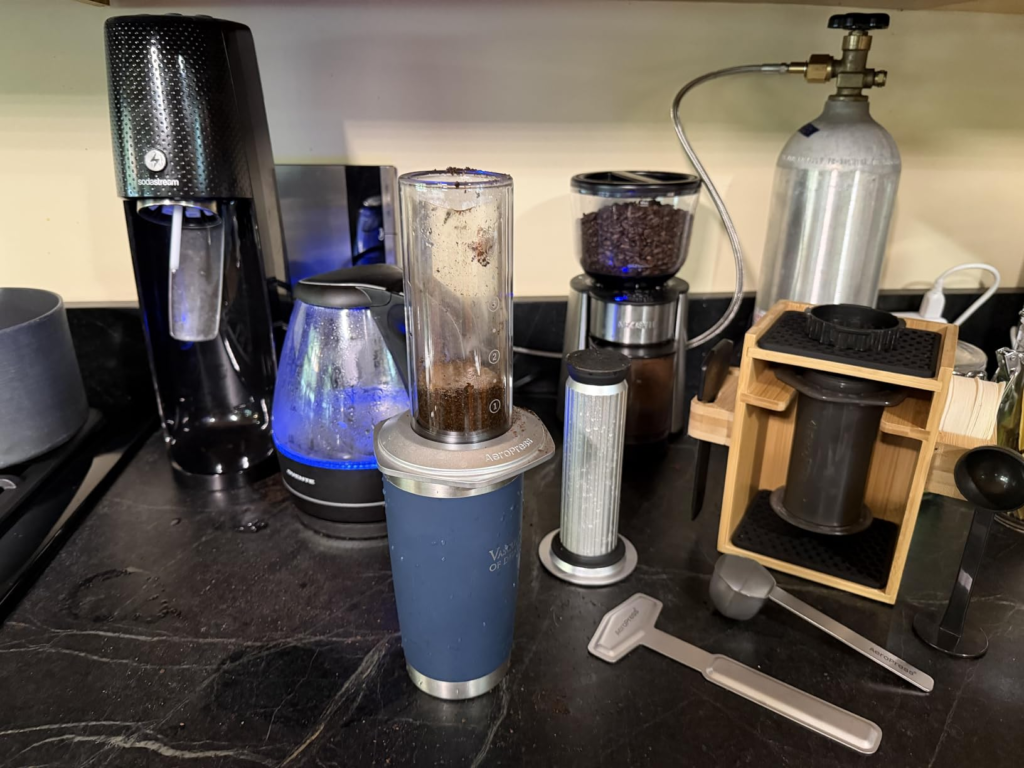
The AeroPress Premium is a countertop object. It is not a travel object, a camping object, a rushed-morning object, or a take-it-to-the-office object.
All of the upgrades make for a fairly heavy handheld coffee machine. Weighing nearly 2 pounds, the premium model has a lot more heft than the 6.4 ounces in the original.
That weight is not incidental. It signals a complete behavioral shift. The Premium is not a brewer you handle carelessly. It does not get tossed into a bag, plunged aggressively, or set down without some awareness of what it’s made of.
While the borosilicate glass can take a couple of knocks, it does break when tipped over onto a quartz counter from a carafe. One real-world user reported that their Premium broke from a single accidental tip during a routine morning. The glass components are particularly prone to breakage, reducing the brewer’s durability and making it less ideal for on-the-go use or rugged environments.
The threshold is this: if your mornings have any meaningful amount of chaos in them, the Premium will start to feel like a liability rather than a luxury.
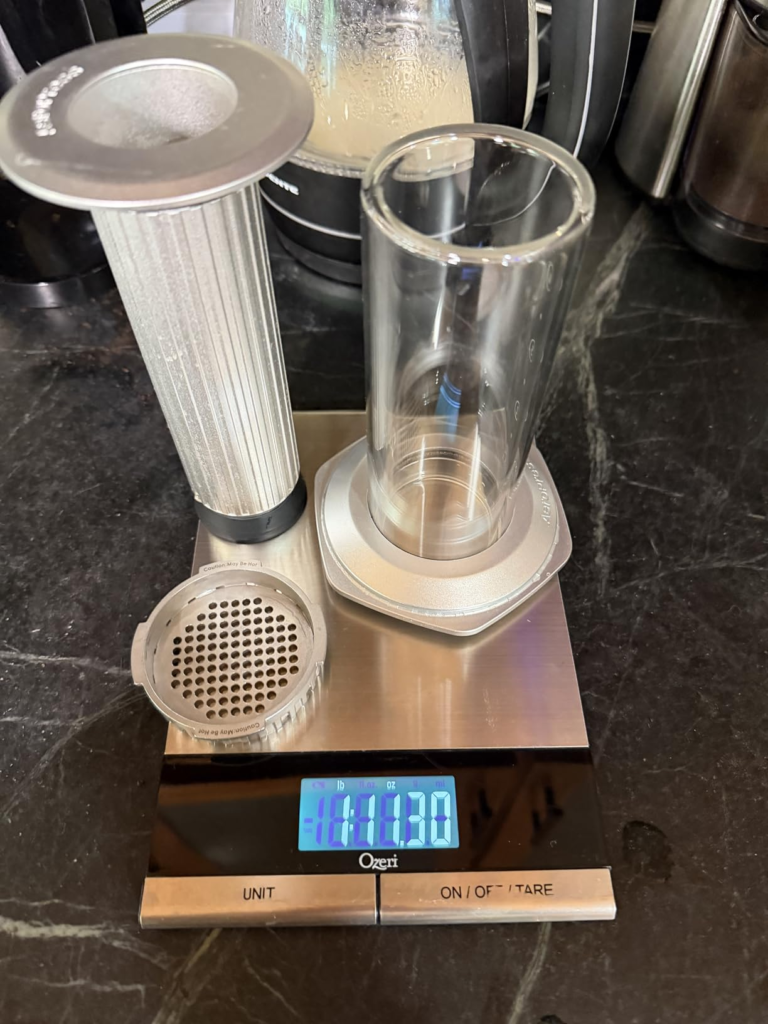
Full Specification & Comparison Table
| Feature | AeroPress Premium | AeroPress Original |
|---|---|---|
| Price | $149.99 | ~$39 |
| Weight | ~1.7 lbs (770g) | 6.4 oz (181g) |
| Chamber Material | Hand-blown double-wall borosilicate glass | BPA-free polypropylene plastic |
| Plunger | Anodized aluminum | Plastic |
| Filter Cap | Stainless steel | Plastic |
| Accessories | Stainless steel scoop + stirrer | Plastic scoop + stirrer |
| Dishwasher Safe | No — hand wash only | Yes (top rack) |
| Travel-Friendly | No | Yes |
| Plastic-Free | Yes | No (BPA-free plastic) |
| Brew Time | ~2 minutes | ~2 minutes |
| Capacity | 10 oz | 10 oz |
| Heat Retention (short brew) | Slightly lower peak temp | Higher peak temp |
| Heat Retention (long steep) | Better sustained temp | Drops faster |
| Extraction Difference | ~0.25% higher | Baseline |
| Taste Difference (2-min brew) | Marginal / not perceptible | Same |
| Fragility Risk | High | Very Low |
Why Most Buyers Misread This Too Early
The comparison trap most people fall into looks like this: “It’s the same AeroPress process, so I’m paying $110 more for materials. That’s irrational.”
That framing is wrong — but it’s also not entirely wrong.
Glass doesn’t hold on to lingering flavors the way plastic sometimes can, which means each cup tastes clean, pure, and exactly how your beans are meant to taste. The glass chamber also holds heat more steadily, giving your coffee a consistent extraction from start to finish.
Those are real, honest improvements. They just aren’t improvements that justify the price jump on the basis of taste alone. The justification lives somewhere else: in the tactile experience, in the elimination of plastic contact anxiety, and in the daily ritual becoming something you deliberately choose rather than merely repeat.
The whole thing feels like brewing in high definition. And the taste? It’s still unmistakably AeroPress: smooth, rich, and remarkably low in acidity. But the upgraded build seems to bring out a touch more clarity, especially when you’re working with delicate beans.
“Touch more clarity” is not a transformation. It is a refinement. People who pay for refinements know they are paying for refinements. People who expect transformation feel cheated.
Real-World Performance Breakdown
| Category | Score | Notes |
|---|---|---|
| Build Quality | ★★★★★ | Exceptional — glass and metal construction feels architectural |
| Brewing Performance | ★★★★☆ | Excellent — identical to original for standard brews |
| Taste Clarity | ★★★★☆ | Marginally better with delicate/light roasts |
| Heat Retention (2-min) | ★★★☆☆ | Slightly lower peak temp than plastic original |
| Heat Retention (10+ min) | ★★★★★ | Outperforms original significantly |
| Portability | ★★☆☆☆ | Not designed for travel or outdoor use |
| Durability | ★★★☆☆ | Survives careful use, vulnerable to careless moments |
| Ease of Cleaning | ★★★★☆ | Hand wash only — no dishwasher |
| Value vs Original | ★★★☆☆ | High for the right buyer, low for the wrong one |
| Aesthetics / Ritual Value | ★★★★★ | Best-looking manual brewer in its category |
Who Is Actually Inside This Problem
You belong in this product’s orbit if you recognize all three of the following:
Your current AeroPress produces coffee you’re genuinely happy with, but the plastic contact still registers as a low-grade concern — especially after hot water steeps for 90 seconds inside it.
Your brewing happens at a fixed location — a kitchen counter, a home office desk — where the brewer is a permanent object rather than a portable accessory.
You have the kind of relationship with your morning coffee where the act of making it carries its own meaning. Not performance for Instagram. Actual private ritual.
The AeroPress Premium is as much a statement piece as it is a coffee maker — ideal for those who are willing to invest in both style and health. That framing is accurate, and it is not an insult. Some purchases are justified by what they change about the experience, not just what they improve in the output.
Where Wrong-Fit Begins
You are not the right buyer if:
You travel with your AeroPress. The weight and fragility of the Premium make bag-packing it a genuine risk. The original and the AeroPress Go were built for mobility. This was not.
You brew quickly in a busy kitchen. If you’re clumsy or tend to rush through your morning routine, this might not be the best choice. The glass demands a slower, more deliberate interaction — not because it’s difficult, but because it cannot absorb the casual carelessness that plastic forgives.
You believe the coffee in your cup will taste noticeably different. It won’t — not for standard two-minute brews. If you’re happy with your current AeroPress, or if budget is a concern, you’re not missing out on better coffee by skipping the Premium.
You expect durability to match the price. Glass at $150 is still glass. Glass, no matter how well made, is always at risk of breaking. One moment of inattention erases the premium feel entirely.
The One Situation Where the AeroPress Premium Becomes Logical
You have a fixed brewing station. You use your AeroPress daily at the same spot. Plastic contact genuinely bothers you — not as an abstract worry, but as a real, recurring thought during the brew. You have tried the original and already know you love the AeroPress method. You are not buying this to discover whether you like AeroPress coffee. You already know.
In that specific profile, the AeroPress Premium review writes itself: it operates smoothly and delivers a great cup of coffee, the materials eliminate the plastic anxiety permanently, and the ritual becomes something you’re proud to engage with every morning.
The price stops feeling like a premium and starts feeling like the correct price for permanently ending a small but persistent daily friction.
What It Solves, What It Reduces, and What It Still Leaves to You
| The Reality | |
|---|---|
| What it eliminates | Plastic contact with hot water, every single brew |
| What it reduces | Flavor interference from material taste memory |
| What it enhances | Ritual quality, tactile satisfaction, visual clarity of brew |
| What it does not change | Your coffee quality if you brew under 3 minutes |
| What it introduces | Fragility risk, weight, hand-wash requirement, non-portability |
| What remains your job | Grind quality, water temperature, coffee sourcing |
| When regret starts | The first time you break it — or the first trip you leave it home for |
Final Compression
The AeroPress Premium review lands here: this is a correct product for a narrow buyer, and an expensive mistake for a wide one.
The coffee method is identical. The ritual is not. The glass matters if plastic bothered you. The weight matters if your mornings move fast. The price is justified by what it changes about your relationship with the brew, not by what it changes in the cup.
As of 2026, AeroPress does not sell a spare glass chamber for the Premium. That detail alone is worth holding in mind: if the chamber breaks, the product is not repairable — it is replaceable, at full cost.
If your brewing is fixed, deliberate, plastic-free by principle, and already AeroPress-faithful — this is where the decision stops being complicated.
If your brewing is mobile, rushed, or coffee-quality-driven first — the $39 original produces the same cup, survives the same bag, and forgives the same morning.
Frequently Asked Questions
| Question | Answer |
|---|---|
| Does the AeroPress Premium taste better than the original? | For standard two-minute brews, the taste difference is marginal and not perceptible to most drinkers. For extended steeps of ten minutes or more, the Premium’s superior heat retention can produce a marginally higher extraction — roughly 0.25% above the original. Grind adjustments easily compensate for this difference. |
| Is the AeroPress Premium worth $150? | Only if you meet a specific profile: fixed brewing location, existing AeroPress user, and genuine plastic-contact concern. If you are new to AeroPress or primarily value portability and coffee quality, the original delivers equivalent results at one-third the price. |
| Can the AeroPress Premium glass chamber break? | Yes. While borosilicate glass is more thermally resistant than standard glass, it is still breakable under impact. One confirmed breakage occurred from a single counter-tip. It is not suitable for travel, camping, or rushed kitchen environments. |
| Is the AeroPress Premium dishwasher safe? | No. Unlike the plastic original, the Premium requires hand washing only. |
| Can I buy a replacement glass chamber if it breaks? | As of 2025, AeroPress does not offer a replacement glass chamber for the Premium. If the glass breaks, the entire unit must be replaced. |
| Who should not buy the AeroPress Premium? | Travelers, outdoor brewers, people who rush through mornings, anyone expecting a dramatic coffee quality improvement, and anyone who would find $150 for a manual brewer difficult to justify on ritual value alone. |
| What is the AeroPress Premium made of? | The brewing chamber is hand-blown double-walled borosilicate glass. The plunger is anodized aluminum. The filter cap is stainless steel. The included accessories (scoop, stirrer) are stainless steel. The plunger seal is silicone. |
Transparency Note:
This analysis is built on aggregated real-world experience.
It extracts what repeatedly holds, what breaks, and what users uncover only after living with the system—then shapes it into a clear model you can use immediately.
Think of it as structured experience, refined and presented so you don’t have to learn it the hard way.
“A quick note: Don’t believe the star ratings, but trust personal experience. This article is a compilation of collected experiences”