SHURE MV7X REVIEW: YOUR ROOM IS THE PROBLEM. THIS MIC WAS ENGINEERED FOR THAT.
You recorded the episode. You listened back. It sounded fine in your headphones — full, warm, present. Then you heard what your listeners actually received: a slightly distant voice floating above a ceiling fan, a keyboard click that survived every take, a low hum that your interface decided to amplify along with your vocal.
The audio wasn’t bad. It just wasn’t isolated. And no amount of post-processing brought it back to what you heard in the moment.
That gap — between what you think you’re capturing and what actually makes it to the final file — is precisely the failure point the Shure MV7X was designed to close.
The Result Looks Fine. The Problem Isn’t.
Most podcasters don’t realize they have a room problem until someone else points it out. The recordings play back. The levels look normal. The waveform fills the timeline. Nothing is obviously wrong.
But dynamic microphones are not equal in how aggressively they reject the environment. Sensitivity, polar pattern execution, internal shock isolation — these are the variables that determine whether your cardioid mic treats your bedroom like a broadcast booth or like an open floor with walls.
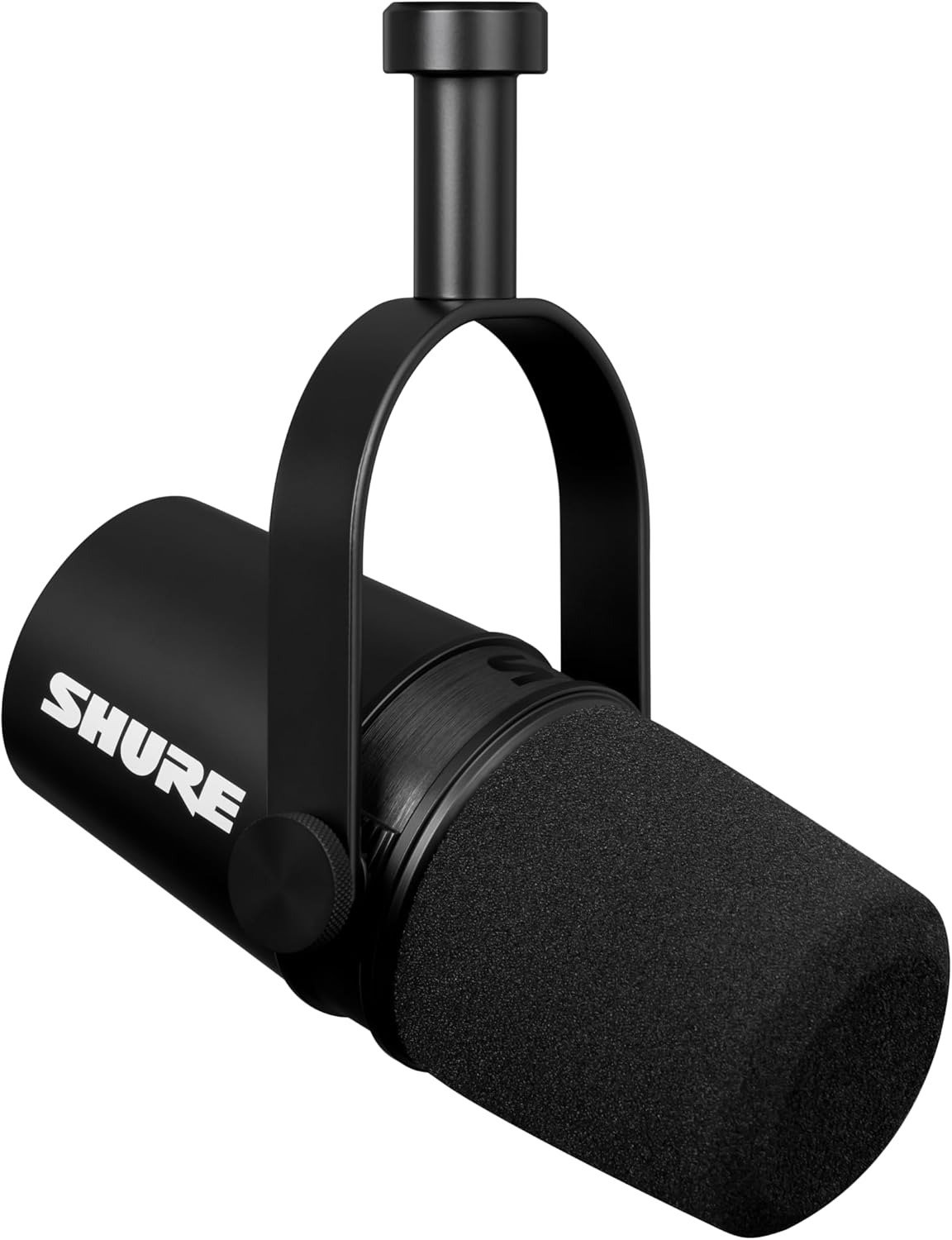
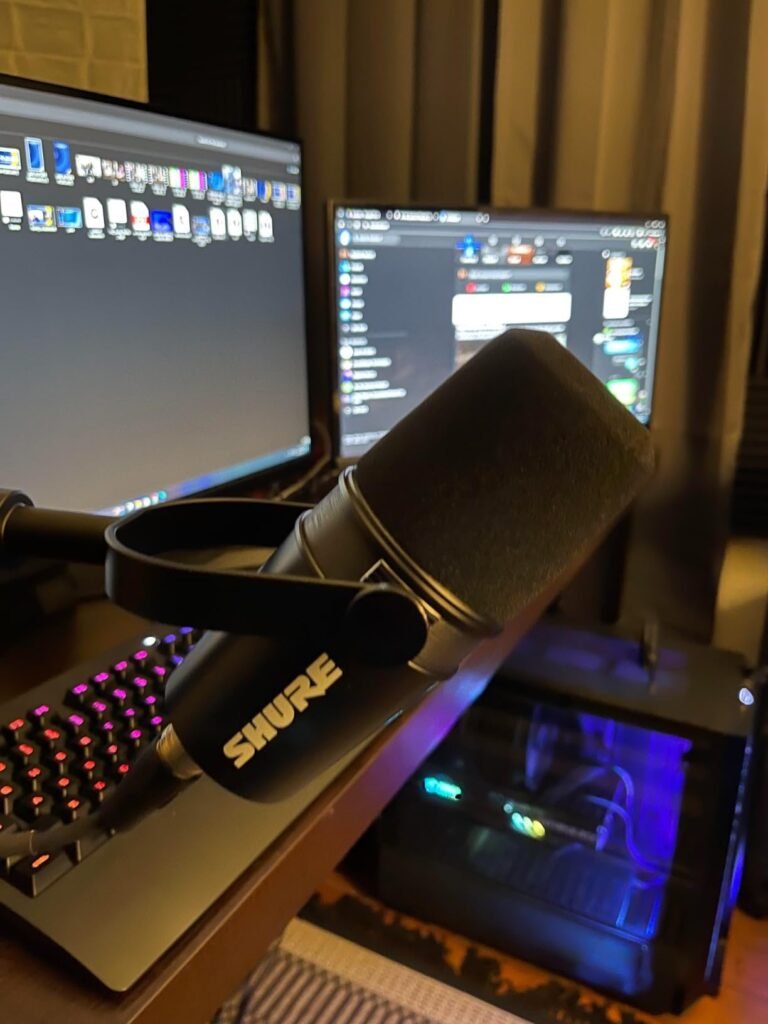
The MV7X was built around this specific asymmetry. Its Voice Isolation Technology isn’t a marketing name for a filter. It’s the combination of three physical elements working together: a dynamic moving-coil cartridge (inherently less sensitive to ambient sound than condenser designs), a tight cardioid polar pattern with aggressive rear rejection, and an internal shock mount that decouples the capsule from desk vibration and mechanical handling noise. The result is that the microphone makes a structural decision before a single signal hit your interface: it narrows the input surface to what is directly in front of it, and treats everything else as irrelevant.
That’s not a feature. That’s an architecture.
What You’re Actually Feeling but Not Naming
Here’s the specific annoyance that brings most people to a mic like this: you’ve already upgraded once. You started with a USB condenser — something that clipped easily, picked up every ambient frequency in the room, and required acoustic treatment you didn’t have. You moved up, but the friction followed you.
Or you’re running a multi-host podcast where each person needs their own dedicated capture. You’ve been managing this with mismatched mics routed through an interface, and the inconsistency is becoming harder to edit around. Everyone sounds slightly different — not in personality, but in depth and presence — and no EQ pass fixes that.
Or you’re a content creator who already owns an audio interface and has been waiting for a mic designed to work with it cleanly, without demanding heroic levels of preamp gain to produce a usable signal.
None of these are beginner problems. All of them are exactly what the MV7X addresses.
The Hidden Mechanism Behind the Miss
The most common failure in dynamic mic selection happens before the first recording. People compare sensitivity numbers — and then buy wrong.
Dynamic microphones are categorically less sensitive than condensers. That’s not a flaw; it’s the physical trade-off that makes them forgiving in imperfect rooms. But within dynamic mics, sensitivity still varies, and that variation determines how hard your interface preamp has to work — and at what gain level noise creeps in.
The MV7X specs at -55 dBV/Pa sensitivity with a 252-ohm output impedance. For comparison, the SM7B — the reference broadcast mic that half the podcasting world aspires toward — is notoriously low-output and often requires an inline preamp like a Cloudlifter to drive it cleanly on modest interfaces. The MV7X was specifically engineered to work without that. Its output level is sufficient for most modern audio interfaces to reach a clean, usable signal without maxing the preamp gain — which is the gain region where interface noise becomes audible.
Independent reviewers confirmed this directly: the MV7X does not ask for a heavy gain load, which means standard interfaces capture it cleanly without introducing preamp noise into the signal chain.
That’s the hidden mechanism most buyers miss when comparing specs on paper. The number that matters isn’t just sensitivity. It’s whether your specific interface can drive that sensitivity cleanly at a reasonable gain setting.
The Threshold Where the Outcome Quietly Breaks
The MV7X performs inside a defined operating envelope. Outside it, the promise of broadcast clarity starts to bend.
| Condition | MV7X Behavior |
|---|---|
| Close-mic distance (2–6 inches) | Optimal. Vocal presence is full, sibilance controlled, plosives largely managed by built-in windscreen |
| Mid-distance (8–12 inches) | Workable, but proximity effect diminishes; voice thins slightly |
| Far distance (12+ inches) | Signal loss begins to require higher interface gain, which reintroduces noise floor risk |
| Untreated bedroom/living room | Rear rejection handles most ambient bleed; imperfect rooms are the design brief |
| Live instrument recording | Dynamic capsule handles high SPL; not designed for this use, but tolerates it |
| Condenser-level room detail | Not achievable — this is a dynamic mic and intentionally so |
The threshold that breaks the outcome is distance. The MV7X is a close-mic instrument. Podcasters who sit far from their microphone — or who prefer to record without close mouth proximity — will push the mic past its clean operating range and inadvertently reintroduce the problems they were solving.
This isn’t a critique. It’s a boundary condition. Close-mic discipline is the prerequisite for everything the MV7X delivers.
Why Most Buyers Misread This Too Early
The most common wrong comparison is MV7X versus the MV7.
People see two microphones from the same manufacturer, nearly identical physical form factors, the same capsule, the same frequency response (50 Hz–16 kHz), the same sensitivity spec. They conclude the MV7X is simply an MV7 with features removed — specifically, the USB output and the touch panel — and therefore a worse value.
This misreads what was actually changed. The MV7X has a lower output impedance than the MV7 (252 ohm versus 314 ohm at 1kHz). This is a meaningful electrical difference in how cleanly the signal transfers to an interface preamp. Podcastage — one of the most cited independent podcast gear reviewers — evaluated both mics directly over XLR and concluded that the MV7X XLR output sounds noticeably better than the MV7’s XLR output, despite identical capsule hardware. The reason is circuit design: the MV7X was engineered from the ground up as a dedicated XLR instrument, not as a hybrid mic with USB capability bolted alongside XLR.
The second wrong comparison is MV7X versus the SM7B. The SM7B is a professional broadcast standard. It is also significantly more demanding on preamp gain, typically requires a Cloudlifter on budget interfaces, and retails nearly twice the price of the MV7X. The MV7X shares the SM7B’s cardioid-dynamic philosophy and its general form factor, but it is not a direct substitute. It is an accessible entry point into that architecture — with the practical advantage that it works cleanly with standard interfaces without additional hardware investment.
Who Is Actually Inside This Problem
| Profile | Does the MV7X fit? |
|---|---|
| Podcaster with existing XLR interface (Focusrite, Scarlett, Audient, etc.) | Yes — core use case |
| Multi-host podcast running several mics into one interface | Yes — XLR-only design makes this clean and cost-efficient |
| Solo creator moving from USB condenser, keeping workflow simple | Yes — if XLR chain is already in place |
| Streamer who wants a single-cable, no-software setup | Yes — no drivers, no app dependency |
| Voiceover artist working in an untreated home space | Yes — Voice Isolation Technology is built for this |
| Musician needing an instrument-quality recording mic | Partial — handles high SPL well, but optimized for speech |
| Absolute beginner with no interface and no XLR chain | No — this mic requires an interface; it will not plug directly into a computer |
Where Wrong-Fit Begins
The MV7X has no USB output. That is not a minor omission for certain buyers — it is a structural incompatibility.
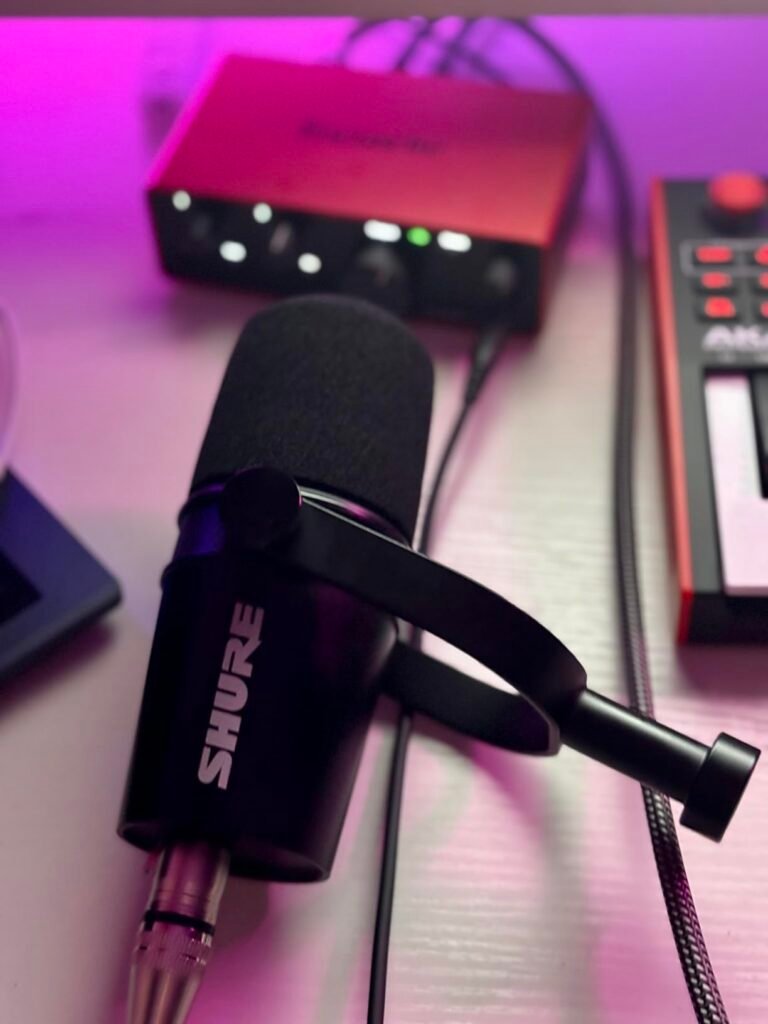
If you are starting from zero and have no audio interface, the MV7X is the second purchase in a chain, not the first. You will need an interface. Budget options from Focusrite, Audient, or Behringer can bring the total investment to a manageable number, but the infrastructure requirement is real and non-negotiable. Buyers who expect the MV7X to replicate the plug-and-play simplicity of a USB mic will feel the friction immediately.
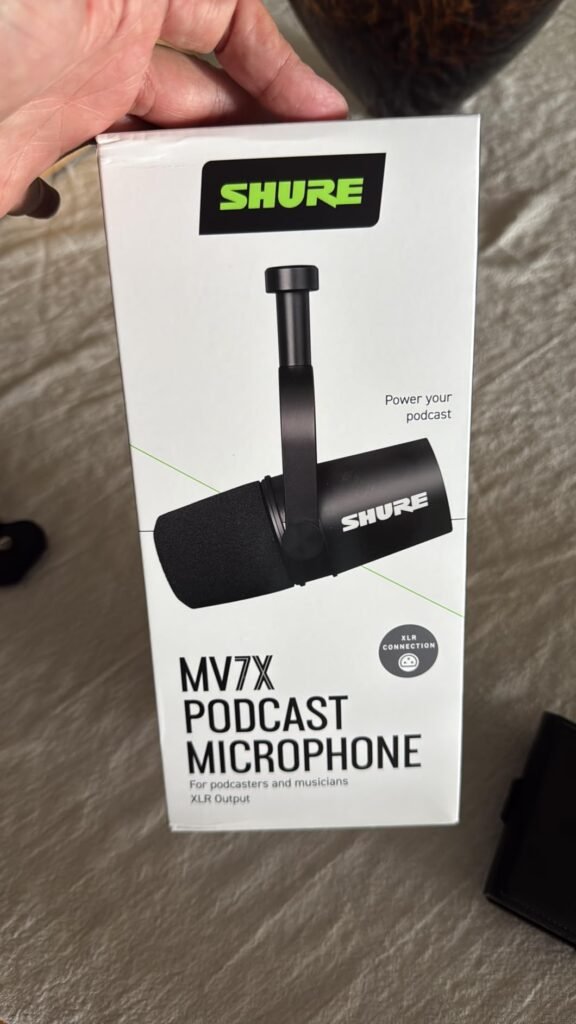
Additionally: the MV7X includes no XLR cable. The box contains the mic, a yoke mount, and a thread adapter. If you do not already own an XLR cable, that is an additional item to source before the first recording session. This catches a meaningful number of first-time XLR buyers off guard.
The MV7X also has no on-board controls. There is no mute button, no gain knob, no headphone output. All signal monitoring and adjustment happens through your interface or DAW. For creators who need to mute quickly during a live stream without touching software, this is a functional gap.
Finally: if your room contains serious acoustic problems — parallel hard walls with strong flutter echo, a live tiled bathroom-style space, persistent HVAC hum close to the mic — the MV7X’s Voice Isolation Technology will reduce the problem but will not eliminate it. Dynamic cardioid rejection is a mitigation tool, not a room treatment substitute.
The One Situation Where This Product Becomes Logical
You already own an audio interface. You are recording voice — podcast episodes, YouTube narration, streaming, voiceover work. You want the closest approximation of professional broadcast sound without the cost of the SM7B and without the preamp-gain requirements that make the SM7B complicated on modest interfaces.
That is the exact situation the MV7X was designed for.
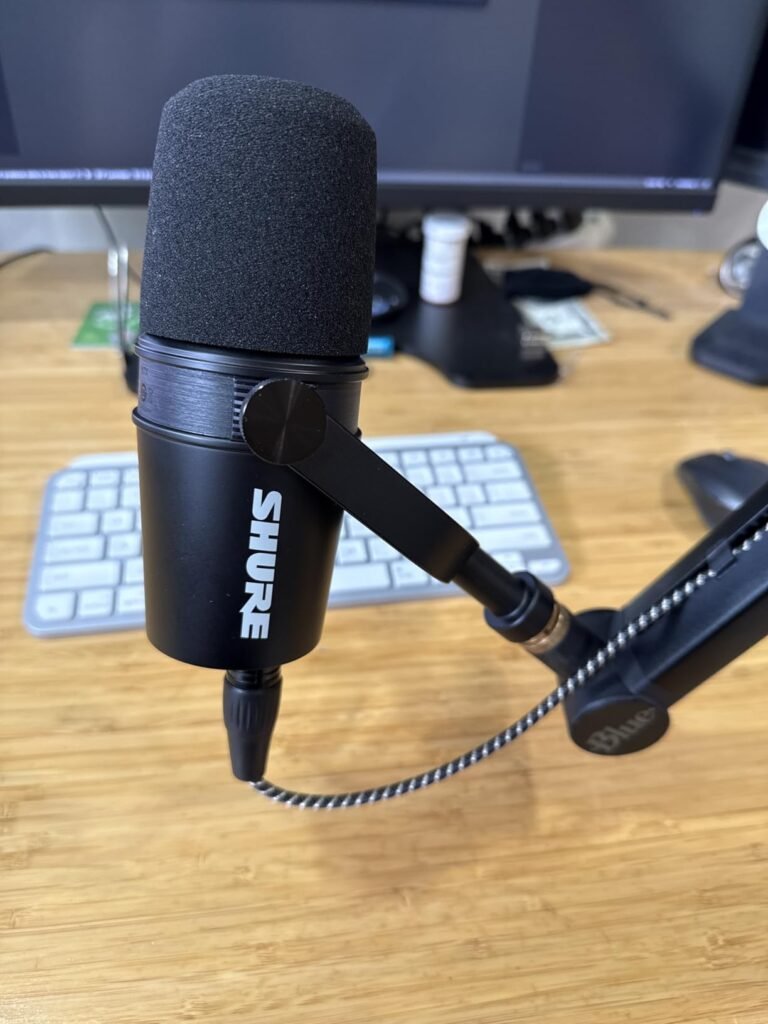
It connects via XLR to your interface. It requires no phantom power — it is a passive dynamic microphone. It produces a clean, warm, mid-forward vocal character with controlled sibilance and aggressive rear rejection. The all-metal construction means it survives daily handling without drift in capsule performance. The internal shock mount means desk vibration doesn’t translate into low-frequency rumble on the recording.
And because it is XLR-only by design — not as a compromise, but as a deliberate engineering focus — the signal path it presents to your interface is cleaner than the hybrid MV7’s XLR output. For a setup centered around an XLR chain, that matters.
Current price on Amazon: approximately $199 (check current price — periodic discounts have brought it to the $157–$165 range).
What It Solves, What It Reduces, and What It Still Leaves to You
| Category | Outcome |
|---|---|
| Room bleed from behind the mic | Solved — cardioid pattern with rear rejection handles this structurally |
| Desk vibration and handling noise | Solved — internal shock mount decouples the capsule |
| Preamp gain requirements on modest interfaces | Reduced — higher output than SM7B; works without Cloudlifter on most modern interfaces |
| Sibilance harshness | Reduced — dynamic capsule naturally controls high-frequency transients |
| Plosive management | Reduced — built-in windscreen handles moderate plosives; close-up speakers may still want an external pop filter |
| Flutter echo in fully untreated rooms | Partially reduced — cannot substitute for acoustic treatment in highly reflective spaces |
| On-board monitoring or muting | Not addressed — no headphone output, no mute button |
| Software-free control | Not addressed — all gain control is at the interface |
| Versatility beyond voice | Limited — optimized for speech, adequate for high-SPL instruments |
The MV7X solves the most common problems at the source: the room, the desk, the interface gain chain. What remains your responsibility is the front-of-room acoustic environment, your monitoring workflow, and mic technique — specifically, staying within close proximity.
Final Compression
The Shure MV7X is not the most feature-rich microphone at its price point. It has no USB output, no on-board controls, no headphone monitoring, and no companion app.
What it has is a purpose-built XLR dynamic capsule, optimized from the circuit level for clean delivery to standard audio interfaces, housed in an all-metal chassis with internal shock isolation, tuned specifically for vocal intelligibility in untreated environments, carrying the acoustic lineage of the SM7B at a fraction of the preamp complexity and cost.
For creators who already operate an XLR chain and need a microphone that treats their bedroom like a booth, this is the decision that stops being complicated.
The logical next step, if your setup already includes an audio interface and XLR capability, is here:
Frequently Asked Questions
| Question | Answer |
|---|---|
| Does the Shure MV7X require phantom power? | No. The MV7X is a passive dynamic microphone. It draws no power from your interface and does not require phantom power (+48V) to operate. This also means it is compatible with virtually any XLR input — interfaces, mixers, podcast recorders — without configuration. |
| Can I connect the Shure MV7X directly to my computer without an interface? | No. The MV7X has an XLR-only output. It cannot connect directly to a computer via USB. You need an audio interface with an XLR input (such as a Focusrite Scarlett Solo, Audient iD4, or similar) to use this microphone with a computer. |
| Is the Shure MV7X XLR output better than the Shure MV7’s XLR output? | Independent testing indicates yes. Although both mics share the same capsule and physical design, the MV7X has a lower output impedance (252 ohm vs 314 ohm) and was engineered as a dedicated XLR instrument rather than a hybrid USB/XLR device. Several reviewers, including Podcastage, have confirmed the MV7X’s XLR output is noticeably cleaner than the MV7’s over the same chain. |
| Do I need a Cloudlifter or inline preamp booster with the MV7X? | In most cases, no. Unlike the SM7B — which has very low output and frequently requires a Cloudlifter on budget interfaces — the MV7X produces enough output signal to drive most modern audio interfaces cleanly without additional gain assistance. At very low-gain interface settings, a Cloudlifter could improve signal-to-noise ratio, but it is not a standard requirement. |
| Does the Shure MV7X pick up background noise? | Less than most microphones in its category. Its cardioid polar pattern aggressively rejects sound from behind the microphone, and the dynamic capsule design is inherently less sensitive to ambient room noise than condenser microphones. However, no dynamic mic eliminates environmental noise entirely — close-mic technique and keeping the mic pointed directly at your mouth remain important for optimal isolation. |
| What is the difference between the Shure MV7X and the Shure MV7? | The MV7 offers both XLR and USB outputs, an on-board touch panel for gain and headphone control, and compatibility with Shure’s MOTIV software app. The MV7X is XLR-only with no on-board controls, no headphone output, and no software dependency. The MV7X was designed specifically for XLR-based setups and produces a cleaner XLR signal than the MV7 due to its dedicated circuit design. |
| Is the MV7X good for streaming? | Yes, for streamers who already run an audio interface in their setup. The no-phantom-power requirement and clean XLR output integrate smoothly into standard streaming chains (OBS, Streamlabs, etc.). The absence of on-board muting may be a consideration for live streamers who need to mute quickly — this would need to be handled via software or a dedicated mute switch on the interface. |
| What audio interface works best with the Shure MV7X? | Any interface with a clean XLR preamp will work. Common pairings include the Focusrite Scarlett Solo or 2i2, the Audient iD4 or iD14, the Universal Audio Volt 1, and the MOTU M2. The MV7X does not require high-gain preamps, so even entry-level interfaces handle it cleanly. |
Transparency Note:
This analysis is built on aggregated real-world experience. It extracts what repeatedly holds, what breaks, and what users uncover only after living with the system—then shapes it into a clear model you can use immediately. Think of it as structured experience, refined and presented so you don’t have to learn it the hard way.
“A quick note: Don’t believe the star ratings, but trust personal experience. This article is a compilation of collected experiences”