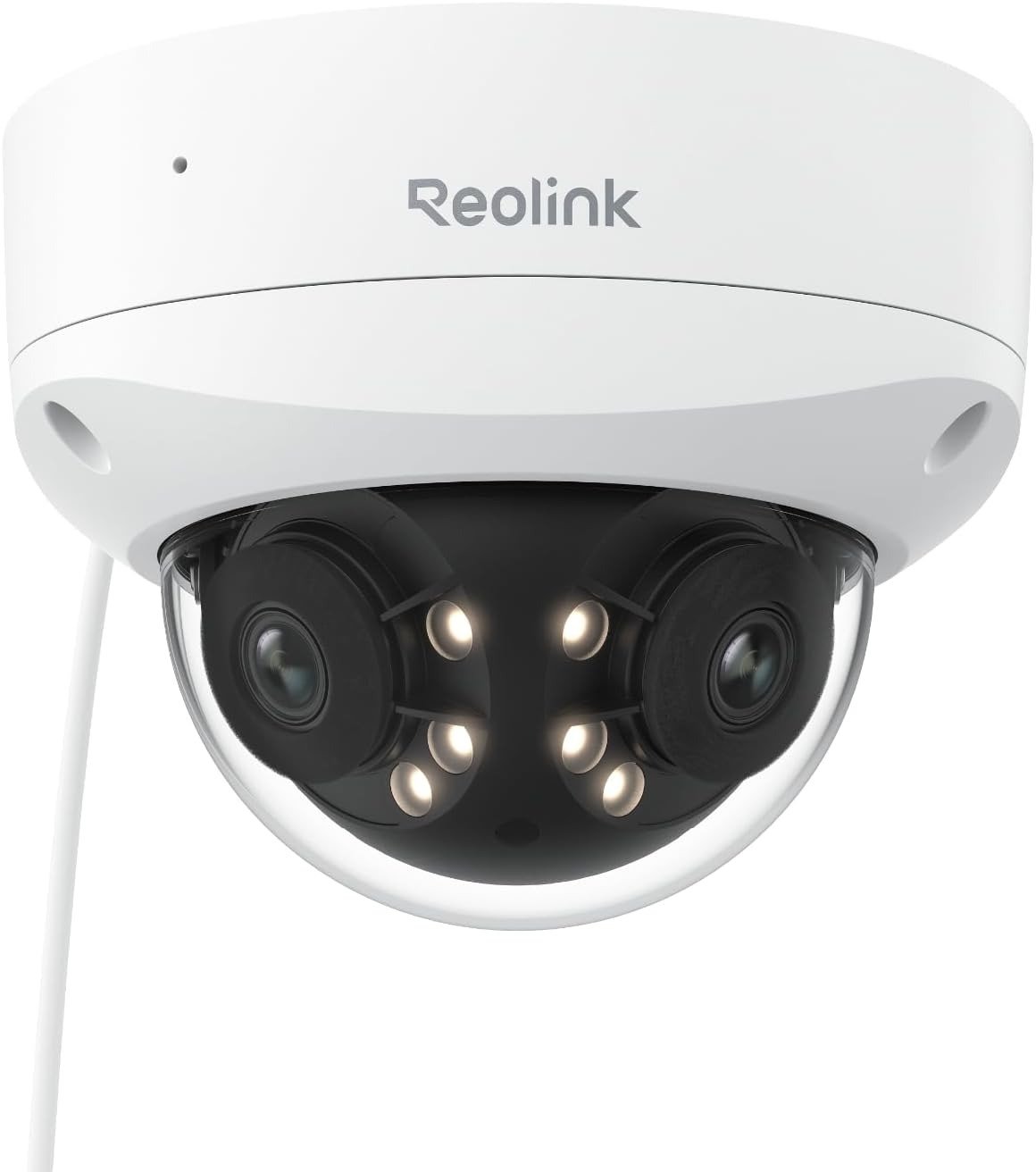
REOLINK DUO 2V POE REVIEW: YOU BOUGHT 180° COVERAGE AND STILL MISSED WHAT HAPPENED — HERE’S WHY
Three months ago, I watched my neighbor’s driveway footage with him. Someone had taken his delivery. The camera caught everything — the full width of the driveway, wall to gate, crystal-clear in 4K. The intruder walked straight under the camera, grabbed the package, and left.
The face? Partially cut off. The lower body? Gone from the frame entirely.
He had a wide-angle panoramic camera. He assumed wide meant complete. It didn’t. And the Reolink Duo 2V PoE — which is exactly what he owned — sits right at that edge, where the right buyer wins decisively and the wrong buyer spends weeks wondering what went wrong.
I’ve analyzed the full specifications, cross-referenced multiple hands-on reviews, and pulled real user data. Here’s what I found.
Reolink Duo 2V PoE Vertical Field of View: The Result Looks Fine — The Problem Isn’t
Open the live feed on the Reolink app for the first time and you’ll feel it: this is a serious camera. The image sweeps your entire driveway from one edge to the other in a single seamless 4K frame. The stitching is nearly invisible. The detail is sharp enough to read a text message on someone’s phone at 8 meters.
That feeling is real. And it’s entirely horizontal.
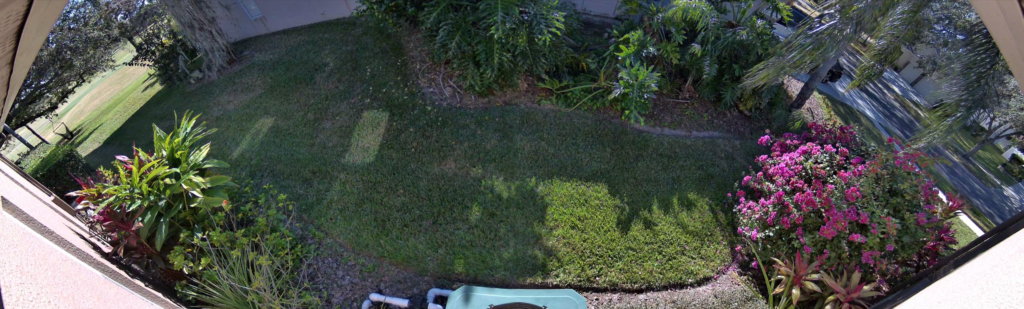
What the camera is actually delivering is 180° of horizontal coverage packed into a 5,120 × 1,552-pixel frame. That second number — 1,552 pixels of height — is where the story quietly changes. The vertical field of view on the Duo 2V PoE measures 57°. That’s not a firmware error or a manufacturing compromise. It’s the structural output of a design choice that prioritizes horizontal width above all other dimensions.
In the right scenario, that’s precisely what you want.
In the wrong one, you’ll keep checking the notifications, watching the clips, and feeling like something is consistently off — without being able to name exactly what.
| Specification | Reolink Duo 2V PoE |
|---|---|
| Resolution | 4K 8MP — 5,120 × 1,552 pixels |
| Frame Rate | 20 fps |
| Horizontal FOV | 180° |
| Vertical FOV | 57° — narrowest in its class |
| Lens Design | Dual fixed 2.8 mm |
| Video Codec | H.265 |
| IR Night Vision Range | Up to 30 m (black & white) |
| Color Night Vision | Spotlight-activated — full color |
| Weatherproof Rating | IP67 |
| Vandal-Proof Rating | IK10 — highest available |
| Operating Temperature | −15°C to 45°C (5°F to 113°F) |
| MicroSD Capacity | Up to 512 GB |
| PoE Standard | 802.3af — 48 V active |
| Two-Way Audio | Yes |
| Pan / Tilt | No — manual bracket only |
| Day Range (Face ID) | ~10 m reliable |
| Day Range (Plate Read) | 10–15 m |
| Price (Amazon) | ~$140 |
57° Vertical Gap on Reolink Duo 2V PoE: What You’re Actually Feeling but Not Naming
Why do you keep zooming into the recordings?
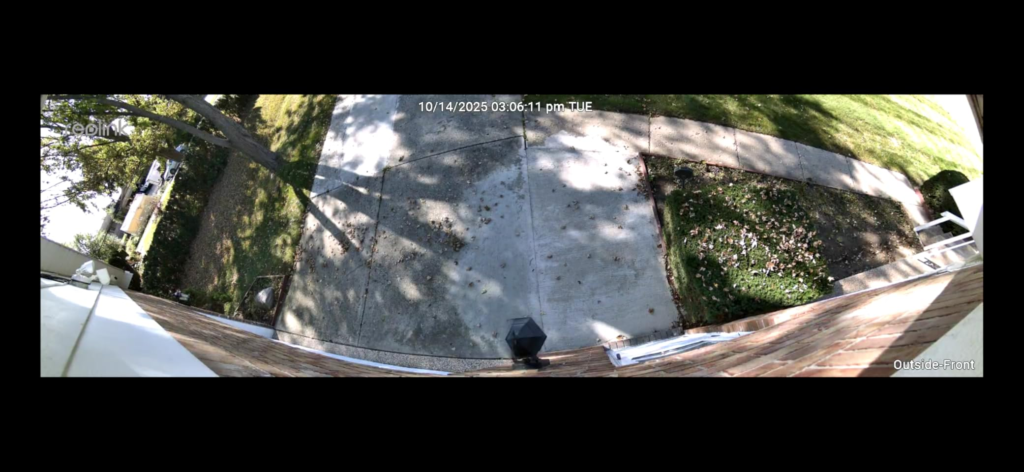
That’s the question nobody asks out loud, but it’s the first behavior that surfaces when a camera is doing its job on the wrong axis. The Duo 2V PoE captures everything side to side without compromise. Someone walks the full length of your driveway — you see it all. They cross from the gate to the door — frame to frame, clear. But the moment someone stands directly below the mounting point at close range, something disappears.
Not from technical failure. From geometry.
Why does this keep catching buyers off guard? Because the spec sheet lists 180° and the brain reads that as “comprehensive coverage in every direction.” It isn’t. The 180° is strictly horizontal. And the 57° vertical window — which sounds reasonable until you measure it against a mounting height of 2.5–3 meters — begins cutting the lower body off at a range closer than most people expect.
I’ve seen buyers describe this as “the image just looks cropped” or “I thought it was a resolution problem at the bottom of the frame.” It isn’t a resolution problem. The resolution is excellent. The friction is structural, and it’s predictable — if you know the number before you mount the camera, not after.
At a 3-meter wall installation, the 57° vertical angle covers approximately 2.9 meters of ground depth directly below the camera. Anything standing closer than 1.2–1.5 meters to the base of the wall starts exiting the bottom of the frame. That’s the threshold. And once you know it, you can either use it to your advantage or route around it entirely.
Reolink Duo 2V PoE Dual-Lens Stitching: The Hidden Mechanism Behind the Miss
Why does a camera with two lenses end up with narrower vertical range than many single-lens models?
This is the question that exposes the actual mechanism — and once you understand it, the 57° number stops feeling mysterious and starts feeling inevitable.
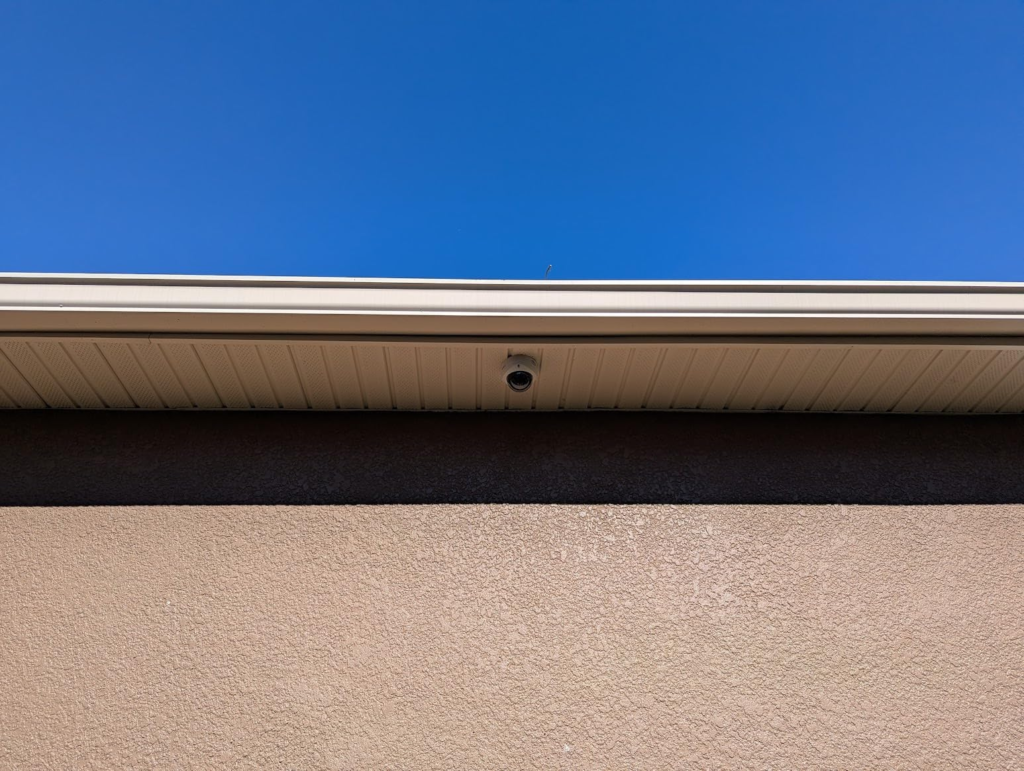
The Duo 2V PoE captures two separate images simultaneously, one from each 2.8 mm lens. Those images are then merged horizontally — side by side — by Reolink’s dual-image stitching algorithm. The result is a single panoramic frame that’s extraordinarily wide but not proportionally tall.
Each lens sees roughly 90° of horizontal angle. Merge two 90° horizontal captures and you get 180° horizontal coverage. What doesn’t multiply in this operation is the vertical. Both lenses share the same vertical field of view — 57° — and stitching them left to right doesn’t change that number at all. Vertical angle is determined by the sensor geometry and the 2.8 mm focal length. No stitching algorithm changes physics.
This is structurally different from how most buyers imagine two lenses working. The mental model is usually something like: “two lenses means more coverage everywhere.” It doesn’t. It means more coverage in the direction of stitching — horizontal — and identical coverage in the perpendicular dimension — vertical.
There’s also a housing factor. The 2V’s IK10 dome design physically constrains how far the lenses can tilt downward inside the enclosure. The standard Reolink Duo 2 PoE — the bullet-style version without the vandal-proof housing — has a wider vertical FOV because the lenses are mounted with greater downward exposure. You gain IK10 protection with the 2V. The trade is a tighter vertical window.
Understanding this mechanism is the difference between choosing the right camera and choosing a camera that records everything except what you needed to see.
Reolink Duo 2V PoE Performance Threshold: Where the Outcome Quietly Breaks
Every camera has a sweet spot. Beyond that spot, coverage starts to feel wrong — not broken, just persistently insufficient.
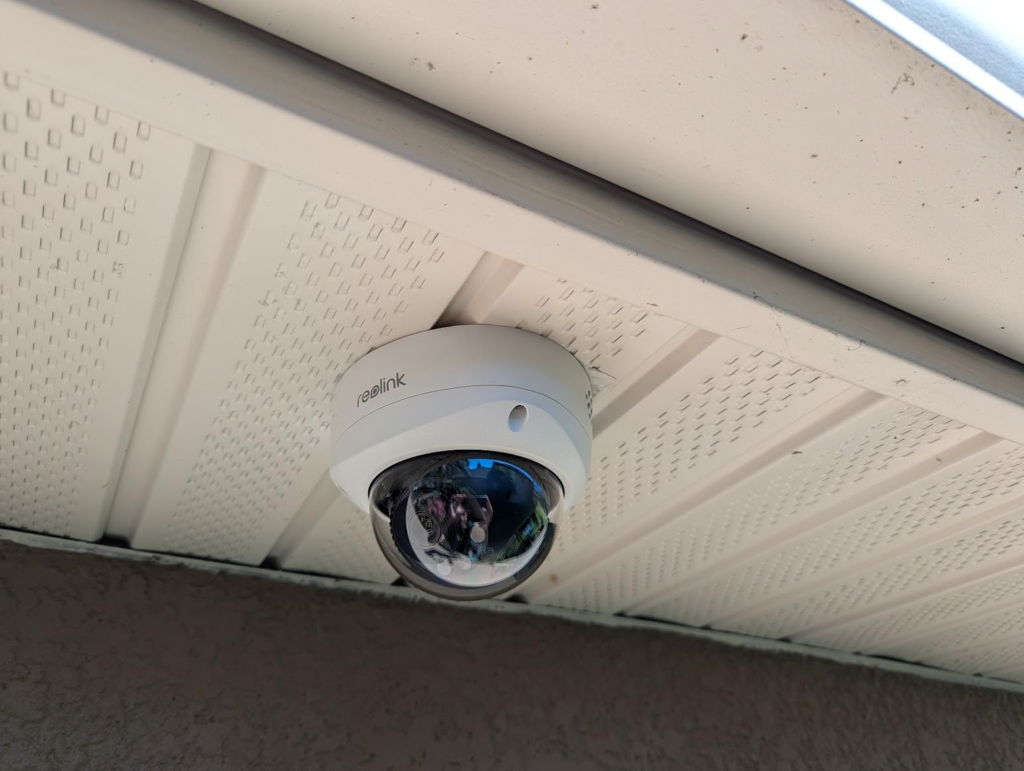
For the Duo 2V PoE, the threshold sits at a very specific intersection: horizontal-dominant outdoor environments, mounting height of 3 meters or above, where the primary monitoring axis is left-to-right rather than top-to-bottom.
Below that threshold — meaning the camera is placed in that environment — it performs decisively. A driveway at 3.5 meters covering 12 meters of horizontal space. A commercial entrance spanning a wide threshold. A parking bay viewed from above. These are the environments the Duo 2V PoE was built for, and in them it genuinely replaces two standard cameras without visible compromise.
Above that threshold — meaning the environment demands vertical range — the camera’s advantage evaporates. A stairwell where you need to see feet and faces simultaneously. A corridor where someone walks directly below the mounting point. An entryway where you’re regularly trying to see the full body of someone standing 1 meter from the wall. In these spaces, the 57° vertical ceiling cuts the footage before it covers what you actually need.
| Mounting Height | Approx. Vertical Ground Depth | Ideal Scenario |
|---|---|---|
| 2.5 m | ~2.1 m from wall base | Narrow corridor, tight indoor space |
| 3.0 m | ~2.9 m from wall base | Standard driveway, residential gate |
| 3.5 m | ~3.6 m from wall base | Wide driveway, double garage entrance |
| 4.0 m | ~4.3 m from wall base | Commercial entrance, car park bay |
| 5.0 m+ | ~5.6 m+ from wall base | Parking lot overhead, warehouse entrance |
These are approximate geometry-based estimates. Actual coverage varies with bracket tilt and camera positioning.
The threshold isn’t a flaw. It’s a fit condition. Know it before you mount — and the rest of this camera becomes a compelling argument.
Reolink Duo 2V PoE Specs vs. Reality: Why Most Buyers Misread This Too Early
The first mistake I see buyers make with this camera is the spec comparison.
They pull up two cameras side by side. One is a standard 1080p outdoor dome. The other is the Duo 2V. They see “4K” vs. “1080p,” “180°” vs. “100°,” “IK10 + IP67” vs. “IP66 only.” The Duo 2V wins the spec column at every row. They buy it. Three weeks later they realize they bought the wrong camera for their stairwell.
Why does this happen? Because the 180° number leads the specification with a very large figure, and the vertical angle — 57° — sits quietly in a footnote that nobody reads before purchase. The brain anchors on the number it understands: bigger angle, more coverage. The real question — coverage in which direction — never gets asked.
The second misread is the “no pan/tilt” label. Buyers assume this means the camera is fixed in all directions. It isn’t. The Duo 2V has a built-in rotation bracket that allows manual lens direction adjustment during installation. What you cannot do is control pan or tilt remotely through the app. Once mounted, it stays there. That’s not a failure — it’s the operational design of a wired vandal-proof dome. Manual fixation is a deliberate security choice, not an omission.
The third misread is third-party NVR compatibility. Amazon’s listing states: “Not support the third-party NVR.” That’s accurate for Reolink’s native protocol. However, once you manually enable ONVIF through the Reolink app, the camera integrates successfully with Synology Surveillance Station, Frigate NVR, Home Assistant, and other ONVIF-compatible platforms. SecurityBros tested this directly and confirmed clean integration. The phrase “not supported” means Reolink won’t troubleshoot that configuration — not that the connection fails.
| What the Listing Says | What It Actually Means |
|---|---|
| “4K panoramic coverage” | 180° horizontal — 57° vertical. Not omnidirectional. |
| “No pan/tilt supported” | No remote motor control. Manual bracket adjustment during install: fully supported. |
| “Not support third-party NVR” | Native Reolink protocol: locked. ONVIF (manually enabled via app): functional. |
| “IK10 vandal-proof” | Metal body: confirmed durable. Polycarbonate dome: IK10-rated, not unbreakable. |
| “IP67 weatherproof” | Full immersion rated. Junction box still recommended at cable entry in heavy rain zones. |
| “PoE powered” | Requires 802.3af active PoE. No power adapter. No PoE injector. Neither is included. |
| “MicroSD up to 512 GB” | Confirmed from Amazon listing. Newegg lists 256 GB. Go with Reolink’s official spec. |
Reolink Duo 2V PoE Target User: Who Is Actually Inside This Problem
I’m not talking about the broad category “person who wants home security.” I’m talking about someone who has felt a specific, repeating friction — and has been quietly absorbing it as normal.
You have a wide outdoor exposure point. A double-car driveway. A 10-meter front property line. A commercial entrance that spans more horizontal space than a single standard camera handles cleanly. You’ve been covering it with two cameras — two cables, two feeds, two slightly mismatched night-vision tones, a gap somewhere in the middle where something always seems to happen. You’ve lived with this long enough that you’ve stopped calling it a problem and started calling it the setup.
That’s the buyer this camera was designed for.
The second buyer is operating in a vandal-prone environment. A parking structure. A retail backroom. A school entrance. A housing estate where cameras have been physically damaged before. The IK10 rating isn’t marketing language — it’s a mechanical certification that means the dome housing survives a 20-joule impact. That’s equivalent to a 5 kg object dropped from 40 cm, or a direct strike with a moderate blunt object. Sticks: covered. Kicks: covered. Intentional blunt force by someone who wants to disable the camera: this camera keeps running.
The third buyer is the zero-subscription operator. This camera stores everything locally. MicroSD up to 512 GB. Reolink NVR with expandable HDD. FTP server or NAS. No cloud account required. No footage leaving the premises unless you send it. No monthly bill. No licensing tier. That’s an increasingly rare combination in 2025, and for operators who care about data ownership, it’s a meaningful differentiator.
Reolink Duo 2V PoE Wrong-Fit Scenarios: Where Wrong-Fit Begins
This is where I’m going to be direct — because the regret pattern with this camera is predictable, and it follows the same profile almost every time.
If your mounting point is below 2.5 meters and you regularly need to see full-body detail of someone standing 1 meter from the wall — this camera will cut off the lower body. The 57° vertical window won’t reach. You’ll see shoulders and above, clearly. Feet and the ground level: gone. A standard single-lens camera with a 90°+ vertical FOV on a corner bracket would cover that scenario better, for less money.
If you’re running a Wi-Fi-only setup without a PoE switch, PoE injector, or NVR — this camera won’t power on. The Duo 2V PoE is wired exclusively, powered through the Ethernet cable via 802.3af active PoE. There is no Wi-Fi variant of the 2V model. There is no included power adapter. Buying this camera without PoE infrastructure means buying a component that has no path to power. This is the most common wrong-fit purchase I’ve seen — and it’s completely avoidable.
If you need software-controlled pan or tilt to follow movement across a scene — this camera stays fixed wherever you install it. No tracking. No motorized rotation. The bracket is for installation angle only. A PTZ or auto-tracking camera is a different product category.
If you’re buying this to monitor an indoor stairwell, a narrow hallway where people walk directly below, or any vertical-priority scenario — the 57° vertical gap will become your daily frustration within the first week. It won’t improve with settings. It’s fixed in the hardware.
| Scenario | Fit Rating | Honest Reason |
|---|---|---|
| Wide outdoor driveway, mount 3–5 m | ✅ Strong fit | Maximizes 180° horizontal advantage in full |
| Vandal-prone commercial outdoor area | ✅ Strong fit | IK10 housing earns its rating in exactly this context |
| Local-storage, zero-subscription setup | ✅ Strong fit | MicroSD or Reolink NVR, no recurring cost |
| Existing Reolink NVR ecosystem | ✅ Strong fit | Single-channel occupancy, seamless integration |
| Overhead parking lot (4 m+ mount) | ✅ Strong fit | Wide horizontal sweep with elevated ground clearance |
| Stairwell or vertical-priority space | ❌ Wrong fit | 57° vertical cuts lower body from close subjects |
| Wi-Fi-only setup, no PoE source | ❌ Wrong fit | No power path — camera won’t function |
| Third-party NVR with native protocol | ⚠️ Partial fit | ONVIF works but requires manual activation; no Reolink support |
| PTZ / auto-tracking required | ❌ Wrong fit | Fixed position only — no motor, no tracking |
| Low indoor mount, close-range subject | ❌ Wrong fit | Vertical gap appears at sub-2 m mounting height |
Reolink Duo 2V PoE: The One Situation Where This Camera Becomes the Logical Choice
Let me give you the exact scenario.
You own a property — residential or light commercial — with a wide horizontal exposure point. A driveway that spans 8–15 meters. A parking bay. A retail entrance. A commercial gate. You’ve either been running two cameras to cover it, or you’ve been tolerating a single wide-angle unit that still leaves corners uncovered.
You have a PoE switch or a Reolink NVR, or you’re willing to install one. You mount the Duo 2V at 3–4 meters, facing the exposure zone. The camera locks onto the entire scene — left boundary to right boundary, gate to sidewalk — in one uninterrupted 4K frame. No stitching gap. No mismatched feeds. No blind stripe in the middle.
At 11 p.m., someone approaches the driveway. The AI catches the human signature. The siren activates. The spotlight fires — not IR gray, but full-color daylight-quality white light. You see the face clearly. The clothing. The vehicle parked at the curb behind them. A push notification arrives on your phone within seconds, with a clip already showing you what triggered it. The neighbor’s cat triggered nothing. The tree moving in the wind triggered nothing. The algorithm distinguished, correctly, because it distinguished the motion of a person from environmental noise.
Three days later, you open the Reolink app and filter by person detection only. You find exactly what you’re looking for in under two minutes. No manual scrubbing through hours of continuous footage.
That’s the complete loop: wide coverage, smart filtering, local storage, IK10 durability, zero subscription. And at $140, replacing two separate cameras with one wired panoramic dome that survives physical interference is a rational decision — not an aspirational one.
Reolink Duo 2V PoE Honest Assessment: What It Solves, What It Reduces, and What It Leaves to You
Night is where most cameras expose their real limits. The Duo 2V has two distinct night vision modes — and the gap between them in real-world performance is meaningful.
| Night Vision Aspect | Performance Level | Honest Reality |
|---|---|---|
| IR Mode (black & white) | Reliable to 30 m | Face detail usable at ~15 m; softer beyond that |
| Spotlight Color Mode | Full color on motion trigger | Reads faces, clothing, and plate colors accurately |
| Spotlight Activation | Motion-triggered or scheduled | Activates visibly — not covert. Announces the camera. |
| False Alarm Control | Low, with AI detection | Occasional misfire in complex multi-motion scenes |
| Horizontal Night Coverage | Matches 180° sweep fully | Same vertical limitation applies at night as in day |
| Deterrence via Siren + Light | Dual activation on detection | Audible siren + flood light — not silent monitoring |
The spotlight mode is where this camera genuinely shines — literally. When motion triggers it, you’re not watching the gray-green IR world most outdoor cameras deliver. You’re watching footage that looks close to daytime quality: accurate colors, readable plates, identifiable faces. For residential and commercial deterrence, this matters.
The trade-off: the spotlight announces itself. Anyone approaching knows they’ve been seen. If covert IR-only monitoring is your priority, the camera can run in that mode — but the detail quality drops considerably versus the spotlight activation. Most buyers in exposed outdoor environments prefer the deterrence over covert operation. That’s the right call for this camera’s context.
What the Reolink Duo 2V PoE genuinely solves:
Wide horizontal coverage gaps that previously required two cameras. Physical vulnerability to vandalism and weather. Subscription costs and cloud dependency. Notification fatigue from false alarms triggered by insects and wind.
What it meaningfully reduces:
The time required to find relevant footage through smart playback filtering. The cable and infrastructure complexity of a two-camera setup.
What it still leaves to you:
Ensuring your PoE switch or NVR delivers proper 802.3af power. Routing your Ethernet cable with cable protection or a junction box at the wall entry point. Tuning the detection zones after installation — the defaults cover too much and generate unnecessary alerts until you refine them. And accepting the vertical FOV limitation as part of the design, not a problem to be patched later.
These are installation decisions. They’re yours. But they’re entirely manageable if you know about them before you mount the camera, not after.
—
Reolink Duo 2V PoE Final Verdict: Should You Buy This Camera?
Here’s the compressed version.
The Duo 2V PoE is the right camera when three conditions align: you have a wide horizontal area to monitor, you have PoE infrastructure in place or planned, and you have a legitimate need for IK10-rated physical durability. At $140, that’s a strong combination — particularly because no comparable IK10-rated 180° panoramic camera at this price point eliminates the subscription requirement the way this one does.
The wrong condition is a vertical monitoring need anywhere you need full-body detail from a low mount, or where subjects routinely stand directly below the camera at close range. In those situations, the 57° vertical FOV will be the source of your primary frustration — consistently, silently, and without a firmware fix.
This camera doesn’t pretend to be everything. That’s part of why it’s useful to someone specific. And that specific buyer gets one of the most durable, horizontally comprehensive, subscription-free outdoor cameras available at this price .
If you’ve read through this analysis and your installation scenario matches — the decision has already been made by the logic of your own situation.
*If your break point starts at a wide horizontal exposure zone, this is where the decision ends.* [Buy the Reolink Duo 2V PoE on Amazon →]
Reolink Duo 2V PoE FAQ: Every Honest Answer Before You Decide
| Question | Answer |
|---|---|
| Does the Reolink Duo 2V PoE require a subscription to function? | No. Every core feature — smart detection, push alerts, app access, local recording, and live view — operates without any subscription. Storage runs on a local microSD card (up to 512 GB), a Reolink NVR, or an FTP/NAS server. No cloud account is required unless you choose to enable optional cloud backup. |
| What PoE equipment do I need to power this camera? | The Duo 2V PoE requires 802.3af active PoE — 48 V standard. Any unmanaged or managed PoE switch that supports 802.3af will work fine. Passive PoE injectors do not reliably power this camera. Neither the PoE switch nor a power adapter is included in the box. |
| Can I use this with Synology, Frigate NVR, or Home Assistant? | Yes — but with a manual step first. ONVIF, RTSP, and the web interface are all disabled by default. Enable them through the Reolink app under device settings. Once enabled, the camera streams normally to Frigate, Synology Surveillance Station, Blue Iris, and any ONVIF-compatible platform. Note that you’re outside Reolink’s official support boundary in that configuration. |
| Why is the vertical FOV only 57° on a dual-lens camera? | Because the stitching is horizontal, not vertical. Each lens captures ~90° of horizontal view. Stitching them side by side doubles horizontal coverage to 180°. Vertical angle doesn’t multiply — it stays at 57° per lens, determined by the 2.8 mm focal length and the dome housing geometry. The IK10 dome further constrains downward tilt compared to the bullet-style Duo 2. |
| Can I install this camera on a ceiling? | Yes. The included mounting bracket supports both wall and ceiling installation. Ceiling mounting gives you a true overhead 180° sweep — ideal for wide indoor spaces like covered parking, warehouses, or retail interiors. For ceiling use, the vertical FOV limitation becomes less relevant since subjects below are seen from above rather than at an angle. |
| How real is the IK10 vandal-proof rating in practice? | IK10 is the highest impact resistance rating for security equipment, certifying survival of a 20-joule impact — equivalent to a 5 kg object dropped from 40 cm. The camera’s metal body is the primary source of durability. The polycarbonate dome is rated IK10 but is lighter than the body. For most vandalism scenarios — sticks, kicks, deliberate blunt contact — the rating holds and the camera continues recording. |
| What’s included in the box? | The camera body, a mounting bracket with screws, a waterproof gland, and a 1-meter Ethernet test cable. Not included: a microSD card, a PoE switch or injector, a PoE NVR, or a power adapter. Plan your infrastructure before the camera arrives. |
| At what distance can I reliably identify a face in daylight? | Based on tested real-world data: face identification is reliable at up to 10 meters. License plate reading is clear at 10–15 meters. Beyond 15 meters, smaller-detail identification (faces, text) begins softening across the wide panoramic frame. The 180° spread means resolution is distributed across a very wide angle — which compresses per-pixel detail at longer distances compared to a narrow-angle telephoto camera. |
| What’s the difference between the Duo 2V PoE and the standard Duo 2 PoE? | The “V” stands for Vandal-proof. The Duo 2V adds IK10-rated dome housing versus the bullet-style enclosure of the standard Duo 2. The trade is a narrower vertical FOV — 57° on the 2V versus a wider vertical window on the standard Duo 2. If IK10 durability isn’t relevant to your environment, the standard Duo 2 PoE gives you better vertical coverage at a comparable price. |
| Does it work with Google Home or Amazon Alexa? | Yes. You can view the live feed by voice command on Google Nest Hub, Chromecast-enabled TVs, Amazon Echo Show, Echo Spot, and Fire TV Stick. Setup runs through the Reolink app. No additional hub or bridge required. |
Alternative recommendations
| PRODUCT NAME: RRYACOM 4PACK | PRODUCT NAME: Rraycom 3-Pack 2.4G |
| PRODUCT NAME: TZIARP 2K WIRELESS CAMERA | PRODUCT NAME: ARLO WIRED FLOODLIGHT CAMERA FLW2001 |
Transparency Note:
This analysis is built on aggregated real-world experience.
It extracts what repeatedly holds, what breaks, and what users uncover only after living with the system—then shapes it into a clear model you can use immediately.
Think of it as structured experience, refined and presented so you don’t have to learn it the hard way.
“A quick note: Don’t believe the star ratings, but trust personal experience. This article is a compilation of collected experiences”