TZIARP 2K WIRELESS CAMERA REVIEW: THE VIDEO IMPRESSED ME — THE BATTERY WINDOW IS A VARIABLE NOBODY EXPLAINS BEFORE YOU BUY
The Result Looks Fine. The Problem Isn’t.
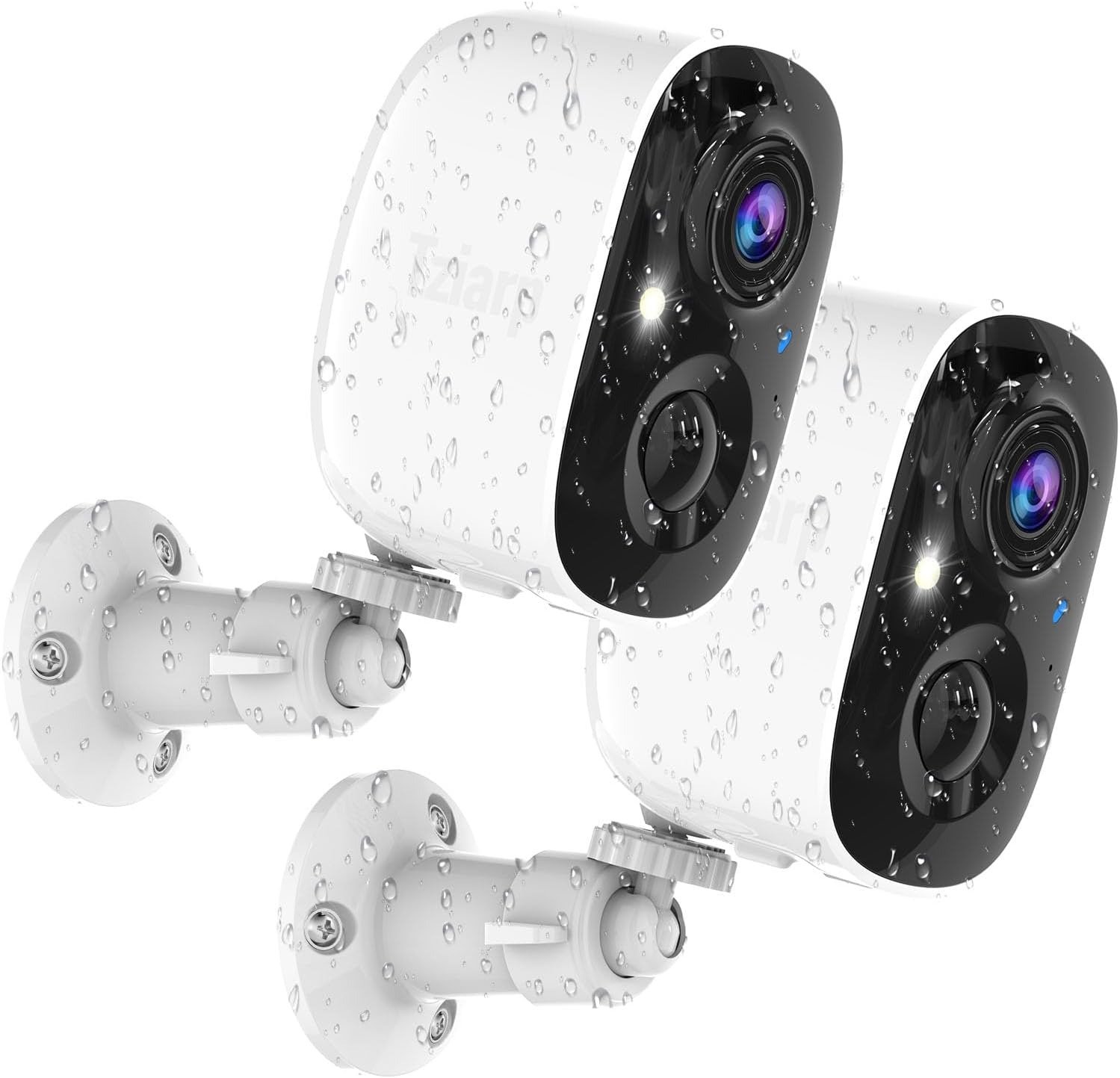
Open the Amazon listing for the Tziarp 2K Wireless Camera 2-Pack and the numbers are hard to argue with. Two cameras under fifty dollars. 2K resolution. Full-color night vision. AI detection. Built-in spotlight and siren. IP65 weatherproofing. A claimed battery life of one to five months on a single charge.
On paper, this is an unusually strong value proposition. And when the cameras arrive and you run them through the first week, you may find yourself thinking the listing was straight with you.
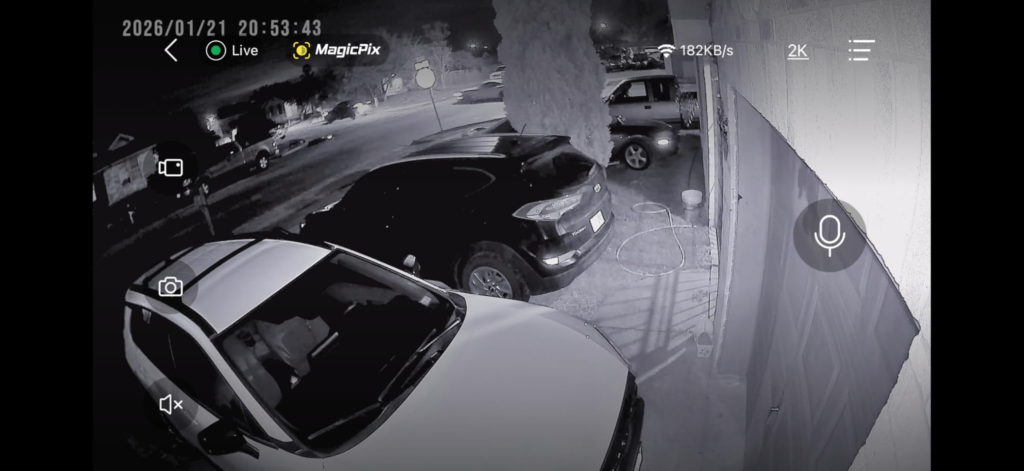
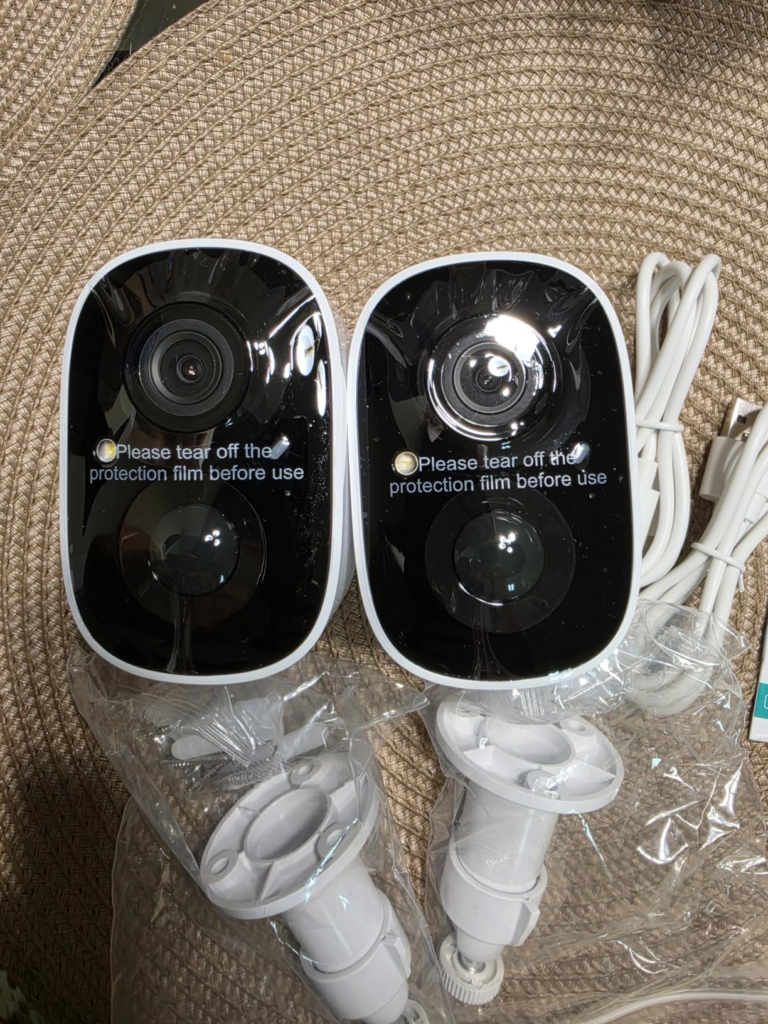
The footage is genuinely clear. Night vision switches modes without prompting. Motion alerts reach your phone. The app pairs in under ten minutes. The cameras feel dense enough for outdoor exposure and sit through rain without degrading.
The problem isn’t what you see in week one. It’s what you discover when you calculate the math behind that “1–5 months” range — and realize how wide that gap actually is.
| Tziarp 2K Wireless Camera — Technical Specifications | |
|---|---|
| Resolution | 2K UHD (approx. 3 megapixels) |
| Night Vision | Dual-mode: Full-color spotlight + Infrared B&W |
| Digital Zoom | 3x |
| Weatherproofing | IP65 (rain, dust, and light-snow resistant) |
| WiFi Compatibility | 2.4GHz ONLY — 5GHz not supported |
| Storage (Local) | microSD up to 128GB — not included |
| Storage (Cloud) | 7-day free trial; subscription required after |
| Recording Mode | Motion-triggered clips only — no 24/7 continuous |
| Battery Capacity | 2,000–2,400 trigger events per full charge |
| App Platform | VicoHome — iOS and Android only (no desktop) |
| Subscription Required For | AI classification (person/vehicle/pet) + Activity Zones |
| Operating Temperature | -4°F to 122°F (-20°C to 50°C) |
| Pack | 2 cameras |
| Price (typical) | ~$49.99 / 2-pack (~$25 per unit) |
What You’re Actually Feeling but Not Naming
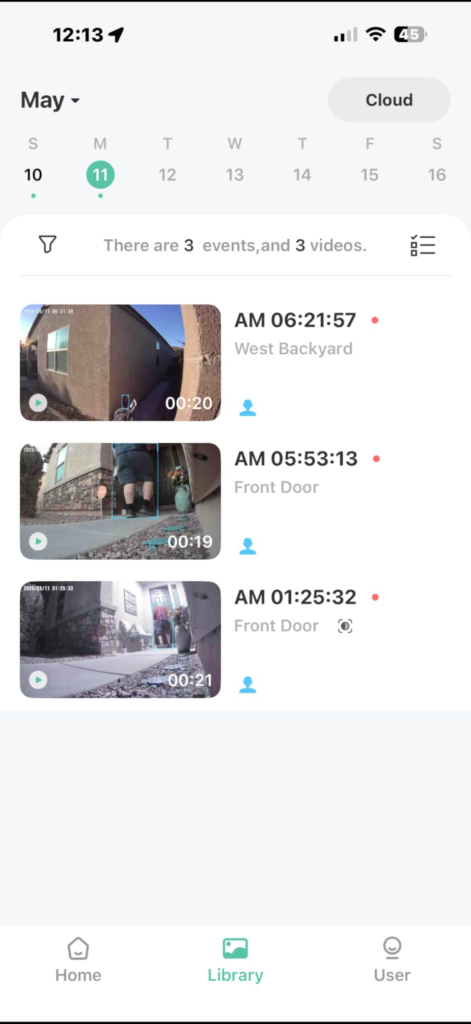
You check the app. Fourteen alerts since this morning. Three of them matter — a delivery, a neighbor walking past, a car pulling into your driveway. Eleven of them are wind-displaced branches, a shadow crossing the driveway at 6 AM, a bird landing on the fence.
The AI flagged all of them equally.
You find the sensitivity dial in settings and reduce it. The false triggers drop. But now something real slips through. You raise the sensitivity again. The branches start talking again.
This is the unnamed frustration that accumulates across weeks of ownership. It isn’t a hardware defect. It’s the gap between what “AI detection” implies on a product listing and what it means in practice without a subscription.
The feature that would actually solve this — custom activity zones, smart filtered alerts that distinguish a person from ambient motion — exists inside the VicoHome app. It sits behind a paid plan.
So you’re not buying a broken camera. You’re buying a camera where the version you assumed you were getting costs extra. The gap between assumption and reality is the uncomfortable truth that most listing descriptions choose not to announce upfront.
The Hidden Mechanism Behind the Miss
The Tziarp 2K camera runs on a rechargeable lithium battery and uses a PIR (passive infrared) sensor to detect motion. When warmth crosses the sensor’s field of view, the camera wakes from low-power sleep mode, initializes the recording module, captures a clip, and pushes an alert to your phone.
Each step draws power. And it happens regardless of whether the trigger was a genuine security event or a leaf catching afternoon light.
Here is what the listing either omits or buries in the FAQ section: a full charge provides approximately 2,000 to 2,400 motion trigger events (recorded as 10-second video clips). Longer recordings consume more power. Battery life doesn’t drain at a fixed daily rate. It drains in proportion to how often the camera wakes up.
This number — 2,000 to 2,400 triggers — is the honest specification behind the “1–5 months” range. The width of that range is entirely a function of your installation environment.
High motion detection frequency and low temperatures can affect battery life. There are two additional hidden variables the listing doesn’t volunteer prominently. First, WiFi signal strength: when the camera struggles to reach the router, it polls more aggressively, drawing overhead current between motion events. Second, outdoor temperature: lithium cells lose effective capacity in cold weather, delivering fewer usable watt-hours than the same charge would provide in mild conditions.
| Common Problem → Real Cause → Practical Response | ||
|---|---|---|
| Issue | What’s Actually Happening | What You Can Do |
| Battery drains in 2–3 weeks | Event volume exceeds the charge capacity quickly | Lower sensitivity OR add Tziarp solar panel accessory (sold separately) |
| Constant false AI alerts | Basic PIR triggers on all motion, no classification | Subscribe to VicoHome Awareness for activity zone filtering |
| Camera won’t connect to WiFi | Router pushes device to 5GHz or merged dual-band | Manually separate 2.4GHz SSID in router settings before setup |
| Live view loads in 15–30 seconds | App and server-side streaming latency (documented) | Use clip history view instead of relying on live stream for incident review |
| microSD not recognized or formatting error | Card too large or incorrect format | Use cards ≤128GB, formatted to FAT32 before insertion |
The Threshold Where the Outcome Quietly Breaks
The threshold for this camera is approximately 20 to 30 trigger events per day.
At or below that volume, the charge cycle math works in your favor. With 2,000 triggers available per charge and 20 daily events, you get roughly 100 days between charges — about 3.3 months. At 10 daily events, you’re approaching the upper end of that “5 months” claim.
Above 30 daily triggers, the math changes quickly.
| Battery Life Reality — Estimated From Verified Buyer Patterns | |||
|---|---|---|---|
| Daily Trigger Events | Math-Based Estimate | Real-World Expectation | Typical Scenario |
| 5–10 events/day | 200–400 days theoretical | 3–5 months | Quiet rear yard, storage shed, low-traffic secondary entrance |
| 15–25 events/day | 80–133 days theoretical | 6–10 weeks | Residential side path, moderate-traffic driveway, garage |
| 40–60 events/day | 33–50 days theoretical | 3–5 weeks | Active front entrance, moderate street exposure |
| 100+ events/day | ~20 days theoretical | 1–3 weeks | Busy pedestrian zone, street-facing, high-ambient-motion area |
Note: Real-world figures fall below mathematical estimates due to WiFi polling overhead, cold-temperature capacity reduction, and the power cost of false-trigger processing.
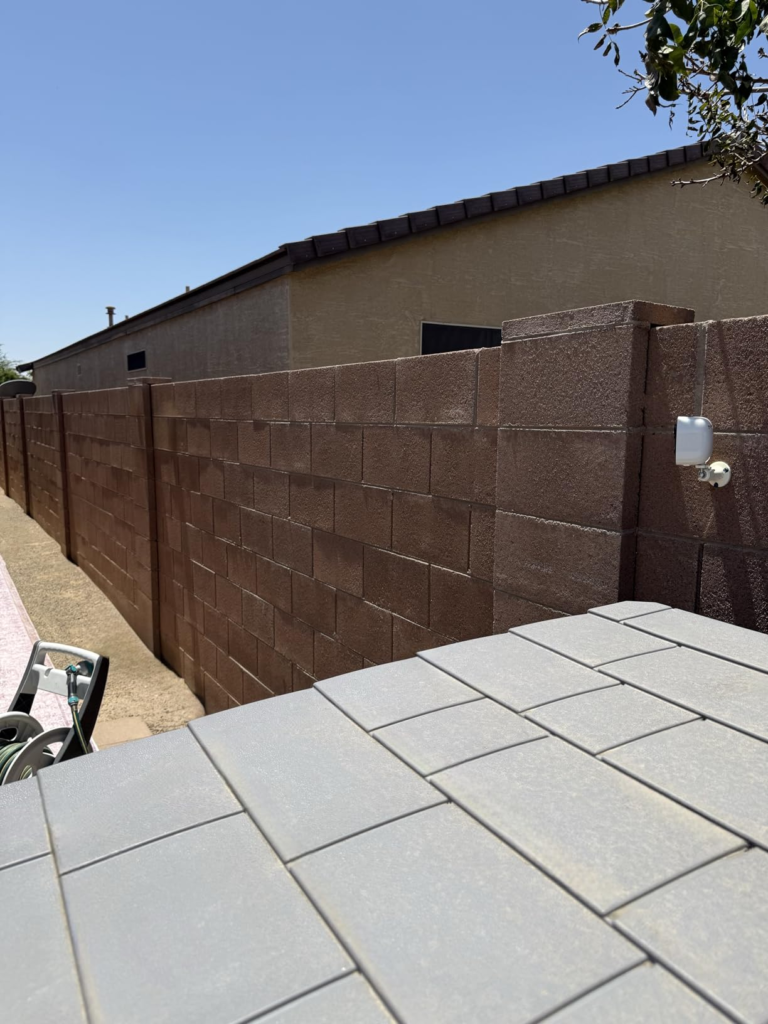
A camera installed quietly behind a property, covering a gate that opens twice a day, can genuinely serve you for four months on one charge. The same hardware mounted at a front door facing a street with regular foot traffic and passing vehicles will need recharging inside a month.
That is not a defect. It is the structural physics of battery-powered security. What makes this threshold worth naming explicitly for the Tziarp is that the features designed to suppress false triggers — the ones that would reduce unnecessary wakeups — require paying extra.

Why Most Buyers Misread This Too Early
The most common pre-purchase mistake is comparing spec sheet against spec sheet: resolution against resolution, IP rating against IP rating, advertised battery months against advertised battery months.
This approach misses the relevant variable entirely.
Battery-powered cameras don’t compete on specifications the way wired cameras do. Their real-world performance is a function of two things no specification sheet lists — the daily activity density of the installation zone, and the WiFi environment. A 2K camera with a strong battery spec sheet installed at a busy entrance will be inferior in daily experience to a 1080p camera with weaker paper specs installed at a quiet rear location, simply because the latter charges once every four months.
The second misread involves AI detection. Advanced AI features — person, vehicle, and pet recognition, and custom activity zones — require a paid subscription plan. Buyers who see “AI motion detection” in the product title and assume that means filtered, classified alerts without subscription are setting themselves up for the false-alert experience that dominates the critical reviews.
| Feature Availability: Free Tier vs. VicoHome Awareness Subscription | ||
|---|---|---|
| Feature | No Subscription | VicoHome Awareness (Paid) |
| Live camera view | ✅ Available | ✅ Available |
| Basic motion detection alerts (all movement) | ✅ Available | ✅ Available |
| Cloud storage | 7-day free trial, then subscription | Up to 60 days history |
| Person / vehicle / pet classification | ❌ Not available | ✅ Available |
| Custom activity zones | ❌ Not available | ✅ Available |
| Filtered smart push alerts | ❌ Not available | ✅ Available |
| Local microSD recording | ✅ Available (card not included) | ✅ Available |
If you plan to use a microSD card for local storage and accept basic motion alerts across the board, the subscription is genuinely optional. If you want AI-filtered alerts that distinguish a person from a tree branch, the subscription is functionally necessary.
Who Is Actually Inside This Problem
The buyer this camera was designed for needs wire-free flexibility where running a cable is either impossible or impractical. A renter. A homeowner who wants coverage at a detached garage, a garden gate, a back fence line, or a secondary entrance where drilling for wiring would require significant effort or landlord permission.
They don’t need 24/7 continuous recording — only clip-based documentation of events. They’re comfortable reviewing an app rather than a DVR. They’re purchasing security awareness, not forensic-grade surveillance infrastructure.
For that buyer, installed in the right zone, the Tziarp 2K delivers accurately. The footage is sharp enough to read license plates in good light at close range, identify faces before subjects leave the frame, and capture package theft in usable detail. The spotlight activates convincingly as an active deterrent — a camera that responds with light and sound during an event is meaningfully more effective at shortening dwell time than a passive recorder. The siren sounds credible. The two-way audio functions well enough for real-time interaction.
At approximately $25 per unit in a 2-pack, this hardware earns its price point within the described use case.
Where Wrong-Fit Begins
The wrong-fit profile is equally distinct.
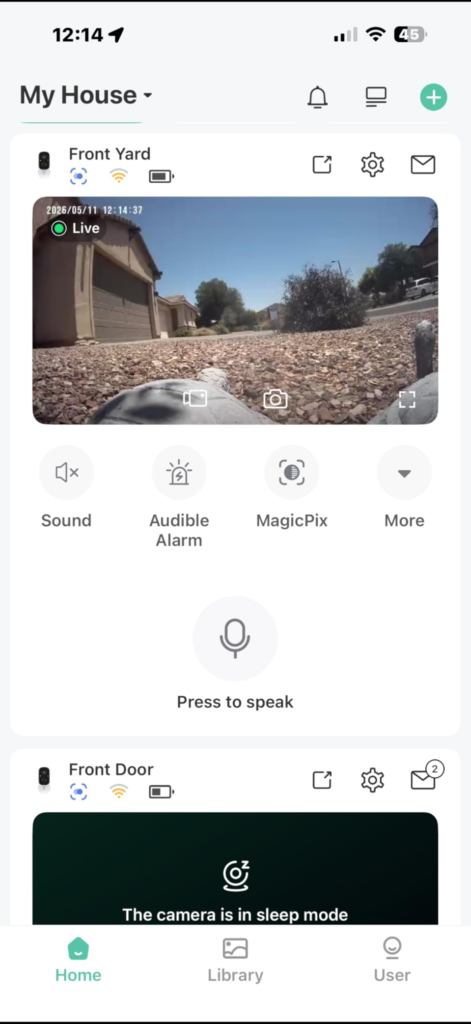
If your intended installation faces a street with regular foot traffic, receives deliveries multiple times per week, and sits in a zone where cars are in motion throughout the day — expect to charge the cameras every 3 to 5 weeks at minimum, and possibly every 2 weeks in winter. That’s not a product failure. It’s the math of high-volume deployment applied to a battery camera.
The camera connects only to 2.4GHz WiFi networks and does not support 5GHz. If your router broadcasts a unified dual-band SSID or prefers 5GHz for new device connections, the camera will not pair without manual network reconfiguration. This catches a consistent share of buyers who skim past that line in the specs.
The camera records motion-triggered clips only and does not support 24/7 continuous recording. There is no workaround within the VicoHome ecosystem at this product tier. If you’re expecting NVR-style continuous footage, this camera is structurally incompatible with that need.
And if you’re planning to rely on AI person-detection without a subscription, the camera will alert you to every movement regardless of source. Filtered discrimination has a paywall.
| Buyer Fit Assessment — Where This Product Belongs and Where It Doesn’t | ||
|---|---|---|
| Scenario | Fit | Rationale |
| Quiet rear yard, low-traffic, 2.4GHz WiFi available | ✅ Strong fit | Event volume is low — long charge cycles, full wire-free benefit |
| Garage, storage shed, side entrance | ✅ Good fit | Moderate daily events, manageable recharge schedule |
| Renter who cannot drill for wired cameras | ✅ Good fit | Battery + mount flexibility solves the access restriction |
| Budget buyer who will add a microSD card | ✅ Good fit | Removes subscription dependency for basic storage entirely |
| Active front entrance facing street | ⚠️ Borderline | High trigger volume — charge cycles become a frequent task |
| Dual-band router with merged SSID | ⚠️ Requires configuration | Must manually isolate 2.4GHz before camera will connect |
| User expecting 24/7 continuous recording | ❌ Wrong fit | Motion-clip recording only — continuous stream unavailable |
| User expecting AI classification without subscription | ❌ Wrong fit | Person/vehicle/pet detection locked behind VicoHome plan |
| Camera in high-wind or ambient-motion-heavy location | ❌ Wrong fit | Constant false triggers accelerate battery drain dramatically |
The One Situation Where This Product Becomes Logical
After everything above, there is a specific condition where buying the Tziarp 2K 2-Pack at this price is the clearest decision available in this category.
You need wire-free placement flexibility. Your installation zone generates low to moderate daily motion — under 25 events per day is a reasonable estimate. You have a stable 2.4GHz WiFi signal reaching the intended mount location. You’re planning to use a microSD card for local storage, which removes the cloud subscription question entirely. And you want 2K footage, an active deterrent spotlight, a functioning siren alarm, two-way audio, and IP65 weatherproofing — at a price that leaves little rational room for dispute.
In that scenario, this camera is not a compromise product. It is the correct tool for the described problem.
Long-term verified buyers with 3-to-6-month ownership consistently confirm that image quality holds, the weatherproofing performs across rain and cold exposure, and the motion-detection system — while broad on triggers — reliably captures what it’s there to capture. The hardware does not disappoint. The gap lives in the subscription layer and the battery math, not in the optics or the build.
What It Solves, What It Reduces, and What It Still Leaves to You
This camera genuinely resolves the physical access problem. Mounting a camera where no power outlet exists, where drilling for wiring is impractical or prohibited, at a location that needs coverage without permanent modification. It solves that problem cleanly, at low unit cost, with 2K-quality output.
It meaningfully reduces the gap between an event occurring and you knowing about it. Motion alerts reach your phone within seconds under normal WiFi conditions. The spotlight and siren shorten dwell time for opportunistic intruders — active deterrence outperforms passive recording in crime-prevention research. Two-way audio adds remote interaction capability that cameras in this price tier rarely include without compromise.
What it leaves to you: the microSD card (budget separately — $8–15 for a reliable 64GB card). The WiFi reconfiguration if your router requires band separation. The decision on whether to subscribe for AI-filtered alerts — $3–5/month approximately, and worth it for high-traffic locations. And the discipline of monitoring battery levels if your installation zone sees heavy activity.
Where regret concentrates: buying this camera for a high-volume, street-facing entrance without first estimating your daily trigger count. A $25 camera that demands weekly charging stops feeling affordable within a month. The math runs in the wrong direction.

| Honest Outcome Summary | |
|---|---|
| What It Solves Well | Wire-free placement, 2K footage, active deterrence via spotlight + siren, two-way audio |
| What It Meaningfully Reduces | Installation friction, wiring constraints, cost per camera, event-blind spots at secondary entrances |
| What Requires Subscription | AI person/vehicle/pet classification, activity zone filtering, extended cloud storage |
| What Remains Your Responsibility | microSD card purchase, 2.4GHz WiFi configuration, battery monitoring in high-activity zones |
| Where Regret Risk Lives | High-traffic installation + no subscription = excessive false alerts + short charge cycles |
Final Compression
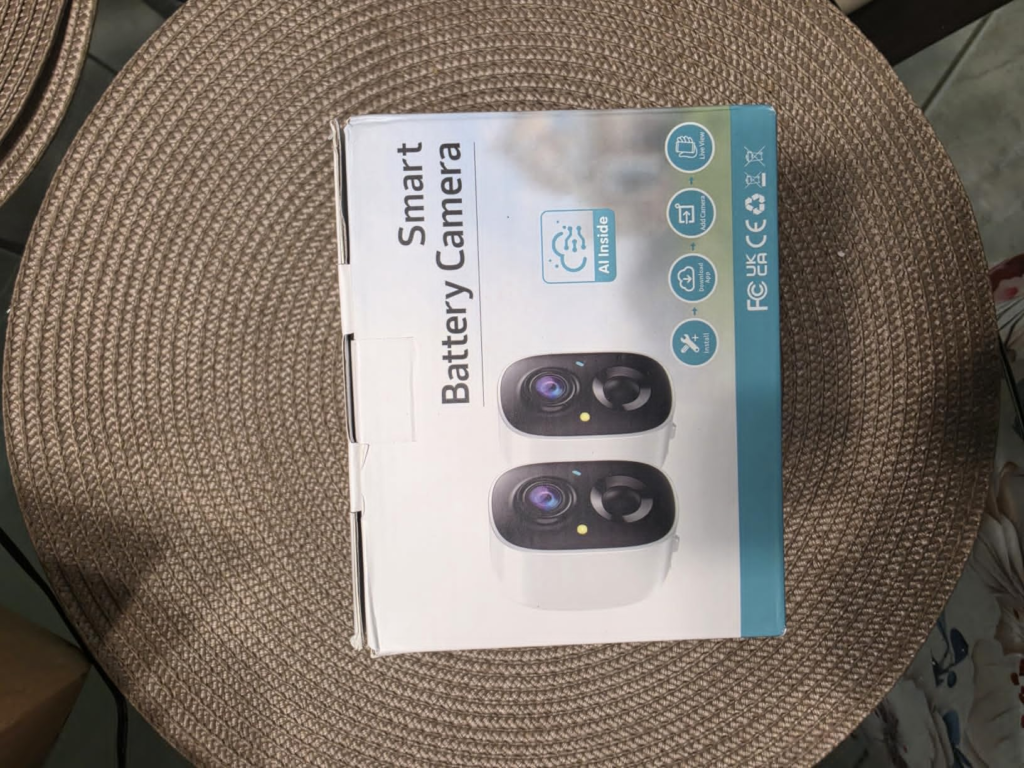
The Tziarp 2K Wireless Camera 2-Pack is capable, honest hardware at a price that should not reasonably include what it delivers. The 2K output is real. The dual-mode night vision performs as described. The spotlight triggers with intent. The IP65 weatherproofing holds in genuine outdoor conditions.
The constraint is not in the hardware. It’s in the distance between how battery life appears on the listing and how it behaves when you calculate trigger volume against a real installation environment. And it’s in the subscription layer that gates the AI features most buyers assume are part of the base product.
If your installation zone generates under 25 motion events per day, you are operating inside the product’s designed threshold. It will serve you without friction.
If you’re mounting this at a primary entrance facing active street traffic — with constant ambient motion, deliveries, and pedestrians — your charge cycle will be short enough to turn wire-free convenience into a recurring obligation.
That distinction is what determines whether this camera is the right answer or the wrong one for your specific situation.
If you’re inside the threshold, the decision is straightforward. The Tziarp 2K 2-Pack is available on Amazon.
Frequently Asked Questions
| Question | Answer |
|---|---|
| Does the Tziarp 2K camera work with 5GHz WiFi? | No. This camera operates exclusively on 2.4GHz networks. If your router broadcasts a dual-band network under a single unified name, you’ll need to separate it into two distinct SSIDs in your router settings — one for 2.4GHz, one for 5GHz — before the camera will pair. Modern mesh network users should verify this carefully before purchasing, as many mesh systems default to steering new devices toward 5GHz. |
| Can I use the camera without a monthly subscription? | Yes, with important caveats. Basic motion alerts, live view, two-way audio, and local microSD storage all function without any paid plan. What requires a VicoHome Awareness subscription: AI classification of person versus vehicle versus pet, custom activity zones to filter false triggers, and cloud storage beyond the initial 7-day free trial period. If you use an SD card and accept unfiltered motion alerts, the subscription is optional. |
| How long does the battery actually last — in real numbers? | The manufacturer confirms each full charge supports 2,000 to 2,400 motion trigger events (10-second clips). Divide that by your expected daily triggers to estimate your charge cycle. At 10 events per day, you approach 200+ days. At 50 events per day, you’re at roughly 40 days. High-traffic locations in cold climates can fall well below those estimates due to temperature-related capacity reduction and WiFi polling overhead. |
| Does the camera record 24/7? | No. This is a motion-triggered recording camera. It wakes when the PIR sensor detects movement, records a clip, and returns to low-power sleep. Continuous recording is not supported at this product tier or within the VicoHome app ecosystem. If 24/7 footage is a requirement, a wired or plug-in camera with local NVR is the correct product category. |
| What storage option is better — microSD or cloud? | For ongoing cost and privacy control, a microSD card is the stronger long-term choice. You pay once for the card (up to 128GB, not included in the box), store recordings locally without monthly fees, and retain footage as long as the card’s capacity allows with loop-overwrite recording. Cloud storage offers remote clip access without physically retrieving the card, but requires a subscription after the free trial. Both can run simultaneously if you choose. |
| Is the VicoHome app reliable? | Functional, with documented limitations. Setup is consistently straightforward. Live view can take 15–30 seconds to load — a known latency issue across multiple verified buyer reports — which makes it less useful for real-time response and more appropriate for clip review. Notification delivery is generally adequate. Multi-device sharing and cross-device login have received criticism in longer-term user reviews for being cumbersome. It is not a polished premium-tier app experience, but it works for the intended use case. |
| Does the camera perform in cold weather? | It operates down to -4°F (-20°C) per manufacturer specifications, so the hardware survives winter. However, lithium battery capacity decreases meaningfully in cold temperatures — plan for shorter charge cycles during winter months compared to mild-weather performance. A solar panel accessory (sold separately by Tziarp) partially offsets this in sunny climates. |
| Can multiple family members access the camera feed? | Yes, shared access is available within the VicoHome app. The process has received mixed feedback — some users report difficulty with account sharing setup and payment screen errors during the configuration. If shared multi-user access is a primary requirement, test the sharing feature within the return window to confirm it functions correctly in your setup before the return period closes. |
Transparency Note:
This analysis is built on aggregated real-world experience.
It extracts what repeatedly holds, what breaks, and what users uncover only after living with the system—then shapes it into a clear model you can use immediately.
Think of it as structured experience, refined and presented so you don’t have to learn it the hard way.
“A quick note: Don’t believe the star ratings, but trust personal experience. This article is a compilation of collected experiences”