I came home at 11:47 p.m. on a Tuesday in late November to find my trash bins knocked over, something scraped along the side of my garage door, and absolutely no usable footage from the camera I had mounted over the driveway. The clip it captured was eight seconds of dark blur — the camera had triggered after whatever happened, not before.
That gap between “I have outdoor security” and “I actually know what happened on my property” — that’s where most floodlight camera buying decisions fall apart.
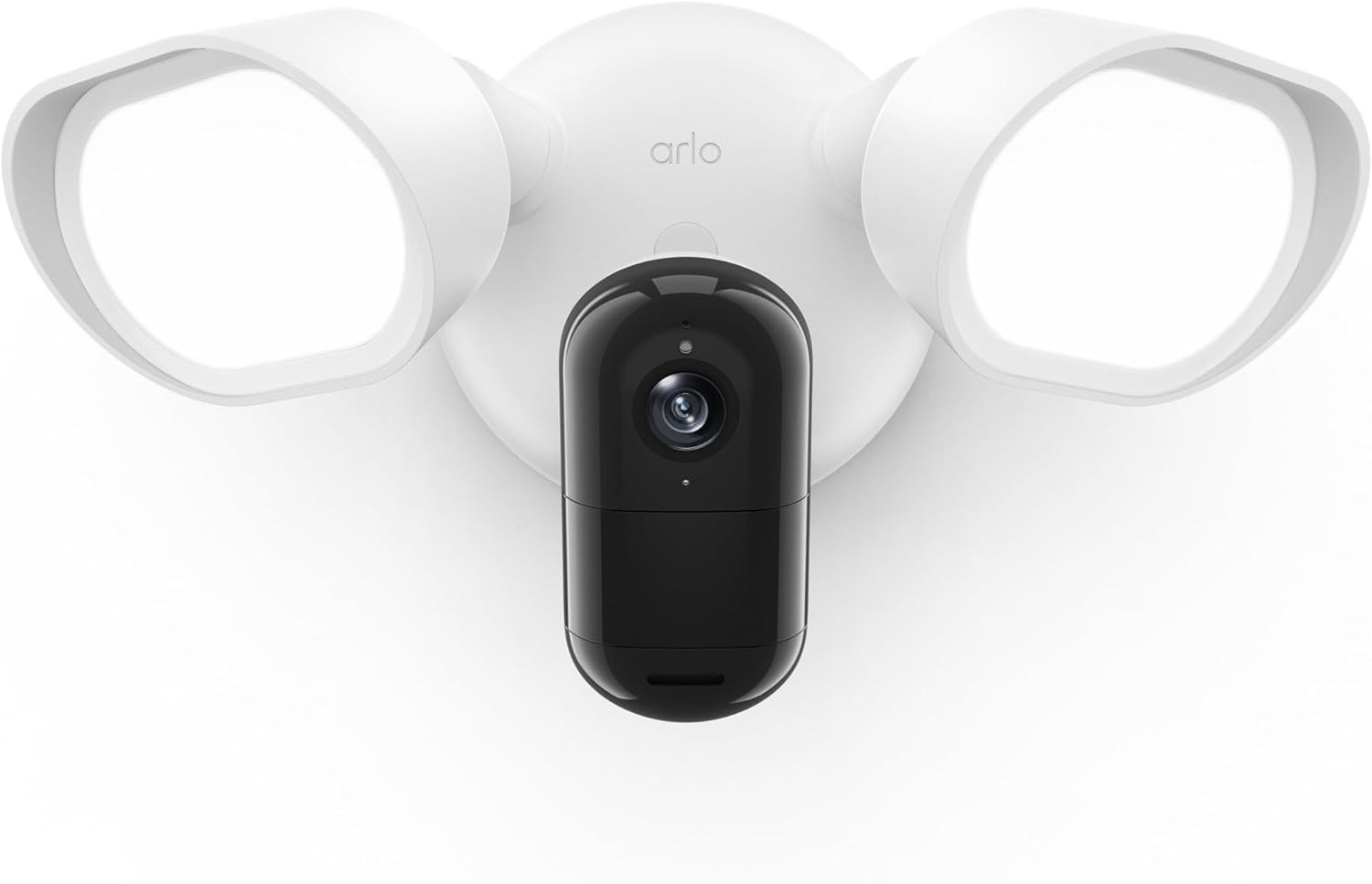
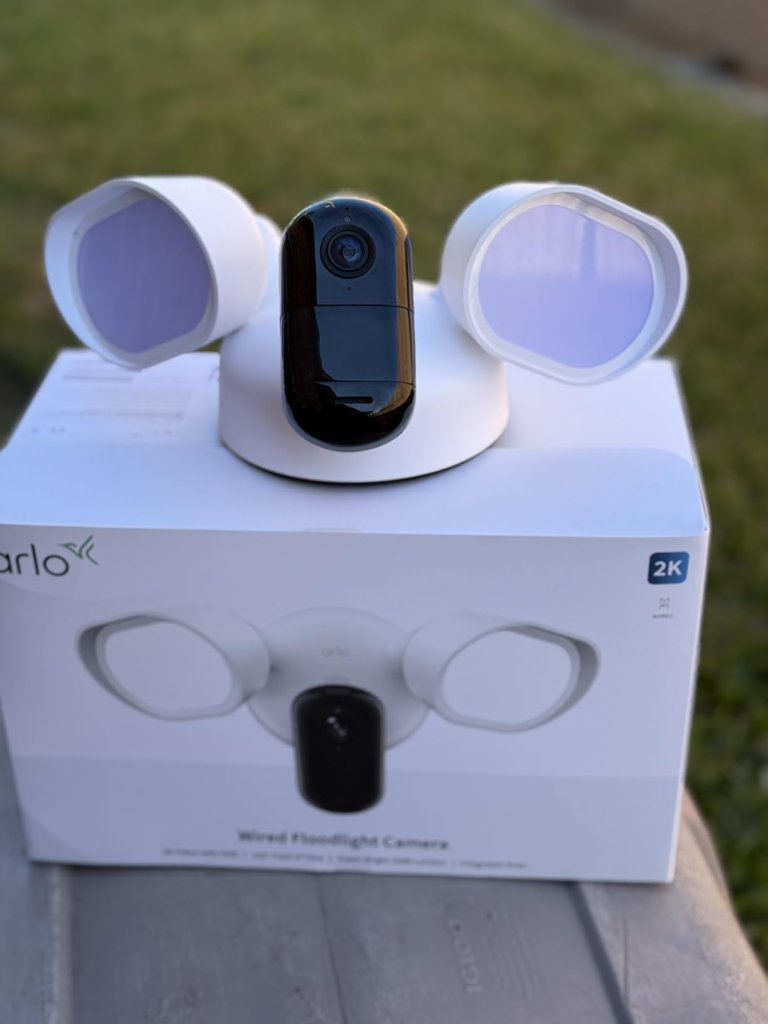
The Arlo Wired Floodlight Camera FLW2001 was my answer to that problem. I researched it for weeks, installed it myself, and then lived with it across seasons. What I found doesn’t match what most rushed reviews tell you. The hardware earns its price. But the product you’re actually buying — the full system, the real capability, the scenario where this becomes the obvious right choice — only activates past a specific threshold that most buyers don’t see until after they’ve already crossed it.
Arlo FLW2001 Performance: The Result Looks Fine. The Problem Isn’t.
From the outside, this camera does exactly what it promises. The 2K HDR footage is crisp and color-accurate. The two floodlights fire within a second of motion. Setup replaced my old outdoor fixture in under 20 minutes, from breaker-off to app-connected.
But why did I still have a four-day gap in my recorded history six weeks after installing it?
Because I exited the free trial period and hadn’t yet chosen a subscription. The camera kept working. The lights kept triggering. But when I pulled up the app to check what had moved outside at 2:13 a.m. on a Wednesday, there was nothing there. Just a notification timestamp and no footage behind it.
That’s the performance contradiction at the heart of this product. The hardware performs cleanly. The recording architecture performs nothing unless you’re inside the subscription.
Feature
Specification
Resolution
2K (2560 × 1440) with HDR
Field of View
160° diagonal
Floodlight Brightness
Up to 2,000 lumens (adjustable 1–100%)
Power Source
Hardwired, 100–240V AC / 50–60Hz
Connectivity
2.4GHz Wi-Fi only (no 5GHz, no Ethernet)
Night Vision
Color + Black-and-White
Two-Way Audio
Yes, with built-in microphone
Integrated Siren
Yes — 80 dB, adjustable via app
Foresight Pre-Recording
Captures 3 seconds before motion trigger
Smart Compatibility
Amazon Alexa, Google Assistant, IFTTT
Weather Resistance
Yes — outdoor-rated, rubber gasket base
Mounting Requirement
4-inch UL-approved round junction box
Dimensions
10.43″ W × 6.65″ H × 5.33″ D
Cloud Storage
Subscription required — 1-month trial included
Local Storage
Not available at launch; SmartHub update in development
Outdoor Security Fatigue: What You’re Actually Feeling but Never Naming
Why do most people stop checking their security camera app within three weeks of installing it?
There’s a pattern to it. The app lands on your phone. The alerts start coming in. You open the first ten. Then the twentieth. By the thirtieth, you’ve trained yourself to ignore the notification sound because most of them mean nothing — wind, a passing car, a recycling bin lid that caught a breeze.
What most buyers are actually carrying when they shop for a floodlight camera isn’t a desire for more lumens. It’s something quieter: alert fatigue from cameras that notify without informing, the dread of knowing an incident happened but having no usable footage, and the specific exhaustion of managing battery-powered cameras that die at the worst possible moment.
The Arlo FLW2001 addresses all three of these problems — but not equally, and not all without a subscription:
Always-on wired power eliminates battery anxiety completely.
Foresight feature captures the three seconds before motion triggers the recording, converting a tail-end clip into an actual account of what happened.
Smart detection distinguishes between a person, a vehicle, a package, and an animal — converting generic motion alerts into actionable information.
But smart detection lives entirely behind the subscription wall. Without a paid plan, you get motion alerts, not filtered alerts. That difference is invisible in a spec table. In daily use, it’s the difference between a camera system that calms you down and one that teaches you to tune it out.
Arlo Wired Floodlight Camera Specs: The Hidden Mechanism Behind the Miss
Most floodlight camera comparisons concentrate on three numbers: resolution, lumens, and field of view. Those metrics describe hardware potential at its ceiling. They don’t describe what happens inside your specific installation.
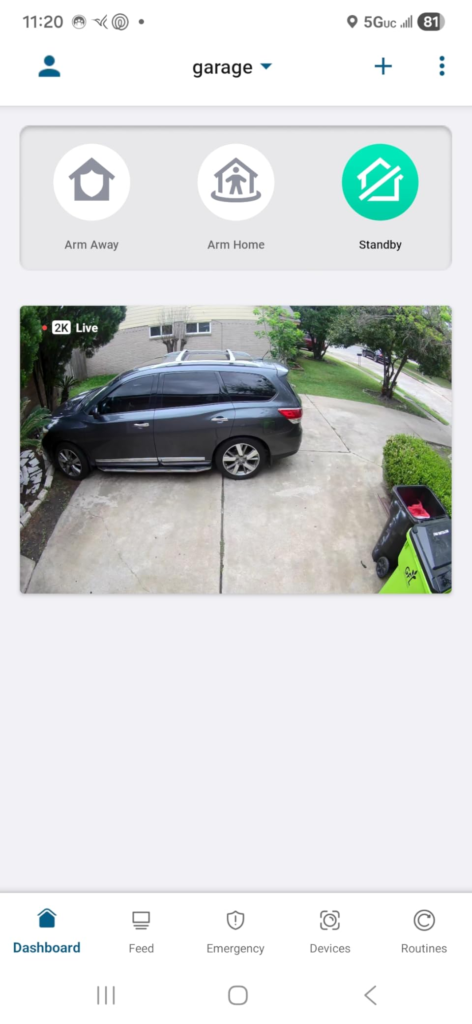
The 160° field of view on the FLW2001 is genuinely wide — wide enough to cover most residential driveways from a single mount point. The 2K HDR video holds detail well in edge conditions: mixed light, partial shadow, HDR-active scenes where one part of the frame is bright and another is dark. Color night vision performs correctly without the floods even being on, though the image sharpens noticeably when the lights aim toward the same zone as the camera.
Here’s what isn’t in the spec table:
Wi-Fi Limitations: This camera connects exclusively via 2.4GHz Wi-Fi. No 5GHz band. No wired Ethernet fallback. At 300 feet line-of-sight from your router under ideal conditions, the connection holds. But metal siding, concrete walls, a garage corner, or a busy 2.4GHz spectrum can push signal quality below the threshold where recordings complete reliably. When they do, you don’t get an error. You get missing footage.
Siren Reality: I tested the 80-decibel siren with the windows closed. I could barely hear it from the next room. It’s not a deterrent; it’s a remote-trigger audible signal useful for confirming an alarm is active via the app, not for stopping anyone in the moment.
Scenario
Performance Score
What Shapes It
Daytime video — clarity
9 / 10
Sharp 2K HDR, accurate color
Night vision — floods off
7 / 10
Functional, detail reduces at distance
Night vision — floods on
9 / 10
Color identification, clear faces at range
Motion detection (no sub)
5 / 10
Generic — high false-alert volume
Smart detection (with sub)
8.5 / 10
Person, vehicle, package — reliable
Wi-Fi stability — strong signal
9 / 10
No drops, consistent live stream
Wi-Fi stability — marginal signal
5 / 10
Gaps appear without warning
Siren as active deterrent
4 / 10
Audible outside; not alarming
Installation complexity
9 / 10
DIY-accessible; 15–20 minutes
App usability
8 / 10
Clean, intuitive, occasionally slow to load
Arlo Secure Subscription Cost: The Threshold Where the Outcome Quietly Breaks
This is the section most reviews reduce to a bullet point in a “Cons” list. It belongs at the center of the conversation because it’s the structural hinge of this entire decision.
The Arlo Wired Floodlight Camera ships with a one-month Arlo Secure trial. When that month ends, the camera becomes a motion-triggered smart floodlight with live streaming capability — and nothing else. No stored history. No footage to review. No way to answer the question: “What happened at 3 a.m. while I was asleep?”
Every use case where a security camera earns its keep in real life requires stored footage. And stored footage requires a subscription.
Arlo Secure Subscription Tiers
Plan
Monthly
Annual
Cameras
Video History
Smart Detection
Emergency Dispatch
Arlo Secure Basic
$7.99
$80
1 only
30 days
❌
❌
Arlo Secure Plus
$11.00
$130
Unlimited
30 days
✅
❌
Arlo Secure Premium
$18.00
$180
Unlimited
60 days
✅
❌
Arlo Secure Elite
$25.00
$250
Unlimited
60 days
✅
✅
The total year-one cost at sale price ($99.99 camera) with the Plus plan ($130/year) is $229.99. At full camera price with the Premium plan, you’re at $329.99 in year one — and $180 in every subsequent year.
That’s not hidden. But it’s also not the number you’re comparing when you look at “$149.99” on a product page next to a Ring at $199 or a Nest at $279. The system cost comparison is what actually governs your decision.
Feature Breakdown: Free Tier vs. Subscription
Feature Category
Without Subscription (Free Tier)
With Arlo Secure Plan
Live Streaming
✅ Full access
✅ Full access
Motion Alerts
✅ Generic motion only
✅ Smart: person, vehicle, package, animal
Foresight
✅ Available
✅ Available
Floodlight & Siren
✅ Full access
✅ Full access
Two-Way Audio
✅ Full access
✅ Full access
Cloud Video Storage
❌ Not available
✅ 30–60 days
AI Event Summaries
❌ Not available
✅ Available on Plus+
Emergency Response
❌ Not available
✅ On Elite plan
Local Storage
❌ Not available
In development (firmware update pending)
Floodlight Camera Comparisons: Why Most Buyers Misread the Arlo FLW2001 Too Early
The most common decision error I see with floodlight cameras is comparing hardware as if hardware is the product. Someone places the Wyze Floodlight V2 ($89.99, 2,800 lumens, 2K) next to the Arlo FLW2001 ($149.99, 2,000 lumens, 2K) and concludes: the Wyze is brighter and cheaper, so Arlo is overpriced.
That comparison measures outputs. It doesn’t measure the mechanism behind the outputs — the detection intelligence, cloud architecture, ecosystem maturity, app reliability, or what happens to your footage at 2 a.m.
Ring Floodlight Cam Plus ($200): Delivers 1080p video. If Ring is already your home security backbone, that integration advantage is worth the premium. If it isn’t, you’re paying for compatibility you don’t have.
Nest Cam with Floodlight ($279): Offers 2,400 lumens and tighter Google Home integration, and includes three hours of free storage without a subscription. Genuinely worth considering for Google ecosystem households.
Eufy Floodlight E340 ($179): The most direct challenge. Similar price bracket, 3,000 lumens, 2K video, pan-and-tilt functionality, and local storage without a subscription via microSD. If no-subscription local storage is your hard requirement, Eufy is a more structurally honest alternative.
Camera
Price
Resolution
Lumens
Subscription Required
Smart Detection
Local Storage
Arlo FLW2001
$149.99
2K HDR
2,000
Yes (from $7.99/mo)
Yes (sub required)
In development
Ring Plus
$199.99
1080p
2,000
Yes (Ring Protect)
Yes (sub required)
No
Google Nest
$279.99
1080p HDR
2,400
No (3h free included)
Yes (sub for extended)
No
Wyze V2
$89.99
2K
2,800
No (12 days free)
Limited
No
Eufy E340
$179.99
2K
3,000
No
Yes (local, no sub)
Yes (microSD)
Who Is Actually Inside This Problem: The Real Arlo FLW2001 Buyer
Here’s what I’ve noticed about the people for whom this camera becomes the obvious right choice:
You understand battery anxiety: You’ve owned a rechargeable outdoor camera before. You know the exact dread of realizing it died at 4 a.m. on the one night something actually happened.
You’re replacing an existing fixture: The junction box is already there, and the wiring is run. You just want to upgrade from a dumb floodlight to a smart security system.
You have a specific problem location: A dark driveway, a garage alley with zero visibility, or a side gate that never has enough light to yield usable footage.
You accept subscriptions: You already pay for cloud backup or streaming, and you understand that $130/year for camera storage and smart detection is the honest price of what you’re actually buying.
You’re in (or open to) the Arlo ecosystem: You don’t have deeply entrenched loyalty to Ring or Google’s infrastructure.
Arlo Wired Floodlight Camera Limitations: Where Wrong-Fit Begins
The wrong buyer for this camera doesn’t look obviously wrong. They can afford it. They want outdoor security. But they’re standing in a situation where this product will underperform quietly.
Why is weak Wi-Fi at the mount location such a specific problem? Because when 2.4GHz signal quality degrades past a reliable threshold, you don’t get an error message. You get missing recordings.
If you refuse to subscribe, this camera becomes a very expensive motion-triggered light with a live stream. If you’re counting on the integrated siren as active deterrence, you’ll be disappointed. And if raw lumen output is your primary criterion, both Wyze and Eufy outperform the Arlo’s 2,000 lumens.
✅ Buy the Arlo FLW2001 If You —
❌ Skip It or Choose Differently If You —
Are replacing an existing hardwired outdoor fixture
Have no existing junction box and need surface mounting
Are comfortable paying $11–$25/month for subscription
Refuse any ongoing subscription cost
Have strong 2.4GHz Wi-Fi signal at the mounting location
Have weak or spotty Wi-Fi at the intended install point
Are deeply integrated with Ring, Google Home, or Apple
Need combined security camera and smart lighting
Need local storage without purchasing additional hardware
Prioritize footage quality and detection intelligence
Need maximum raw lumens to cover a large open yard
Are comfortable with cloud-only storage currently
Require local storage as a hard non-negotiable today
The One Situation Where the Arlo FLW2001 Becomes the Logical Choice
If you’re still reading this, you’ve probably already located yourself inside a specific situation. You have an outdoor fixture going in at the end of your driveway, above the garage door, or over the side gate. You want recorded, reviewable, searchable footage. You’ve run the math, and you know that $130 per year for the Plus plan is the real cost of the feature set that makes this camera worth owning. You’re not surprised by that number.
That’s the situation where the Arlo Wired Floodlight Camera stops being a purchase you’re debating and starts being the step that closes the gap.
What the Arlo FLW2001 Solves, Reduces, and Still Leaves to You
It solves battery anxiety permanently. Once hardwired, you never think about power again.
It solves darkness at its mounting location with two independently adjustable floodlights that can cover multiple zones.
It reduces false-alert fatigue (with a subscription) by filtering generic motion into specific categories (person, vehicle, package).
It reduces the risk of missing events through the free Foresight feature, utilizing a three-second pre-motion buffer.
What it doesn’t solve: The cloud dependency. Every recorded clip goes to Arlo’s servers. If your internet goes down, recording stops. What it doesn’t solve: The siren gap. At 80 dB, this cannot function as active audible deterrence. What it leaves to you: Positioning judgment. The wide 160° field of view requires you to take ten minutes to calibrate detection zones in the app to avoid alerts from neighbor driveways.
Final Verdict: The Only Decision That Actually Matters
The Arlo Wired Floodlight Camera FLW2001 is not an overpriced camera. It’s an accurately priced entry point into an ecosystem that has a real operating cost.
At $99–$150 for the hardware and $130–$180 per year for a meaningful subscription, you’re building a security system with 2K HDR footage, 2,000 lumens of articulating light, color night vision, Foresight pre-event capture, smart AI detection, and a clean app. That system, as a complete whole, earns its price at the Plus tier.
If your situation clears the threshold — wired location, subscription budget, solid Wi-Fi signal — the decision is already made. This is the product. If your situation doesn’t clear it, look to the Eufy E340 for local storage or the Wyze V2 for budget-friendly brightness.
Arlo Wired Floodlight Camera FLW2001 – Frequently Asked Questions
Question
Answer
Does the Arlo Wired Floodlight Camera record without a subscription?
No. Without an active Arlo Secure plan, the camera streams live video and sends basic motion alerts, but it does not record or store any footage. Once the included one-month trial expires, no clips are saved to the cloud unless you subscribe. For most security use cases, a subscription is functionally required.
What does installation actually require?
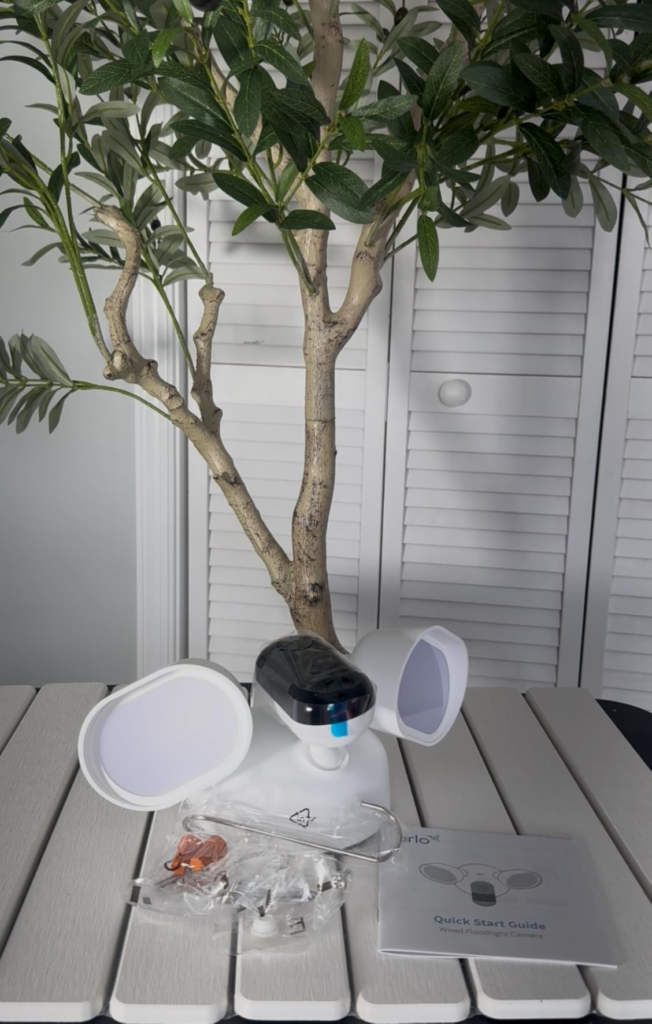
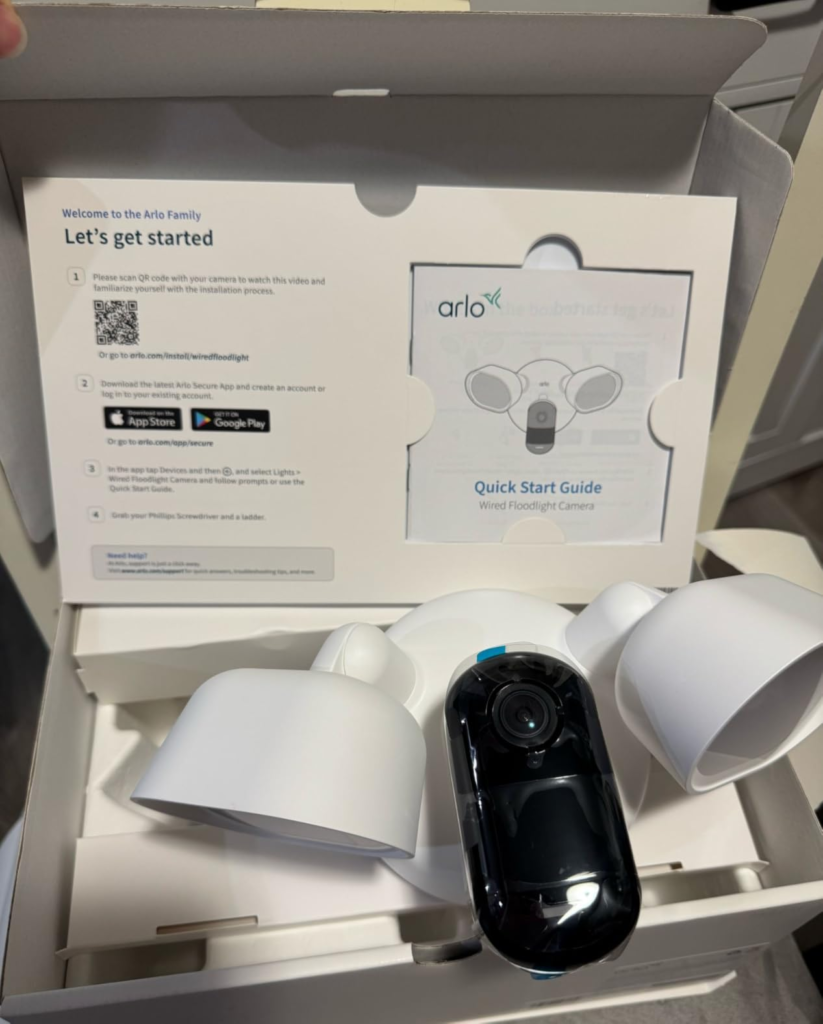
You need an existing 4-inch UL-approved round junction box with a hardwired 100–240V AC / 50–60Hz connection — typically found where an outdoor light fixture is already mounted. Installation is a DIY-friendly job: turn off the breaker, remove the old fixture, connect the wires, mount the bracket, and finish setup in the Arlo Secure app. Most users complete it in 15–20 minutes.
Why does the Arlo FLW2001 only support 2.4GHz Wi-Fi?
Arlo designed this camera for 2.4GHz to maximize outdoor range, since 2.4GHz penetrates walls and travels farther than 5GHz. However, 2.4GHz is more susceptible to interference from metal surfaces and competing networks. If your intended mounting location has weak 2.4GHz coverage, add a mesh Wi-Fi node or extender before installing the camera.
Is the integrated siren actually useful?
It depends on your expectations. At 80 dB with adjustable duration, it’s audible outdoors and useful as a remote-triggered alert you can activate from the app. It is not loud enough to function as a true physical deterrent or to reliably wake occupants inside a home with closed windows. Think of it as a notification device, not a stopping mechanism.
When will local storage be available?
Arlo has confirmed that a future firmware update will add SmartHub compatibility, allowing the FLW2001 to record to a microSD card or USB storage connected to a compatible Arlo SmartHub or Arlo Ultra 2 SmartHub. That update was still pending at the time this review was written. Until it releases, all recording is cloud-only.
How good is the color night vision?
Genuinely impressive. Color night vision captures identifiable, accurate-color footage in very low light conditions without the floods active. Faces and license plates become more legible when the floodlights aim toward the same zone as the camera. Black-and-white night vision is also available and performs cleanly as a fallback.
What happens to the floodlight if the camera loses internet connection?
The floodlight continues operating independently. It responds to motion and follows your preset schedule even without internet. The camera stops recording while offline, but the lights remain functional — an important distinction for installations where the light’s primary purpose is automatic area illumination.
Can the camera mount to a ceiling or overhead surface?
Yes. The FLW2001 supports inverted ceiling mounting, and the Arlo Secure app includes a 180° video flip setting to correct the image orientation. All adjustment and setup is handled through the app after mounting.
This analysis is built on aggregated real-world experience.
It extracts what repeatedly holds, what breaks, and what users uncover only after living with the system—then shapes it into a clear model you can use immediately.
Think of it as structured experience, refined and presented so you don’t have to learn it the hard way.
“A quick note: Don’t believe the star ratings, but trust personal experience. This article is a compilation of collected experiences”