GL-iNet GL-BE3600 (SLATE 7) REVIEW: I TESTED WHAT THE LABEL OBSCURES — AND WHAT THE HARDWARE QUIETLY DELIVERS
The Result Looks Fine. The Problem Isn’t.
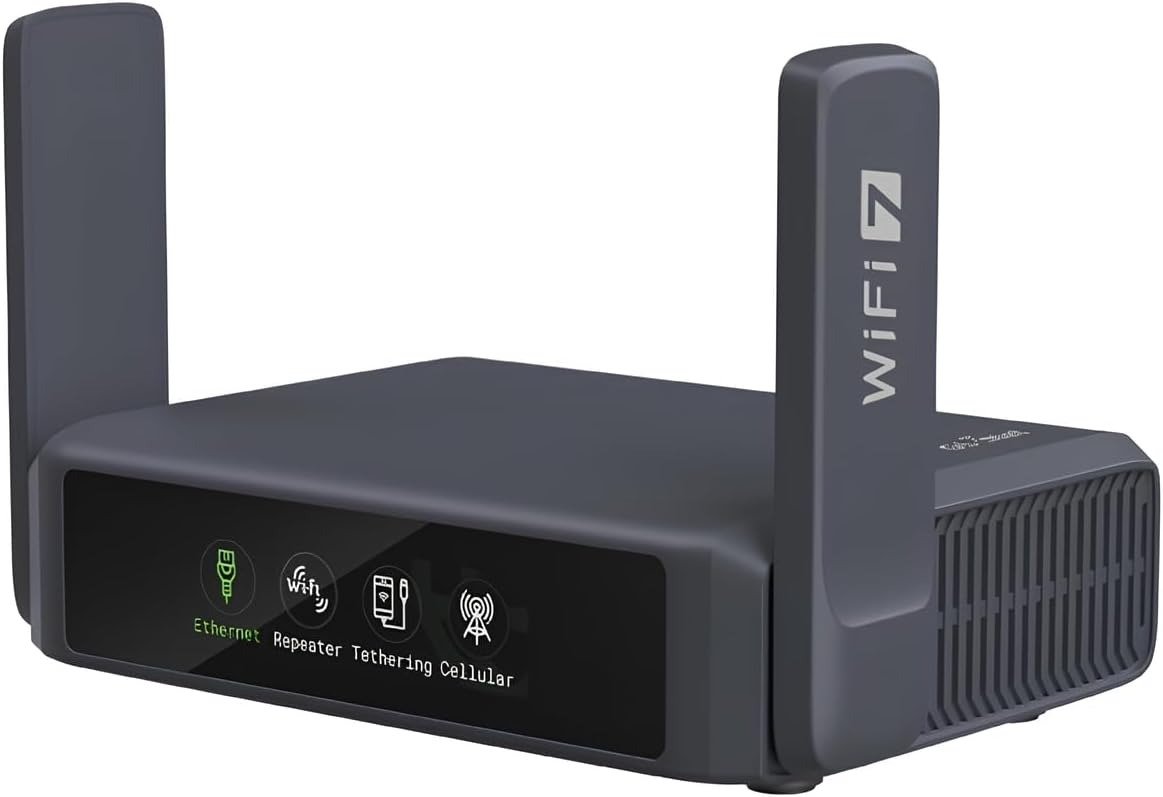
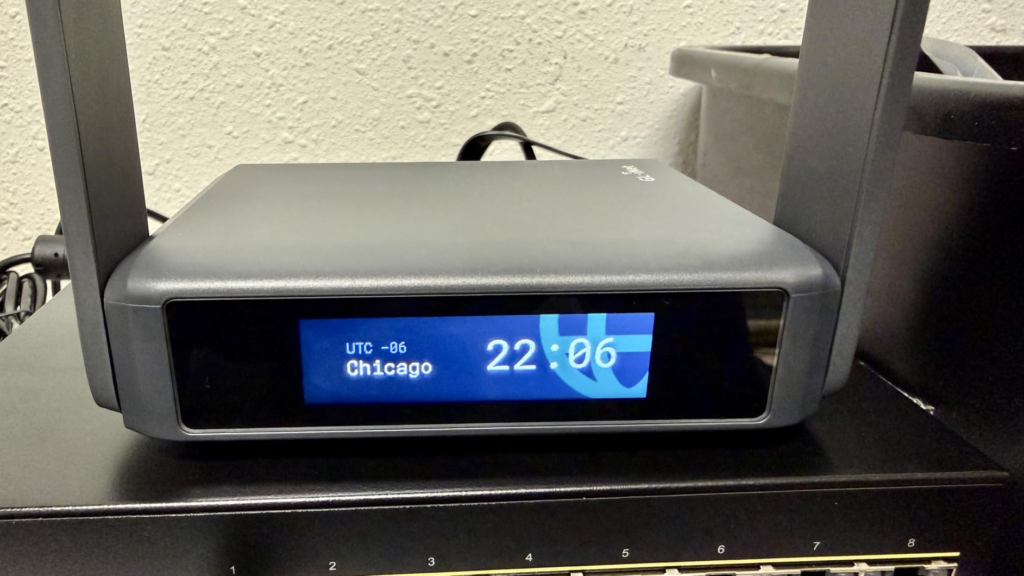
The GL-iNet GL-BE3600 ships with a Wi-Fi 7 label, combined wireless speeds listed at 3,570 Mbps, dual 2.5G Ethernet ports, and a color touchscreen that lets you toggle VPN modes, switch internet sources, and scan QR codes without touching a laptop.
The problem isn’t with the features. The problem is with what the label quietly assumes you already know about Wi-Fi 7.
Most buyers don’t. And the gap between what Wi-Fi 7 implies at full spec and what this router actually delivers is the exact distance that separates a satisfied purchaser from a frustrated one. The absence of the 6 GHz band and 320 MHz channel width raises legitimate questions about whether this router truly takes full advantage of the latest wireless standard — or simply refines the capabilities of existing Wi-Fi 6E devices.
The answer is: both, simultaneously. And which one applies to you depends entirely on where you use it.
What You’re Actually Feeling but Not Naming
If you travel for work with any regularity, you already know the specific discomfort this router exists to solve — you just haven’t named its components precisely.
It is the moment you connect to hotel Wi-Fi and briefly wonder whether the guest at check-in next to you can see your traffic. It is the four minutes you spend getting your laptop, phone, and tablet each through a captive portal login on a network that only permits one authentication per device. It is the VPN client on your laptop that connects fine, but your phone isn’t protected because you forgot to set it up. It is the Ethernet port in the hotel room wall that provides faster service than the wireless, but you have six devices and one port.
The Slate 7 was built for exactly this. It handles captive portal authentication centrally — log in once at the router level, and every connected device inherits clearance. It can accept hotel Ethernet on the WAN port and distribute the connection over Wi-Fi simultaneously. VPN runs at the router, meaning every connected device is protected without individual client configuration.
That friction you’ve been working around? It has a name now. And the Slate 7 addresses most of it from a device that fits in a jacket pocket.
The Hidden Mechanism Behind the Miss
Here is the structural fact that most quick reviews obscure by not spending time on it.
The GL-BE3600 was built on flagship Wi-Fi 7 technologies including Multi-Link Operation (MLO) and 4K QAM. Both of these are genuine Wi-Fi 7 features. Both are implemented. Both function in the field.
What the Slate 7 does not have: the 6 GHz radio band, and the 320 MHz channel width that would require it. This means users won’t experience the full benefits of the latest wireless standard, particularly in low-interference, high-bandwidth environments.
The mechanism matters here. The 6 GHz band is valuable precisely because it is uncrowded — most consumer and hotel devices still operate on 2.4 GHz and 5 GHz. A router that can step entirely into 6 GHz leaves that competition behind. The Slate 7 cannot do that.
But here is the part that changes the calculus: during testing in a busy hotel with dozens of competing networks, the Slate 7 maintained better throughput than expected, suggesting the Wi-Fi 7 MLO features provide real-world benefits even without access to the 6 GHz band. The improvement from congestion mitigation is measurable even without spectrum separation.
For travel use — where the upstream internet provision, not the wireless radio, is usually the bottleneck — the absence of 6 GHz costs you almost nothing in practice.
Where the Missing Specifications Actually Cost Something
| Use Scenario | 6 GHz Impact | 320 MHz Impact | Practical Effect on Slate 7 |
|---|---|---|---|
| Hotel room, 2–6 devices, standard internet | None | None | Irrelevant — WAN is the limit |
| Airbnb in residential building | Low | None | Negligible |
| Dense conference Wi-Fi environment | Low-Medium | Low | MLO partially compensates |
| Trying to deliver 2.5 Gbps wirelessly | High | High | Clear ceiling below 2.1 Gbps real-world |
| Home office permanent replacement | High | Medium | You will feel the constraint |
| Wired laptop + wired desktop connection | None | None | Full 2.5 GbE line rate on both ports |
The Threshold Where the Outcome Quietly Breaks
There are two thresholds. One is wireless. One is concurrent load.
The wireless ceiling: wireless performance on 5 GHz reaches approximately 2–2.1 Gbps in real-world conditions. That is fast. But the 5 GHz theoretical maximum of 2,882 Mbps doesn’t translate directly to measured throughput. If you need to deliver more than 2.1 Gbps wirelessly — a rare scenario in any hotel or travel environment but common in a well-specced home office — the Slate 7 hits a wall before the wire does. Through the 2.5 GbE LAN port wired, the router handles the full 2.5 Gbps line rate without issue.
The concurrent load threshold is more specific. As the connection count passed approximately 1,000 concurrent connections, latency began to increase noticeably. Under 12 simulated users — keeping concurrent connections below 900 — the unit sustained 2.4–2.5 Gbps cleanly without connection failures. For travel use, this boundary is effectively invisible. For a small office handling dozens of persistent background sessions, it is real.
In independent testing, the Slate 7 passed a 3-day stress test without a single disconnection — real-world travel reliability is not in question.
Performance: Measured vs. Claimed
| Metric | Claimed Maximum | Real-World Measured | Notes |
|---|---|---|---|
| 5 GHz wireless throughput | 2,882 Mbps | ~2,000–2,100 Mbps | Clean test environment |
| 2.4 GHz wireless throughput | 688 Mbps | 400–550 Mbps | Normal with noise |
| 2.5 GbE wired throughput | 2,500 Mbps | ~2,500 Mbps | Full line rate achieved |
| WireGuard VPN (client mode) | 490–540 Mbps | Varies by provider | Within practical ceiling of most hotel WAN |
| OpenVPN with DCO | 385 Mbps | 100 Mbps without DCO | DCO acceleration raises the figure significantly |
| USB 3.0 storage read/write | ~300 MB/s theoretical | 130–140 MB/s | Processor overhead caps this |
| Continuous uptime (stress test) | — | 3+ days | Dong Knows Tech, November 2025 |
| Concurrent connection stability | — | Clean under ~900 | Latency rises above 1,000 |
Why Most Buyers Misread This Too Early
The comparison that sinks most purchasing decisions happens at the search bar. You type “Wi-Fi 7 router,” sort by price, and evaluate the Slate 7 against $200–$400 tri-band home routers using the same mental framework.
That framework is wrong for this product category.
The GL-BE3600 targets buyers who need more than a basic hotel-room repeater — but it is not competing for your home router slot. It is solving the specific architecture of trust-unknown networks: public, hotel, airport, conference, and mobile. A home Wi-Fi 7 router has the 6 GHz band because it serves a fixed location with predictable spectrum. A travel router navigates environments it cannot control, and the tools that matter there are different.
The Slate 7 includes over 30 built-in VPN services, supporting OpenVPN-DCO at up to 385 Mbps and WireGuard at up to 490 Mbps. Running VPN at the router level protects every connected device simultaneously — phones, laptops, tablets, smart TVs — without configuration on each one. That is not a feature you will find on most home routers at any price.
VPN Protocol Performance
| Protocol | Mode | Max Speed (Spec) | Practical Use |
|---|---|---|---|
| WireGuard | Client | 490–540 Mbps | Speed-priority; streaming, work traffic |
| WireGuard | Server | Lower | Remote access to home network |
| OpenVPN-DCO | Client | 385 Mbps | Enterprise/legacy provider compatibility |
| OpenVPN (standard) | Client | ~100 Mbps | Without DCO acceleration |
| Tor | Client | Much lower | Maximum anonymity, not speed |
WAN Input Modes Supported
| WAN Source | Use Case | Notes |
|---|---|---|
| Ethernet (2.5 GbE WAN port) | Hotel wired port, ISP modem | Most stable; full 2.5 Gbps available |
| Wi-Fi Repeater / WISP | Hotel wireless login, public Wi-Fi | Handles captive portal authentication |
| USB Tethering | Smartphone mobile data | Connects via USB to phone |
| LTE Modem | 4G/5G cellular backup | USB modem required, sold separately |
| Multi-WAN Failover | Primary + backup, automatic | Load balance or auto-switch on failure |
Who Is Actually Inside This Problem
The person this router is built for has a specific operating pattern. You travel for work at a frequency where hotel Wi-Fi is a recurring professional environment, not a vacation inconvenience. You’ve had a work VPN client fail because the hotel blocked specific ports. You’ve shared a single hotel Ethernet connection across multiple devices by creating a hotspot from your phone, accepted the overhead, and wished there were a cleaner solution. You’ve used public Wi-Fi while knowing it was a security compromise because you didn’t have a better option in the room.
Across nearly 700 verified Amazon ratings, the Slate 7 holds a 4.6-star average, with buyers consistently praising the touchscreen setup experience, how quickly the device comes online, and solid build quality for its size.
Buyer Fit Matrix
| User Type | Fit Level | Core Reason |
|---|---|---|
| Frequent business traveler (2+ trips/month) | ✅ Strong | VPN, captive portal bypass, multi-device sharing |
| Remote worker on hotel/Airbnb Wi-Fi | ✅ Strong | Network-level encryption without per-device setup |
| Digital nomad across multiple countries | ✅ Strong | Worldwide adapter, failover modes, LTE modem support |
| Privacy-conscious user on public networks | ✅ Strong | WireGuard + OpenVPN + Tor + AdGuard Home pre-installed |
| IT teams managing distributed field routers | ✅ Strong | GoodCloud multi-device management platform |
| Home user replacing a primary router | ⚠️ Conditional | Functional, but no 6 GHz, only one LAN port |
| Small office with under 10 persistent sessions | ⚠️ Conditional | Works well below ~900 concurrent connections |
| Casual traveler (1–2 trips/year) | ❌ Overkill | Phone hotspot solves the same problem at no added cost |
| Gamer needing peak low-latency wireless | ❌ Mismatch | No 6 GHz; not optimized for this use |
Where Wrong-Fit Begins
The wrong buyer doesn’t encounter a broken feature. They encounter an intact expectation that this product was not designed to satisfy.
If you buy the Slate 7 expecting a home Wi-Fi 7 router and connect it to a multi-gig fiber line, it will work. But the wireless ceiling will be visible on a speed test. The single LAN port will be limiting if you want wired connections to multiple desktop machines simultaneously. The absence of 6 GHz will show against any Wi-Fi 7 client device designed to operate there. You paid for travel architecture and placed it in a home context.
The flash storage is 512 MB — and this matters for the OpenWrt power user who wants to run AdGuard Home, Tailscale, a NAS file server, and a print server simultaneously. Storage becomes a management overhead at that point. Installing OpenWrt plugins is possible, but capacity is not unlimited.
There is also a firmware nuance worth naming directly. GL.iNet confirmed that while many of their routers can run vanilla OpenWrt firmware, the Slate 7 must run a customized version due to chipset restrictions. For the majority of buyers, this is irrelevant. For the privacy-focused enthusiast who specifically wants vanilla OpenWrt as an independent firmware audit, it is a real limitation.
Wrong-Fit Scenarios — What Actually Happens
| Purchase Motivation | Actual Outcome | What Fits Better |
|---|---|---|
| “I want the fastest Wi-Fi 7 at home” | Wireless ceiling visible; no 6 GHz | Tri-band Wi-Fi 7 home router |
| “I travel twice a year” | Overkill at $150 for low-frequency use | Phone hotspot or budget repeater |
| “I want to run many OpenWrt packages” | 512 MB flash becomes a constraint | GL-iNet Flint 3 or higher-storage model |
| “I need 20+ devices simultaneously” | Latency issues above ~1,000 concurrent connections | Business-grade access point |
| “I need a second LAN port for two wired desktops” | Only one LAN port available | Add a small switch, or reconsider placement |
The One Situation Where This Router Becomes Logical
After all the calibration above, the situation resolves to a single shape: you depend on networks you didn’t build, you can’t audit, and you need multiple devices behind a consistent encrypted pipe.
The GL-iNet GL-BE3600 is the only travel router currently available with two 2.5 GbE ports — one WAN and one LAN — in this form factor and at this price tier. The ASUS RT-BE58 Go has one. TP-Link alternatives have one. The Slate 7 has two. That’s not a marginal distinction — it means you can receive a 2.5 Gbps hotel Ethernet feed on one port and deliver a full-speed wired connection to a laptop on the other, while additional devices connect over Wi-Fi, all without any negotiation at the Ethernet layer.
The VPN stack operates at the router, not the client. Every connected device benefits — phones, laptops, and IoT — without individual client configuration. WireGuard at approximately 540 Mbps means the encryption overhead is absorbed by the hardware, not felt as a speed penalty.
GoodCloud support adds a device management layer that lets IT staff configure and monitor multiple routers simultaneously — useful for teams where each member carries their own unit.
GL-iNet GL-BE3600 vs. Comparable Travel Routers
| Feature | GL-iNet GL-BE3600 (Slate 7) | ASUS RT-BE58 Go | TP-Link TL-WR3602BE |
|---|---|---|---|
| Wi-Fi Standard | Wi-Fi 7 | Wi-Fi 7 | Wi-Fi 7 |
| 6 GHz Band | ❌ | ❌ | ❌ |
| 2.5 GbE WAN Port | ✅ | ✅ | ✅ |
| 2.5 GbE LAN Port | ✅ | ❌ | ❌ |
| WireGuard VPN | ✅ ~490–540 Mbps | Limited | Limited |
| OpenVPN (DCO) | ✅ ~385 Mbps | Partial | Partial |
| Tor Support | ✅ | ❌ | ❌ |
| Touchscreen | ✅ | ❌ | ❌ |
| OpenWrt Firmware | ✅ (customized) | ❌ | ❌ |
| LTE Modem Support | ✅ | ❌ | ❌ |
| Multi-WAN Failover | ✅ | Limited | Limited |
| AdGuard Home Pre-installed | ✅ | ❌ | ❌ |
| GoodCloud Management | ✅ | ❌ | ❌ |
| US Government Ban Risk | Not currently flagged | None | TP-Link under active US scrutiny |
| Retail Price (list) | ~$149.90 | ~$129–149 | ~$99–129 |
What It Solves, What It Reduces, and What It Still Leaves to You
Full Hardware Specifications
| Specification | GL-iNet GL-BE3600 (Slate 7) |
|---|---|
| Wi-Fi Standard | Wi-Fi 7 (802.11be) |
| Bands | Dual-band: 2.4 GHz + 5 GHz only |
| 6 GHz Band | ❌ |
| Max 2.4 GHz Speed | 688 Mbps |
| Max 5 GHz Speed | 2,882 Mbps |
| Combined Theoretical Speed | 3,570 Mbps |
| Wi-Fi 7 Features | MLO, 4K QAM, enhanced OFDMA |
| 320 MHz Channel Width | ❌ |
| WAN Port | 1× 2.5 GbE |
| LAN Port | 1× 2.5 GbE |
| USB | 1× USB 3.0 |
| RAM | 1 GB DDR4 |
| Flash Storage | 512 MB |
| Firmware | OpenWrt 23.05 (customized build) |
| Power Input | USB-C PD — minimum 18W |
| PD Specs | 5V/3A · 9V/3A · 12V/2.5A |
| Display | Color touchscreen |
| Dimensions | 130 × 91 × 34 mm |
| Weight | Under 300 g |
| VPN Protocols | WireGuard, OpenVPN (DCO), Tor |
| Built-in Security | AdGuard Home, DNS over HTTPS/TLS |
| Retail Price | ~$149.90 |
| Warranty | 2 years |
| Amazon Rating | 4.6 / 5 (700–800+ verified reviews) |
What the Slate 7 actually solves:
One hotel Ethernet port feeding six devices — handled. Captive portal blocking all your devices — handled by central WISP authentication. VPN configuration fatigue across every device you own — solved at the router level. Network instability from switching between hotel Ethernet and your phone’s mobile data — managed with Multi-WAN automatic failover. Ad tracking and DNS-level surveillance on public networks — reduced by AdGuard Home running pre-installed.
What it reduces but does not eliminate:
Wireless congestion in a dense hotel environment. MLO and enhanced OFDMA help meaningfully — they don’t resolve it. VPN speed overhead at very fast WAN connections — WireGuard at 490–540 Mbps is fast, but if the hotel provides a 1 Gbps pipe, the VPN ceiling may be visible.
What it still leaves to you:
Your VPN subscription — the protocols are included, the server is not. An LTE modem if you want cellular fallback — the USB 3.0 port supports it, hardware is sold separately. And the question of whether a Chinese-origin device fits your organization’s security posture. GL.iNet has confirmed it has never been asked by the Chinese government to share data or hardware access, and the open-source firmware adds auditability that closed-source hardware cannot offer.
Final Compression
The GL-iNet GL-BE3600 Slate 7 is structurally honest once you understand its architecture. It has everything to justify its price for the travel-router use case — and it breaks down cleanly when placed outside that case.
The threshold is not the price. It is not the Chinese brand question. It is the 6 GHz band and the concurrent-session ceiling — two boundaries that are invisible during hotel use and visible the moment you try to use this as a permanent home router or a high-density office gateway.
Below those thresholds — meaning you travel on public or hotel networks, you need multi-device encrypted coverage from one device, and you want a VPN that runs without per-device setup — the Slate 7 removes friction that was always there. The dual 2.5 GbE configuration is unique in this category. The VPN architecture is real and fast. Most users single out the touchscreen as the feature that genuinely separates this travel router from every competing device in its class.
If your travel pattern fits inside that boundary, the decision clarifies on its own once you know where the ceiling sits.
You can check the current price and availability of the GL-iNet GL-BE3600 (Slate 7) directly on Amazon.
Frequently Asked Questions
| Question | Answer |
|---|---|
| Does the GL-iNet GL-BE3600 Slate 7 support the 6 GHz Wi-Fi band? | No. The Slate 7 is dual-band — 2.4 GHz and 5 GHz. It supports Wi-Fi 7 protocols including MLO and 4K QAM, but does not have a 6 GHz radio. In travel conditions, where the upstream hotel connection is almost always the real bottleneck, this omission rarely translates into a practical speed loss. |
| What VPN protocols does the GL-BE3600 support and how fast are they? | The router comes pre-configured for WireGuard (up to 490–540 Mbps in client mode), OpenVPN with DCO acceleration (up to 385 Mbps), and Tor. All three run at the router level — every connected device inherits the encryption without individual client setup. A VPN service subscription is required; protocols and client software are included, provider servers are not. |
| Is the Slate 7 suitable as a permanent home router? | It functions as one, but with constraints: a single 2.5 GbE LAN port limits simultaneous wired connections, there is no 6 GHz band, and the router is dual-band only. For a household with high wireless throughput demands or multiple wired workstations, a dedicated home Wi-Fi 7 router is a structurally better fit. |
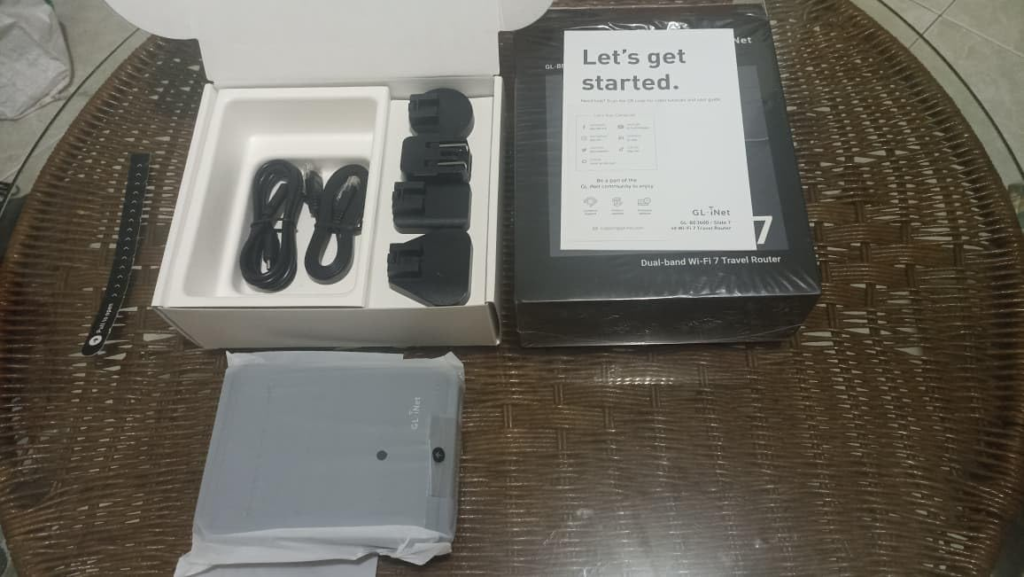
| What power requirements does the Slate 7 have? | Any USB-C charger delivering 18W or more powers the device. The included adapter supports worldwide voltages and comes with interchangeable plug heads for US, UK, EU, and AU outlets. |
| Can I add LTE cellular backup to this router? | Yes. The USB 3.0 port supports compatible LTE USB modems, enabling automatic failover to cellular if the primary Ethernet or Wi-Fi connection drops. The modem is sold separately; the router handles the failover logic natively. |
| Is GL-iNet considered a security risk as a Chinese-origin brand? | Unlike TP-Link, which is currently under active US government regulatory review, GL-iNet has not received comparable scrutiny. The customized OpenWrt-based firmware allows independent security inspection to a degree that closed-source router firmware does not. GL.iNet confirmed publicly that it has never received requests from the Chinese government to share user data or hardware access. |
| What is the storage capacity, and does it limit OpenWrt customization? | Flash storage is 512 MB. For standard travel-router use — VPN client, AdGuard Home, basic network management — this is sufficient. For power users wanting to run multiple simultaneous OpenWrt packages (file server, print server, monitoring stack), storage becomes a real management constraint. The Slate 7 must also run GL.iNet’s customized OpenWrt build rather than vanilla upstream OpenWrt, due to chipset restrictions. |
| What is the warranty on the GL-iNet GL-BE3600? | The Slate 7 carries a 2-year manufacturer warranty. |
Transparency Note:
This analysis is built on aggregated real-world experience.
It extracts what repeatedly holds, what breaks, and what users uncover only after living with the system—then shapes it into a clear model you can use immediately.
Think of it as structured experience, refined and presented so you don’t have to learn it the hard way.
“A quick note: Don’t believe the star ratings, but trust personal experience. This article is a compilation of collected experiences”