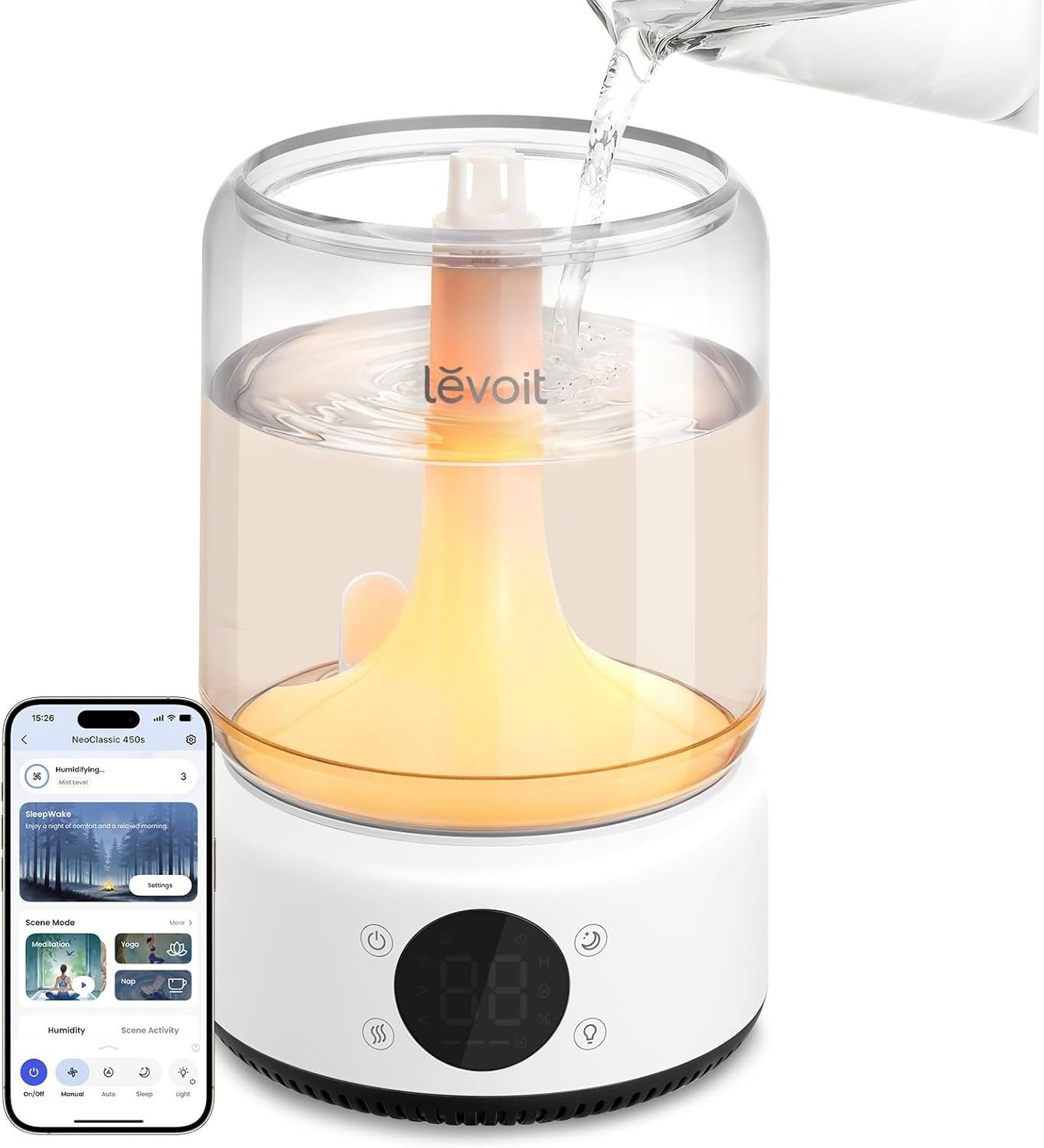
LEVOIT NEO CLASSIC 450S
The Result Looks Fine. The Problem Isn’t.
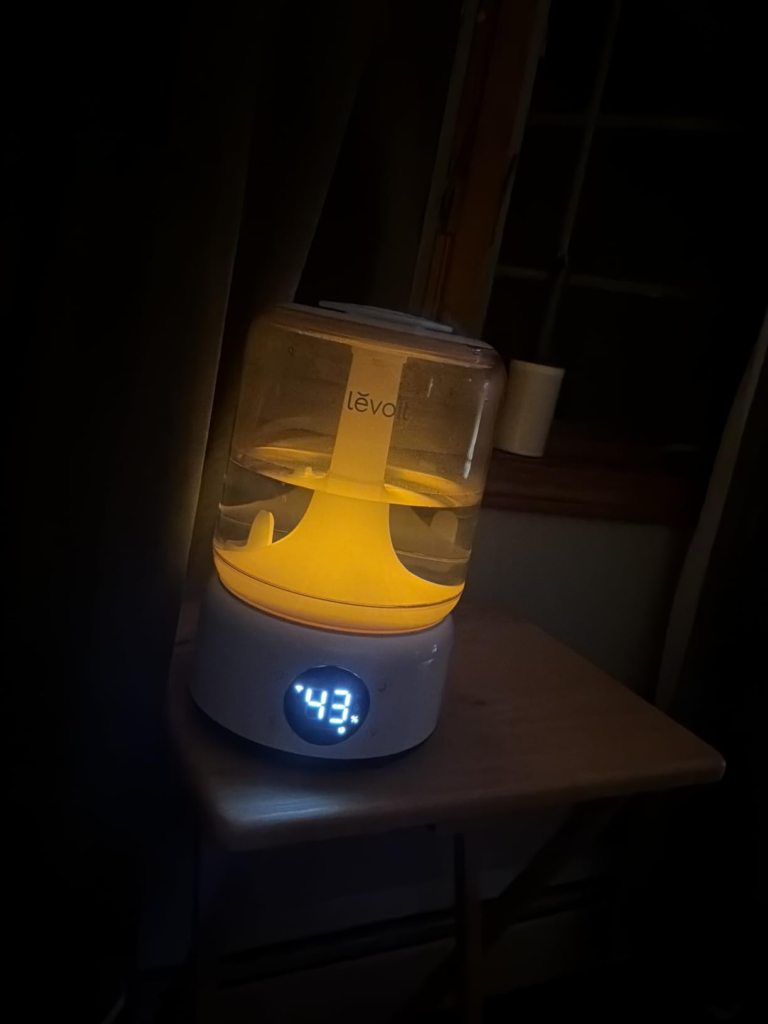
You run a smart humidifier overnight. The display reads 52% relative humidity. You wake up with a scratchy throat. There’s a faint white powder on the nightstand. The app says everything is normal.
This specific mismatch defines the smart humidifier category more honestly than any spec sheet does. The number looks right. The air doesn’t feel right. Something between the machine’s reading and the room is absorbing the benefit before it reaches you.
That gap is the subject of this review — where it lives, what drives it, and whether the LEVOIT Neo Classic 450S is the unit that closes it or simply moves it somewhere you check less often.
What You’re Actually Feeling but Not Naming
The friction isn’t dramatic. It builds gradually.
First it’s the white residue on the nightstand. Then the faint tank odor after three weeks of daily use. Then the auto mode running all night while the room still feels dry by morning. Then the discovery that cleaning takes longer than expected because the nozzle doesn’t disassemble cleanly.
None of these is a defect. Each is a structural consequence of how ultrasonic humidification actually works, combined with how most buyers use it: tap water, moderately large rooms, inconsistent cleaning.
The feeling has a name: maintenance dread. It’s the slow accumulation of small cleaning obligations and unclear performance feedback that makes you use the unit less, then intermittently, then not at all — and replace it with a vague plan to “get a better one later.”
The Hidden Mechanism Behind the Miss
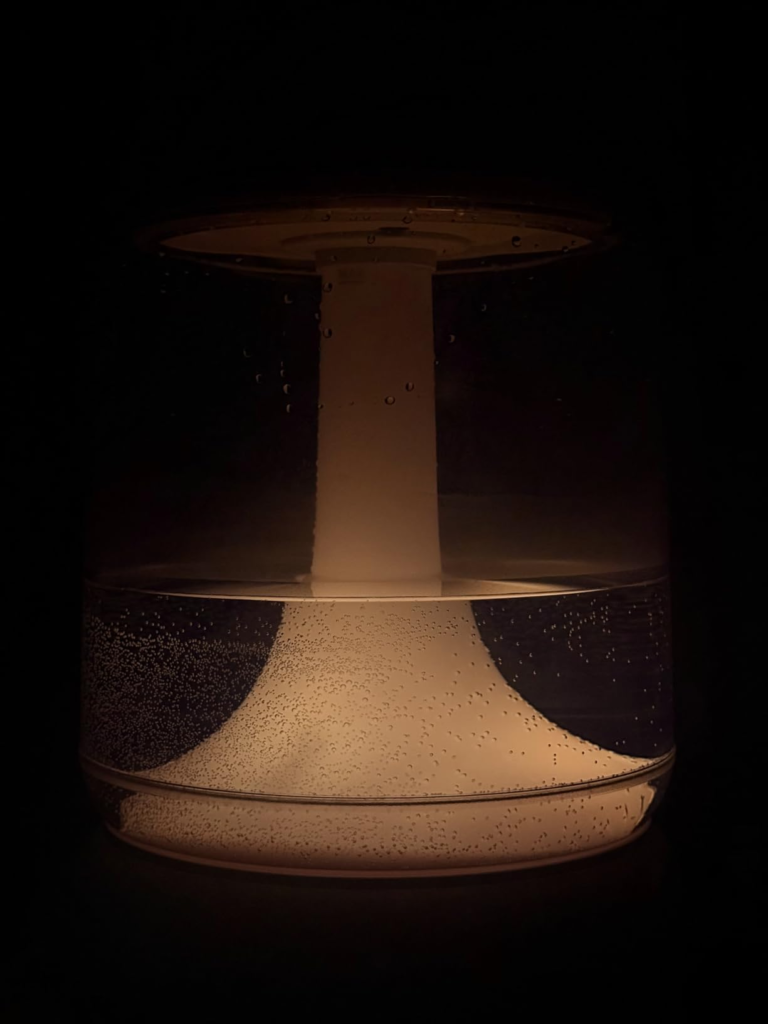
Ultrasonic humidifiers work by vibrating a ceramic disc at very high frequency, turning water into fine mist particles that rise into the air. The process is quiet and filter-free. It also carries dissolved minerals from whatever water sits in the tank. Those minerals don’t evaporate — they land on surfaces as white dust and coat the disc and tank walls as scale.
The sponge filter included with most units absorbs some minerals over time. It doesn’t eliminate them. Once the filter saturates — typically within two to four weeks of daily use with average tap water — mineral transfer resumes freely.
A second mechanism: the built-in humidity sensor reads locally. It sits near the mist output, where humidity is always higher than the room average. In a 300 sq ft bedroom, that gap is typically 8–12 percentage points. In a larger or open-plan space, it can exceed 20 points.
The machine isn’t miscalibrated. It’s reading an accurate number from a specific location that doesn’t represent your whole room. Auto mode responds to that local reading — which means it may stop running at exactly the moment the far corner still needs more moisture.
The Threshold Where the Outcome Quietly Breaks
Three variables define where a smart humidifier’s display stops matching the room’s actual condition.
| Variable | Performance Zone | Degraded Zone |
|---|---|---|
| Water quality (TDS) | Below 100 ppm — distilled or RO filtered | Above 150 ppm — standard tap water |
| Room size and geometry | ≤ 350 sq ft, closed door, 8-ft ceiling | 400+ sq ft, open-plan, high ceiling |
| Required output level | Low or Sleep Mode sufficient | Medium or High needed to reach target RH |
| Cleaning frequency | Light rinse weekly | Less than weekly — buildup accelerates fast |
| Sensor reading accuracy | Near center of small closed room | Corners, far walls, open-plan second half |
All three thresholds can coexist in the same room. When they do, the unit appears to function while delivering materially less than expected. The display stays green. The air stays dry. Neither tells you where the problem is.
Why Most Buyers Misread This Too Early
The comparison that kills accurate judgment is noise level. Three humidifiers list 21dB, 26dB, and 28dB. The buyer ranks them by number and selects the lowest. What that number doesn’t include: 21dB is the Sleep Mode minimum output specification. At medium output — the level most rooms actually require to hold 45% RH overnight — noise typically rises to 26–28dB. The advantage narrows or disappears depending on what output level your room demands.
Coverage faces the same compression. Manufacturers measure it in empty rooms under standard conditions. A furnished bedroom with a bed, dresser, curtains, and a person generating body heat has roughly 25–30% less effective air volume. Rated coverage of 376 sq ft translates to approximately 260–280 sq ft of practical coverage in a typical furnished bedroom.
The most overlooked spec is cleaning design. Most ultrasonic humidifiers require hand scrubbing, vinegar soaks, and careful nozzle disassembly per session — typically 15–20 minutes. Over 90 days of winter use, that accumulates to 22+ hours of maintenance. A dishwasher-safe design reduces that figure to 2 minutes of disassembly and a standard dishwasher cycle. The arithmetic matters because maintenance avoidance is the primary reason most humidifiers stop being used within their first winter.
Who Is Actually Inside This Problem
The person who needs this specific product lives in a heated apartment in winter, sleeps in a room that dries out faster than outdoor conditions suggest it should, and wakes up with a scratchy throat two or three mornings a week — a symptom that clears by mid-morning without explanation.
They may already own a humidifier. They stopped using it because it was too loud at the output level needed, too prone to white residue, too demanding to clean weekly, or too dumb to maintain itself on a schedule. They’re now looking for a unit that disappears into the room: runs scheduled, holds a target humidity, and doesn’t become a weekend chore to maintain.
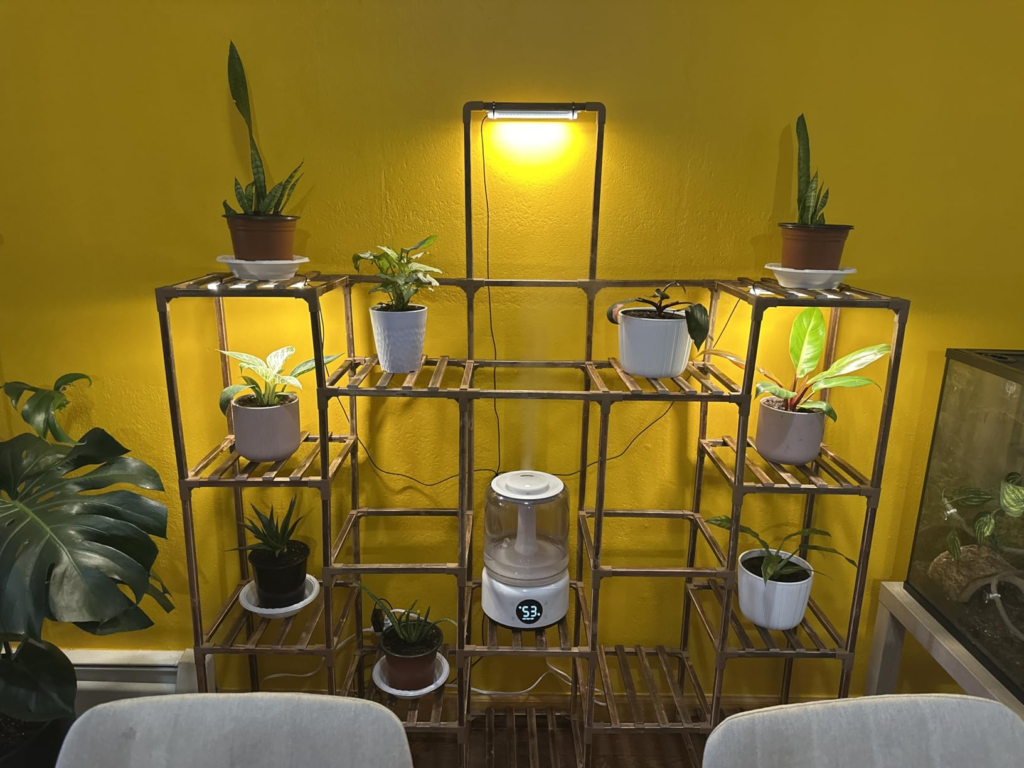
This profile also includes parents managing infant bedroom conditions — consistent 40–50% RH overnight is a pediatrician-standard recommendation for respiratory comfort. And plant owners running humidity-sensitive tropical species who need reliable automation rather than manual daily checking.
What connects all three: they want zero overhead. They’re willing to pay more for a unit that genuinely reduces the friction of consistent use.
Where Wrong-Fit Begins
| Buyer Profile | Fit Verdict | Reason |
|---|---|---|
| Closed bedroom, ≤ 350 sq ft, filtered water | ✅ Strong fit | Specs match conditions exactly |
| Infant nursery, steady overnight RH needed | ✅ Strong fit | 42H runtime + 21dB Sleep Mode + no blue light |
| Tropical plants, humidity-sensitive species | ✅ Solid fit | Auto Mode + VeSync scheduling |
| Open-plan living area, 400–600 sq ft | ⚠️ Weak fit | Coverage insufficient in open geometry |
| Winter congestion relief, warm mist needed | ❌ Wrong category | Cool mist only — no heating element exists |
| Tap water user, hard water above 200 ppm TDS | ⚠️ Marginal | White dust and scaling accelerate significantly |
| 60+ hours runtime between refills required | ❌ Undersized | 42H max at minimum; ~20H at medium output |
| Light-sensitive sleeper, no blue light needed | ✅ Fit | Blue light-free night light, Sleep Mode off |
The warm mist boundary is structural, not a setting. This is a cool mist unit — no mode, firmware version, or adjustment can change that. If warm mist matters to you for winter comfort or faster moisture dispersion, this product does not serve that need, regardless of how well everything else fits.
The One Situation Where This Product Becomes Logical
The LEVOIT Neo Classic 450S (B0GQH7J1SW) was built around a single architectural decision that separates it from the previous generation of smart humidifiers: every water-contact component is dishwasher-safe.
The tank, the lid, and the detachable sink — the part most prone to mineral accumulation — can all go in the dishwasher. The base uses a dry-contact design and requires only a wipe-down between cycles. No vinegar soak. No 20-minute scrubbing session. No tools needed to disassemble the nozzle.
This changes the maintenance equation permanently. The friction that causes most ultrasonic humidifier owners to gradually stop using their units — then blame the product — is structurally removed. Consistent daily use no longer carries a consistent daily penalty.
Everything else follows from that foundation.
| Specification | LEVOIT Neo Classic 450S |
|---|---|
| Model ID | B0GQH7J1SW |
| Tank Capacity | 4.2L (1.11 gal) |
| Mist Type | Cool Mist — Ultrasonic |
| Mist Output | 270 mL/h |
| Max Runtime | 42 hours (at minimum output) |
| Noise Level | 21dB (Sleep Mode) / 26dB (standard operation) |
| Room Coverage | 376 sq ft / 35 m² |
| Cleaning System | Dishwasher-safe tank, lid, and detachable sink |
| Smart Control | VeSync app / Amazon Alexa / Google Assistant |
| Auto Mode | Maintains target RH with ±5% sensor accuracy |
| Night Light | Blue light-free, 2 adjustable brightness levels |
| Scene Mode | Ambient light + music synchronization |
| Essential Oil | Aroma tray integrated into base |
| Auto Shutoff | Activates on empty tank detection |
| Dimensions | 8.1 × 8.1 × 12.8 in |
| Weight | 3.9 lb / 1.77 kg |
| Wattage | 24W |
| Material | Food-grade, BPA-free |
The VeSync app handles scheduling, real-time humidity monitoring, mist level control, and Auto Mode management. It connects to Alexa and Google Assistant for voice control. Scene Mode allows the ambient light and audio settings to sync with specific usage contexts — sleep, focus work, or relaxation routines.
One honest note: the built-in sensor reads locally, as all embedded sensors in this category do. For accurate room-wide humidity data, a standalone hygrometer placed six to eight feet from the unit provides a more representative reading — and allows you to offset the app’s Auto Mode target accordingly.
What It Solves, What It Reduces, and What It Still Leaves to You
| Category | What the Neo Classic 450S Delivers |
|---|---|
| Solves | Dry bedroom air during heated winter months |
| Solves | Morning nasal congestion from overnight air dryness |
| Solves | Maintenance friction — dishwasher-safe design replaces 20-min cleaning sessions |
| Solves | Static electricity and tight skin from consistently low indoor humidity |
| Reduces | Sleep disruption from noise — 21dB sits below whispered conversation level |
| Reduces | White dust buildup — with purified or distilled water |
| Reduces | Manual oversight — Auto Mode + VeSync scheduling |
| Still requires | Purified or distilled water for clean, dust-free operation |
| Still requires | Weekly base wipe and periodic filter check |
| Still requires | Standalone hygrometer for accurate room-wide humidity data |
| Does not provide | Warm mist — cool mist only |
| Does not provide | Reliable coverage beyond 376 sq ft |
| Does not provide | Marathon runtime beyond ~42H at minimum output (~20H at medium) |
The most predictable regret scenario: buying this unit expecting warm mist, open-plan room coverage, or zero-effort operation without purified water. All three of those assumptions break the product before it has a fair operating condition. The fit question is structural — it comes before preference.
Final Compression
The LEVOIT Neo Classic 450S answers one question with precision: what is the version of this product that removes the maintenance penalty from daily use?
21dB in Sleep Mode. Dishwasher-safe parts. 42 hours before refilling. App-scheduled automation that runs without supervision.
If your room is a closed bedroom under 350 sq ft, you use filtered water, and you’ve owned a humidifier before and stopped using it because the upkeep accumulated faster than the benefit — the Neo Classic 450S was designed for exactly that failure pattern.
If you need warm mist, run an open-plan room larger than 400 sq ft, or refuse to use anything but tap water — those gaps are real, and no level of app integration resolves them. The fit question settles first.
If the conditions align, the decision isn’t complicated.
Frequently Asked Questions
| Question | Answer |
|---|---|
| Does the LEVOIT Neo Classic 450S work with tap water? | It operates on tap water, but hard water above 150 ppm TDS will produce visible white dust on furniture within the first week and accelerate mineral scale inside the tank. Levoit’s official recommendation is purified or distilled water. If tap water is unavoidable, increase cleaning frequency to twice weekly and replace the sponge filter monthly instead of quarterly. |
| How accurate is the built-in humidity sensor? | The sensor reads accurately — but locally. It measures humidity near the mist output, not across the room. In a 300 sq ft bedroom, the room average typically runs 8–12 points below the sensor reading. Placing a standalone hygrometer six to eight feet from the unit gives a more representative figure. You can then adjust the Auto Mode’s target setting in the VeSync app accordingly. |
| What is the real runtime at medium mist output? | The 42-hour spec applies at minimum (low) output with a full 4.2L tank. At medium output — the level most closed bedrooms need to reach and hold 45% RH — expect 28–32 hours of runtime. At high output, roughly 18–22 hours. Budget for refilling approximately every two nights if you run the unit at medium overnight. |
| Can the display and night light be turned off completely? | Yes. Sleep Mode disables the display automatically when activated. The night light turns off independently through the VeSync app. The night light uses no blue-light elements — it operates in a warm, low-intensity mode with two adjustable brightness levels, or fully off. |
| Is this unit safe for a baby nursery? | The cool mist output, 21dB Sleep Mode, and blue light-free night light make it technically appropriate for nursery use. No heating element means no burn risk from hot water. Levoit recommends distilled water for nursery environments specifically to minimize mineral particles in the mist. |
| How does the dishwasher-safe cleaning work in practice? | The water tank, lid, and detachable sink (the base component that contacts water) are all dishwasher-compatible. The main unit base stays dry by design and requires only a quick wipe-down. Disassembly for loading takes approximately 90 seconds. No vinegar soaks, no scrubbing tools, no nozzle disassembly. |
| Does the VeSync app work without Wi-Fi? | Basic physical controls on the unit — power, mist level, Sleep Mode — function without Wi-Fi. App-based features including scheduling, Auto Mode via app, Scene Mode, real-time humidity monitoring, and voice assistant control all require an active 2.4GHz Wi-Fi connection. |
| How does the Neo Classic 450S compare to the OasisMist 450S? | |
| Tank Capacity | LEVOIT Neo Classic 450S: 4.2L <br> LEVOIT OasisMist 450S: 4.5L |
| Mist Type | LEVOIT Neo Classic 450S: Cool Mist only <br> LEVOIT OasisMist 450S: Warm + Cool Mist |
| Cleaning Method | LEVOIT Neo Classic 450S: Dishwasher-safe parts <br> LEVOIT OasisMist 450S: Manual cleaning only |
| Noise Level (Sleep Mode) | LEVOIT Neo Classic 450S: 21dB <br> LEVOIT OasisMist 450S: 26dB |
| Night Light | LEVOIT Neo Classic 450S: Blue light-free <br> LEVOIT OasisMist 450S: No ambient light |
| Scene Mode | LEVOIT Neo Classic 450S: Yes <br> LEVOIT OasisMist 450S: No |
| Coverage | LEVOIT Neo Classic 450S: 376 sq ft <br> LEVOIT OasisMist 450S: 430 sq ft |
| Warm mist for winter | LEVOIT Neo Classic 450S: ✗ <br> LEVOIT OasisMist 450S: ✓ |
| Maintenance effort | LEVOIT Neo Classic 450S: Low — dishwasher cycle <br> LEVOIT OasisMist 450S: Medium-High — manual scrubbing |
| Ideal profile | LEVOIT Neo Classic 450S: Maintenance-averse bedroom user, nursery, plant care <br> LEVOIT OasisMist 450S: User who needs warm mist and broader room coverage |
If warm mist and broader coverage are the primary requirements, the OasisMist 450S is the correct product. If maintenance simplicity, quieter Sleep Mode operation, and dishwasher cleaning are the primary requirements, the Neo Classic 450S is the sharper choice.
What water filter does this unit use, and when should it be replaced?
The Neo Classic 450S uses a mineral absorption sponge filter pre-installed in the tank. With purified water, replace it every 2–3 months. With tap water use, replace it monthly. Filter saturation is the point where white dust output increases noticeably — that’s the practical signal for replacement, regardless of time elapsed.
Transparency Note:
This analysis is built on aggregated real-world experience.
It extracts what repeatedly holds, what breaks, and what users uncover only after living with the system—then shapes it into a clear model you can use immediately.
Think of it as structured experience, refined and presented so you don’t have to learn it the hard way.
“A quick note: Don’t believe the star ratings, but trust personal experience. This article is a compilation of collected experiences”