Levoit Core 300S Review: The Air Looks Clean. Your Sensor Thinks So Too. Both Are Wrong.
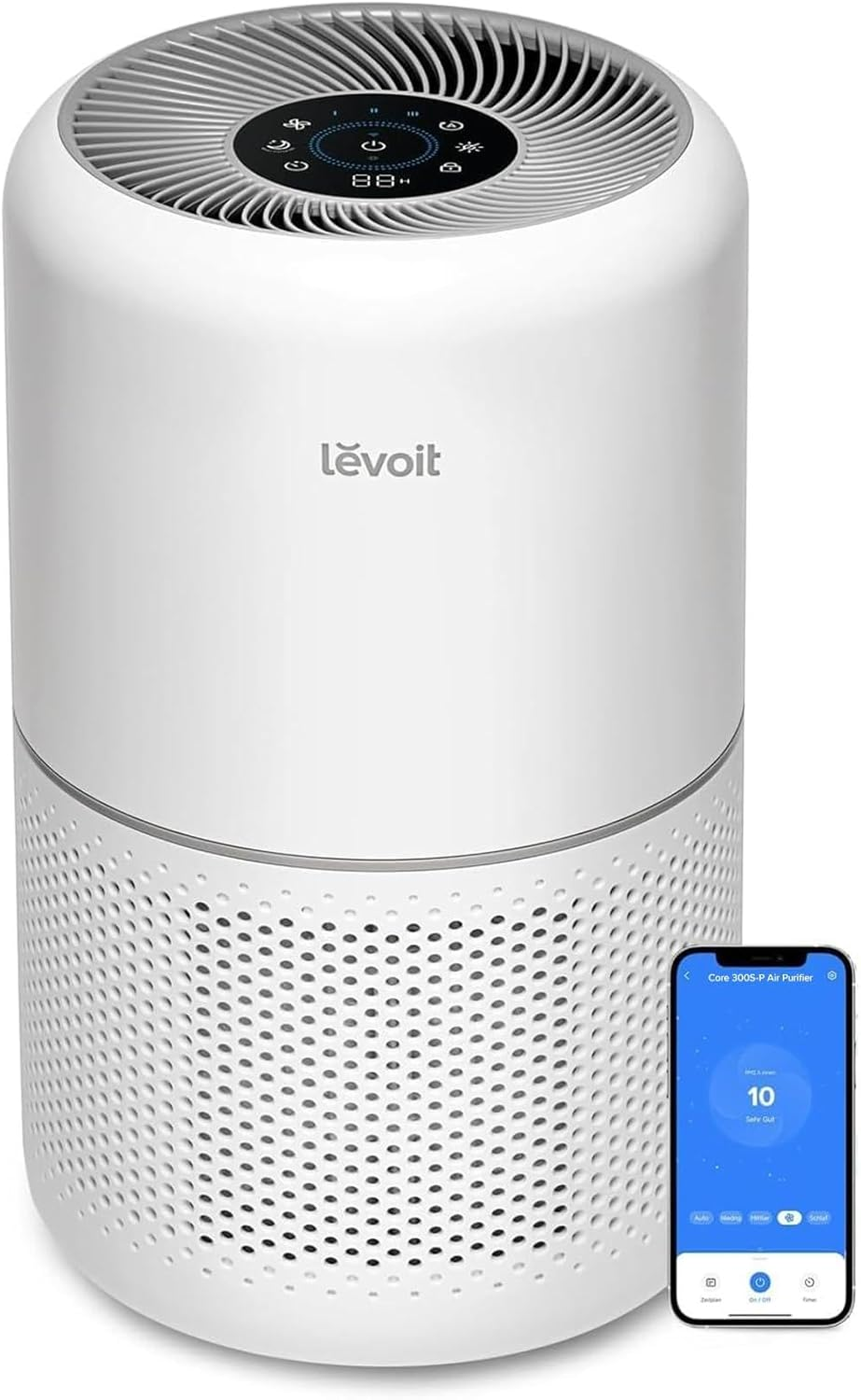
LEVOIT CORE 300S
The Result Looks Fine. The Problem Isn’t.
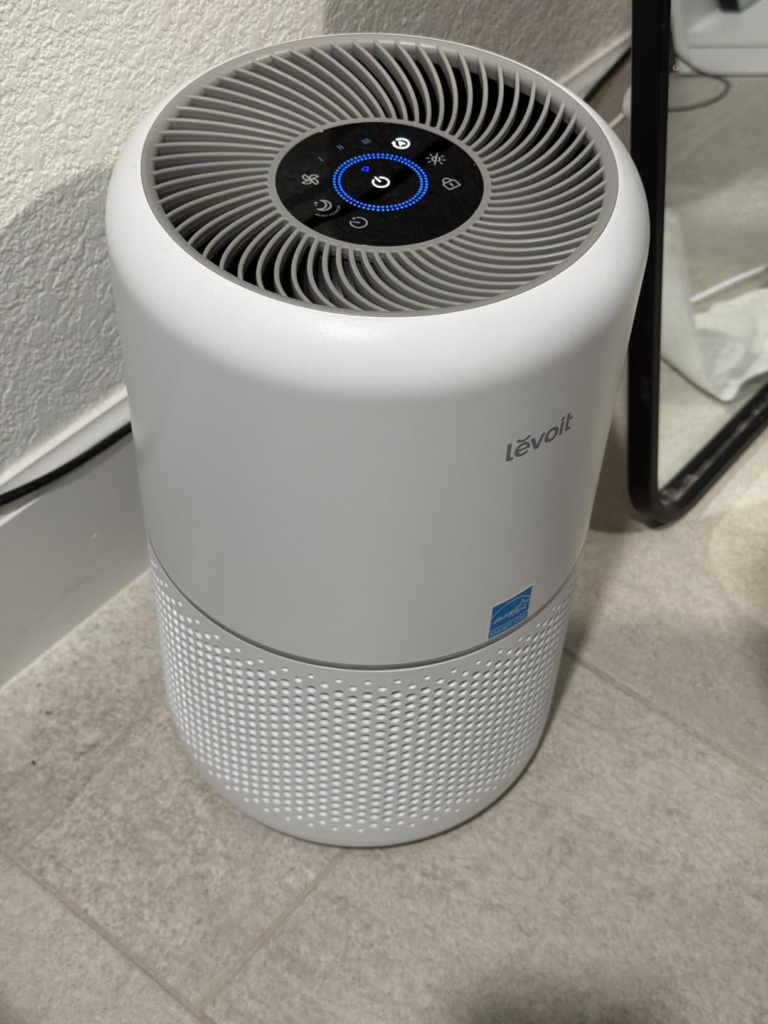
You placed the Levoit Core 300S on your nightstand, pressed auto, and watched the LED ring glow green. The display read “Very Good.” You went to sleep.
The unit was running at low speed. The fan barely hummed. The air in your room measured under 35 µg/m³ of PM2.5 — and the machine decided that was clean enough to slow down.
The device categorizes 0–35 µg/m³ as “Very Good.” In reality, 35 µg/m³ is seven times higher than the WHO annual limit of 5 µg/m³. When the built-in sensor detects the air as “Very Good,” it automatically lowers its fan speed — at the precise moment it should be working harder.
This is not a malfunction. It’s how the machine was designed. And it explains why a significant portion of buyers report sleeping fine next to their purifier while their allergy symptoms don’t actually improve.
The Core 300S is a legitimately good product. But there is a threshold baked into its auto logic that produces a gap between what you see and what you’re actually breathing — and that gap is the entire story.
What You’re Actually Feeling but Not Naming
You bought the air purifier because something wasn’t right. Morning congestion that shouldn’t be there. Eyes that react indoors in ways they don’t outside. A pet in the house, or dust that resets faster than you clean it. A city you live in where the outdoor air quality is “fine” by local standards, and yet.
The feeling isn’t dramatic. It’s low-level. A persistent background interference.
Many people have no idea how much aerosol exposure, cooking particles, and accumulated indoor pollutants affect their air quality on a daily basis — until a device starts logging it.
The Core 300S gives you that data. The VeSync app shows you PM2.5 readings in real time. That visibility is one of the machine’s genuine strengths.
The discomfort comes when the data says “Good” and your body disagrees. That contradiction doesn’t mean the machine is broken. It means the threshold defining “Good” doesn’t match the standard your health actually requires.
The Hidden Mechanism Behind the Miss
The Core 300S has three things working inside it simultaneously that most buyers treat as one: the physical filter, the air quality sensor, and the auto mode logic that connects them.
The filter is real. AHAM VERIFIDE with CADR ratings of 141 CFM for smoke, 156 CFM for dust, and 175 CFM for pollen — independently tested, transparently published. That’s not marketing. Those numbers hold up.
The AirSight™ Plus Laser Dust Sensor scans surroundings, detecting airborne pollutants in real time, and uses that data to determine the most suitable fan speed when running in auto mode.
Here is the mechanical reality: the sensor reads particle density, feeds that reading into a classification table (Very Good / Good / Moderate / Poor), and the table triggers a fan speed tier. The table’s thresholds are Levoit’s own definitions — not WHO air quality guidelines.
When the sensor detects “Very Good” (below 35 µg/m³), it automatically lowers fan speed. In practice, it should clean the air at higher speed to remove more pollutants and ensure PM2.5 stays below the WHO annual limit.
Result: the filter is capable. The sensor is real. But the logic connecting them draws the boundary in the wrong place for anyone sensitive enough to notice the difference between 35 µg/m³ and 5 µg/m³.
The machine isn’t lying. Its definition of “very good” simply does not match what the WHO considers safe for long-term respiratory health.
The Threshold Where the Outcome Quietly Breaks
Call it the Comfort Threshold: the point at which the Core 300S decides it has done enough, reduces speed, and leaves a measurable residue of fine particles that its own display will never flag as a problem.
Below the Comfort Threshold (readings under 35 µg/m³), the unit enters what is effectively a maintenance mode. Fan slows. Noise drops. The app shows a green ring. Nothing in the interface tells you that WHO’s recommended safe level is seven times lower than this point.
Above the Comfort Threshold — cooking smoke, candles, a heavy pet day, outdoor air infiltration — the machine responds well. The 300S sensor detected smoke particles 8 seconds faster than a human could smell them. Reactive performance is genuinely strong.
The problem is not what happens above the threshold. The problem is what happens below it — when the machine declares victory and stops competing for the last, most important fraction of particulate reduction.
For someone who runs the unit occasionally, or who has moderate ambient pollution: the Comfort Threshold doesn’t matter. The air gets perceptibly cleaner, the unit runs quietly, and the value is obvious.
For someone with diagnosed respiratory sensitivity, chronic allergies, or a newborn in the room — someone for whom the difference between 30 µg/m³ and 5 µg/m³ is biologically meaningful — the Comfort Threshold is where the product’s promise quietly ends.
| Condition | Auto Mode Behavior | Effective Outcome |
|---|---|---|
| PM2.5 > 35 µg/m³ | High fan speed triggered | Strong reactive cleaning |
| PM2.5 12–35 µg/m³ | Medium or low speed | Partial maintenance mode |
| PM2.5 < 12 µg/m³ | Lowest speed / sleep-adjacent | WHO gap widens, undetected |
| Manual Speed 3 (always on) | Full CADR delivered continuously | Consistent therapeutic cleaning |
Why Most Buyers Misread This Too Early
The most common buying mistake: purchasing the Core 300S and judging it against other compact air purifiers on the market, as if all compact purifiers define “clean air” the same way.
The Core 300S uses a 26W motor — almost half the power of the Core 300’s 45W motor — with nearly identical CADR performance. Annual energy use runs approximately 139 kWh/year, compared to 254 kWh/year for its predecessor.
That efficiency advantage is real and measurable. But efficiency means nothing if you’re optimizing the wrong outcome.
The second mistake: assuming that “smart” means “accurate to clinical standards.” Smart, in the context of the Core 300S, means the machine makes automatic decisions. The quality of those decisions is bounded by the calibration of the sensor and the thresholds programmed into its logic — not by WHO guidelines.
There are complaints from Amazon users pointing out that the built-in sensor can be inaccurate. Separately, Dyson questioned whether the Core 300S met HEPA standards. Levoit argued the claims were based on independent data, then decided to permanently stop using those challenged claims — meaning the BBB never assessed the evidence. Levoit subsequently removed “True HEPA” from the Core 300S and now emphasizes a 3-stage filtration process.
This is not a verdict on the machine’s filtration effectiveness. The AHAM VERIFIDE CADR is independently tested and stands. But the “True HEPA” episode reveals something about how the product’s claims were positioned relative to how they’ve held up to external scrutiny.
Buyers who read spec sheets and compare CADR numbers often conclude the Core 300S wins its price category. They’re frequently right. Buyers who need their air purifier to close the WHO gap without manual intervention frequently find that the auto mode is the weakest part of the machine — not the filter.
Who Is Actually Inside This Problem
The Core 300S was designed for a specific environment. A cylinder 14 inches tall and 9 inches wide, weighing 6 pounds, rated to clean 219 square feet up to 5 times per hour. That’s a bedroom. A home office. A baby’s room. A single enclosed space where air recycling happens continuously.
This product fits you if:
- Your space is 150–219 sq. ft. and consistently enclosed
- You have moderate ambient pollution (city air, pets, occasional cooking)
- You want hands-off operation with smart scheduling via the VeSync app
- You need Alexa or Google Assistant voice integration
- You want energy efficiency: running the Core 300S all day, every day at maximum speed adds approximately $24.44 to your annual electricity bill — and most users won’t run it at max all the time.
- You are not clinically sensitive to particulate matter in the 5–35 µg/m³ range
- You understand that “auto mode” means “automated by Levoit’s thresholds,” not “automated by WHO standards”
This product fits you if you use it correctly:
- Manual Speed 3 during high-pollution events (cooking, candles, guests)
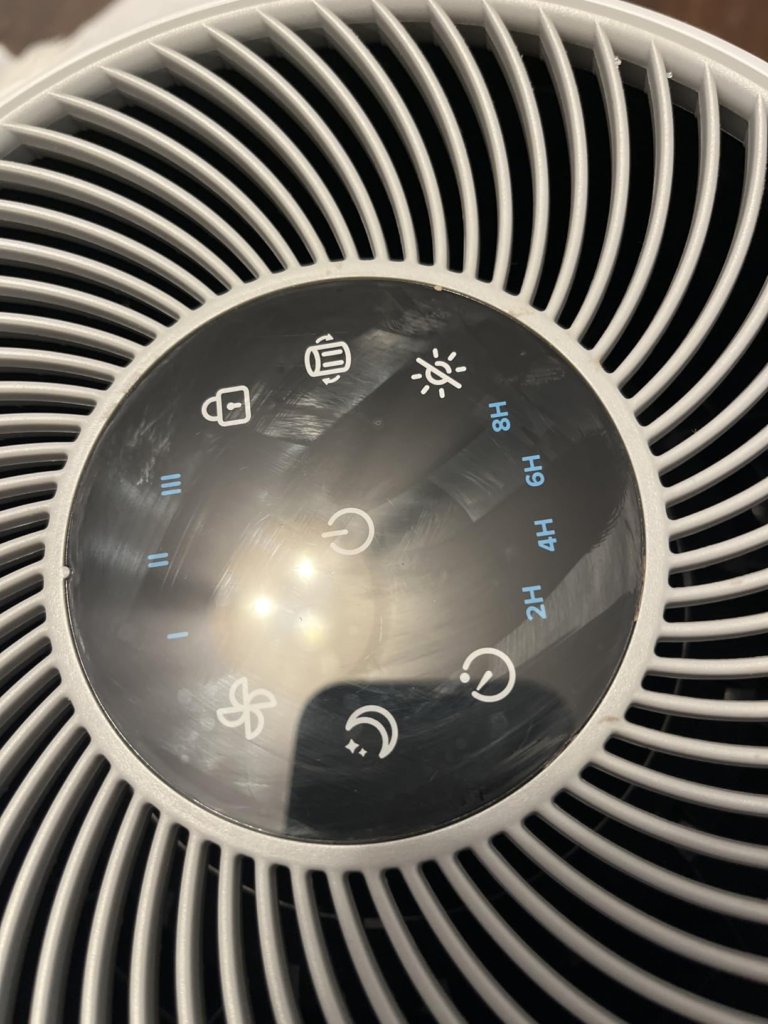
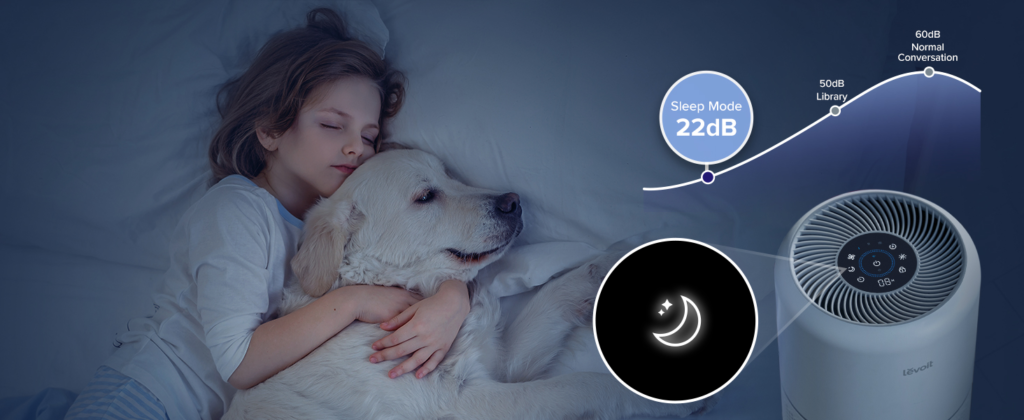
- Sleep Mode at night (quiet, low-light, consistent at under 22 dB)
- Auto Mode for baseline maintenance between active events
Where Wrong-Fit Begins
The Levoit Core 300S starts producing regret in specific, predictable conditions. Know these before you buy.
Wrong-fit signal #1: Your room is larger than 250 sq. ft.
Performance varies depending on room size. The CADR is engineered for 219 sq. ft. A living room, an open-plan kitchen, a bedroom with adjoining bathroom airflow — the unit works harder but never achieves the same air change rate. The auto mode slows down before it should, now in a larger volume.
Wrong-fit signal #2: You have clinical-grade sensitivity to PM2.5
If your physician has advised you to maintain indoor air at WHO PM2.5 standards, auto mode will not get you there consistently. You will need to run Speed 3 manually, which negates one of the machine’s core selling points.
Wrong-fit signal #3: You want “set it and forget it” — truly
Some Reddit users report they have a Core 300S with Wi-Fi capability but never use the app — they just use the buttons on the screen and question why everything needs Wi-Fi. The machine is not a burden. But the people who got the most from it learned how its modes actually work. The people who felt let down assumed the auto mode was smarter than it is.
Wrong-fit signal #4: You have a motor failure history or harsh-use environment
Some users report motor squealing that developed over time, with units needing warranty replacement — one within 30 days, another after six months. This is not a majority experience. Warranty support exists. But it is worth noting for buyers in environments with high-intensity continuous operation.
| Buyer Profile | Fit Assessment |
|---|---|
| Light allergy, bedroom, 150–219 sq. ft. | Strong fit |
| Pet owner, moderate dander, enclosed room | Strong fit with Pet Allergy filter |
| City dweller, moderate outdoor PM2.5 | Good fit on manual speed 2–3 |
| Clinical PM2.5 sensitivity, closed room | Partial fit — requires manual mode |
| Open-plan room over 300 sq. ft. | Poor fit — CADR insufficient |
| Looking for “smart” to mean clinically accurate | Wrong product category |
The One Situation Where the Levoit Core 300S Becomes Logical
You have a specific, enclosed room — a bedroom, a nursery, a home office — between 150 and 220 square feet. The air in that room accumulates particles from living: pet dander, dust, outdoor infiltration through windows, cooking odors that drift. You want to run something continuously without thinking about it. You want to be able to check the air quality from your phone when you travel. You want it to work with Alexa.
You don’t need it to perform to WHO PM2.5 standards on autopilot. You need it to make the air measurably and consistently better than it was, to run quietly enough to sleep through, and to cost almost nothing in electricity.
The Levoit Core 300S is one of the best small air purifiers tested — affordable, highly efficient, equipped with smart features. Its motor is well-optimized, making it a very low power consumer that is also affordable to maintain. Performance achieved outstanding results in independent tests, with air improvement comparable to some much larger and more powerful purifiers.
Its three-step filtration system filters out 99.97% of PM2.5 particles, capturing dust, hair, lint, fibers, fur, and smoke particles, as well as tackling odors, fumes, and VOCs.
That is the Core 300S’s real value proposition. Not clinical precision. Not whole-home coverage. Not a set-and-forget replacement for active air management.
One room. Continuous, quiet, low-cost, app-monitored purification. That’s the machine’s natural habitat. Inside that habitat, it works.
What It Solves, What It Reduces, and What It Still Leaves to You
| Category | What the Core 300S Delivers |
|---|---|
| Pet dander (enclosed room) | Strong capture with Pet Allergy filter variant |
| Dust and pollen | CADR of 156 CFM dust / 175 CFM pollen — independently verified |
| Smoke and VOCs | Reactive performance is fast; activated carbon layer handles odors |
| Noise at night | Sleep Mode at 22 dB — genuinely silent |
| Energy cost | ~$24/year at max speed continuous — among the lowest in class |
| App and voice control | VeSync app, Alexa, Google Assistant — functional, not gimmicky |
| Filter cost | Replacement every 6–8 months; genuine filters recommended |
| Category | What It Does Not Deliver |
|---|---|
| WHO PM2.5 compliance on auto | Auto mode stops at Levoit’s “Very Good” threshold, not WHO’s |
| Large room coverage | Performance degrades meaningfully above 250 sq. ft. |
| Sensor clinical accuracy | Built-in sensor is directional, not calibrated to lab-grade standards |
| Whole-home air management | One unit = one room. No exceptions. |
| Humidity or VOC monitoring | Air quality data is PM2.5 only |
What it still leaves to you: learning which mode to run when. Using Speed 3 or Speed 2 proactively — before you cook, before guests arrive, before allergy season peaks — rather than relying on auto to detect and respond. The machine reacts well. But reactive is not the same as preventive.
Filter replacement is also your responsibility to track honestly. Levoit recommends replacing filters every 6 to 8 months, and genuine Levoit filters are designed specifically for these models — off-brand filters may affect performance.
Frequently Asked Questions
| Question | Answer |
|---|---|
| Does the Levoit Core 300S actually clean the air, or is it just moving it around? | It actually cleans it. AHAM VERIFIDE CADR ratings are independently tested. The filtration removes verified percentages of smoke, dust, and pollen at measured flow rates. The filter quality is not the machine’s weakness. |
| Why does my Core 300S run on low even when I can smell something? | Because the AirSight sensor classifies PM2.5 levels under 35 µg/m³ as “Very Good,” and at that reading it reduces fan speed. Your nose may detect VOCs or gases that the PM2.5 sensor doesn’t register. Switch to Speed 2 or 3 manually when cooking or when odors are present. |
| Is the auto mode reliable enough to use every night? | For most users in moderately polluted environments: yes, it provides consistent background purification. For anyone with documented respiratory sensitivity to PM2.5 at WHO thresholds: run Speed 2 or 3 manually at night, or the gap between the sensor’s “Good” and WHO’s “Safe” may matter to your health. |
| What’s the real annual cost to run the Core 300S? | Running at maximum speed, all day, every day adds approximately $24.44 to your annual electricity bill. In practice, with sleep mode and auto mode cycling, real-world costs will be lower. Filter replacement every 6–8 months is the larger ongoing cost to factor in. |
| Can I use it in my living room (400 sq. ft.)? | You can, but it won’t achieve the same air change rate. It’s designed for 219 sq. ft. at 5 air changes per hour. In a 400 sq. ft. room, that rate drops significantly. The unit will help, but it won’t dominate the space the way it dominates a bedroom. |
| Does it work with Alexa and Google Home? | Yes — simply ask Alexa or Google Assistant to control the air purifier. The VeSync app also allows remote adjustment of settings, air quality monitoring, scheduling, and more. |
| Is the “True HEPA” dispute a reason not to buy it? | Levoit removed the “True HEPA” label from the Core 300S after Dyson challenged those claims. They now emphasize a 3-stage filtration process. The AHAM VERIFIDE CADR numbers remain independently tested and published. The filtration works. The labeling changed. Judge the machine on the certified performance numbers, not on the marketing that was removed. |
| Who should not buy the Levoit Core 300S? | Anyone who needs an air purifier for a space larger than 250 sq. ft., anyone who requires WHO-standard PM2.5 compliance on full autopilot, and anyone who cannot or will not learn the difference between when to use auto mode and when to switch to a fixed speed. |
Final Compression
The Levoit Core 300S is not a sophisticated air quality management system. It is a compact, efficient, app-connected air purifier designed to make one enclosed room measurably cleaner — continuously, quietly, and at low cost.
With similar CADR scores and filter technology to its predecessor, the Core 300S wins on smart features and a lower energy draw that cancels out the cost premium within a couple of years of use.
Its sensor is real but not clinically calibrated. Its auto mode is functional but not set-and-forget for the medically sensitive. Its filter does what independent testing says it does.
If you have one bedroom, moderate ambient pollution, and you want the air measurably better without managing it daily — this is a logical decision.
If you need the auto mode to keep you inside WHO PM2.5 standards without manual input, this is the wrong product. Not a bad product. The wrong one for that specific requirement.
The decision is not “is the Core 300S good?” It is “does my actual problem fit inside what this machine actually solves?”
If it does — and for most buyers in a correctly sized room, it does — stop delaying. The cost of running it wrong, or running it in the right room, is not large. The cost of continuing to breathe what you bought it to remove is.
Transparency Note:
This analysis is built on aggregated real-world experience.
It extracts what repeatedly holds, what breaks, and what users uncover only after living with the system—then shapes it into a clear model you can use immediately.
Think of it as structured experience, refined and presented so you don’t have to learn it the hard way.
“A quick note: Don’t believe the star ratings, but trust personal experience. This article is a compilation of collected experiences”