Jura ENA 8 Review: The Expensive Mistake Is Buying It for the Wrong Reason
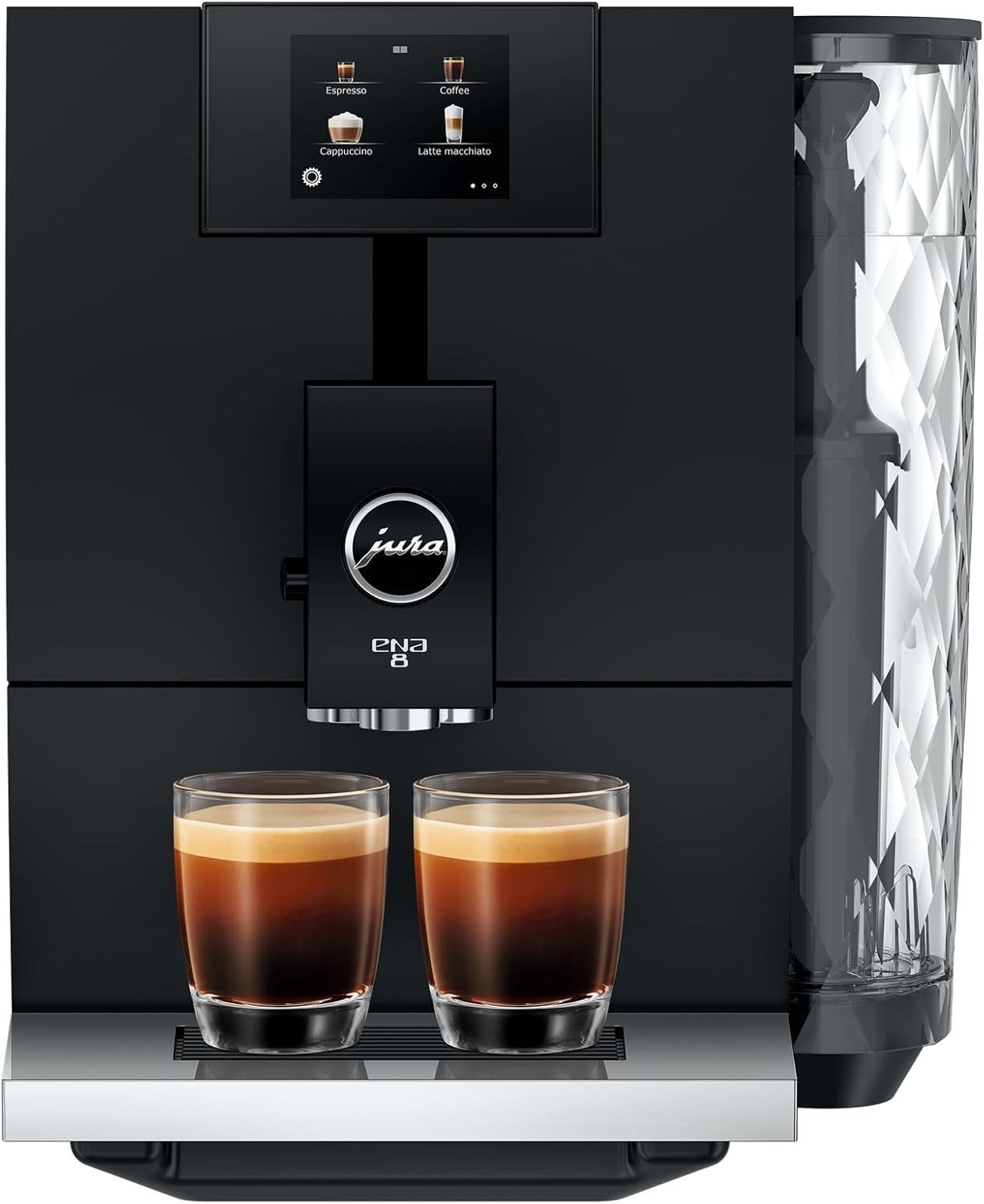
JURA ENA 8
The Result Looks Fine. The Problem Isn’t.
A bad coffee machine usually announces itself with noise, mess, or a cup that tastes flat. The Jura ENA 8 is more dangerous than that. It looks polished. It works fast. It pours drinks that make you think the problem is solved. Then the real question creeps in a week later: did I buy a compact luxury machine, or did I buy a very elegant compromise that only makes sense for one kind of kitchen and one kind of drinker?
That is the tension around this machine. On paper, it is small, refined, and technically loaded: a 10.7 x 12.7 x 17.5 inch body, a 1.1 L water tank, a 125 g bean container, 15 specialties, Jura’s aroma-focused grinder, fine-foam milk system, and a two-cup function for non-milk drinks. In expert reviews, the pattern is consistent too: strong espresso quality, notably good milk texture, premium materials, and a footprint that makes sense where larger superautomatics do not.
But that smooth first impression can hide the real buying risk. The ENA 8 is not a broad “best for everyone” machine. It is a threshold machine. Cross the right threshold, and it feels justified. Miss it, and the price starts scraping at you every morning.
What You’re Actually Feeling but Not Naming
What many buyers are chasing is not “better coffee” in the abstract. It is relief.
Relief from a cluttered counter.
Relief from frothing milk manually before work.
Relief from that small daily drag where a home coffee routine keeps asking for one more hand, one more minute, one more compromise.
That is why the ENA 8 attracts attention so easily. It promises a strange combination that most machines handle poorly: small body, one-touch milk drinks, premium finish. Homegrounds frames it clearly – this is Jura’s compact answer for people who want milk-based drinks without giving over half the counter to a larger box. Whole Latte Love leans the same way, describing the machine as unusually strong at delivering nuanced flavor and fluffier foam for its class.
And there is a psychological wrinkle here that matters. You do not resent a large machine for being large if it performs like a beast. You do resent a compact machine if its convenience starts asking for repeated refills, repeated emptying, repeated cleaning, or repeated excuses. That is why this product lives or dies on fit, not glamour. The coffee can be excellent. The ownership rhythm is the real verdict.
The Hidden Mechanism Behind the Miss
The hidden variable is simple: the ENA 8 is not really selling coffee quality first. It is selling milk convenience inside a small-space envelope.
That distinction changes everything.
Jura gives you the visible layer – 15 specialties, touchscreen operation, a fine-foam milk system, 3D brewing, and a grinder designed for aroma consistency. Reviewers then fill in the invisible layer: the machine’s strength is not that it beats every rival on absolute feature count; it is that it compresses a premium milk-drink workflow into a body that still fits where many superautomatics do not. That is why experts keep comparing it not to random espresso makers, but to Jura’s own larger E8.
Here is the mechanism in plain English:
| What the spec says | What it really means in daily life |
|---|---|
| 1.1 L water tank | You gain compactness, but you pay with more frequent refills |
| 125 g bean hopper | Fresh beans cycle through faster, but heavy users will refill often |
| Approx. 10-serving grounds container | The machine stays trim, but cleanup arrives sooner |
| Fine-foam milk system | Milk drinks feel effortless, which is where the premium starts making emotional sense |
| Two-cup function for non-milk drinks | It helps households sharing black coffee, but it is not true high-volume milk output |
Those are not flaws in isolation. They are the price of the design logic. The miss happens when buyers read the machine as a luxury all-rounder instead of a compact milk-drink specialist.
The Threshold Where the Outcome Quietly Breaks
This is the threshold I would name: the refill-and-rinse threshold.
Below that line, the ENA 8 feels sharp, fast, and strangely satisfying.
Above it, the machine begins to feel smaller than its price.
The evidence points to the same practical pressure points. Jura’s own manual confirms the compact capacities: 37.2 oz water, 125 g beans, roughly 10 servings in the grounds container. The manual also shows what ownership really involves when milk is part of the routine: automatic prompts, milk-system cleaning, daily rinsing of the dual spout after milk use, and regular replacement of the milk pipe and spout parts for hygiene. Independent reviewers echo the same trade-off. Homes & Gardens found the grounds setup small enough to need daily emptying in heavier-use households, and noted that accessing it means pulling out the whole front drip-tray assembly. Coffeeness, meanwhile, basically treats the smaller tank and daily emptying as the natural cost of the format.
That threshold is not dramatic. It is quieter than that. It sounds like this:
one more water refill than you expected
one more tray emptying than feels elegant
one more milk-system rinse when you only wanted to tap a button and walk away
That is where premium design stops feeling luxurious and starts feeling conditional.
Why Most Buyers Misread This Too Early
Because they compare the wrong things.
They compare finishes.
They compare drink menus.
They compare the thrill of ownership.
That is the trap.
The ENA 8 can absolutely win those shallow comparisons. It looks expensive because it is. It is compact in a way that feels almost architectural. It offers one-touch milk drinks, a touchscreen, and the kind of polished interface that makes many cheaper machines feel crude. Reviewers consistently praise the espresso, the milk foam, and the intuitive daily use. Owners who love it tend to repeat the same trio: easy setup, easy cleaning, excellent flavor.
But the earlier, better question is harsher: what exactly am I paying to avoid?
If the answer is “I want automatic milk drinks and I do not have room for a larger machine,” the ENA 8 becomes sharply coherent.
If the answer is “I just want the best value Jura” or “I mainly drink black coffee” or “my kitchen can fit the E8 anyway,” the logic weakens fast.
That is not theory. Multiple review sources converge on it. HomeCoffeeExpert explicitly frames the ENA 8 as a stripped-back E8 with fewer drinks and less milk customization. The newer specialist comparison source goes further: if the E8 fits and pricing is close, the E8 is usually the better buy; the ENA 8 earns its place when space genuinely blocks the bigger machine. Even Homegrounds, which is broadly favorable, keeps returning to the same idea – small kitchens, small offices, touch-of-a-button milk drinks, premium convenience in a tight footprint.
Who Is Actually Inside This Problem
You are inside the ENA 8 problem if three things are true at once.
| Real-fit condition | Why it matters |
|---|---|
| You drink milk-based coffees often | This machine’s premium is concentrated in one-touch milk convenience and foam quality |
| Your counter space is genuinely limited | Compact size is not a side benefit here; it is the main justification |
| You still care about cup quality, not just automation | Reviews repeatedly praise flavor clarity, consistency, and milk texture |
That is the buyer this machine serves best: not the bargain hunter, not the black-coffee purist, not the feature maximalist. The right buyer is the person who wants a cappuccino or flat white before work, hates the ritual mess of manual steaming, and cannot give up the counter width a bigger Jura asks for. That is why specialist reviewers keep describing the ENA 8 as the compact answer to a milk-drink problem, not the universal answer to home espresso.
Psychologically, this matters more than spec sheets admit. The machine does not just save motions. It removes a tiny daily negotiation. No grinder on one side. No pitcher on the other. No half-awake steam wand cleanup while the kitchen light still feels hostile. That reduction in friction is what people are really buying when they say a machine like this “changes mornings.”
Where Wrong-Fit Begins
Wrong-fit begins the moment you need the ENA 8 to be larger than it is.
If you mainly drink espresso, lungo, or plain coffee, some reviewers plainly argue that Jura’s simpler models or other machines offer cleaner value because the ENA 8’s premium is tied to the milk system. If you want cold drinks or iced functions, this is not your machine. If you expect high-volume hosting without repeated refills, the compact tank, hopper, and grounds bin stop feeling “clever” and start feeling undersized. And if you are the kind of buyer who becomes irritated by maintenance prompts, milk rinses, or tray management, the ownership texture will wear on you faster than the espresso charm can cover.
There is also a quieter risk: owner sentiment is not perfectly smooth. Amazon’s review sample shows both enthusiastic praise for flavor, speed, and easy cleaning, and a meaningful pocket of lower-star complaints, including defect concerns and disappointing experiences. That does not prove a systemic failure. It does prove that premium pricing raises emotional stakes. When a machine costs this much, even a minor quirk feels louder.
So no, this is not the machine for everyone.
And that is exactly why it can be the right machine for someone very specific.
The One Situation Where This Product Becomes Logical
Here is the single situation where the Jura ENA 8 stops feeling indulgent and starts feeling structurally justified:
You want genuinely good one-touch milk drinks, every day, in a kitchen where a larger premium superautomatic is either visually intrusive or physically unreasonable.
That is the point.
Not “I want a fancy coffee machine.”
Not “I want the most features.”
Not “I want to impress people.”
I mean this exact condition: your mornings involve cappuccino, latte macchiato, flat white, or cortado often enough that manual prep becomes a tax, and your kitchen cannot absorb the footprint of a fuller machine without turning the counter into a parking lot.
In that one situation, the ENA 8 becomes very hard to dismiss. The official feature set backs the logic: 15 specialties, one-touch milk handling, compact dimensions, aroma-focused grinding, and fine-foam delivery. Independent reviewers back the lived result: milk texture is a real strength, flavor quality is consistently high, and the machine’s reason for existing is not broad superiority – it is compact milk-drink competence without a major quality collapse.
That is the moment the price stops looking like decoration and starts looking like compressed labor. The ENA 8 is expensive, yes. But if it removes the exact friction you keep paying with time, counter space, and annoyance, the cost starts to read differently.
What It Solves, What It Reduces, and What It Still Leaves to You
Here is the clean version.
| It solves | It reduces | It still leaves to you |
|---|---|---|
| One-touch access to espresso and milk drinks in a small footprint | Morning friction, manual milk prep, countertop sprawl | Regular water refills, tray emptying, milk-system care |
| Better milk-drink ease than espresso-only compact machines | Decision fatigue around grind-steam-clean routines | Consumables and hygiene discipline |
| Premium-feeling automation without a full-size body | Mess compared with many semi-automatic workflows | The need to be honest about your drink habits |
The manual is unambiguous about the maintenance reality: milk use requires cleaning attention, daily disassembly and rinsing of the dual spout is recommended after milk preparation, and the milk pipe/spout parts should be replaced periodically. Troubleshooting guidance also makes clear that neglected cleaning shows up in foam quality and performance. That matters because the ENA 8 is not magic. It is a high-convenience machine, not a no-responsibility machine.
That is also why the trust case here is stronger when stated narrowly. This machine does not solve every coffee problem. It does not give you a café’s flexibility. It does not erase upkeep. What it does is compress a very specific daily workflow into something tighter, faster, and less mentally noisy. For the right buyer, that is enough. More than enough.
Final Compression
Most people do not need the Jura ENA 8.
That is the best thing I can say about it.
Because the people who do need it usually need it for one sharply defined reason: they are tired of sacrificing milk-drink convenience to save space, and tired of sacrificing space to get milk-drink quality. The ENA 8 is one of the rare machines built exactly for that collision. Its compact body, 15-drink menu, fine-foam system, and strong espresso reputation all support that role. Its small tank, small grounds capacity, and maintenance rhythm are the price of entry.
So the decision compresses to this:
If you mainly drink black coffee, step away.
If your counter can comfortably take an E8-class machine, think twice.
If you want daily milk drinks, care about cup quality, and your kitchen space is genuinely tight, this is where the vague search usually ends.
Transparency Note:
This analysis is built on aggregated real-world experience.
It extracts what repeatedly holds, what breaks, and what users uncover only after living with the system—then shapes it into a clear model you can use immediately.
Think of it as structured experience, refined and presented so you don’t have to learn it the hard way.
“A quick note: Don’t believe the star ratings, but trust personal experience. This article is a compilation of collected experiences”