HiBREW H13 Review: The Cheap Espresso Shortcut Looks Smart Until the Wrong Threshold Appears
HOMBREW H13
The expensive mistake in home espresso is rarely the machine you cannot afford. It is the machine that looks just competent enough to let you postpone a cleaner decision.
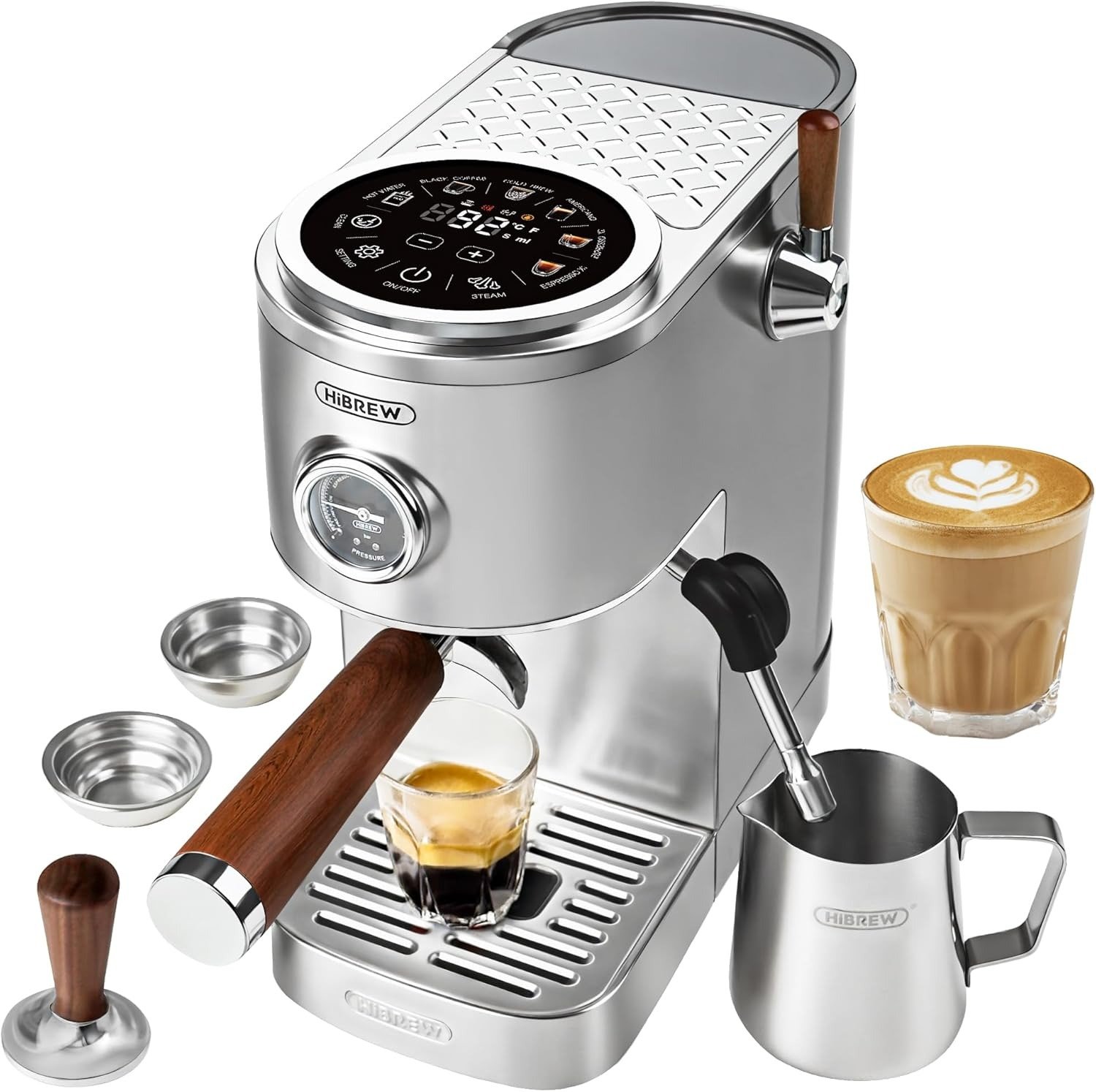
I kept coming back to that while studying the HiBREW H13. On paper, it throws out the kind of language that makes a tired buyer lean forward: dual heating, 58mm portafilter, OPV, touchscreen, adjustable temperature, pre-infusion, hot-water outlet, 2100W power, and a price that sits far below the old psychological wall most people associate with serious milk-drink workflow. The trap is obvious. The sheet looks richer than the budget. The harder question is not whether it can make espresso. It can. The harder question is where the illusion of value starts to crack.
The Result Looks Fine. The Problem Isn’t.
A quick shot with fresh beans can make almost any machine look innocent.
That is why so many buyers misread entry-level espresso. They judge the first crema, the first warm cup, the first clean photo on the counter. They do not judge the fourth drink, the rushed weekday milk texture, the cleanup friction after a shot, the point where the machine stops feeling like a tool and starts feeling like a negotiation. That is exactly where the H13 becomes interesting. It is not trying to win on romance. It is trying to win on compressed workflow: fast heat-up, simultaneous brew-and-steam behavior through dual thermoblocks, one-touch drink presets, and a standard 58mm format instead of the smaller, more closed accessory path that often forces extra spending later.
The first impression, then, is not false. It is just incomplete.
What You’re Actually Feeling but Not Naming
Most people do not say, “I need a better thermal workflow.” They say something softer. More human.
They say the coffee routine feels messy.
They say milk drinks feel slower than they should.
They say the machine technically works, but the whole thing never settles into rhythm.
That vague annoyance has a shape. It usually comes from three repeating costs:
- waiting cost
- cleanup cost
- correction cost
Waiting cost is the pause between brewing and steaming, or the drag of a machine that breaks your morning tempo. Cleanup cost is the wet, drippy, slightly irritating aftermath that makes you hesitate before pulling another shot. Correction cost is the constant compensation you perform because the machine or preset is not naturally landing where espresso logic says it should. Owners praising the H13 tend to praise temperature adjustability, sweeter shots than smaller-group alternatives, and usable steam performance for flat whites and lattes; the harsher criticisms cluster around pressure behavior, questionable gauge usefulness, occasional setup inconsistency, and support concerns. That pattern matters more than the star count because it tells you what kind of friction the machine removes and what kind it may introduce.
The Hidden Mechanism Behind the Miss
Here is the hidden variable: the H13 is not compelling because it is cheap. It is compelling because it moves a workflow feature down into a lower price band.
That is different.
HiBREW markets the H13 around a “dual boiler” idea, but its own detailed material also describes a dual thermoblock setup: one path for brewing, one for steaming, with brew-ready heat in under 40 seconds and steam ready at about 60 seconds. A thermoblock is not the same thing as a full, heavy, traditional boiler system. It heats water on demand rather than storing a stable body of hot water in the same way a true boiler does. That distinction matters because “dual boiler” sounds like you are buying café-class thermal authority, while “dual thermoblock” is really a more practical promise: faster transitions, simultaneous functions, less waiting, and a smaller footprint. Those are not the same victory.
The H13’s strongest mechanical idea is not prestige. It is tempo.
That is why the 58mm group matters too. A 58mm format is closer to commercial norms, opens the door to a wider accessory ecosystem, and generally supports more standard puck-prep habits than the smaller baskets many beginner machines rely on. Add adjustable pre-infusion, brew temperature, water volume, and a stated OPV-managed 9-bar extraction target behind the 20-bar pump spec, and the machine starts to make sense as a workflow correction device, not a luxury statement.
The Threshold Where the Outcome Quietly Breaks
The threshold is not “Can it make espresso?”
That is too low.
The real threshold is this: Are you already paying, every day, for a broken milk-drink workflow and a cramped entry-level platform?
If the answer is no, the H13 can look more impressive than it feels. If you mostly drink straight espresso, make one cup at a time, do not care about steaming speed, and are still learning grind and puck prep, then a cheaper machine may still be enough. But if your routine involves repeated cappuccinos, back-to-back lattes, hot-water use for Americanos, or frustration with smaller-format accessories and upgrade clutter, the decision changes shape very quickly. The machine’s promise becomes less about taste in isolation and more about removing the little delays that quietly poison the ritual.
Here is the threshold in plain language:
| Threshold signal | What it means |
|---|---|
| You regularly make milk drinks | Simultaneous brew/steam starts to matter |
| You are tired of waiting between functions | Dual-thermoblock design has real value |
| You want 58mm tools without piecemeal upgrades | The machine’s format becomes part of the argument |
| You hate cryptic controls | The touchscreen moves from gimmick to relief |
| You expect dry, tidy post-shot cleanup like pricier machines | This is where the H13 starts to show its limits |
Source basis: official specs and feature set, owner reports, and technical background on heating systems and solenoid behavior.
Why Most Buyers Misread This Too Early
Because they compare features like children sorting shiny stones.
More bars. More icons. More drinks. More words on the box.
That is not how this category should be read.
A good espresso buying decision is usually governed by three less glamorous things:
- temperature behavior
- workflow continuity
- cleanup honesty
The H13 gives you a lot on the first two. It is less clean on the third. One HiBREW-hosted hands-on review praised the simultaneous brew-and-steam behavior, the included accessories, and the under-€300 value logic, while also pointing to mostly plastic housing and a cheap-feeling drip tray. Another HiBREW-hosted test explicitly noted the absence of a solenoid valve and the resulting drip after brewing. That absence is not a cosmetic footnote. A three-way solenoid helps depressurize the group after the shot, which means drier pucks, cleaner removal, and less of that messy, wet after-feel that makes budget machines feel budget every single day.
So yes, the H13 may outperform the lazy expectation attached to its price. But it does not erase the laws of machine design. It shifts which compromises you live with.
Who Is Actually Inside This Problem
I would put the true-fit buyer into a very specific room.
This is the person who has already crossed from “coffee is nice” into “workflow is starting to irritate me.” Not a hobbyist chasing chrome mythology. Not a café owner. Not a collector of polished Italian nostalgia. A home user in the middle.
Usually, that person looks like this:
- They make espresso and milk drinks, not just one or the other.
- They want more control than capsule or super-automatic convenience, but not a machine that punishes them with cryptic operation.
- They care about standard 58mm compatibility.
- They are price-sensitive, but not so price-sensitive that they want to buy cheap twice.
- They can accept a machine that is strategically strong rather than universally refined.
One owner described it as a competent upgrade from a Bambino, citing more stable adjustable water temperature and better portafilter preheating behavior; another said an OPV adjustment transformed overly high pressure into “perfect” coffee. Those are not beginner fantasies. They are threshold signals. They suggest the H13 is best understood by someone who already knows what has been bothering them, even if they have not yet named it clearly.
Where Wrong-Fit Begins
Wrong-fit begins where refinement matters more than spec leverage.
If you want a proven support experience, the H13 has warning signs. Recent user complaints on Reddit describe poor communication, pressure-gauge behavior they considered meaningless, and frustration over solenoid-valve claims. A single complaint is not a market census, but it becomes more serious when it overlaps with another hands-on review explicitly noting no solenoid valve and post-shot dripping. That overlap turns a rumor into a boundary.
Wrong-fit also begins if you are buying the phrase “dual boiler” as if it means full premium-boiler class behavior. The H13’s value case is stronger when read as a dual-thermoblock workflow machine with strong paper specs, not as a giant-killer that makes higher-tier engineering irrelevant. And wrong-fit begins if you are the sort of buyer who will obsess over panel materials, machine heft, and premium tactile finish every time you lock in the portafilter. At 5.2 kg, with reports of mostly plastic housing and suction cups helping stabilize insertion, the H13 is solving a problem, not starring in a design museum.
The One Situation Where This Product Becomes Logical
The H13 becomes logical when your break point is workflow drag, not status anxiety.
That is the moment.
If you are already frustrated by entry-level machines that make milk drinks feel slower than they should, if you want a standard 58mm path without assembling upgrades one accessory at a time, and if you care more about getting into a smoother routine than owning a prestigious badge, this machine suddenly stops looking random. It starts looking targeted.
Here is the cleanest way I can frame it:
| What you are really buying | Why it matters |
|---|---|
| Dual-thermoblock brew/steam workflow | Less waiting between shot and milk |
| 58mm standard portafilter and baskets | Better long-term accessory logic |
| Adjustable temperature, pre-infusion, volume | More room to correct for beans and roast style |
| Touchscreen with presets | Lower operating friction |
| Separate hot-water spout | Faster Americano/long black routine |
| Low entry price for this feature mix | The main structural appeal |
| What you are not buying | Why that matters |
|---|---|
| Proven premium chassis feel | Some reviewers note plastic-heavy execution |
| Clear evidence of top-tier support | User complaints exist |
| Solenoid-assisted tidy finish | Dripping after shots has been reported |
| True high-end dual-boiler prestige | This is a value-engineered compromise machine |
Source basis: official parameters, HiBREW feature pages, HiBREW-hosted hands-on reviews, user-owner threads.
That is the whole authorization. Not “buy because it is amazing.” Buy because the wrong pain has finally become expensive.
If this is the condition you are actually dealing with, the HiBREW H13 product page is the logical next step.
What It Solves, What It Reduces, and What It Still Leaves to You
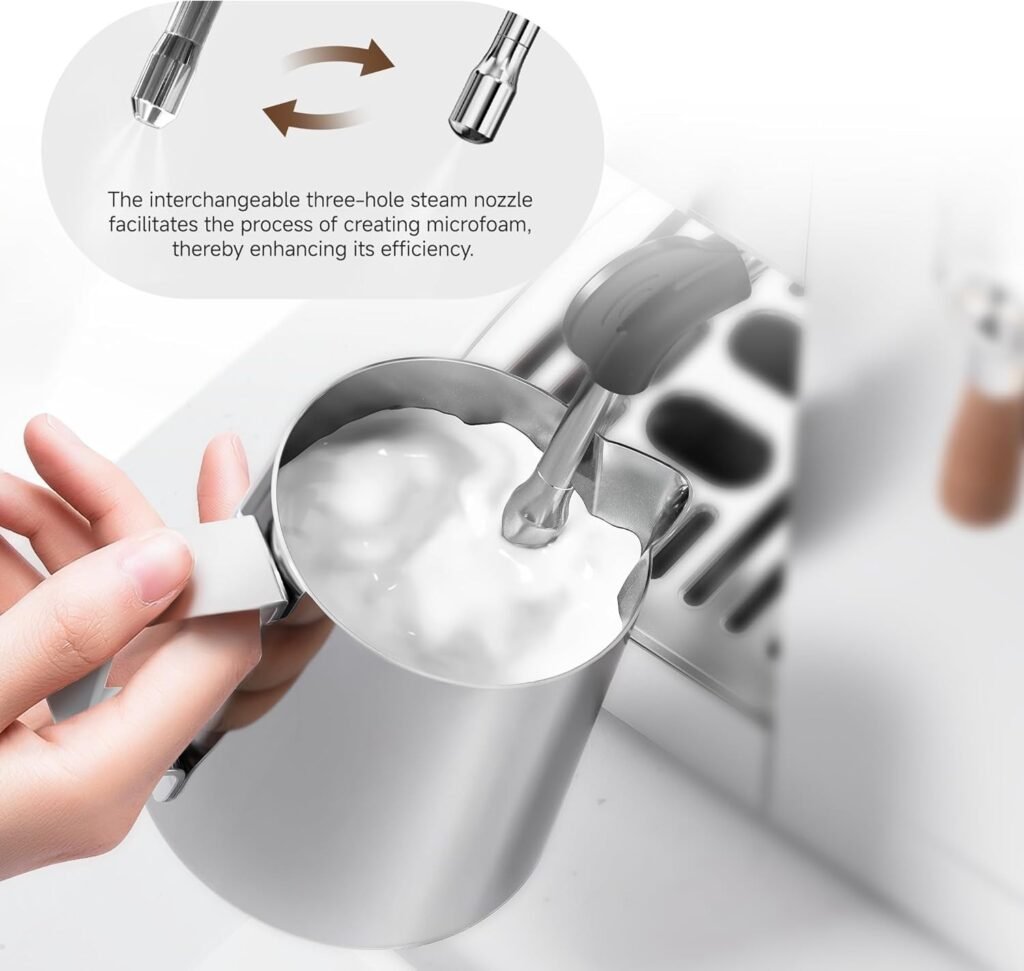
What it solves is fairly concrete: it shortens the dead air between brewing and steaming, gives you a more standard espresso format than many cheaper alternatives, and lowers the control barrier with a clearer interface and programmable settings. That is a meaningful package. The machine also ships with useful basics in the box, including a 58mm portafilter, baskets, tamper, milk jug, and an extra steam nozzle, which reduces the usual entry-level nickel-and-diming.
What it reduces is the psychological tax of a clumsy routine. Less waiting. Less button confusion. Less sense that you bought a toy.
What it still leaves to you is the part no honest article should hide:
- You still need a grinder good enough to make the machine matter.
- You still need puck prep that is not careless.
- You still need to accept that support quality and long-term reliability are not as well-proven here as they are with more established premium ecosystems.
- You still need to live without the cleaner post-shot behavior that a three-way solenoid typically supports.
And there is one more thing. The presets themselves are not sacred. One hands-on reviewer questioned HiBREW’s default drink-volume logic, especially the “double espresso” volume. That is not a deal-breaker. It is a reminder. The machine gives you structure, not wisdom. You still have to know when to override it.
Final Compression
The HiBREW H13 is not dangerous because it is bad.
It is dangerous because it is good in a very specific way.
It gives budget-conscious buyers a taste of workflow relief that usually lives higher up the price ladder: simultaneous brew-and-steam behavior, 58mm compatibility, quick heat-up, usable programmability, and a cleaner on-ramp into semi-automatic espresso. For the right person, that is not marketing fluff. That is real daily relief.
But the machine also draws a hard line around itself. The body is not truly premium. The support story is not spotless. The solenoid question does not disappear. The cleanup experience is unlikely to feel as crisp as better-engineered machines. That means the right decision here depends on whether your current pain lives before or after that boundary.
If your routine is still casual, the H13 may be more machine than you need.
If your expectations are premium, it may be less machine than you want.
If your mornings are already being slowed down by a weak espresso workflow and you want the shortest honest path out of that friction, this is where the blur starts to clear.
Transparency Note:
This analysis is built on aggregated real-world experience.
It extracts what repeatedly holds, what breaks, and what users uncover only after living with the system—then shapes it into a clear model you can use immediately.
Think of it as structured experience, refined and presented so you don’t have to learn it the hard way.
“A quick note: Don’t believe the star ratings, but trust personal experience. This article is a compilation of collected experiences”