AIRTHINGS WAVE ENHANCE REVIEW: THE ROOM LOOKS FINE. THE AIR DISAGREES.
AIRTHINGS WAVE ENHANCE
Nothing on a walkthrough tells you the air is the problem. The sheets are clean, the temperature feels right, nothing smells off — and you still wake up heavier than you went to bed, or hit a wall at your desk by mid-afternoon in the same room you sleep in. Why does a room that looks fine keep producing mornings that don’t?
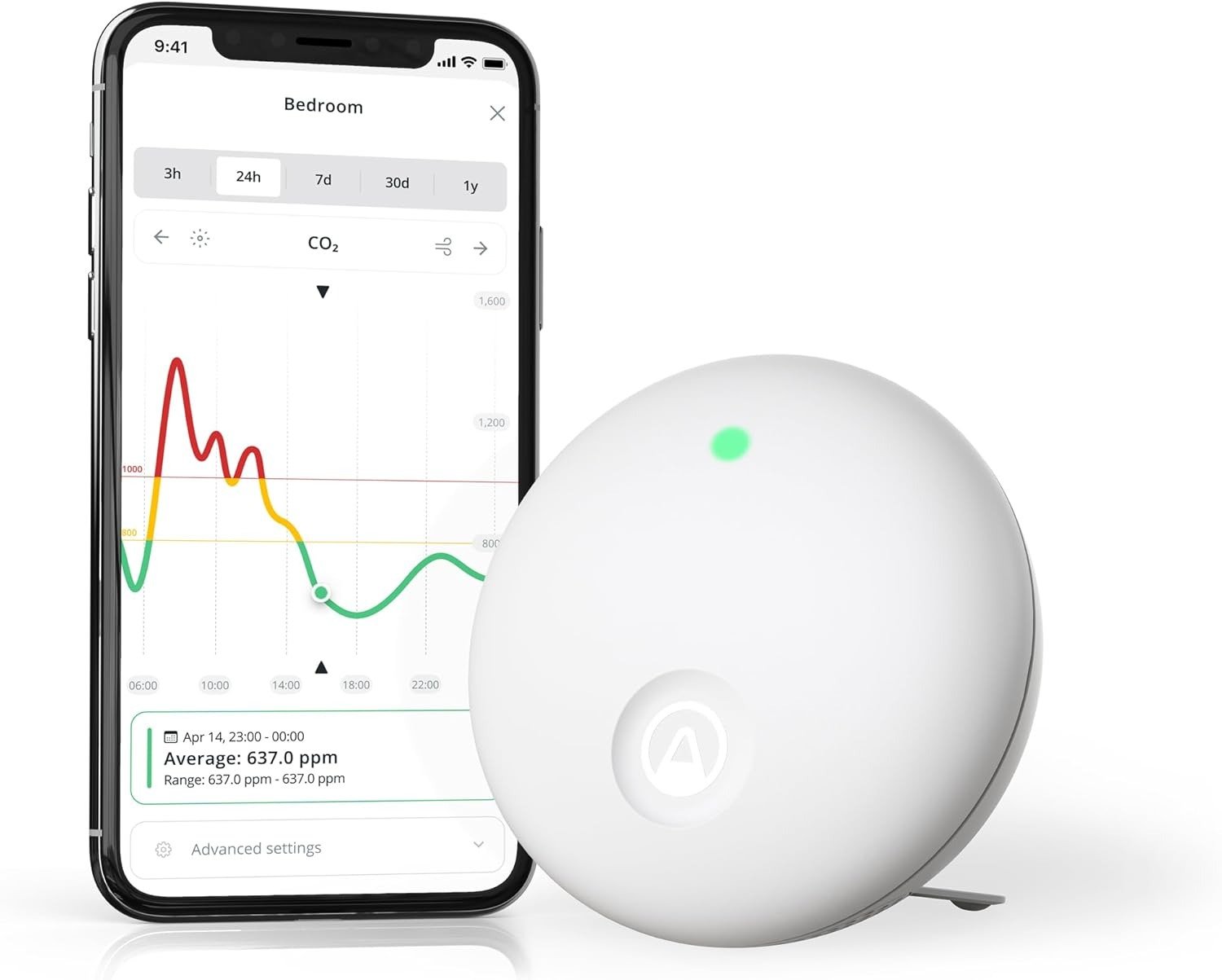
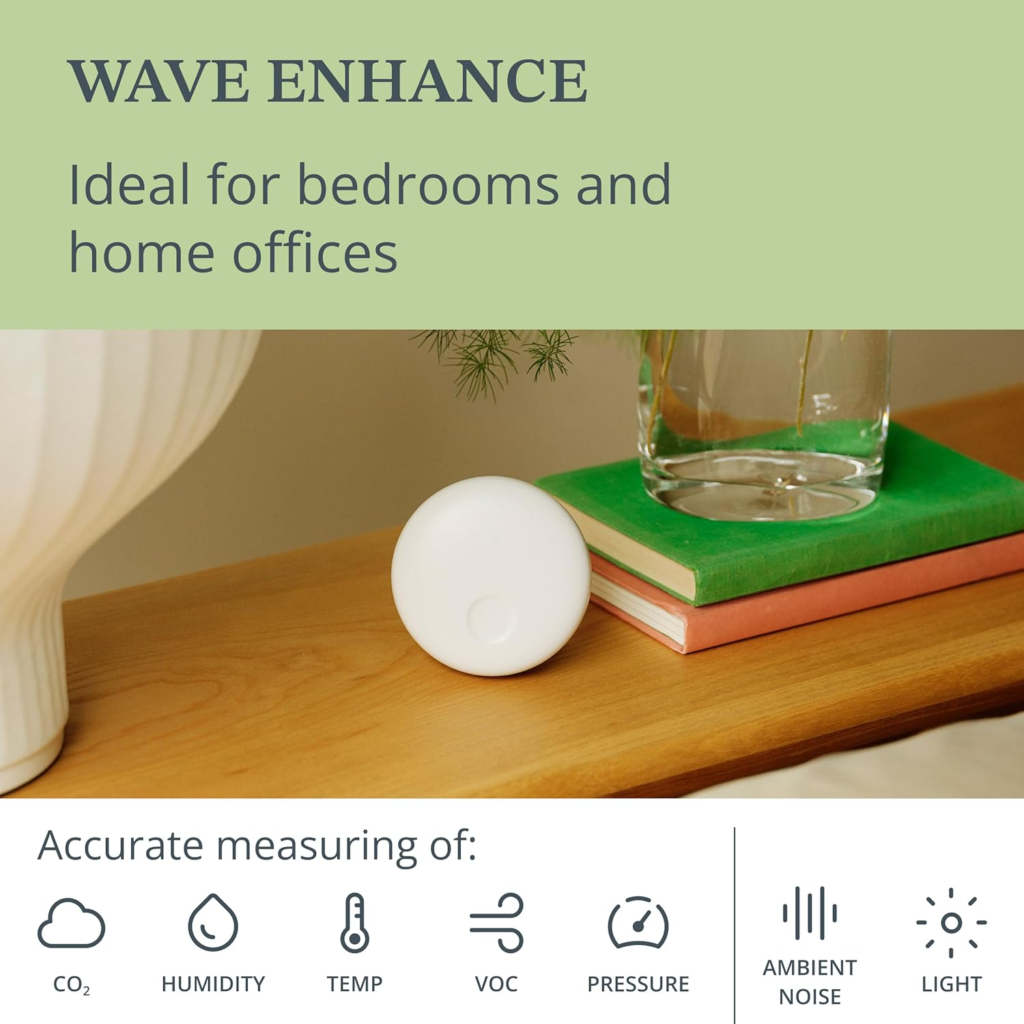
That gap between how a room looks and how it actually performs is exactly what the Airthings Wave Enhance was built to close. It’s a small, battery-powered puck from Airthings — a Norwegian company that’s been building indoor sensors since 2008, originally known for radon detection — and it tracks seven things most people never think to check: CO2, VOCs, humidity, temperature, air pressure, ambient noise, and ambient light. One tester at Sylvane put it in a second-floor bedroom expecting nothing unusual, since the household had never had air-quality complaints — and instead found CO2 levels on that floor were consistently far too high, a discovery surprising enough that it prompted the family to rework their home’s ventilation system. Nothing about that bedroom looked wrong. The number said otherwise.
CO2 AND SLEEP: WHAT YOU’RE FEELING BUT NEVER NAMING
Most people don’t reach for “carbon dioxide” when they’re describing how they feel — they say “just tired,” “brain fog,” “I slept eight hours and it didn’t help.” That’s the trouble with CO2: it has no smell, no color, and it sets off nothing. The usual suspects — waking up groggy despite a full night, a stretch of restlessness you can’t explain, an afternoon crash at the home desk that coffee doesn’t touch — are exactly the pattern that shows up in the research on elevated bedroom CO2. It’s not a dramatic symptom. It’s a quiet tax on the next day that most people blame on stress, screens, or just getting older.
HOW CO2 QUIETLY WRECKS SLEEP: THE HIDDEN MECHANISM
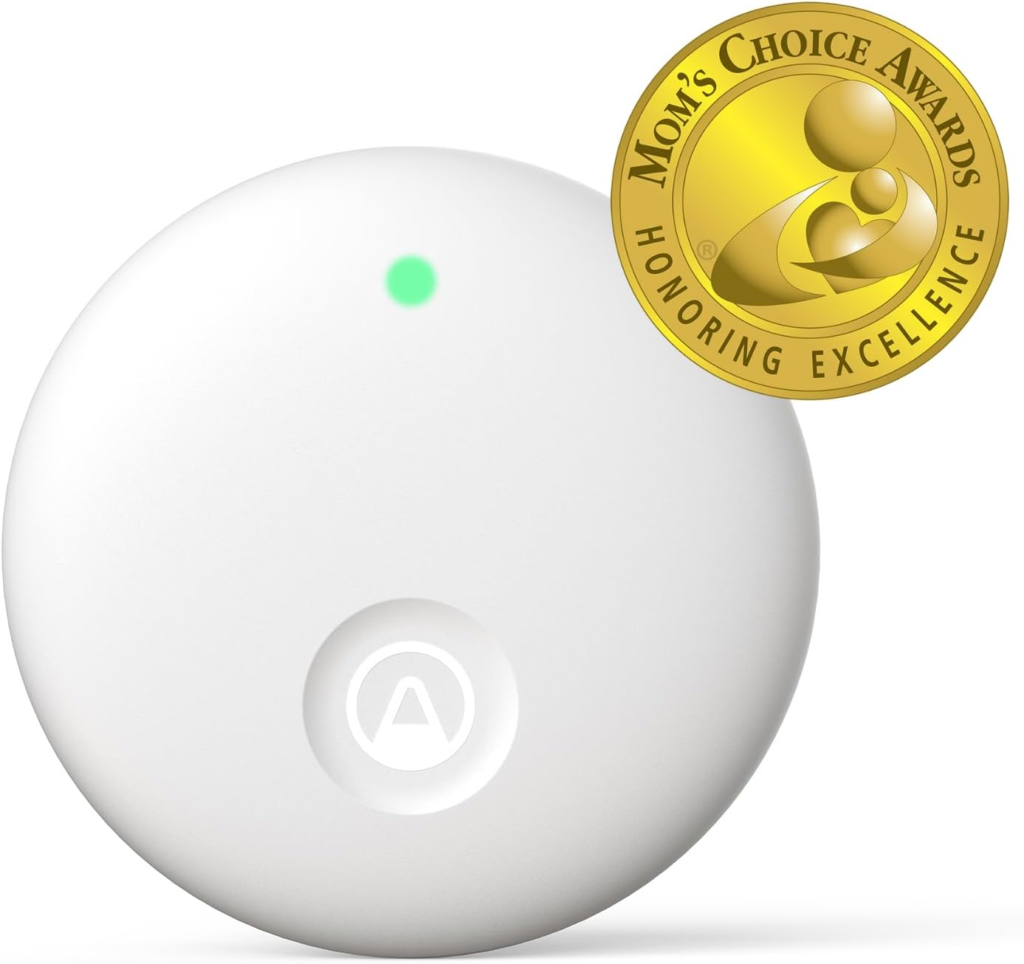
Here’s the mechanism, and it’s simpler than it sounds: two people (or one person and a dog) breathing in a closed room with the door and windows shut have nowhere for exhaled CO2 to go, so it climbs steadily through the night. A field-lab study tracking healthy adults across different bedroom ventilation levels found that raising average bedroom CO2 to around 1,000 ppm measurably reduced sleep efficiency and increased time spent awake compared to a well-ventilated baseline, with deep sleep dropping further and stress-linked cortisol rising at 1,300 ppm. Your body doesn’t fully wake up — it just breathes a little faster, your heart rate ticks up, and your sleep gets interrupted by micro-arousals you never remember. You don’t feel a spike. You feel the aggregate the next morning.
SAFE CO2 LEVELS FOR BEDROOMS: THE THRESHOLD WHERE SLEEP QUIETLY BREAKS
Danish researchers who ran controlled bedroom-ventilation trials found a clear split point: below roughly 750 ppm, CO2 doesn’t meaningfully affect sleep quality — but above about 2,600 ppm, it affects sleep quality enough to impair next-day cognitive ability, with effects possibly starting even lower. Here’s roughly how that maps to a real bedroom:
| CO2 Level (ppm) | What It Usually Means | What the Research Links to It |
|---|---|---|
| 400–800 | Fresh, well-ventilated air | Associated with undisturbed, efficient sleep |
| 800–1,000 | Good, low risk | Generally treated as the safe ceiling for a bedroom |
| 1,000–1,500 | Getting stuffy | Measurable drop in sleep efficiency, more time awake |
| 1,500–2,600 | Common in a closed bedroom by early morning | Lighter sleep, less deep sleep, higher morning cortisol |
| 2,600+ | Poor ventilation, multiple sleepers, or pets | Linked to shorter sleep duration and reduced next-day focus |
Most bedrooms with a closed door and no ventilation drift past the “good” range within a few hours of lights-out. You’d never know, because nothing about the room changes except a number you can’t see.
AIR QUALITY MONITOR VS. AIR PURIFIER: WHY MOST BUYERS GET THIS WRONG
The most common mix-up isn’t about this specific device — it’s about the category. A monitor tells you what’s in the air; it doesn’t change it. The Wave Enhance won’t scrub VOCs or filter smoke (that’s what Airthings sells its separate Renew purifier for). It also doesn’t measure radon or fine particulate matter (PM2.5) — those live on Airthings’ Wave Plus and View Plus instead, which we’ll get into below. And because there’s no live number on the device itself, people expecting an always-on digital readout like a classic office CO2 meter are often surprised the real data lives in the app. None of that makes it a worse product — it just means it’s a specific tool, not a universal one, and most of the disappointed reviews online trace back to someone expecting it to be something it was never built to be.
AIRTHINGS WAVE ENHANCE SPECS: FULL SENSOR AND HARDWARE BREAKDOWN
| Spec | Detail |
|---|---|
| Sensors | CO2 (NDIR), VOC (metal-oxide), temperature, humidity, air pressure, ambient noise (dBA), ambient light |
| CO2 sensor range | 400–5,000 ppm, self-calibrated on a weekly automatic baseline |
| VOC sensor range | 0–10,000 ppb, self-calibrated continuously against the cleanest air the sensor has been exposed to |
| Humidity / temp accuracy | ±3.0% RH humidity; ±1°F (±0.5°C) temperature |
| Connectivity | Bluetooth 4.2+; optional Airthings SmartLink hub through a View-series monitor for remote access |
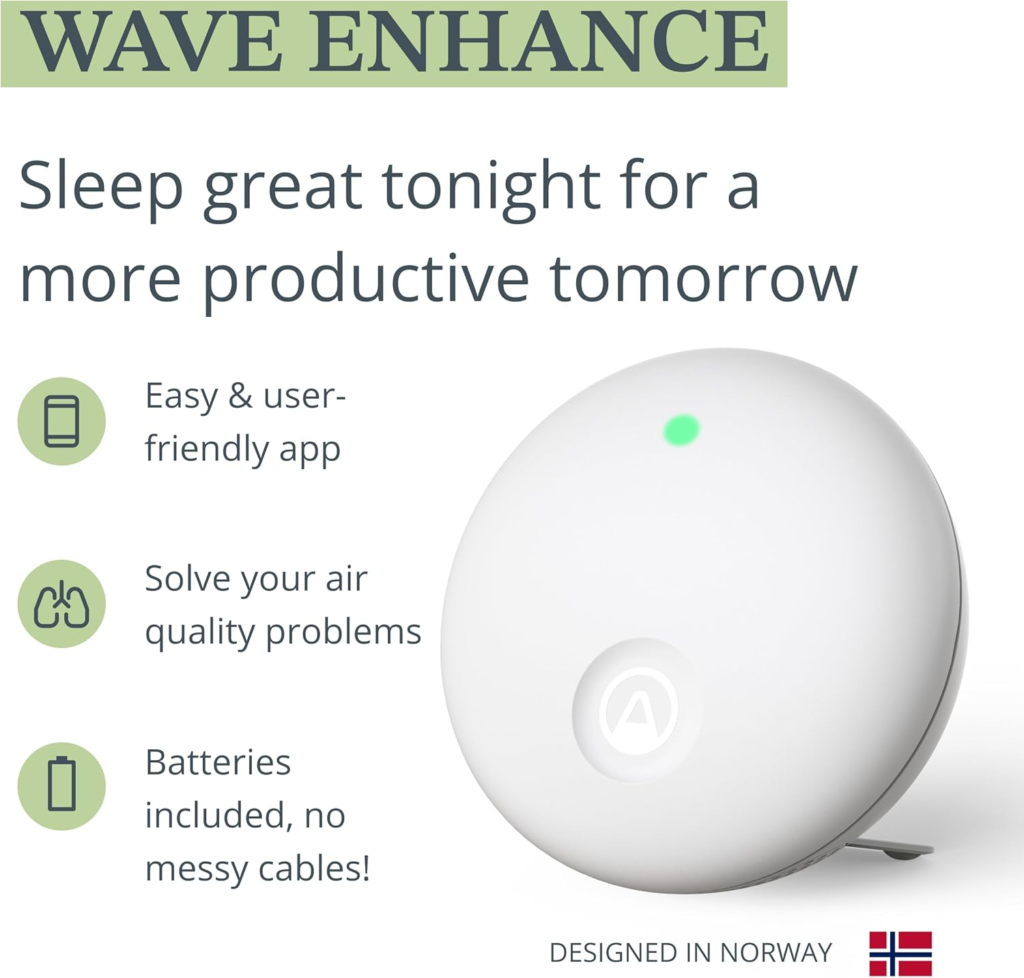
| Battery | 2x AA, included — 14 months on Bluetooth alone, up to 17 months with SmartLink hub connectivity |
| Display | None — capacitive touch button plus a center LED (green/yellow/red) |
| Size / weight | 3.15 in. diameter, 1.06 in. thick, 3.4 oz |
| Mounting | Wall (adhesive strips included), flat surface, or built-in fold-out stand |
| Placement | 40–70 in. off the floor, at least 3 ft from vents, windows, or doors |
| App | Free, iOS/Android + web dashboard, no subscription required for home use |
| Smart home | Alexa and Google Assistant (basic voice readings only), IFTTT, Homey |
| Warranty | Standard warranty plus a free optional 5-year extension |
| Launch price | $149.99, later listed nearer $160 on Airthings’ own site — check the current Amazon price, since it moves with sales |
WAVE ENHANCE VS. WAVE PLUS VS. VIEW PLUS: WHICH AIRTHINGS MONITOR ACTUALLY FITS YOU
| Model | Typical Price | Radon | CO2 / VOC | PM2.5 | Noise / Light | Display | Best For |
|---|---|---|---|---|---|---|---|
| Wave Mini | ~$70–90 | No | VOC only, no CO2 | No | No | LED only | Mold-risk add-on for a bathroom or closet |
| WAVE ENHANCE | ~$150 | No | Yes | No | Yes | LED only | Bedroom sleep + home-office focus |
| Wave Plus | ~$230–280 | Yes | Yes | No | No | LED only | Whole-home baseline, including radon |
| View Plus | ~$330 | Yes | Yes | Yes | No | E-ink screen, acts as its own hub | Main living space; can also bring your Waves online |
If radon is what’s keeping you up — literally, since it’s a basement and ground-floor concern — the Wave Enhance isn’t the device for that job; the Wave Plus is. If wildfire smoke or general dust is the worry, that’s PM2.5 territory, which means View Plus. The Wave Enhance earns its place specifically in the room where you sleep or work, tracking the things that quietly shape how you feel there.
WHO SHOULD BUY THE WAVE ENHANCE — AND WHO SHOULD SKIP IT
Makes sense for you if:
- You wake up tired more often than makes sense given your hours in bed
- You work from a bedroom or home office and hit an unexplained afternoon slump
- You’re a light sleeper who wants to know if noise or early light is the disruptor, not just CO2
- You want to check on a kid’s room without an audio-recording device — Airthings is explicit that the noise sensor doesn’t record sound at all; it only samples ambient decibel level briefly every six seconds
- You already own or are considering a View Plus and want the bedroom covered too
Skip it if:
- Radon is your actual concern (get the Wave Plus instead)
- Wildfire smoke or fine dust (PM2.5) is what you’re tracking (View Plus)
- You want a live number on the device itself without opening an app — a screen-based monitor like the Aranet4 fits that habit better
- You’re set on getting instant push alerts the moment air quality dips; without a paired View-series hub, notifications are inconsistent
SETUP AND REAL LIFE WITH THE WAVE ENHANCE: WHAT ACTUALLY HAPPENS
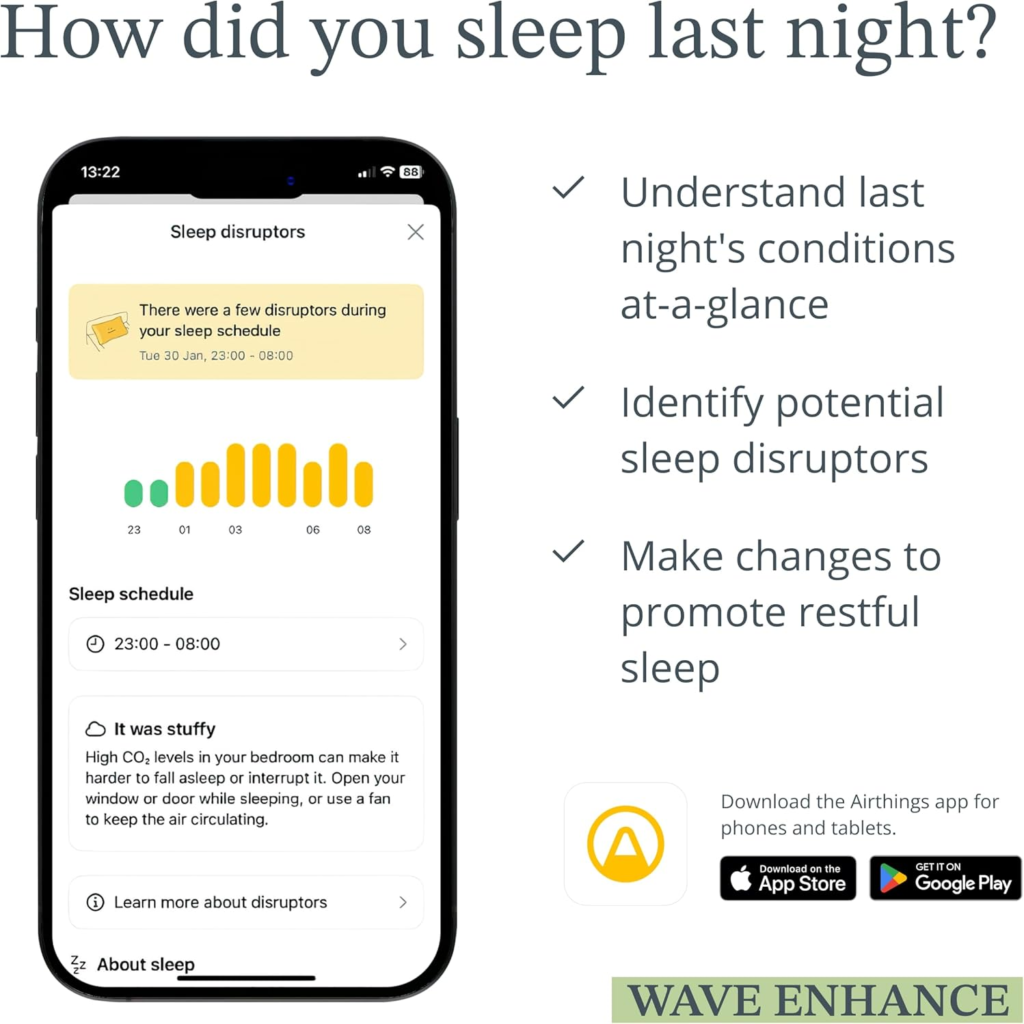
Setup is genuinely quick: download the app, pair over Bluetooth, and you’re gathering data within a few minutes. What takes longer is the sensors settling in — CO2 and VOC readings fluctuate for the first several days as the device builds its baseline, so don’t judge it on day one. Day to day, a quick tap on the touch button lights the center ring green, yellow, or red for an at-a-glance read; anything beyond that means opening the app or the web dashboard for the actual numbers and the daily Sleep Disruptors report. The one honest limitation worth flagging: without a paired hub, push notifications are thin. One reviewer who left all notification settings on reported effectively never getting a proactive alert — checking meant opening the app and looking. That’s a real trade-off for the battery life you get in return, not a defect, but it changes how you’ll actually use the thing day to day: this rewards a habit of checking in, not a promise it’ll ping you.
On accuracy: a verified buyer running two units described the CO2 sensor as reliable enough to change their own ventilation habits, said the light sensor settled a real debate about blackout curtains, and was candid that they weren’t fully sold on VOC precision — reasoning, fairly, that identifying specific harmful VOCs is genuinely difficult, so treating the number as a directional trend rather than a lab-grade reading felt like a reasonable way to use it. That lines up with how the VOC sensor is built: it self-calibrates against the cleanest air it’s personally seen, so it’s better at showing you when something changed than giving you an exact, comparable number over months.
THE ONE SITUATION WHERE THE WAVE ENHANCE IS THE LOGICAL CHOICE
If the actual question you’re trying to answer is “why does this one room make me feel worse than it should,” and radon and wildfire smoke aren’t part of that question, the math is straightforward: one battery-powered device, no subscription, roughly $150, covering the seven factors most likely to explain a bad night or a foggy afternoon. That’s a narrow, specific job — but it’s the job most people buying an air-quality monitor for a bedroom or office are actually trying to do.
WHAT IT SOLVES, WHAT IT REDUCES, AND WHAT STILL DEPENDS ON YOU
It solves the invisibility problem — turning “I just feel off in here” into an actual number you can act on. It reduces guesswork, so you’re not randomly trying humidifiers, new pillows, or blackout curtains without knowing which one your room actually needs. What it doesn’t do is fix anything by itself. Cracking a window, running a fan, fixing a stuck vent, swapping a scented candle for an unscented one — that part is still on you. The Wave Enhance’s entire value is in telling you when and what to act on, not in acting on your behalf.
AIRTHINGS WAVE ENHANCE: PROS AND CONS
| Pros | Cons |
|---|---|
| Tracks 7 real sleep/focus factors in one small unit | No on-device number, just a 3-color LED |
| Free app, no subscription for home use | Notifications are thin without a paired hub |
| 14–17 month battery life on 2 replaceable AAs | No radon or PM2.5 sensor |
| Doesn’t record audio, dBA level only | VOC reading is a trend, not a lab-precise figure |
| Flexible mounting: wall, stand, or flat | Needs several days to settle into an accurate baseline |
| Free optional 5-year extended warranty | Bluetooth-only unless paired with a View-series hub |
Frequently Asked Questions
| Question | Answer |
|---|---|
| Does the Wave Enhance detect radon? | No. It measures CO2, VOCs, humidity, temperature, pressure, noise, and light — not radon. For radon, look at the Wave Plus or a dedicated Wave Radon. |
| Do I need a subscription to use it? | No. The app and web dashboard are free for home use. Airthings only charges for its separate business-tier service, which doesn’t apply here. |
| Does it record sound? | No. It measures ambient noise level in decibels every few seconds — it cannot and does not record actual audio. |
| How accurate is the CO2 sensor? | It uses NDIR technology, the same type found in professional-grade sensors, with weekly self-calibration. It’s reliable for trend and threshold purposes, though it’s a consumer device, not lab equipment. |
| How long does the battery really last? | 14 months on Bluetooth alone, up to 17 months if it’s paired with a SmartLink hub, on two standard AA batteries. |
| Can I check my air quality remotely, like from work? | Not by default — Bluetooth only reaches your phone within about 30 feet. Anytime, anywhere access requires pairing it to a View-series monitor acting as a hub. |
| What’s the real difference between this and the Wave Plus? | Radon detection and a higher price. The Wave Plus adds radon and drops noise/light tracking; the Wave Enhance is built specifically for bedrooms and home offices at a lower cost. |
FINAL VERDICT: IS THE AIRTHINGS WAVE ENHANCE WORTH IT?
For the specific question it’s built to answer — what’s actually happening in the room where you sleep or work — the Wave Enhance is a well-reasoned, honestly-priced answer, not a gadget looking for a problem. It won’t tell you about radon or smoke, and it won’t fix the air for you. But if a room that looks fine keeps producing mornings that aren’t, this is how you stop guessing.
Transparency Note:
This analysis is built on aggregated real-world experience.
It extracts what repeatedly holds, what breaks, and what users uncover only after living with the system—then shapes it into a clear model you can use immediately.
Think of it as structured experience, refined and presented so you don’t have to learn it the hard way.
“A quick note: Don’t believe the star ratings, but trust personal experience. This article is a compilation of collected experiences.”