The Eufy Video Smart Lock E330 Can Make a Door Feel Sharper, Safer, and More Expensive—Until Your Entry Layout Quietly Breaks the Illusion
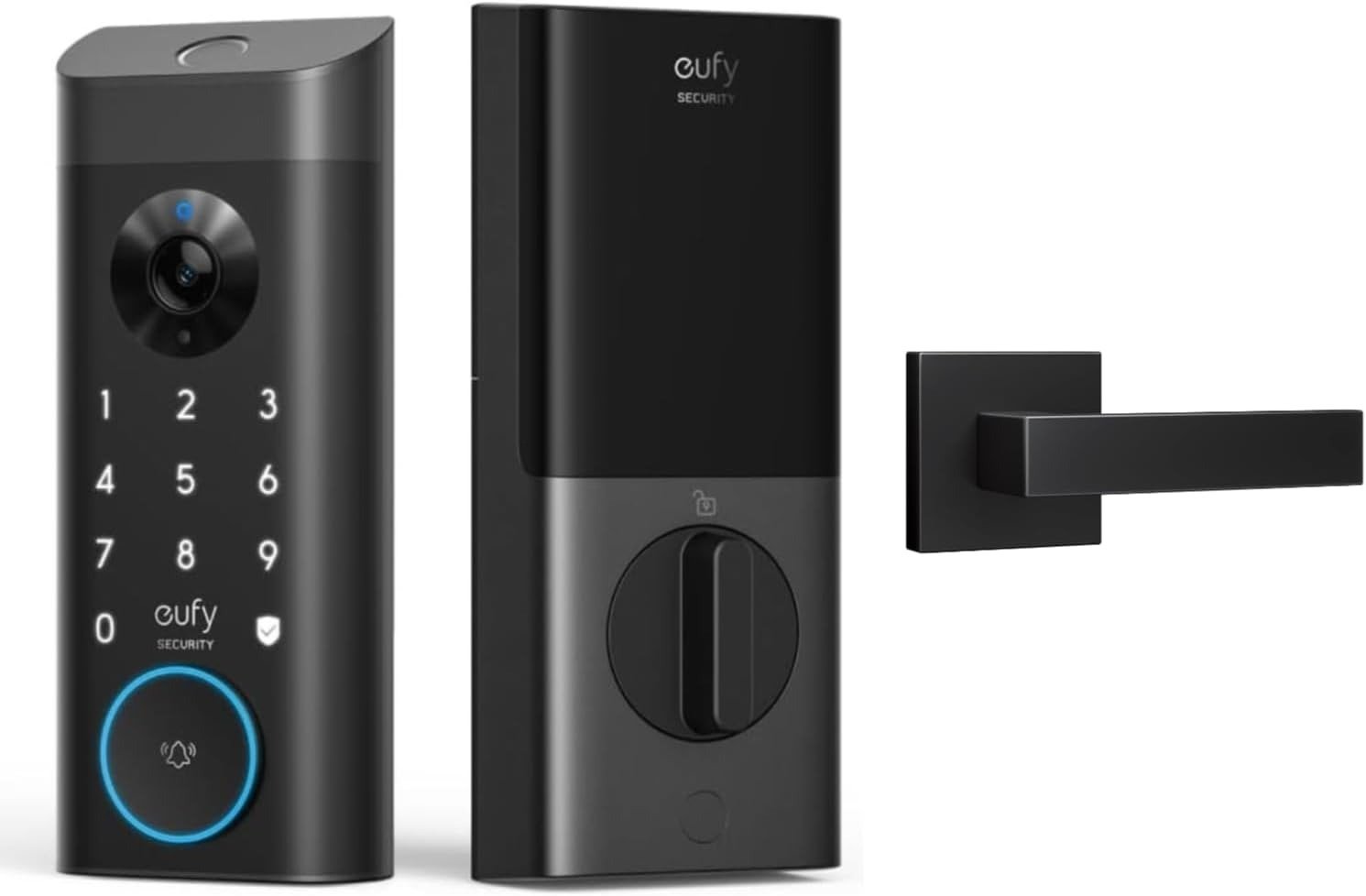
EUFY VIDEO SMART LOCK E330
The Result Looks Fine. The Problem Isn’t.
A lot of front doors look “upgraded” long before they actually work better. That is the trap here.
The Eufy Video Smart Lock E330 is seductive on paper because it compresses three separate objects into one face on the door: smart lock, video doorbell, and camera. Eufy positions it as a direct-Wi-Fi, 2K, fingerprint-enabled, subscription-free entry device with a 10,000mAh rechargeable battery, IP65 weather resistance on the camera section, and BHMA Grade 3 certification.
Independent reviewers broadly agree that the core idea is real, not gimmicky: setup is easy, the 2K image is clear, the fingerprint reader is quick, and the lack of a required subscription matters. But those same reviewers also keep circling back to the same friction points: vertical viewing is limited, the battery story changes dramatically with real activity, and the lock is far more door-dependent than the product glamour suggests.
What I kept coming back to is this: the E330 is not really a “smart lock review” product. It is a door-condition product. If your entry geometry is friendly, the E330 feels clean, modern, and unusually efficient. If your door shape, jamb depth, visitor habits, or daily traffic fall outside its comfort zone, the very thing that looked elegant starts feeling compromised.
Even its public review pattern tells the same story. On Amazon, the product page shows a 4.1/5 rating from 3,437 ratings. Lowe’s shows 4.7/5 from 31 reviews. That spread does not read like random noise to me. It reads like a fit-sensitive device landing in very different homes with very different entry conditions.
What You’re Actually Feeling but Not Naming
The irritation this lock solves is not “I want a smarter home.” That is too vague. Too polished. Too showroom.
The real itch is smaller and more embarrassing than that. It is the tiny friction of a front or side door that asks for too many motions: reach for the key, glance at a separate doorbell feed, open an app, wonder who is outside, wonder whether the door locked behind you, wonder whether the package is still on the step. You do not feel unsafe every minute. You feel interrupted. Repeatedly.
That is why the E330 concept lands so hard. It folds access, confirmation, and visibility into one object. Tom’s Guide found the fingerprint scanner consistently recognized a registered finger within about two seconds, even with water or grease on it, and the lock supports multiple access paths including fingerprint, keypad, app, voice, and key. It also allows temporary access codes and PIN scrambling to obscure the real code. In plain English: fewer little pauses, fewer tiny doubts, fewer clumsy handoffs between devices.
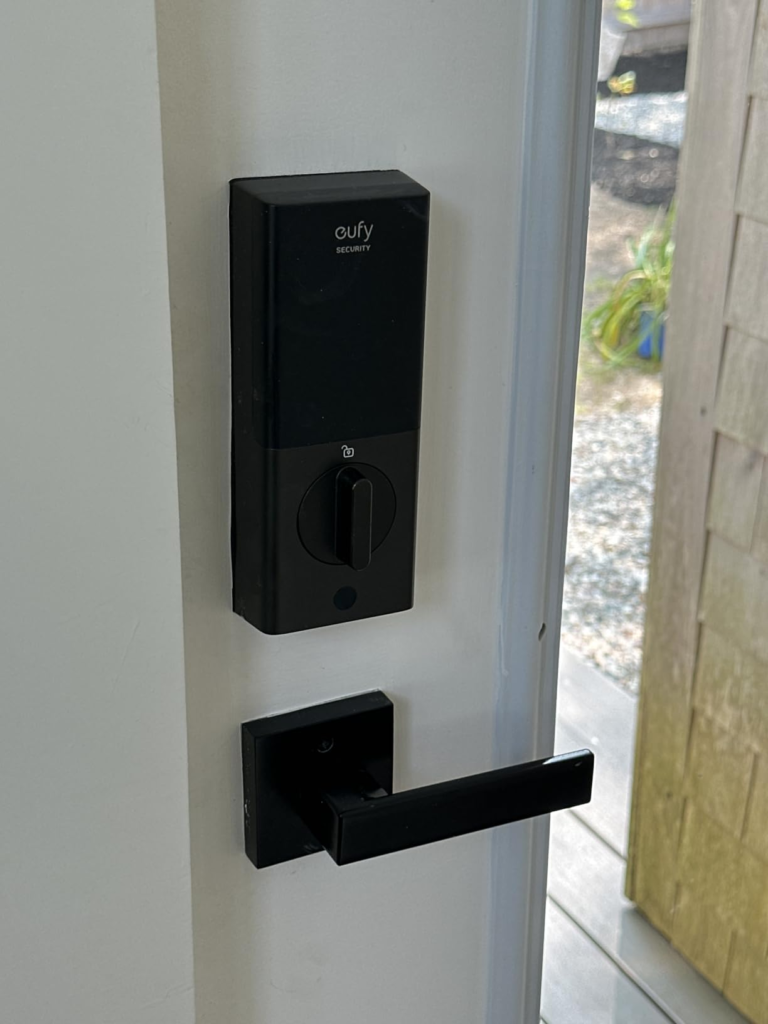
And visually, it changes the door in a way separate gadgets rarely do. Reviewers described it as sleek, compact, and sharp-looking rather than bulky. On the right door, especially a modern flat entry with dark hardware, it does not read like “I mounted more tech.” It reads like the door was designed to behave this way from the start.
The Hidden Mechanism Behind the Miss
Here is the part most buyers misread: the E330 does not fail because it is weak. It fails because it is stacked.
When you merge lock, keypad, doorbell button, camera, battery, motion detection, and app control into one vertical body, every advantage begins competing with another. The camera sits where the lock sits, not where the best doorbell camera would sit. The battery has to feed both access and surveillance. The visitor has to find the button where a normal person does not expect a button to be. The result is not random compromise. It is structural compromise.
Tom’s Guide liked the responsiveness: fast alerts, reliable AI detection, good image quality, and human-only detection that helped minimize false alerts. They also reported alerts within roughly two seconds and a maximum detection range of 17 feet, with reliable notice when someone crossed a backyard gate about 15 feet away. But the same review also flagged the narrow field of view, especially vertically, which means the camera cannot always see what the best dedicated video doorbells are now designed to catch near the bottom of the frame.
The Gadgeteer ran into another side of the same design equation: excellent lock behavior and near-instant notifications, but battery drain severe enough that keeping the “smart video” side fully active felt costly.
That is the hidden mechanism: the E330 is strongest when your door asks it to do one compact job, not every job at maximum intensity all the time.
What the hardware promises What that means in daily use Source
| 2K camera with f/1.6 aperture | Clear enough footage for identification and live checks, but camera placement still matters more than raw resolution |
|---|---|
| Five unlock methods | Fingerprint, keypad, app, voice, and physical key reduce access friction for mixed households |
| Direct Wi-Fi, no required subscription | No extra bridge for the E330 itself and local-first value is stronger than many subscription-driven rivals |
| 10,000mAh rechargeable battery | Convenient on paper, but real battery life depends heavily on activity and enabled features |
The Threshold Where the Outcome Quietly Breaks
This is the threshold that matters: the door-geometry-and-traffic threshold.
Below that line, the E330 feels smart. Above it, it starts feeling like a negotiation.
SafeWise highlighted the physical conditions clearly: the lock wants a standard door and deadbolt, at least 45mm of vertical distance between the deadbolt and the handle, and no screen door. A deep door jamb can also compromise night vision quality and viewing range. Tom’s Guide found it worked best where the door faced the exact zone that needed monitoring. That is a threshold, not a footnote. Once your door falls outside it, image usefulness drops before the marketing story does.
There is also a battery threshold. Eufy lists about three months of battery life for the E330. Tom’s Guide, under roughly 10 events per day, saw drain just under 20% per week and ended up charging it twice over three months. The Gadgeteer reported a much harsher case, burning through 58% in 11 days before aggressively disabling features to stretch runtime. Those are not contradictions. They are the same product crossing different motion, alert, and surveillance thresholds.
| Threshold condition | What happens when you stay inside it | What happens when you cross it | Source |
|---|---|---|---|
| Flat, standard door with clean deadbolt spacing | Cleaner install and more useful camera framing | Fit problems, compromised camera angle, harder justification | |
| Door faces the exact area you care about | Camera becomes a practical confirmation tool | Narrower framing becomes an actual blind spot | |
| Moderate activity and disciplined settings | Battery feels manageable | Battery becomes maintenance, not convenience | |
| Visitors can intuit the button placement | Doorbell function feels unified | People knock, hesitate, or miss the button entirely |
Why Most Buyers Misread This Too Early
Because they judge it like a feature stack.
That is the lazy reading. Camera. Fingerprint. Keypad. Wi-Fi. No fee. Done.
But the E330 should be judged by friction removed per compromise introduced. That changes everything. A normal buyer sees “three devices in one.” A better buyer asks, “Did this save me three decisions, or did it cram three compromises onto one plate?” The answer depends less on the spec sheet than on where the lock sits, what it sees, who uses the door, and how often motion events fire.
You might think the strongest selling point is convenience. I do not. The stronger selling point is decision consolidation. One glance. One unlock surface. One app location. One exterior object. That is why some owners love it and others cool on it. They are not buying the same thing emotionally. One group is buying less clutter and less routine friction. The other is buying “a better doorbell,” and that expectation is where disappointment begins.
Tom’s Guide practically says this without saying it outright when it recommends the E330 more naturally for back or side doors where combined lock-plus-video control matters more than classic front-door doorbell behavior.
Who Is Actually Inside This Problem
The right buyer is not “anyone who wants a smart lock.” Too broad. Too expensive a mistake.
The right buyer is someone whose door suffers from one of these three conditions:
| Real condition | Why the E330 fits | Source |
|---|---|---|
| You want lock control and video confirmation on the same door, from the same interface | The device merges both functions without requiring a separate subscription path | |
| You use a side, back, rental, or secondary entry where access control matters more than package-view theatrics | Review testing found the E330 especially sensible on back or side doors | |
| You are tired of juggling codes, fingerprints, app access, and guest timing across multiple devices | It supports multiple user profiles, temporary codes, and several unlock methods in one unit |
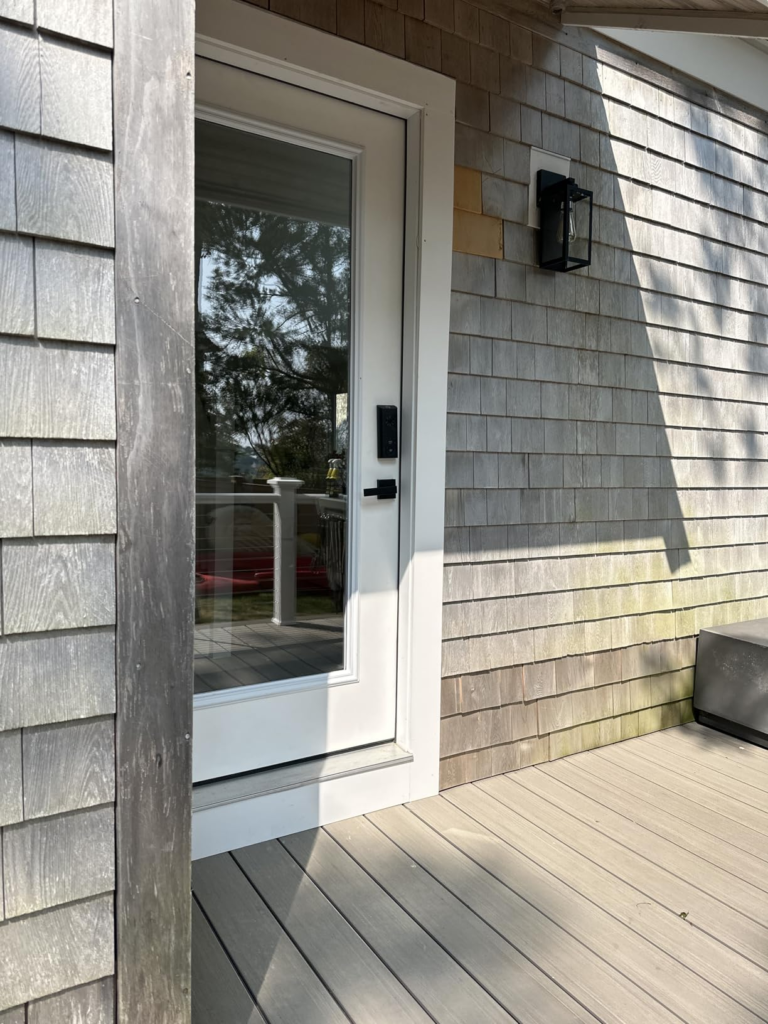
This is also where the product becomes visually persuasive. On a secondary entrance, garage-adjacent entry, or side gate door, the E330 gives the area a more intentional look. Not flashy. Not luxury theater. More like the space stopped apologizing for itself. The camera, bell, and lock no longer fight for wall space. The entry looks tighter, tidier, and more deliberate because the hardware is no longer scattered. That reading is consistent with reviewer descriptions of the unit as sleek, compact, and sharp-looking.
Where Wrong-Fit Begins
Wrong-fit begins the moment you ask this lock to impersonate a perfect front-door doorbell.
If your priority is tall vertical package visibility, obvious visitor button placement, screen-door compatibility, or the longest possible battery interval under heavy activity, the E330 starts leaking value. Tom’s Guide explicitly flagged weaker vertical coverage and visitor confusion around the integrated button. SafeWise called out night performance limitations in certain door setups and flatly noted that the lock does not play nicely with screen doors.
The Gadgeteer’s battery experience is the sharpest warning of all: when the lock is asked to stay “fully alive” as a surveillance device, battery comfort can vanish fast.
There is another wrong-fit that buyers hate admitting: status anxiety. Some people do not want one smart entry object. They want the most impressive spec in every category. That mindset usually ends in comparison loops, not satisfaction. The E330 is not for that buyer. It is not eufy’s highest-grade lock in its broader lineup, and the company’s own comparison page places newer family models above it on certification and ecosystem breadth. If you need the product to win every category war on paper, you will never stop second-guessing it.
The One Situation Where This Product Becomes Logical
The E330 becomes logical in one very specific situation:
You have a standard door with the right spacing, no screen-door conflict, a viewing angle that matters more horizontally than vertically, and a real desire to collapse lock control plus live front-door awareness into one clean object.
That is where the product stops being a gadget and starts behaving like infrastructure. You get quick fingerprint access, video confirmation, local storage, easy install, direct Wi-Fi, and no monthly fee pressure.
Reviewers repeatedly praised setup simplicity, fast access, and the fact that the core experience works without the usual subscription tax hanging over every notification.
In that one situation, the E330 has a real psychological advantage too. It removes the split-brain feeling at the door. You are no longer treating entry, identity, and visibility as separate chores. You touch one surface and the door answers as one system. That is the real luxury here. Not gold trim. Not inflated tech theater. Just less friction, less clutter, less doubt.
What It Solves, What It Reduces, and What It Still Leaves to You
| Category | What the E330 genuinely solves | What it reduces | What it still leaves to you | Source |
|---|---|---|---|---|
| Access | Fast fingerprint entry and multiple unlock options | Key scrambling, code management chaos, repeated key use | Battery charging and user setup discipline | |
| Visibility | Live view and event capture from the same door hardware | App-switching between lock and doorbell systems | Accepting narrower framing than the best dedicated doorbells | |
| Cost | Local storage and no required subscription | Ongoing cloud-fee pressure | Upfront price remains relatively high | |
| Aesthetics | Cleaner, more consolidated door hardware presence | Wall clutter and add-on gadget sprawl | Making sure the door style actually flatters the unit | |
| Security routine | Faster confirmation and alerts | Small daily doubts about whether the door is locked or who is outside | Accepting Grade 3 hardware status and fit limits |
This is the honest shape of the deal. The E330 does not solve door geometry. It does not solve visitor habits. It does not solve high-traffic battery physics. It solves the mess that happens when a perfectly normal residential entry asks you to juggle too many small security actions with too many separate pieces.
Final Compression
I would not buy the Eufy Video Smart Lock E330 because it is a lock. I would buy it because a particular door has crossed a threshold where separate lock logic and separate doorbell logic have become annoying enough to deserve compression.
That is the whole decision.
If your door is standard, your spacing is right, your view line is clean, your traffic is moderate, and your frustration is really about daily entry friction rather than doorbell perfection, this product becomes easy to defend. If your break point starts there, the next step is the product page
If those conditions are not true, the E330 does not become “bad.” It becomes expensive ambiguity. And that is where regret usually starts—not when the hardware fails, but when the buyer names the wrong problem first.
Transparency Note:
This analysis is built on aggregated real-world experience.
It extracts what repeatedly holds, what breaks, and what users uncover only after living with the system—then shapes it into a clear model you can use immediately.
Think of it as structured experience, refined and presented so you don’t have to learn it the hard way.
“A quick note: Don’t believe the star ratings, but trust personal experience. This article is a compilation of collected experiences”