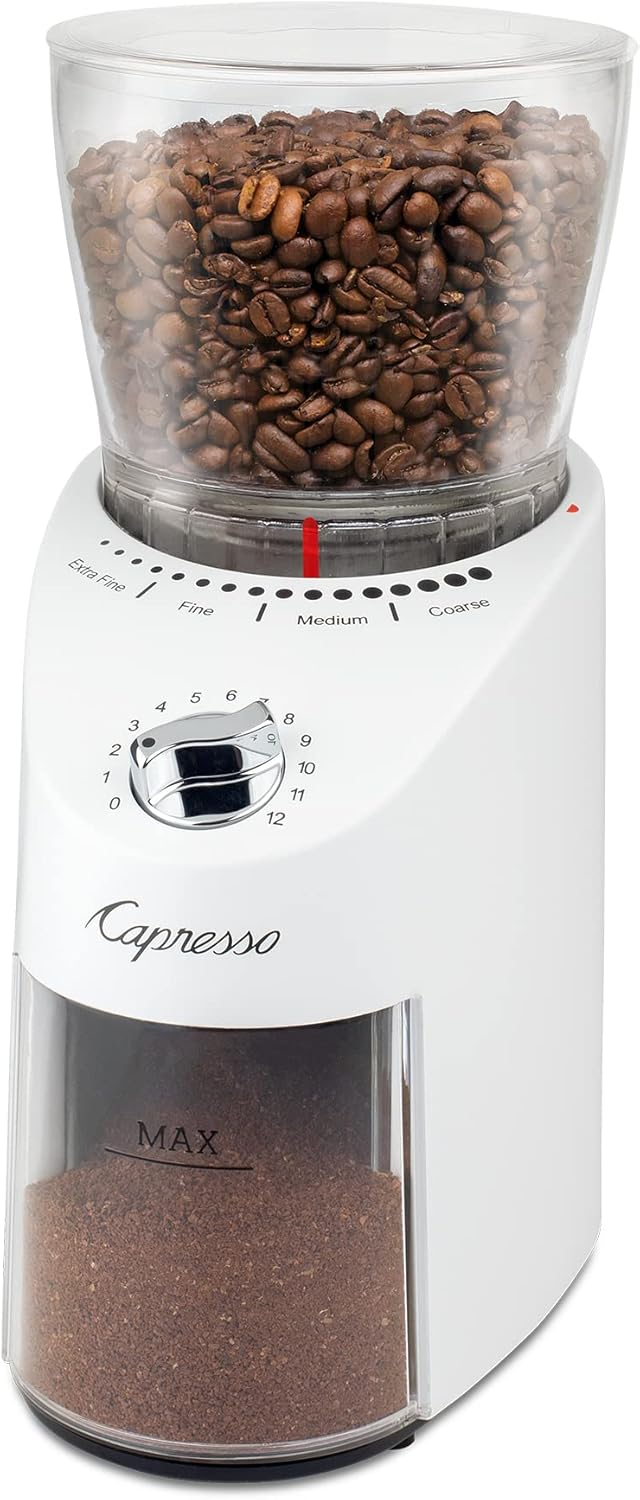
MY CAPRESSO INFINITY PLUS REVIEW: YOU’LL LOVE IT UNTIL YOU MEET ITS ONE HARD CEILING
The Result Looks Fine. The Problem Isn’t.
Your coffee tastes better than before. The grounds look uniform. The machine runs quietly. You tell yourself the upgrade worked.
And in most cases, it did.
The Capresso Infinity Plus replaced your blade grinder, eliminated the burning smell, and brought your morning cup noticeably closer to something real. For the first several weeks, nothing in the experience suggests you made the wrong call.
The problem isn’t visible in the first month. It doesn’t announce itself. It shows up later — when you try to tighten your pour-over extraction and it won’t cooperate. When you dial toward espresso and the shot pulls uneven. When you realize the “extra fine” setting is producing grounds that fall somewhere between fine enough and actually fine, and there is no adjustment left to close the gap.
The machine didn’t break. The machine is doing exactly what it was built to do. You just didn’t know where its ceiling was when you bought it.
What You’re Actually Feeling but Not Naming
There’s a specific frustration in owning a grinder that’s 90% of what you need.
It’s not the frustration of a broken product. It’s subtler. The grinder works. The coffee is drinkable. But something keeps you adjusting — changing ratios, tweaking bloom time, replacing the beans — chasing a variable that isn’t the beans.
Users consistently report that the grind consistency feels right for coarser settings, and the cup selector works as expected. The machine earns real loyalty in that range.
But then comes the maintenance friction. The grounds cling to the plastic container from static, so they don’t all pour out cleanly. If there are any beans left in the top when you remove the lid, they fall across the counter.
Small things. The kind you dismiss the first time, tolerate the second time, and quietly resent by the fourth month.
The annoyance isn’t the grinder failing. It’s the grinder revealing that its design logic was built for a different user than the one you’re becoming.
The Hidden Mechanism Behind the Miss
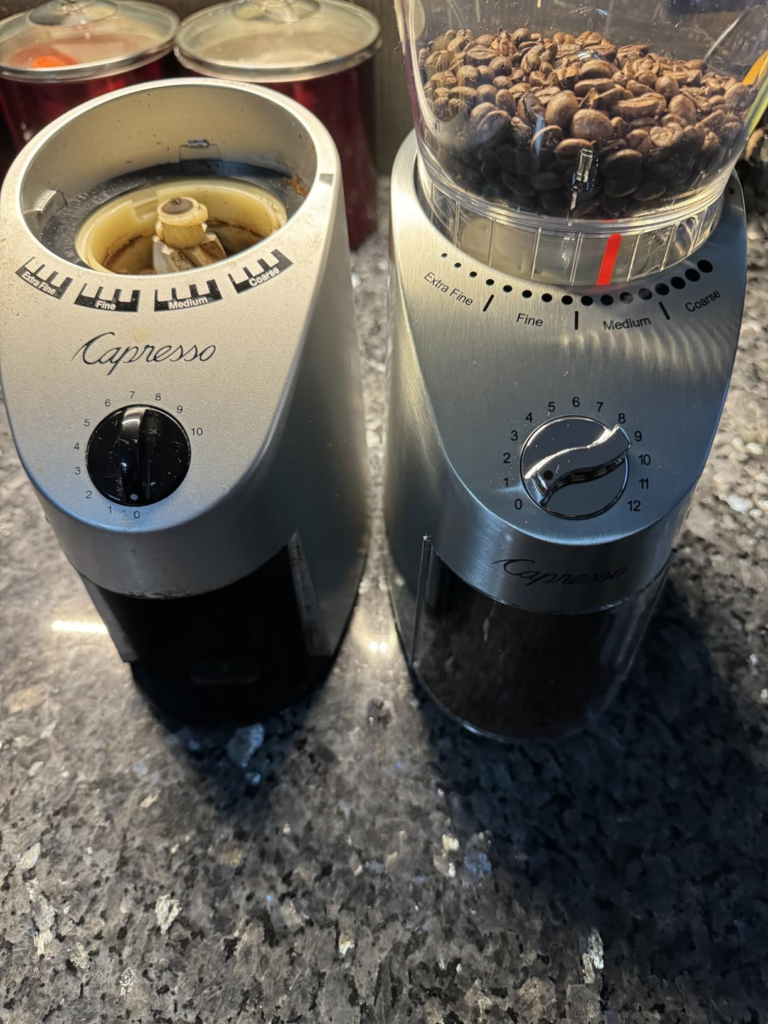
The Capresso Infinity Plus is engineered around a specific mechanical philosophy: slow is better.
Operating at less than 450 RPM, the motor uses a gear reduction system that minimizes friction and heat buildup, preserving the aromatic oils in the bean rather than burning them off during the grind. This is not marketing language. It is the actual reason this grinder tastes cleaner than blade alternatives at three times the price.
The conical burrs are produced as matched pairs and hand-assembled in Switzerland, with computer-controlled grinding heads cutting angles and shapes to within 0.1 mm precision. For a grinder under $100, that is a legitimate claim, not a brochure claim.
The mechanism that makes it good is also what defines its limit.
The 100-watt motor is relatively low power compared to most other home grinders. This means it can stall when faced with a dense light roast, particularly at very fine grind settings. That stall is not a defect. It is the motor reaching the boundary of its design tolerance. The gear reduction system that protects your coffee’s flavor at medium settings does not have the torque reserve to push through light roast density at espresso-fine levels without slipping, slowing, or producing inconsistent particle distribution.
The machine is faithful to its design. The design just has a ceiling.
The Threshold Where the Outcome Quietly Breaks
Call it the Grind Tension Threshold: the point at which the motor’s low-RPM design, a clear advantage for most brewing, becomes the exact constraint that prevents precision at the fine end.
| Brewing Method | Performance at This Grinder | Threshold Status |
|---|---|---|
| French Press | Consistent, reliable, excellent | Well below threshold |
| Drip / Filter | Solid performance across settings | Below threshold |
| Pour-Over (medium) | Good; minor inconsistency at finer steps | Approaching threshold |
| AeroPress (medium-fine) | Acceptable; margin narrows | Near threshold |
| Espresso (pressurized) | Functional on second-finest setting | At threshold |
| Espresso (non-pressurized) | Inconsistent extraction, unable to dial in | Above threshold |
| Light Roast at Fine | Motor stress, particle inconsistency | Breaks threshold |
| Turkish | Insufficient fineness, chewy texture | Beyond design range |
Capresso claims the Infinity is suitable for Turkish through cold brew, but the actual grinding range is 300 to 1,200 microns — suitable for drip, pour-over, and French press, but not as fine as needed for true espresso or Turkish coffee.
That 300-micron floor is where the threshold lives. Everything above it, the machine handles well. Everything below it, the machine cannot reliably reach.
Why Most Buyers Misread This Too Early
The entry-level grinder market has a specific trap: feature-led judgment.
Most buyers compare settings counts, RPM numbers, and hopper sizes. They read that this grinder has 16 settings and assume 16 settings means 16 usable positions across the full flavor spectrum. They see “extra fine” on the dial and interpret that as espresso-capable.
The Infinity is better at producing a consistent coarser grind, which is why many users choose it for French press or pour-over. For finer grinding, it won’t match up as well as competing entry-level grinders with more adjustment precision.
The comparison most commonly made is against the Baratza Encore. The conclusion most people reach too quickly is that they are interchangeable.
They are not.
Both use conical burrs. The main difference shows up in espresso: the Capresso Infinity doesn’t have the precision needed to dial in a shot, though it will deliver a reasonably even grind that lets you get close — provided you’re using a pressurized portafilter.
| Feature | Capresso Infinity Plus | Baratza Encore |
|---|---|---|
| Grind Settings | 16 | 40 |
| RPM | <450 | 550 |
| Price | ~$100 | ~$170 |
| Espresso Capability | Pressurized only | Limited (non-pressurized) |
| Repairability | Limited parts availability | Full part ecosystem |
| Best Use Case | Coarse to medium methods | Medium to medium-fine range |
| Burr Longevity | 200–400 lbs of coffee | 500–1,000 lbs of coffee |
| Static Issue | Present (worsens over time) | Minimal |
The Capresso isn’t the worse grinder. It’s the grinder built for a different user.
Who Is Actually Inside This Problem
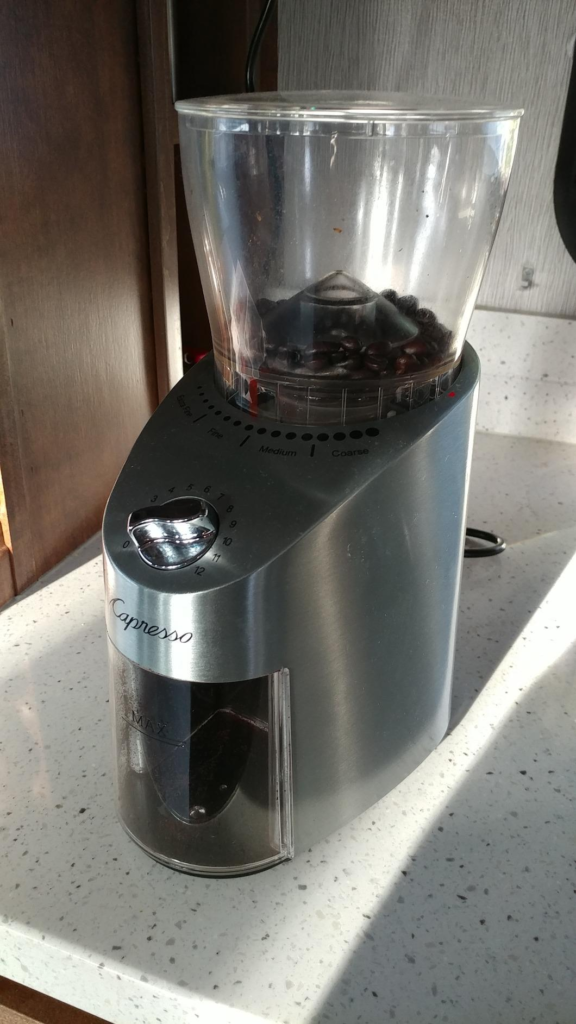
The Capresso Infinity Plus is the right grinder for a specific person at a specific stage.
You are the target user if:
- You brew drip, French press, pour-over at medium settings, or occasional AeroPress
- You came from a blade grinder or pre-ground coffee
- You want freshly ground beans without learning a technical skill set
- Your espresso machine uses a pressurized portafilter
- You value a quiet machine that doesn’t rattle the kitchen awake
- You want a legitimate quality grind under $100 without compromise at your actual brewing method
The Capresso Infinity Plus holds a special place among reviewers who recommend it most often to friends getting more serious about coffee — people who want to step up without draining their bank account.
Users consistently cite its quiet operation, user-friendly design, and consistent grinding capabilities as the reasons it earns repeat recommendations in that range.
The machine delivers exactly what this person needs. The threshold never gets crossed because this person never pushes toward it.
Where Wrong-Fit Begins
The regret scenario is predictable. It almost always follows the same arc.
Someone buys this grinder with a drip brewer. Enjoys it for three months. Gets more interested in coffee. Buys a non-pressurized espresso machine. Tries to dial in. Can’t. Blames the beans. Orders different beans. Still can’t. Searches forums. Learns the grinder was the ceiling all along.
You will experience wrong-fit if:
- You own or plan to own a non-pressurized espresso machine
- You grind primarily for pour-over and want repeatable extraction precision
- You frequently brew with light roast single-origin beans at fine settings
- You want a grinder you can repair yourself over years of use
- You need grind precision tighter than the 16-step range allows
- You are an intermediate coffee person, not a beginner
For pour-over, AeroPress, or any method where grind consistency directly affects extraction, the Capresso’s steel burrs degrade noticeably after 6 to 8 months of daily use, producing increasingly uneven particles that make medium-fine brews taste muddy.
The degradation curve is the part no spec sheet mentions. At purchase, the grinder performs at its best. The margin for error shrinks as the burrs wear, and in this price range, the burr longevity is the honest limiter.
The One Situation Where This Grinder Becomes Logical
After everything above, here is the situation where the Capresso Infinity Plus is not a compromise — it is the correct answer:
You brew drip or French press daily. You came from a blade grinder or pre-ground coffee. You want to taste what freshly ground beans actually taste like without a learning curve or a $200 entry ticket. You have a standard drip machine or a pressurized espresso maker. You want something quiet, simple, Swiss-assembled, and built to last several years at your specific use frequency.
No other conical burr grinder in its class preserves more flavor and aroma at this price point. The innovative gear reduction motor allows for the slowest grinding speed available, creating less friction and heat for the best results at any grind setting within its designed range.
For that user, in that kitchen, with that brewing method — this grinder is not a stepping stone. It is the destination.
The $100 price is not a discount on a worse product. It is an accurate price for a product with a specific ceiling, built for a specific floor.
What It Solves, What It Reduces, and What It Still Leaves to You
| Category | What the Grinder Does |
|---|---|
| Solves | Stale pre-ground coffee, blade grinder heat damage, morning inconsistency, flavor flatness in standard brew methods |
| Reduces | Counter noise vs. comparable grinders, grind time per cup, morning friction for drip and French press users |
| Does Not Solve | Espresso dialing precision, light roast fine-grind density, Turkish-level fineness, long-term burr consistency past 6–8 months of heavy daily use |
| Leaves to You | Static management (especially in low-humidity environments), occasional cleaning of the grinding chamber, matching your brewing method honestly to the grinder’s range |
Static buildup is a real issue that tends to develop over months of use. It can be largely resolved by periodically hand-washing the removable plastic components with mild soapy water and brushing out the grinding chamber.
The machine doesn’t hide its limits. The limits just don’t announce themselves in the product description.
Final Compression
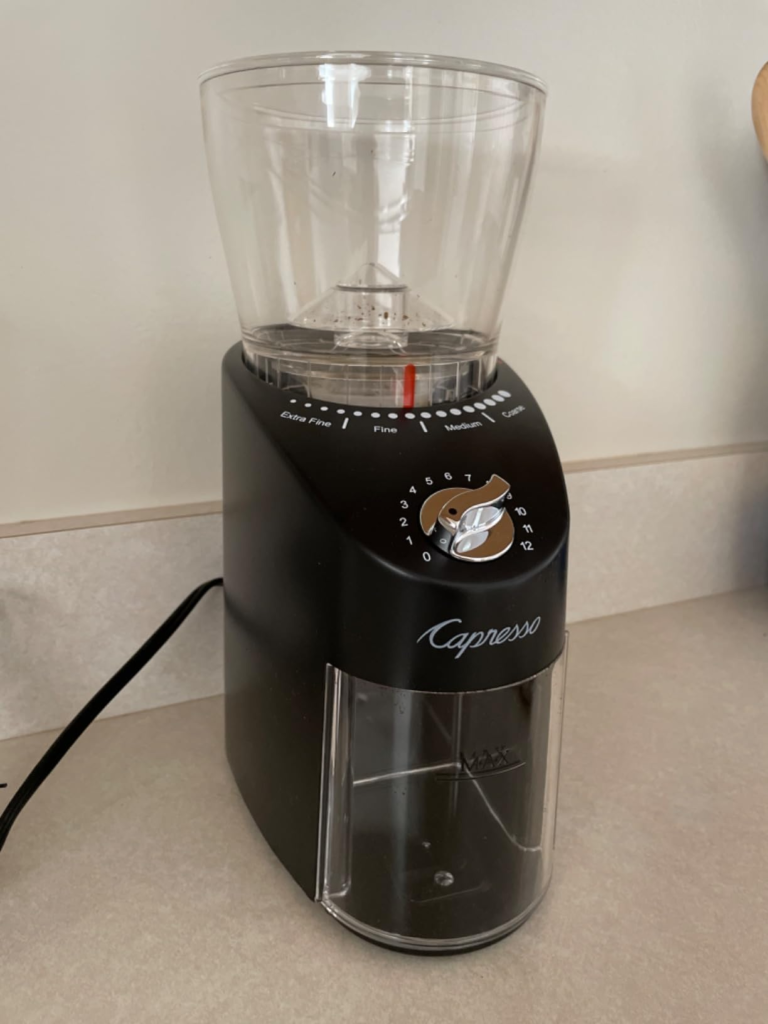
If your brewing method lives between French press and medium pour-over, and you are coming from anything worse than a proper burr grinder, the Capresso Infinity Plus will close the gap that has been costing you flavor every morning. The Swiss-assembled burrs, the slow motor, and the 16-step range are more than enough for what this grinder was actually built to do.
If you are chasing espresso precision, light roast extraction at fine settings, or a grinder that remains consistent across three to five years of daily medium-fine grinding, this is not your machine — and buying it first will cost you the same money twice.
The decision is not complex once you know the threshold. It just rarely gets stated this clearly before purchase.
If your brewing method is inside this grinder’s designed range, the next step is simple:
Frequently Asked Questions
| Question | Answer |
|---|---|
| Is the Capresso Infinity Plus good for espresso? | It can produce a fine grind suitable for pressurized portafilter espresso machines. For non-pressurized espresso where precision dialing is required, the 16 settings do not offer the adjustment resolution needed for consistent results. |
| How loud is the Capresso Infinity Plus? | Measured testing places it at 73 to 78 dB — meaningfully quieter than most burr grinders in its class, which typically run 80 to 85 dB. It is not silent, but it will not wake others in the next room under most conditions. |
| Does it have a static problem? | Static does develop with use, particularly in low-humidity environments. It causes grounds to cling to the plastic container. The issue is manageable by periodically washing the removable components and keeping the grinding chamber clean. |
| How many cups can it grind at once? | The cup selector covers 1 to 12 cups per grind cycle. The bean hopper holds up to 11 oz of whole beans; the ground coffee container holds up to 4 oz. |
| How does it compare to the Baratza Encore? | The Encore offers 40 grind settings versus 16, better grind consistency at medium-fine settings, and a full replacement parts ecosystem. The Capresso costs roughly $70 less. For drip and French press users, the Capresso is sufficient. For pour-over precision or planned espresso use, the Encore or a more capable grinder is the more honest purchase. |
| How long do the burrs last? | Under regular daily home use, the steel burrs are estimated to handle approximately 200 to 400 lbs of coffee before noticeable consistency degradation. For one to two cups per day, that represents roughly two to four years of use. |
| Can I grind light roasts with it? | Yes at medium to medium-coarse settings. At very fine settings, the 100-watt motor can stall under the density of hard light roast beans, producing inconsistent particle sizes. This is a known limitation of the motor’s power ceiling, not a defect. |
Transparency Note:
This analysis is built on aggregated real-world experience.
It extracts what repeatedly holds, what breaks, and what users uncover only after living with the system—then shapes it into a clear model you can use immediately.
Think of it as structured experience, refined and presented so you don’t have to learn it the hard way.
“A quick note: Don’t believe the star ratings, but trust personal experience. This article is a compilation of collected experiences”