YOUR INTERNET PROBABLY ISN’T SLOW. YOUR ROUTER IS JUST BREAKING IN A MORE EXPENSIVE WAY.
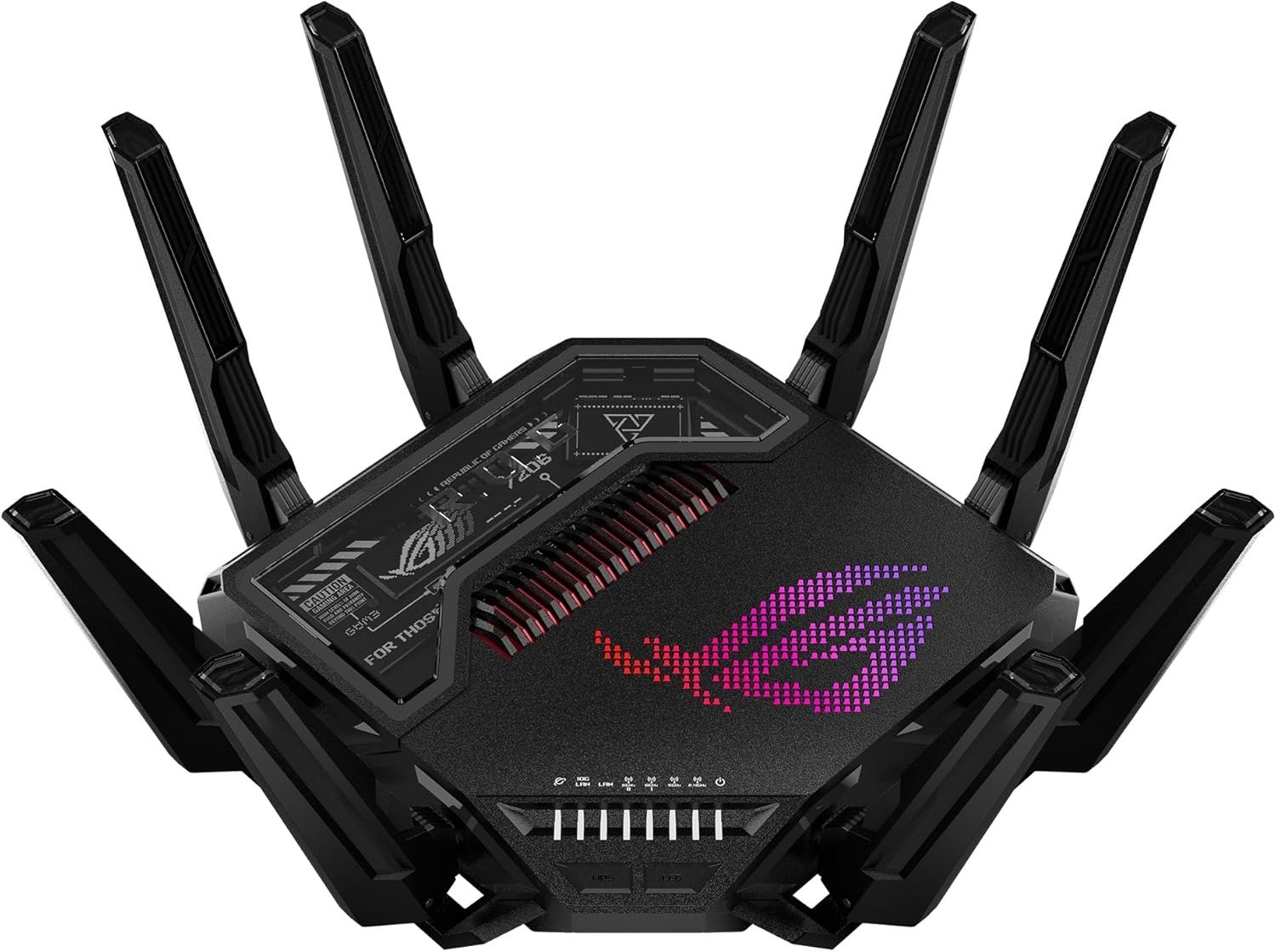
The ugly part is this: a lot of “fast” home networks do not collapse with a dramatic outage. They decay quietly. A game update drags in one room, a 4K stream softens in another, a phone clings to the wrong band, and the whole house starts feeling sticky, delayed, slightly off. That is the kind of failure people misread. They blame the ISP. They blame the walls. They blame the number on the speed test they ran two feet from the router. I wouldn’t. When I line up the ASUS ROG Rapture GT-BE98 Pro against lab testing, official specs, and owner feedback, the pattern is much narrower than the marketing suggests: this is not a “better router” in the vague sense. It is a threshold router. It starts making sense only when your network has already become too dense, too fast, or too demanding for ordinary hardware to hide its weakness.
THE RESULT LOOKS FINE. THE PROBLEM ISN’T.
A weak router often performs like a polished liar. The homepage loads. The speed test looks healthy. The first five minutes feel normal. Then the seams start showing. Not everywhere. Not all at once. Only when three things collide: distance, concurrent traffic, and clients with very different radio capabilities. That is where the GT-BE98 Pro separates itself. RTINGS found outstanding top speeds and good range overall, but also noted that older devices on 5 GHz can slow down noticeably at longer distances, and that wireless latency is merely adequate for general use rather than ideal for competitive play. Tom’s Hardware, meanwhile, highlighted the strong 6 GHz consistency and unusually deep wired connectivity. In plain English: this router is not magic. It is a machine built to keep a busy network from fraying as early as cheaper ones do.
WHAT YOU’RE ACTUALLY FEELING BUT NOT NAMING
Most people do not say, “My router is crossing a congestion threshold.” They say, “The house feels weird online.” That vague irritation usually has a shape:
- A powerful plan that never feels consistently powerful
- Rooms that are not dead zones, but never feel clean
- Fast downloads, then sudden hesitations, jitter, or device handoff friction
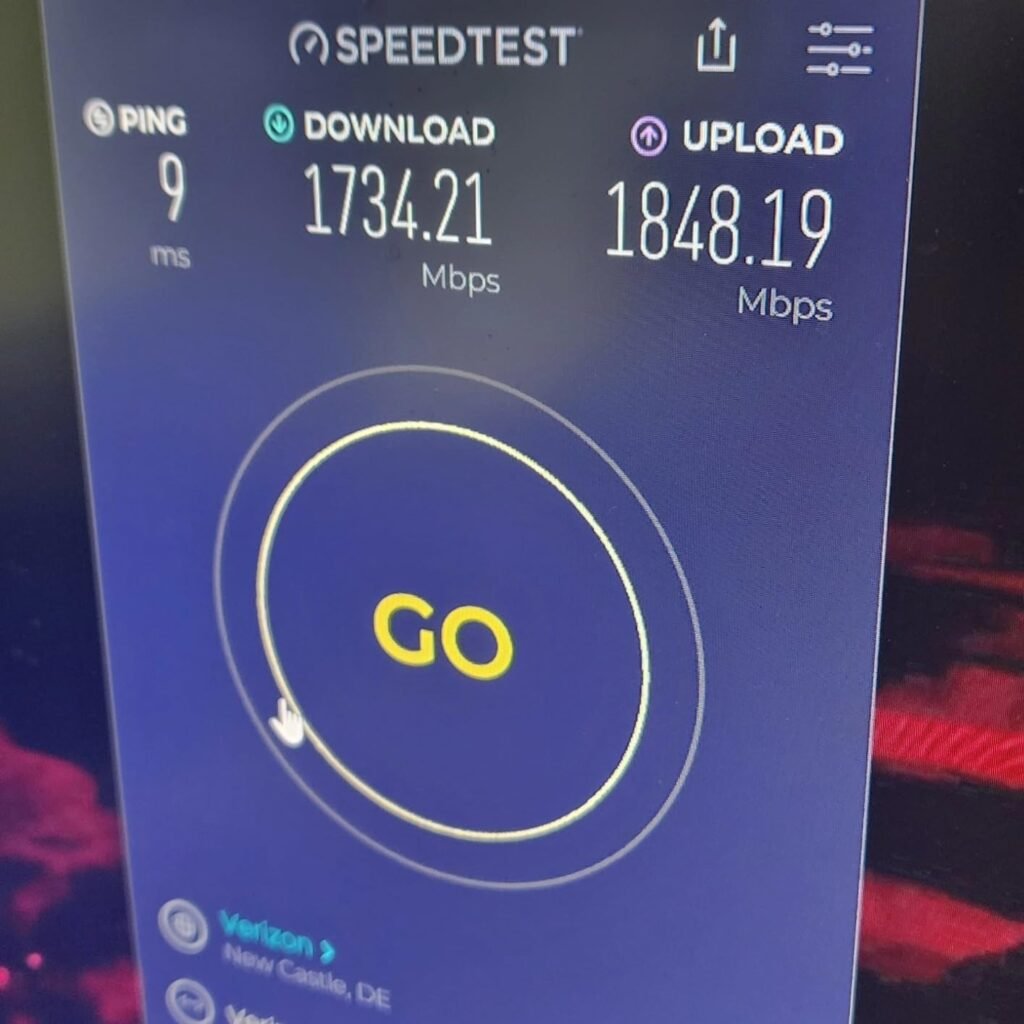
That is not just “bad Wi-Fi.” It is a mismatch between the network you now run and the hardware still trying to manage it. The GT-BE98 Pro is built around exactly that kind of mismatch: quad-band Wi-Fi 7, dual 6 GHz radios, 320 MHz channels, 4K-QAM, Multi-Link Operation, dual 10G ports, and four 2.5G ports. Those specs matter only because they widen the lane count and reduce the traffic fighting that starts when one router is trying to serve too many heavy jobs at once.
THE HIDDEN MECHANISM BEHIND THE MISS
Here is the hidden mechanism most buyers miss: they judge routers as if peak speed were the product. It is not. The real product is composure under mixed load.
Think of a normal high-end router as a wide road with a few clever traffic lights. It feels excellent until the hour changes. Then the trucks arrive, two lanes merge, someone brakes, and the smooth drive turns ragged. The GT-BE98 Pro attacks that problem with brute radio width and brute port density. ASUS rates it for up to 30 Gbps aggregate wireless capacity, with two separate 6 GHz bands, support for 320 MHz bandwidth, 4K-QAM, and MLO; the hardware also includes a quad-core 2.6 GHz CPU, dual 10G ports, and four 2.5G ports. Dong Knows’ testing described it as one of the fastest Wi-Fi routers available, with sustained multi-gigabit Wi-Fi 7 throughput and strong Wi-Fi 6E and 6 performance as well. The point is not the headline number. The point is that this router has more space to absorb chaos before the house starts feeling brittle.
THE THRESHOLD WHERE THE OUTCOME QUIETLY BREAKS
This is the line I would use.
| Threshold signal | What it usually means | Why the GT-BE98 Pro matters here |
|---|---|---|
| You pay for multi-gig internet | Your old router is now the choke point | Dual 10G plus quad 2.5G gives the wired side room to breathe |
| You own Wi-Fi 6E or Wi-Fi 7 devices | Your current network cannot fully exploit newer radios | Dual 6 GHz bands and 320 MHz channels raise ceiling and capacity |
| Your house has mixed client types and heavy simultaneous use | Stability matters more than peak screenshot speed | Extra bands and port flexibility reduce traffic pileups |
| You care about competitive gaming | Wi-Fi alone is still not enough | Dedicated 10G gaming port and wired options matter more than wireless promises |
That last row matters. RTINGS is very explicit: for competitive gaming, Ethernet is still the better path, because the router’s wireless latency is okay, not elite. This is one of the most important truths about the GT-BE98 Pro. It is a superb network foundation for gaming. It is not a law of physics repeal. If you buy it expecting Wi-Fi to behave like a cable in every serious match, you are buying the wrong fantasy.
WHY MOST BUYERS MISREAD THIS TOO EARLY
Because they shop by the wrong scoreboard.
- They compare “top speed.”
- They compare “gaming features.”
- They compare “future-proofing.”
Too early.
The better question is harsher: At what point does my current network stop feeling trustworthy? That is the threshold question. Not “Is this router powerful?” Of course it is. Tom’s Hardware called out its wealth of gaming software, strong 6 GHz performance, and large number of LAN ports. TechRadar framed the broader GT-BE98 line as serious overkill for many buyers. Amazon review summaries show the same split in plain language: people praise build quality, speed, coverage, and setup, while mixed opinions cluster around value, occasional connectivity complaints, and whether the asking price is justified. That split is exactly what I would expect from a threshold product. Under the threshold, it feels excessive. Past the threshold, it starts looking rational.
WHO IS ACTUALLY INSIDE THIS PROBLEM
I would put you inside this problem if at least three of these are true:
- You have multi-gig broadband, or you are about to
- You run a dense home with streamers, consoles, gaming PCs, cameras, phones, and smart-home devices all tugging at the same network
- You already own Wi-Fi 6E or Wi-Fi 7 hardware and hate knowing you are underfeeding it
- You want heavy wired expansion without immediately moving to a full prosumer stack
- You are tired of the small humiliations: delayed roaming, random hiccups, packet wobble, or the sense that the network is “fine” right up until everyone is home
This is also a better fit if you want one powerful core unit first and the option to expand later with AiMesh. ASUS explicitly positions the second 6 GHz band as useful for dedicated wireless backhaul in an AiMesh setup, which is one of the more practical advantages of this model over simpler routers.
WHERE WRONG-FIT BEGINS
I would not point most people to this router.
- Not the apartment user with a basic plan.
- Not the buyer chasing a number rather than a network problem.
- Not the person whose devices are still mostly older Wi-Fi 5 or standard Wi-Fi 6 clients.
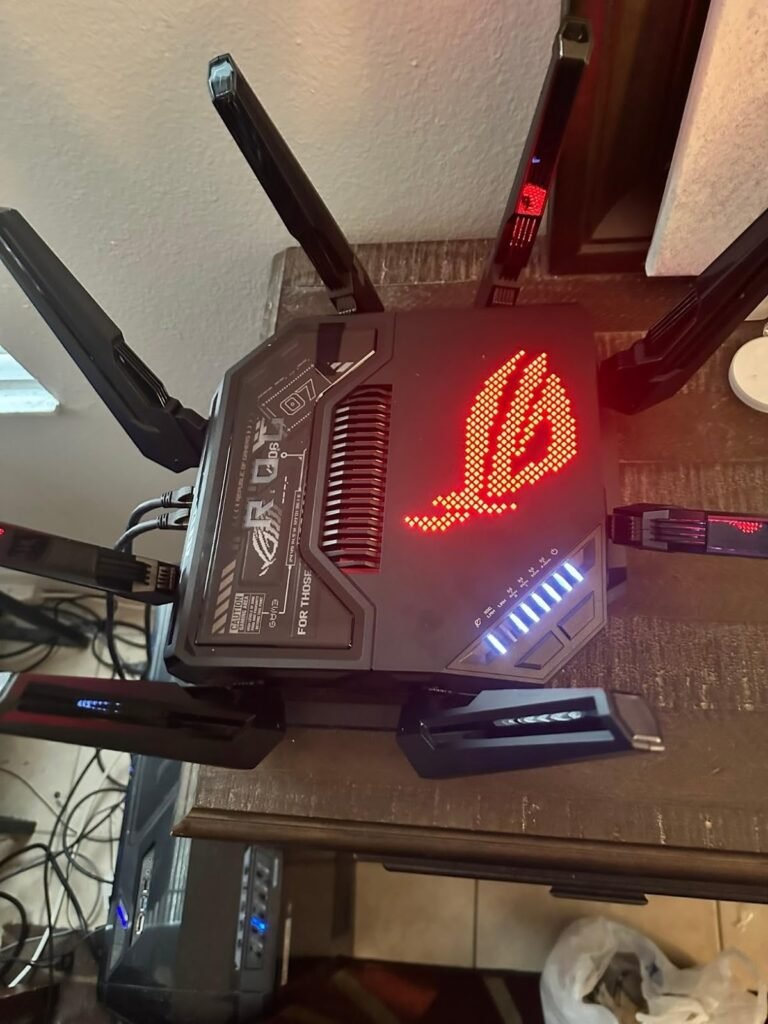
- Not the shopper who wants invisible décor; this thing is physically large and aggressively styled.
- Not the buyer who thinks paying more removes the need for wired discipline in serious gaming.
And not the person who is emotionally allergic to firmware maturity cycles. Early owner commentary and later review discussion both make it clear that Wi-Fi 7’s first wave has involved evolving firmware and feature maturity. ASUS continues to ship updates for the GT-BE98 Pro, including 2026 fixes for roaming stability, 2.5G LAN/WAN stability, remote connection stability, and security-related issues. That is reassuring in one sense: the platform is active. It is also a quiet warning: this is advanced hardware living in an evolving standard, not a frozen appliance.
THE ONE SITUATION WHERE THIS PRODUCT BECOMES LOGICAL
Here is the exact situation where I stop hesitating.
You have already crossed into a house-wide performance problem that cheap advice cannot solve. You do not need another cute router. You need a serious network core with enough radio headroom, enough wired headroom, and enough management flexibility that the system stops bending every evening.
That is where the ASUS ROG Rapture GT-BE98 Pro becomes logical.
Not because it is “the best for everyone.” It isn’t.
Not because the gaming labels are hypnotic. They aren’t.
Because the hardware profile is unusually stacked: dual 10G, quad 2.5G, dual 6 GHz radios, quad-band Wi-Fi 7, a 2.6 GHz quad-core CPU, and software depth that multiple reviewers describe as extensive. Even current owner sentiment on Amazon follows that line: strong praise for speed, coverage, build quality, and features, with the usual tension concentrated around price and occasional stability complaints. At Amazon, the product page shows a 4.1/5 average from 434 global ratings; ASUS’s own support page lists an official store price of $699.99 at the time of access, while the Amazon listing surfaced at $599.99 in the snapshot I reviewed. This is expensive hardware. But once you are solving the right problem, “expensive” and “mispriced” stop being the same word.
WHAT IT SOLVES, WHAT IT REDUCES, AND WHAT IT STILL LEAVES TO YOU
What it solves:
- A router becoming the bottleneck in a multi-gig home
- A dense device environment that keeps exposing weak backhaul, weak radios, or weak port selection
- A high-end setup where newer Wi-Fi clients deserve more than generic tri-band hardware
What it reduces:
- The odds of your network feeling congested under simultaneous heavy use
- The need to compromise on wired expansion for gaming rigs, NAS, or workstations
- The friction of trying to stretch a mainstream router into a house that no longer behaves like a mainstream house
What it still leaves to you:
- You still need wired Ethernet for genuinely serious competitive gaming; RTINGS is blunt about that
- You still need compatible Wi-Fi 7 or 6E clients to unlock the point of the hardware
- You still need sane placement, sane configuration, and firmware hygiene
- You still need to admit when your house needs mesh expansion rather than one heroic box in the wrong corner
This is the part weaker articles skip. The GT-BE98 Pro cannot rescue bad fit, bad placement, bad expectations, and old clients all at once. It can only remove the router as the house’s quiet saboteur.
FINAL COMPRESSION
I would compress the entire decision into one sentence:
If your network only looks fast until the house is fully alive, this is the class of router you buy when you are done pretending the bottleneck is somewhere else.
The ASUS ROG Rapture GT-BE98 Pro is not a casual upgrade. It is a correction for a specific break point: multi-gig service, many active devices, newer clients, serious wired needs, and a growing distrust of consumer-grade smooth talk. That is why I would not recommend it broadly—and why I would recommend it hard once that threshold is real.
If that is the condition you are actually dealing with, this is the logical next step.
Transparency Note:
This analysis is built on aggregated real-world experience.
It extracts what repeatedly holds, what breaks, and what users uncover only after living with the system—then shapes it into a clear model you can use immediately.
Think of it as structured experience, refined and presented so you don’t have to learn it the hard way.
“A quick note: Don’t believe the star ratings, but trust personal experience. This article is a compilation of collected experiences”