Peugeot Bresil Coffee Mill Review: The Grind Looks Perfect, So Why Does the Coffee Taste Off?
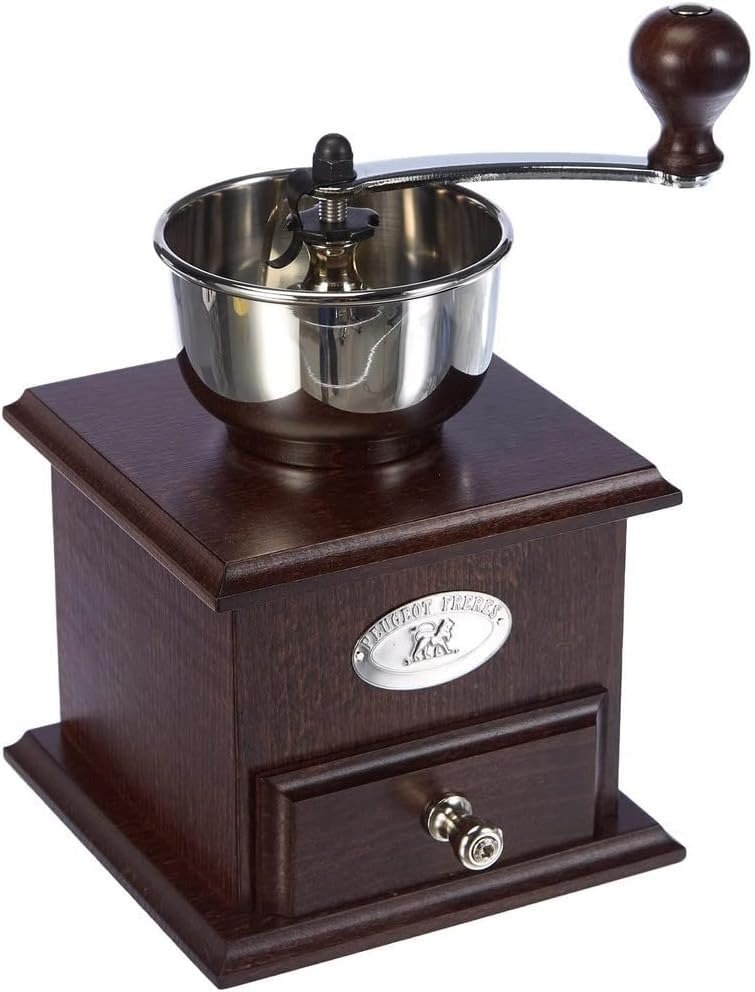
PEUGEOT BRESIL COFFEE MILL
You turn the crank, the beans crack and hiss, and walnut-toned dust starts sifting into the little wood drawer. For about ten seconds, this feels exactly like the coffee ritual you pictured when you hit “buy.” Then you slide the drawer out and half your grind is on the counter instead of in it. That gap — between how this mill looks in a product photo and how it behaves on your actual counter at 6 a.m. — is what this review is really about.
Peugeot Bresil Grind Quality: The Result Looks Fine. The Problem Isn’t.
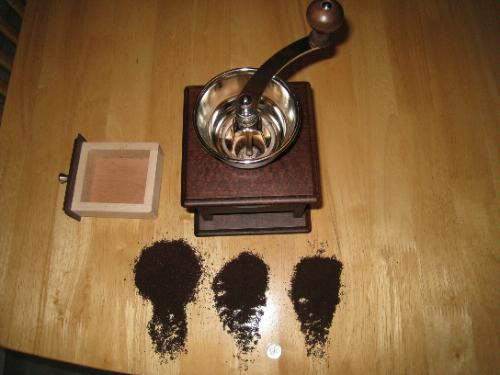
Judged purely on the coffee it produces, the Bresil earns its reputation — it sits around 4.4 stars across hundreds of ratings, and most of that praise is aimed at one thing: the grind itself. Owners who switched from a cheap blade grinder describe the difference in one word — even. No more fine dust sitting next to pebble-sized chunks in the same scoop, the kind of uneven grind that makes a French press taste bitter in one sip and watery in the next. A case-hardened steel mechanism cracks each bean before grinding it, and that two-stage action is why the particle size holds steady turn after turn.
So if the coffee isn’t the problem, why do so many people put this mill down after two weeks feeling let down? Because grind quality was never what anyone doubted. The part nobody warns you about is what happens in the thirty seconds after the grinding stops.
Manual Coffee Grinder Frustration: What You’re Actually Feeling but Not Naming
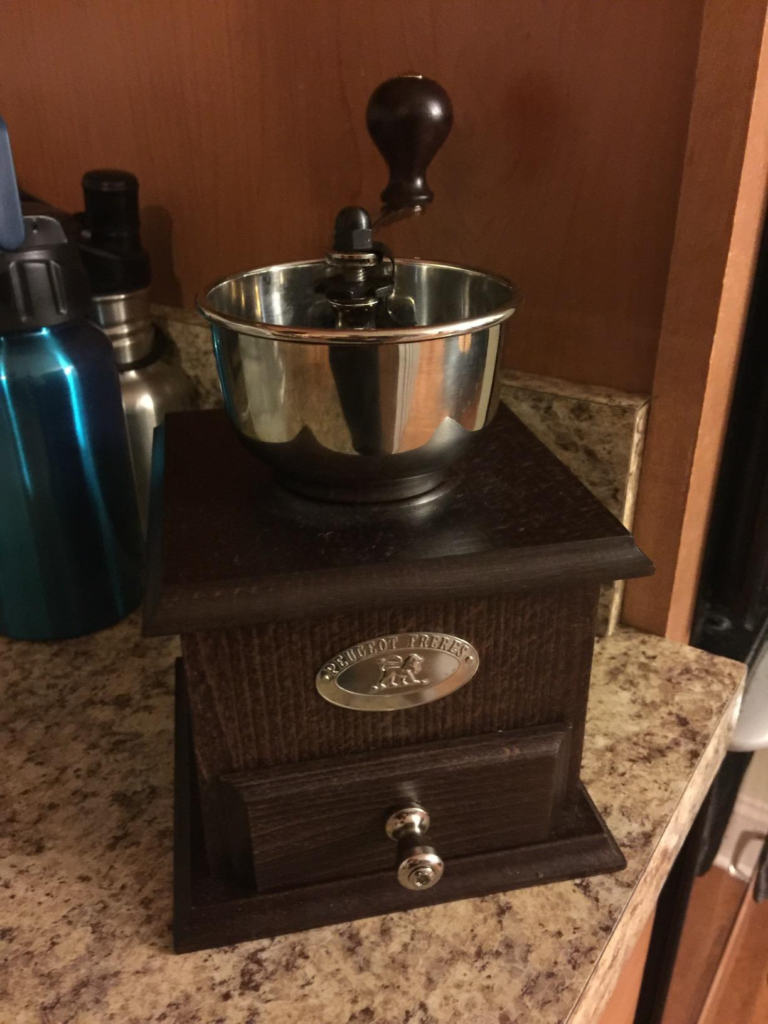
Here’s the annoyance you probably haven’t put into words yet: this is a $150-plus kitchen object that still leaves grounds on your counter, and some mornings, on the floor. Not because you’re doing anything wrong. The mill has no rubber feet or grippy base, so on a smooth countertop it tends to slide while you crank — which means you’re bracing it with one hand and grinding with the other, right when precision matters most. Grounds that don’t drop cleanly into the drawer catch on the outer lip instead, and from there, gravity takes them wherever it wants.
None of that shows up in a listing photo. It shows up on a Tuesday morning when you’re already running late — and it’s the real reason some owners return a mill they otherwise loved the taste from.
Peugeot Bresil Burr Mechanism: The Hidden Mechanism Behind the Miss
Two details explain both the quality and the mess, and they come from the same piece of design.
First, the mechanism: a case-hardened steel burr, hardened the way a good knife blade is, built as a two-stage cracker-then-grinder — a design Peugeot has used since 1840. That’s why the grind holds together at any setting instead of falling apart at the extremes. Adjustment is stepless, controlled by a thumbwheel under the crank: clockwise tightens the grind, counter-clockwise loosens it, with no fixed notches locking you in.
Second — and this is the part most listings gloss over — the body isn’t solid walnut. It’s sustainably sourced French beechwood, kiln-dried and finished with a walnut-toned stain. That’s not a downgrade; beech is dense and resists warping better than most softer show-woods. But it does mean the smooth, sealed surface has almost no texture to grip a counter. A frictionless base, combined with a hopper you’re actively torquing sideways as you crank, is why it slides. It’s not a defect. It’s a predictable side effect of the same finish that makes the mill look this good sitting out.
| Spec | Detail |
|---|---|
| Type | Manual, hand-crank burr mill |
| Made in | France (mechanism design dates to 1840) |
| Body | Sustainably sourced French beechwood, walnut-stained finish |
| Mechanism | Case-hardened steel, two-stage crack-then-grind |
| Grind adjustment | Stepless thumbwheel (clockwise = finer) |
| Hopper capacity | 7 tablespoons of whole beans |
| Drawer capacity | 8 tablespoons, about 2 oz ground coffee |
| Height | About 8.75 inches |
| Warranty | Lifetime on the mechanism, 5 years on the exterior |
| Typical price | Roughly $150–$165, depending on retailer |
Peugeot Bresil Grind Settings: The Threshold Where the Outcome Quietly Breaks
Peugeot’s own product description recommends the Bresil for drip, French press, and pour-over — full stop. Some third-party listings go further and market it as espresso-capable, since cranking the thumbwheel all the way clockwise does produce a genuinely fine powder.
Here’s the threshold that claim runs into: fine and consistent are two different achievements. Hand-grinder communities that compare manual mills side by side generally agree the Bresil is stronger at medium-to-coarse settings than at true espresso fineness — resistance at the tightest settings raises the odds of an uneven pull, the kind that tastes sour or hollow instead of balanced. That’s not unique to this mill; it’s a limit shared by almost every hand-crank grinder at this price, since espresso-grade consistency usually takes the internal precision — and price tag — of a dedicated espresso grinder several times the cost.
If your habit lives at the coarse-to-medium end, you’ll likely never meet this threshold at all.
| Thumbwheel Position | Grind Result | Best Match |
|---|---|---|
| Loosened (counter-clockwise) | Coarse, chunky | French press, cold brew |
| Mid-range | Medium | Drip, pour-over (V60, Chemex) |
| Tightened (clockwise) | Fine | Moka pot |
| Fully tightened | Very fine | Espresso — inconsistent per hand-grinder community reports |
Peugeot Bresil vs Electric Burr Grinders: Why Most Buyers Misread This Too Early
The comparison most people run in their head is “manual versus electric,” as if that’s the whole decision. It isn’t. An $80 electric blade grinder and a $150 manual burr mill aren’t even competing for the same job — one chops beans into random sizes with spinning blades, the other crushes them between two fixed surfaces to a chosen size. That’s the trap: judging the Bresil against the grinder you already own, instead of against what an electric burr grinder at the same price would actually deliver.
The more useful question isn’t manual-versus-electric. It’s how much you value quiet, a slower morning, and a good-looking countertop object, against thirty extra seconds of arm work per cup. Buyers who skip that question and buy on looks alone are the ones most likely to feel disappointed a month in — not because the mill underperforms, but because they never asked what they were actually trading for the aesthetic.
Who Should Buy the Peugeot Bresil: Who Is Actually Inside This Problem
This mill fits a specific daily pattern, not a general one. It’s built for one to four cups at a time — the hopper holds about 7 tablespoons of beans, enough for a solo pour-over or a small French press, not a full pot for a house of five. It fits people already brewing with a Chemex, a V60, a French press, or a basic drip machine, who grind fresh because they can taste what stale pre-ground coffee costs them.
| This Fits You If… | Look Elsewhere If… |
|---|---|
| You brew 1–4 cups via French press, pour-over, or drip | You need espresso-grade consistency every morning |
| You grind fresh beans in small batches | You’re grinding for a full household or office at once |
| You want a countertop piece that looks intentional | You want zero maintenance and zero manual effort |
| You don’t mind a slower, quieter ritual | You’re not willing to manage a little counter cleanup |
Peugeot Bresil Pros and Cons: Where Wrong-Fit Begins
Where does the wrong-fit purchase usually start? Almost always with someone buying this as their only grinder for an espresso machine, or expecting it to grind for six people every morning. Neither is what it’s built for, and both lead to the same regret — a beautiful mill that feels like the wrong tool for the job it’s being asked to do.
| Strengths | Weaknesses |
|---|---|
| Consistent, even grind at coarse-to-medium settings | No grip feet — slides on smooth counters |
| Two-stage steel mechanism, lifetime warranty | Grounds can spill past the drawer edge |
| Stepless adjustment, coarse to fine | Not reliably consistent at true espresso fineness |
| Solid, attractive countertop presence | Wood exterior needs occasional oiling |
| Small footprint, ideal for 1–4 cup batches | Manual effort adds 20–40 seconds per grind |
Is the Peugeot Bresil Coffee Mill Worth It: The One Situation Where It Becomes Logical
Strip away the marketing and the complaints, and there’s one situation where this stops being a maybe and becomes the obvious answer: you drink one or two cups a day, you already brew pour-over, French press, or drip, and you’ve been tolerating an inconsistent grind from a blade grinder or bottom-shelf burr mill longer than you’d like to admit.
In that situation, the Bresil isn’t competing with a $2,000 espresso setup — it’s competing with the grinder currently sitting on your counter producing an uneven cup. Against that competition, a mechanism refined since 1840 for exactly this job, backed by a lifetime warranty on the part that matters most, is hard to argue with.
Peugeot Bresil Real-World Performance: What It Solves, What It Reduces, and What It Still Leaves to You
What it solves: the uneven, unpredictable grind that ruins pour-over and French press coffee. What it reduces: guesswork, since the stepless thumbwheel lets you dial in a setting and repeat it, instead of hunting for it every time. What it still leaves to you: managing the mess. A damp cloth after each use, a small silicone mat or strip of grip tape under the base, or just bracing it against a counter edge while you crank — any of these solves the sliding problem that shows up in nearly every long-term review. The wood also wants occasional food-safe oil on the outside only; oiling the inside will taint your coffee, so keep those separate. It’s a small habit, not a burden — but it’s real, and it’s fair for you to know it before the box shows up.
Peugeot Bresil Coffee Mill FAQ: Straight Answers to the Questions Before You Buy
| Question | Answer |
|---|---|
| Is the Peugeot Bresil manual or electric? | Manual only. You crank it by hand — no motor, no cord. |
| Is the wood actually walnut? | No. The body is French beechwood, finished with a walnut-toned stain. The engineering lives in the mechanism, not the wood species. |
| Can I use it for espresso? | You can turn the grind fine enough to try, but hand-grinder communities generally rate it stronger for French press, pour-over, and drip than for consistent espresso-grade fineness. |
| How much coffee can I grind at once? | The hopper holds about 7 tablespoons of whole beans; the drawer collects up to 8 tablespoons — roughly 2 ounces of ground coffee. Enough for a solo pour-over or a small French press, not a full pot for a crowd. |
| How do I clean and maintain it? | Brush out the hopper and drawer after each use, wipe the wood with a slightly damp cloth along the grain, and oil the exterior occasionally with food-safe oil — never the inside. |
| What does the warranty cover? | The grinding mechanism carries a lifetime warranty; the wood exterior is covered for five years. |
Final Verdict on the Peugeot Bresil Coffee Mill: Where the Decision Stops Being Vague
If you’ve read this far, you already know which side of this you’re on. Either you brew one or two cups a day the slow way and you’re tired of an uneven grind — or you need espresso every morning, and no hand mill in this price range is going to fix that for you.
If you’re in the first group, delaying this just means another month of gritty French press or bitter pour-over from a grinder that was never built to do better. This is where it stops being vague:
Transparency Note:
This analysis is built on aggregated real-world experience.
It extracts what repeatedly holds, what breaks, and what users uncover only after living with the system—then shapes it into a clear model you can use immediately.
Think of it as structured experience, refined and presented so you don’t have to learn it the hard way.
“A quick note: Don’t believe the star ratings, but trust personal experience. This article is a compilation of collected experiences.”
![The Hands-Free Espresso Problem: When Convenience Breaks Consistency ([شاركنينجا][1])](https://focusedinsight.net/wp-content/uploads/2026/02/image-26.png)