W-KING D10 Review: I Trusted the 120W Claim — Here Is What the Speaker Actually Delivered
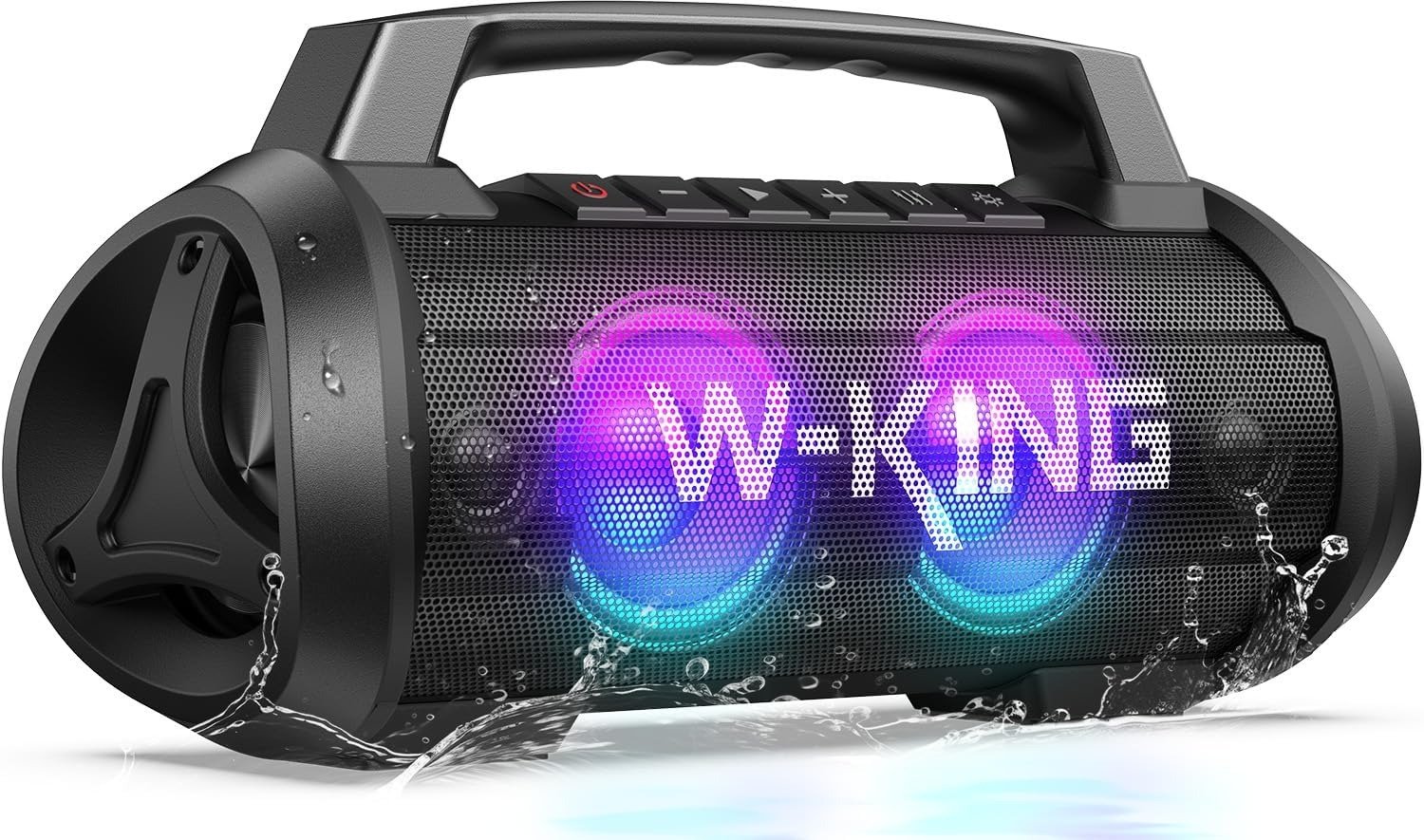
W-KING D10
I remember standing in a parking lot two summers ago, watching someone blast music from a speaker I couldn’t name — loud enough that three aisles over I could feel the kick drum in my chest. Not hear it. Feel it. And the sound wasn’t distorted. It wasn’t clipping. It was just there, the way a real sound system is there.
That’s the expectation “120W” creates. A physical, clean, room-filling presence.
When the W-KING D10 landed on my desk, that parking lot memory was the benchmark I was measuring against. The specs said 120W peak. The box said 42 hours. The listing said IPX6. None of those numbers mean much in isolation. What matters is what happens when you’re fifty people deep at a Saturday afternoon barbecue and someone says turn it up.
That’s what this review is actually about.
W-KING D10 Audio Performance: The Result Looks Fine — The Problem Isn’t
Plug it in. Press play. At 60% volume, the D10 sounds genuinely impressive.
The bass hits. Not politely — it actually registers in the room. The highs don’t smear into each other at the top. The 30-degree tilt built into the cabinet design sends sound upward toward ear level rather than horizontally into people’s shins, which creates a noticeably wider listening area than most boombox-style speakers at this price.
So where’s the problem?
The problem is that “sounds great at 60%” is a fundamentally different promise than “120W outdoor party speaker.” Anyone buying a speaker this size is planning to push it. What happens when you do — that’s what most reviews don’t say clearly enough.
W-KING D10 — Complete Technical Specifications
| Specification | Value |
|---|---|
| Peak Power Output | 120W |
| RMS Power (Continuous Real Output) | 70W |
| Maximum SPL | 110 dB |
| Driver Configuration | 2 × 45W woofers + 2 × 15W tweeters |
| Passive Radiators | 2 oversized |
| DSP Algorithm | WDSP 2.0 (proprietary) |
| Battery Capacity | 15,600 mAh |
| Claimed Battery Life | Up to 42 hours |
| Bluetooth Version | 5.4 |
| Waterproof Rating | IPX6 |
| AUX Input | 3.5 mm |
| Microphone Input | 6.35 mm (1/4″) dynamic |
| TF Card Playback | MP3 / WAV |
| TWS Stereo Pairing | 2 units = 240W peak / 140W RMS |
| USB Power Bank Output | Yes |
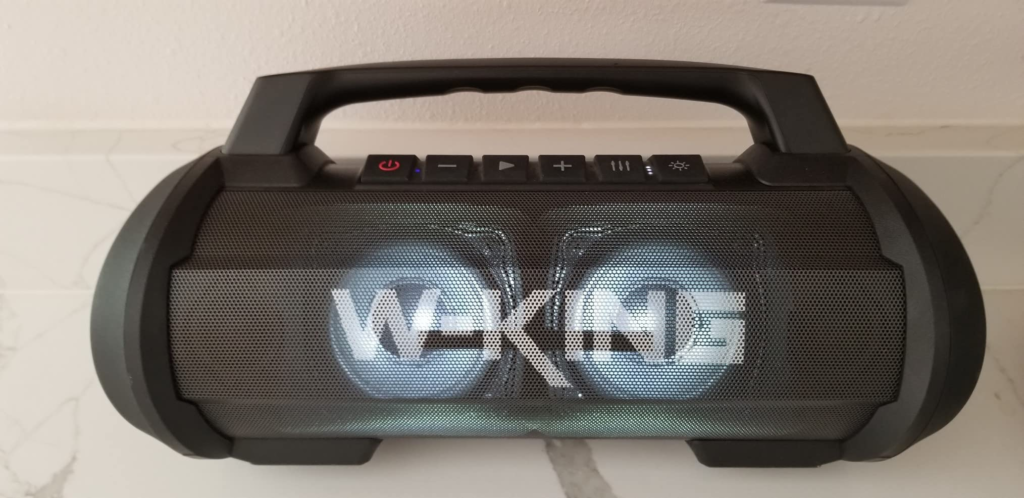
| LED Lighting | 7-color RGB, beat-synced |
| EQ Modes | 2 (Standard / Bass Boost) |
| Approximate Weight | ~8 lbs (3.6 kg) |
| Bluetooth Range | ~100 ft (30 m) |
The specs look clean. But the spec sheet isn’t where the actual listening experience lives.
W-KING D10 Bass Character: What You’re Feeling — But Probably Not Naming
I’ve had this conversation more times than I can count: someone bought a “100W” or “120W” Bluetooth speaker, set it up, and came back not angry — just deflated. The bass was there, kind of. But it wasn’t what they expected.
Why is that?
Because there are two distinct types of bass, and the product description almost never tells you which one you’re getting.
The D10 delivers upper-bass impact — the warm punch of a kick drum, the thud between roughly 80 and 200Hz that registers in your chest. This is what makes pop feel full, rock feel driven, and hip-hop feel present. What it doesn’t extend into is genuine sub-bass depth — the frequencies below 60Hz that move air, rattle glass, and make a bass-heavy mix feel physical at maximum volume.
Both things get called “bass.” They feel completely different in practice.
The two large passive radiators in the D10 are working. They move real air, they add resonance, they make the room feel occupied by sound. But they are tuned for upper-bass warmth and impact, not for sub-frequency extension. This is a design decision — one that matters a great deal to specific listeners.
D10 Bass Performance by Genre — Honest Fit Table
| Genre | Upper-Bass Behavior | Sub-Bass Depth | Fit Rating |
|---|---|---|---|
| Pop / Indie / Singer-Songwriter | Warm, full, clear | Not required | ★★★★★ |
| Rock / Alternative | Controlled punch, strong kick | Adequate | ★★★★★ |
| Classical / Jazz / Acoustic | Natural imaging, no muddiness | Not relevant | ★★★★☆ |
| Hip-Hop (moderate volume) | Solid thump, physical impact | Present | ★★★★☆ |
| EDM / Electronic (moderate volume) | Energetic, wide presence | Adequate | ★★★★☆ |
| Hip-Hop / EDM at maximum volume | Slight upper-bass compression | Lacks deep rumble | ★★★☆☆ |
| Sub-bass chasing / club-style sound | Not the D10’s territory | Insufficient below 60Hz | ★★☆☆☆ |
If your genre sits in the bottom two rows and that distinction matters to you, stop reading this article and re-evaluate the speaker. If you’re in the top five, keep going — this speaker has something real for you.
70W RMS vs. 120W Peak: The Hidden Mechanism Behind the Miss
Why does almost every Bluetooth speaker in this price bracket claim 100W or 120W and then feel like it didn’t quite deliver?
Because those numbers refer to peak power — the theoretical maximum the amplifier can produce in a momentary burst under ideal lab conditions. The number that describes what you actually hear for the duration of a four-minute song is called RMS — Root Mean Square — the continuous, sustained output the amplifier can actually maintain.
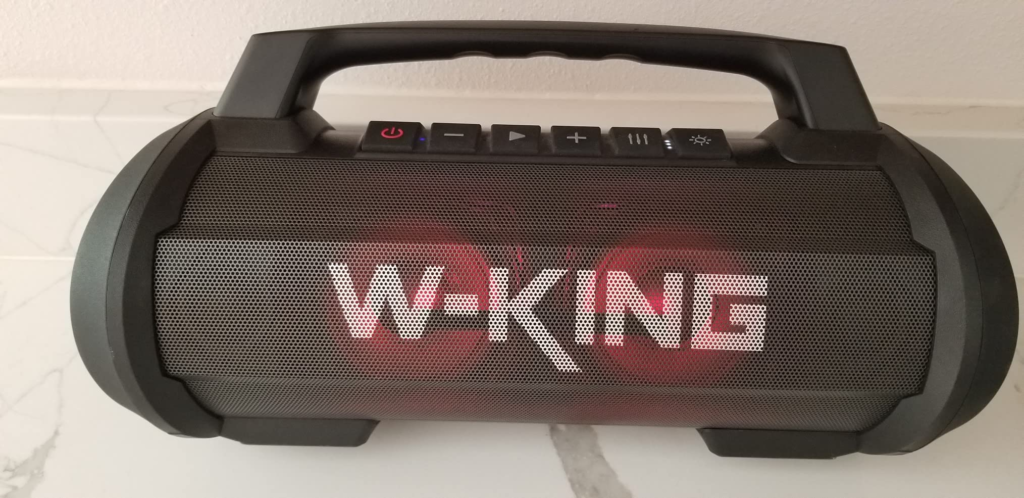
The W-KING D10 is 70W RMS. That’s the real number.
Speaker Wattage Decoded — What the Numbers Actually Measure
| Number on the Box | What It Measures | When It Applies |
|---|---|---|
| Peak Power (120W) | Momentary maximum burst | Brief transients, bass drops |
| RMS Power (70W) | Continuous real-world output | 99% of your listening time |
| PMPO | Marketing-constructed fiction | Essentially never |
| SPL (110 dB) | Maximum loudness at peak | Lab measurement; short duration |
Now, 70W RMS from a four-driver configuration with DSP processing and passive radiators is legitimately substantial for a portable speaker under $150. The WDSP 2.0 algorithm continuously adjusts frequency balance to push output toward the ceiling without allowing distortion — and it works. Multiple real users, across Reddit threads, deal forums, and independent review pages, confirm the same thing: no audible distortion at maximum volume. That’s a genuine achievement at this price. Most competitors in this class start clipping somewhere between 80 and 85% volume.
The D10 doesn’t. That gap matters more in a real-world outdoor setting than the wattage number does.
W-KING D10 Battery Life: Where the 42-Hour Claim Quietly Breaks
This is the section most reviews handle with optimistic vagueness. I won’t.
The 42-hour battery claim is technically accurate. And for the way most people reading this will actually use this speaker, it’s almost entirely the wrong number to focus on.
Why? Because 42 hours is the battery life at low volume — approximately 30% output or below. The battery life at actual party volume is a different planet.
W-KING D10 Estimated Battery Life by Volume Level
| Volume Setting | Estimated Playback | Typical Use Case |
|---|---|---|
| 20–30% (background / ambient) | 35–42 hours | Work from home, quiet kitchen |
| 40–50% (moderate listening) | 20–28 hours | Small gathering, indoor social |
| 60–70% (confidently loud) | 12–18 hours | Backyard party, patio, garden |
| 80–90% (very loud, outdoor) | 6–10 hours | Beach event, crowd, open field |
| 100% (maximum output) | 4–6 hours | Festival setting, max party mode |
A construction worker in a Canadian deal forum documented using the D10 daily at high volume on a job site for over two years — concrete dust, CPVC glue, impacts, the whole thing. His summary: battery still holds a full 8-hour shift; nothing broken. That kind of durability data is worth more than any battery test run over a weekend.
The threshold where the 42-hour promise breaks: when you’re expecting all-party coverage from that number. At loud outdoor volume, you get 6 to 10 hours. Which is still excellent — but it’s not 42, and the difference matters for how you plan an event.
W-KING D10 vs. JBL and Competitors: Why Most Buyers Misread This Too Early
The most common comparison I see in Bluetooth speaker forums: “Is this better than the JBL Xtreme 3?”
Why is this the wrong comparison to make?
Because the JBL Xtreme 3 costs over $300 and is engineered primarily for sound refinement and acoustic balance in a tightly tuned enclosure. The D10 is engineered for feature density, battery endurance, and output volume at under $150. These are different products solving different problems. Forcing them into the same comparison frame misleads buyers in both directions.
W-KING D10 vs. Key Competitors — Side-by-Side Breakdown
| Feature | W-KING D10 | JBL Xtreme 3 | Soundcore Boom 2 | Tribit StormBox Blast |
|---|---|---|---|---|
| Peak Power | 120W | 100W | ~80W | ~90W |
| RMS Power | ~70W | ~60W | ~40W | ~45W |
| Claimed Battery Life | 42 hours | 15 hours | 24 hours | 30 hours |
| Waterproof Rating | IPX6 | IP67 | IPX7 | IPX7 |
| 6.35mm Mic Input | ✅ | ❌ | ❌ | ❌ |
| TWS Stereo Pairing | ✅ (240W peak) | ✅ | ✅ | ✅ |
| USB Power Bank | ✅ | ✅ | ✅ | ❌ |
| RGB Lighting | ✅ 7-color | ❌ | ✅ | ✅ |
| Audiophile Sound Profile | ★★★☆☆ | ★★★★☆ | ★★★☆☆ | ★★★☆☆ |
| Feature Density per Dollar | ★★★★★ | ★★★☆☆ | ★★★★☆ | ★★★★☆ |
| Approximate Price | ~$100–150 | ~$329 | ~$130–170 | ~$130–170 |
Independent ranking by SpeakerRanking.com places the D10 at #49 out of 67 boombox-class speakers for pure sound quality — and that ranking comes with an honest note: “Upper bass boost, bass not that deep.” I’m not hiding that number. It’s accurate.
But pure sound quality rankings don’t factor in battery endurance, feature set, or price-to-capability ratio. When all four dimensions are on the table simultaneously, the calculation changes substantially.
W-KING D10 Ideal User: Who Is Actually Inside This Problem
I stopped recommending speakers generically a few years ago. Not because good speakers don’t exist — they do. But because the right speaker depends entirely on one question that most people skip past on their way to reading spec sheets.
Why are you actually buying a speaker?
The D10 is the right answer for someone whose honest answer to that question includes one of the following:
— I need to fill a backyard, park, or beach with sound that carries over wind and conversation and ambient noise.
— I want to run a full-day gathering without charging breaks, or at least without charging anxiety.
— I want karaoke capability without buying a separate machine.
— I work in construction, camping, or outdoor environments and need something that survives actual abuse.
— I have a budget under $150 and want the highest capability-per-dollar in this class.
— I plan to eventually pair two units for a wide, immersive stereo wall of sound.
W-KING D10 Buyer Fit Matrix
| Use Case | Fit | Notes |
|---|---|---|
| Backyard BBQ (20–60 people) | ✅ Ideal | Fills the space; no PA system needed |
| Beach or poolside all-day session | ✅ Ideal | IPX6 confirmed; 10–18h at party volume |
| Camping / road trips | ✅ Ideal | Shoulder strap; USB power bank for phone |
| Karaoke night (home or outdoor) | ✅ Ideal | 6.35mm input; clean vocal output; low latency |
| Daily rugged outdoor / job site use | ✅ Ideal | Confirmed durable over 2+ years real-world use |
| Small apartment at moderate volume | ⚠️ Possible | Minimum volume is still fairly loud |
| Audiophile reference home listening | ❌ Wrong fit | Upper-bass coloration; not frequency-neutral |
| True sub-bass / club-level low end | ❌ Wrong fit | Not deep enough below 60Hz |
| Late-night quiet personal listening | ❌ Wrong fit | Minimum output too loud for this context |
W-KING D10 Real Limitations: Where Wrong-Fit Begins
There are three specific situations where this speaker will leave you genuinely dissatisfied — not because it’s broken, but because the mismatch was there before the box was opened.
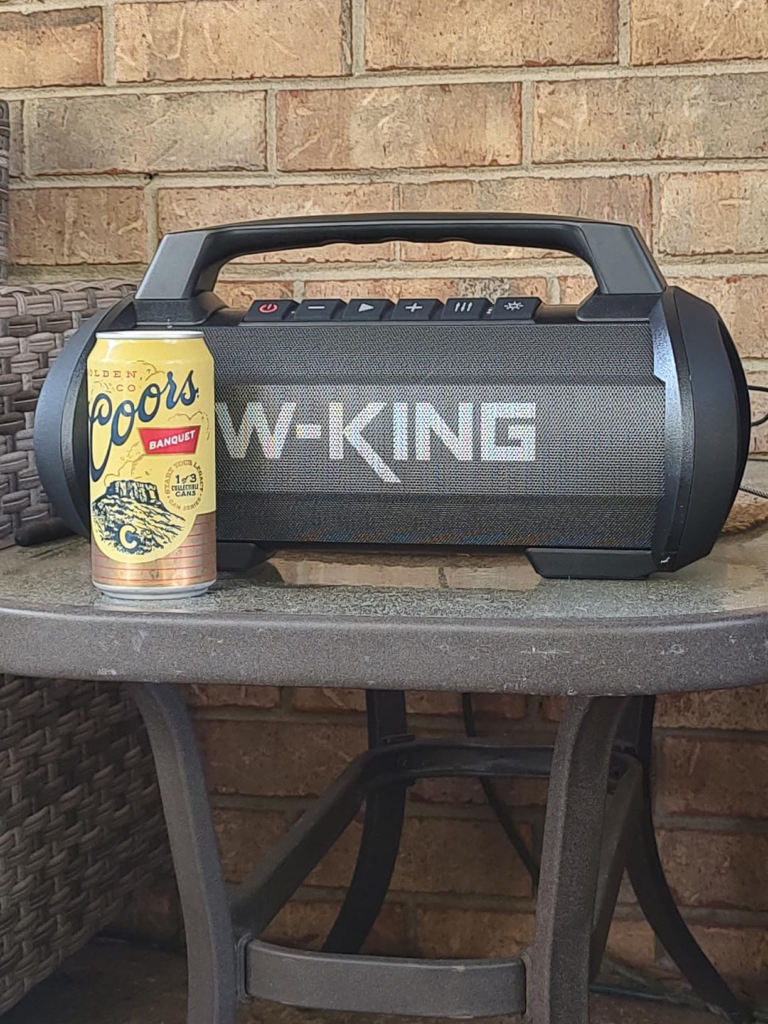
Situation one: You want it shelf-mounted and clean. The carry strap on the D10 is physically integrated into the housing design. Multiple users across independent forums report needing to cut the strap to remove it for clean shelf placement. For outdoor use, this is irrelevant. For permanent indoor mounting, it’s a real documented inconvenience.
Situation two: You need a quiet speaker. Even at its lowest volume setting, the D10 is not a whisper. Users who share apartment walls or want late-night personal listening consistently report that the minimum output is more than the situation calls for.
Situation three: You expect flat, reference-quality audio. The WDSP 2.0 tuning and passive radiator design push the D10 toward an upper-bass warmth profile. A trained ear hears the coloration. If you want to hear a recording exactly as it was mixed, this speaker will color it.
Common Pre-Purchase Misreadings That Consistently Lead to Regret
| Assumption | The Reality |
|---|---|
| “120W means it will shake walls” | 120W peak ≠ 70W RMS continuous; peak is momentary |
| “42 hours means all-party coverage” | 42h is at ~30% volume; party volume gives 4–10 hours |
| “More drivers equals deeper bass” | Driver count affects projection; tuning determines frequency depth |
| “IPX6 means I can submerge it” | IPX6 = rain/splash resistant, not waterproof underwater |
| “It’ll sound like JBL at this wattage” | Sound quality is about engineering and tuning, not watts alone |
| “The bass will go deep and low” | D10 bass is punchy and upper-range focused; sub-bass is limited |
W-KING D10 Karaoke and Outdoor Sound: The One Situation Where It Becomes Logical
After everything above — the bass profile, the RMS reality, the battery curve, the strap integration — there is one specific condition under which recommending the D10 stops being approximate and becomes obvious.
You need a loud, durable, all-day outdoor speaker with microphone capability and power bank function under $150 that won’t distort when pushed to its ceiling.
In that condition, the D10 earns its position. Not by default, and not because nothing else exists. Because at this price bracket, combining 70W RMS output, IPX6 protection, a 15,600mAh battery that charges your phone while it plays, a genuine 6.35mm karaoke mic input with low latency and clean vocal output, dual passive radiators, and 240W peak TWS pairing capacity is nearly impossible to replicate elsewhere at this cost.
The no-distortion-at-max-volume performance — confirmed repeatedly by real users in independent forums with no commercial motive — is the single edge that separates this speaker from most of its competition at this price point. Most portable speakers in this class start audibly clipping between 80 and 85% volume. The D10 doesn’t.
That’s the gap between a party where someone had to turn the speaker down because it started sounding bad, and a party that ran its full course.
W-KING D10 Honest Assessment: What It Solves, What It Reduces, and What It Still Leaves to You
What the W-KING D10 genuinely solves:
Insufficient volume outdoors. Battery anxiety during long events. The cost of a separate karaoke machine. The risk of a speaker dying from one rain shower or poolside splash.
What it reduces:
The stress of managing charging mid-event. The irritation of distortion creeping in as the volume goes up. The price gap between wanting serious portable output and being able to afford it.
What it still leaves on your side:
The decision of whether upper-bass warmth fits your music or whether you need true sub-bass depth. The management of the strap situation if indoor shelf mounting matters. The recalibration of “42 hours” into “6–10 hours at actual party volume.” The understanding that this is a feature-rich outdoor performance tool — not a home reference system.
W-KING D10 Honest Performance Scorecard
| Category | Score | What It Means in Practice |
|---|---|---|
| Volume Output for Price | 9 / 10 | Genuinely loud; 110dB is real at max |
| Upper-Bass Impact | 8 / 10 | Warm, punchy, physically present |
| Sub-Bass Depth | 5 / 10 | Limited below 60Hz; not its role |
| Clarity at Max Volume | 8 / 10 | No distortion — remarkable at this price |
| Battery Life (50–60% volume) | 9 / 10 | 15–20h real-world; excellent |
| Battery Life (80–100% volume) | 6 / 10 | 4–8h; the 42h claim is low-volume only |
| Build Quality and Durability | 8 / 10 | IPX6 confirmed; survives real outdoor use |
| Feature Density per Dollar | 10 / 10 | Karaoke + power bank + RGB + TWS at this price: unmatched |
| Neutral Reference Sound Quality | 5 / 10 | Upper-bass colored; unfair category for this speaker |
| Karaoke / Mic Input Performance | 8 / 10 | 6.35mm works well; low latency; clean vocal output |
The buyer who will feel regret: the audiophile who filtered by wattage numbers and expected reference-monitor neutrality.
The buyer who won’t: anyone who needed outdoor volume, full-day battery, waterproof construction, and mic capability without spending $300.
W-KING D10 Final Verdict — Decision Compressed
I’ve listened to speakers that measured better in a quiet room. I’ve also watched people try to push cheaper alternatives at a crowded outdoor event, hit their distortion ceiling at 75% volume, and spend the rest of the evening apologizing to the music.
The D10 doesn’t win a controlled listening test against a properly tuned monitor. It wins the practical test in a park, a backyard, a beach, or a job site where the metric isn’t neutrality — it’s endurance, volume, and whether the speaker is still clean when the evening peaks.
If the condition you’re actually dealing with is outdoor volume, long battery life, waterproof construction, microphone capability, and a price under $150 — this is where the decision stops being vague.
If your real need is neutral audio, quiet personal listening, or deep sub-bass extension, stop here and choose a different speaker. Buying this one won’t change what it is, and knowing that now costs nothing.
For anyone in the former situation, [current pricing and availability are listed on Amazon]
W-KING D10 FAQ — Questions Nobody Asks Before Buying
| Question | Answer |
|---|---|
| Is the 120W claim real or is it inflated marketing? | 120W is the peak power — the momentary maximum the amplifier can reach in a burst under lab conditions. The continuous real-world output is 70W RMS. Both numbers are technically accurate; one describes a moment, the other describes your listening session. 70W RMS from a four-driver setup with DSP optimization is genuinely substantial at this price — but it’s not 120W sustained. |
| Does the 42-hour battery actually hold up? | At 30–40% volume, close to it — yes. At outdoor party volume (80–100%), expect 4–8 hours. At moderate outdoor volume (60–70%), expect 10–18 hours. The claim is measured at low volume and isn’t technically false. It’s just not the number that describes how most buyers will actually use this speaker. |
| Is the D10 good for audiophiles? | No. The D10 has an upper-bass tuning profile that creates warmth and punch — not frequency-neutral reproduction. For critical listening, reference music analysis, or flat playback, this is the wrong tool. |
| Can it handle real rain, not just splashes? | IPX6 means it’s rated to withstand powerful water jets and sustained rain. Users in multiple forums have confirmed it performs normally after being caught in rainstorms. It is not rated for submersion — don’t drop it in a pool. |
| Does the karaoke function actually work? | Yes — and this is one of the D10’s genuine differentiators. The 6.35mm (quarter-inch) dynamic microphone input delivers clean vocal output with low latency. No noticeable delay between voice and speaker output. Note: the microphone may or may not be included depending on the specific SKU you’re purchasing; verify before buying. |
| Is the carry strap detachable? | Not easily. Multiple users across independent forums and deal communities report that the strap is physically integrated and requires cutting to remove cleanly. If indoor shelf mounting is your plan, account for this before you buy. |
| What does 110dB actually feel like? | 110dB is roughly the level of a jackhammer at moderate distance. In practice, the D10 at maximum volume in an open outdoor space carries clearly 100–150 feet in calm conditions. In a closed room, most people find it uncomfortably loud above 70% volume. |
| Can I pair two D10 units together? | Yes. Pairing two D10s via True Wireless Stereo creates a 240W peak (140W RMS) system with true left/right channel separation. The pairing is initiated by double-pressing the power button on both units. Multiple users confirm the process is straightforward and the connection holds stable. |
Transparency Note:
This analysis is built on aggregated real-world experience.
It extracts what repeatedly holds, what breaks, and what users uncover only after living with the system—then shapes it into a clear model you can use immediately.
Think of it as structured experience, refined and presented so you don’t have to learn it the hard way.
“A quick note: Don’t believe the star ratings, but trust personal experience. This article is a compilation of collected experiences”