Your Humidifier Is Running — So Why Does Your Bedroom Still Feel Like a Desert?
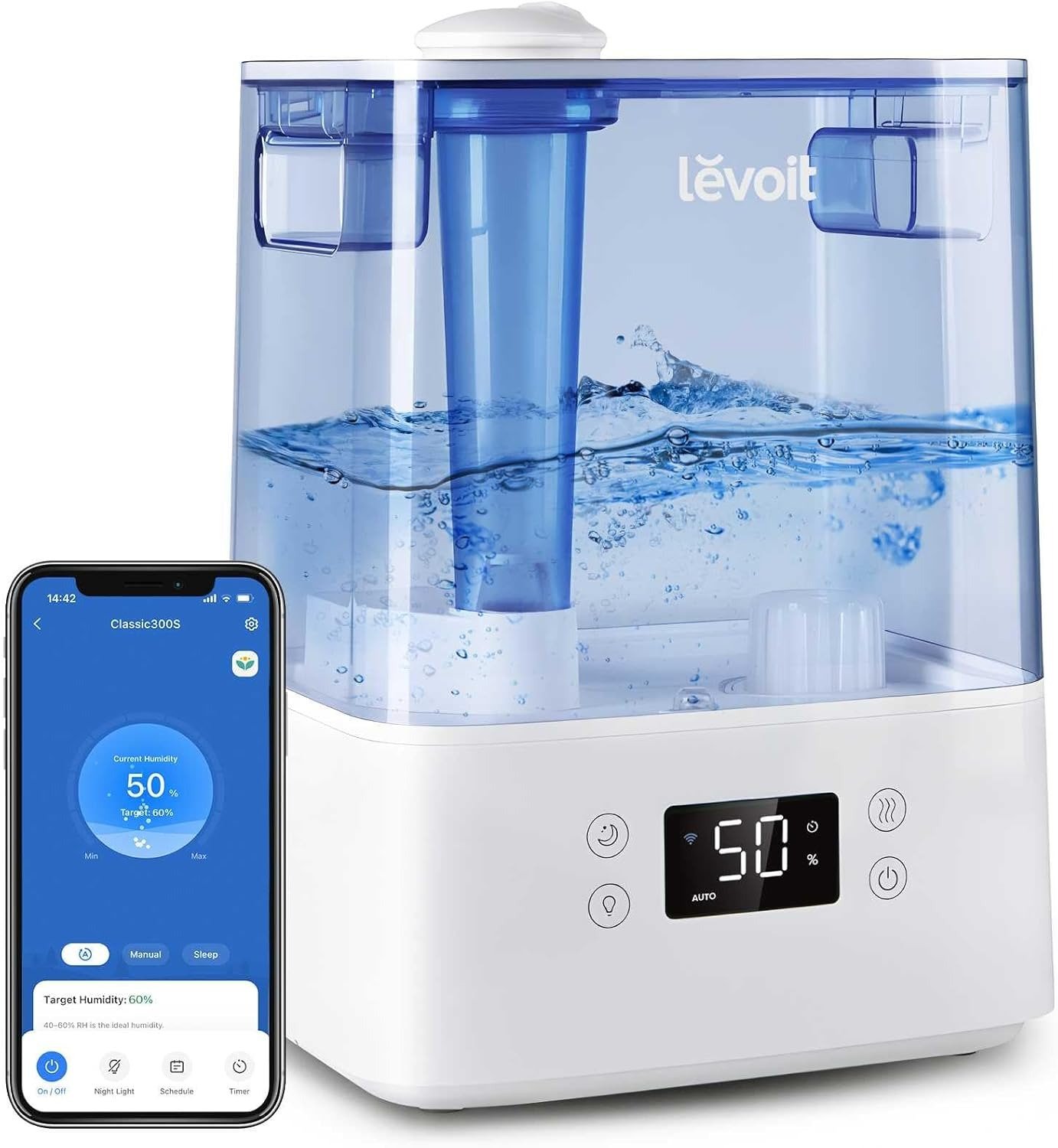
LEVOIT LV600S
The Result Looks Fine. The Problem Isn’t.
You set it up. You filled it. You turned it on. The mist is visible, the display shows a number, and it ran quietly through the night.
But you woke up with dry eyes. Or your throat still caught at 3 AM. Or the static electricity crackled again when you touched the doorknob. Or your skin still felt tight by morning.
The humidifier was operating correctly. That’s not the same as it being the right tool for the room.
Most ultrasonic humidifiers perform their basic function — they release moisture. What they don’t do is maintain it. There’s a gap between “unit is running” and “room humidity is held at the level that actually affects how you breathe, how your skin feels, and whether congestion builds.” That gap is the exact place where the experience collapses.
What You’re Actually Feeling but Not Naming
The frustration with cheap or undersized humidifiers rarely shows up as a single clear failure. It shows up as a collection of friction points that seem unrelated:
You wake up thirstier than you should be. Your lips are dry even though you drank water before bed. Your sinuses feel compressed in winter in a way that over-the-counter sprays only briefly relieve. Your wood furniture cracks slightly at the joints by February. The plants you positioned nearest to the unit are fine — everything six feet further away looks dull and brittle.
None of this reads as “humidifier problem” in the moment. It reads as “maybe I need to drink more water,” or “it’s just a dry winter,” or “this is getting old.”
It isn’t age. It isn’t just the season. It’s a room that is consistently running 5 to 15 percentage points below the humidity threshold where those symptoms stop.
The Hidden Mechanism Behind the Miss
Ultrasonic humidifiers work by vibrating water at high frequency to produce a fine mist. The physics is efficient and the noise output is low — often below 30 decibels. That’s genuinely useful.
The hidden problem is that output rate and sustained room coverage are two different measurements, and most buyers only read the first one.
A humidifier that produces 200 mL of mist per hour in a 300 sq ft bedroom will raise humidity fast — until it doesn’t. If there’s no real-time sensor reading the actual room humidity and adjusting mist output to compensate for air leaks, window cold spots, ceiling height, or the compounding dry pull of central heating, the unit runs at a fixed level and the room humidity drifts.
You get a spike, then a slow decline. By 3 AM, the room is back near where it started.
| Factor | Impact on Real Humidity |
|---|---|
| Central heating running overnight | Removes 8–12% RH continuously |
| Room larger than 400 sq ft | Output rate insufficient without sensor compensation |
| No humidity sensor | Unit runs at fixed rate regardless of actual RH |
| Tap water in ultrasonic units | Produces white mineral dust, coats surfaces |
| Tank under 4L | Requires refill mid-night or runs dry by 4 AM |
The unit isn’t broken. The architecture just doesn’t close the loop.
The Threshold Where the Outcome Quietly Breaks
There is a humidity range — roughly 40% to 60% RH — where the specific benefits people associate with humidifiers actually occur. Skin barrier integrity improves. Nasal mucosal membranes stay moist enough to filter effectively. The throat doesn’t scratch. Congestion reduces. Sleep quality measurably improves.
Below 40%: the benefits disappear almost entirely, even if the unit is running.
Above 60%: the room tips into a range where mold and dust mites become a real biological concern.
The threshold isn’t the humidifier running. The threshold is the room staying between those two numbers — automatically, continuously, without you checking it.
An ultrasonic unit with no sensor runs at whatever output level you set. It has no knowledge of where the room sits. In practice, it either overshoots and generates too much moisture (condensation on windows, mold risk) or undershoots and delivers the experience described above — running all night, solving nothing.
The sensor-guided auto mode is not a luxury feature. It’s the mechanism that closes the loop between “mist output” and “room condition.”
Why Most Buyers Misread This Too Early
The most common comparison mistake is comparing tank size to tank size, or mist output rate to output rate, between different models.
Those numbers describe capacity, not behavior.
A 6L tank that runs 60 hours on low is irrelevant if “low” doesn’t actually maintain the room humidity. A high mist output number is irrelevant if the unit runs at that rate regardless of whether the room is at 35% or 58% RH.
The second most common mistake is reading “large room coverage” as a flat guarantee. Coverage ratings in humidifier specs assume an idealized environment — low ceiling, minimal air exchange, no central heating. In a real bedroom with a forced-air heating system running in winter, that coverage number can compress by 30–40%.
| What the Spec Says | What It Actually Means |
|---|---|
| “Up to 753 sq ft coverage” | In ideal static conditions, not with heating running |
| “60-hour runtime” | On the lowest mist setting, not on auto mode |
| “Smart app control” | Requires Wi-Fi setup and VeSync account |
| “Whisper quiet, under 30dB” | On cool mist mode; warm mist setting runs slightly louder |
| “Easy top fill” | Tank is accessible from above; base unit still needs detailed weekly cleaning |
The spec sheet tells you what the unit can do in the best case. The question is what it does in the room you actually live in.
Who Is Actually Inside This Problem
This situation specifically applies to someone who:
Sleeps in a medium-to-large bedroom (300–750 sq ft) that uses forced-air heating or central cooling, creating dry-air conditions for 4–7 months per year.
Has experienced recurring morning congestion, dry throat, or cracked lips in winter that aren’t explained by illness.
Has owned a basic humidifier before and found it worked for a week, then seemed to stop making a difference — even though nothing was wrong with the unit.
Has plants near a window that show stress in dry months despite regular watering.
Has a partner or child in the same room whose sleep is disrupted by dryness, but who doesn’t want the unit running at audible noise levels.
Wants to set a target and have the room stay near it without checking every night.
This is not a situation for someone with a very small room (under 200 sq ft), someone who only experiences mild seasonal dryness, or someone who uses tap water and isn’t willing to switch to distilled or filtered water — that last point will be addressed directly.
Where Wrong-Fit Begins
There are real boundaries to where this product belongs, and ignoring them creates the disappointment described in the opening section.
The white dust issue is not optional. All ultrasonic humidifiers — including the LV600S — disperse mineral particles from tap water in the form of fine white dust that settles on furniture, electronics, and floors. This is not a defect. It is the physics of ultrasonic misting. The fix is simple: use distilled or purified water. If you are not willing to do this, an ultrasonic humidifier of any brand will frustrate you within two weeks. An evaporative model would be the right fit instead.
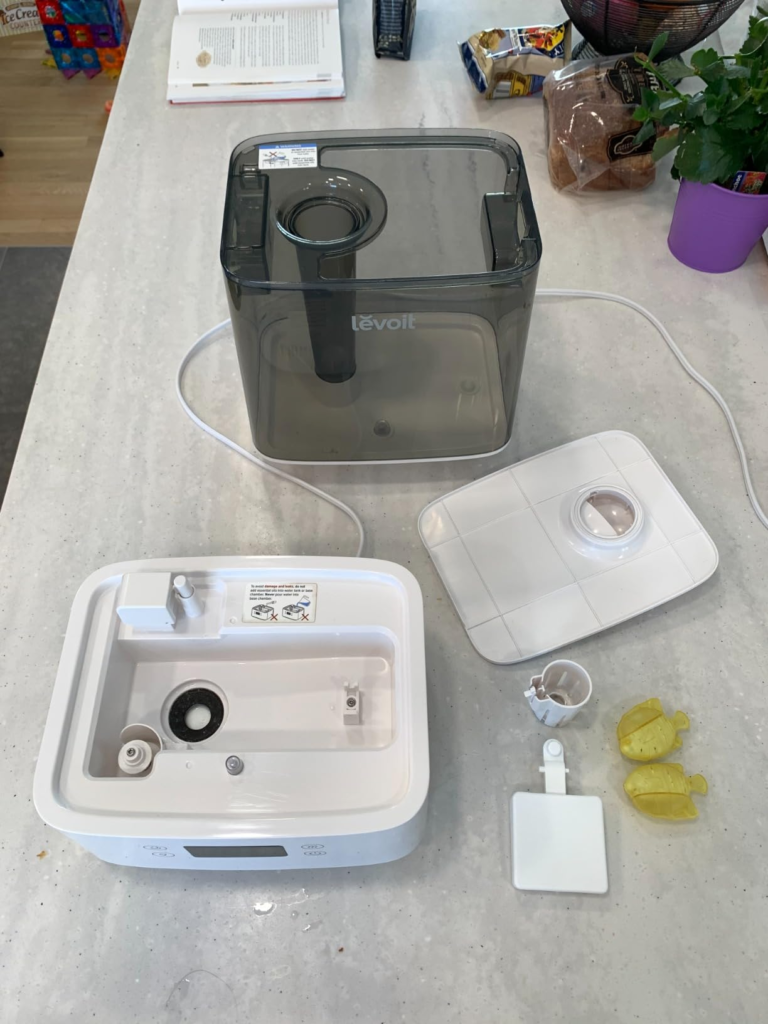
The cleaning commitment is real. The base unit has components — the transducer, the aroma tray, the inner walls — that accumulate mineral scale. Weekly cleaning with a white vinegar solution is necessary to maintain output and prevent bacterial growth. Users who bought the unit and cleaned it irregularly reported declining performance and odor. The top-fill design makes refilling simple. Cleaning the base is more involved, and that distinction matters for long-term satisfaction.
Room size has a hard ceiling. The 753 sq ft coverage rating applies to cool mist mode in favorable conditions. In a large open-plan living area with high ceilings and a running HVAC system, the unit will struggle to maintain target humidity without running at maximum output — which shortens runtime and increases noise. For spaces larger than 600 sq ft with active HVAC, the LV600S OasisMist 1000S (10L floor model) is the appropriate step up.
| Who Fits | Who Doesn’t |
|---|---|
| Bedroom 300–600 sq ft, forced-air heat | Open-plan space over 700 sq ft with high ceilings |
| Willing to use distilled/purified water | Uses tap water exclusively and won’t change |
| Wants auto humidity maintenance | Wants manual-only control without apps |
| Will clean weekly | Prefers low-maintenance evaporative model |
| Tolerates 2–3 minute setup via VeSync app | Avoids all smart home apps entirely |
The One Situation Where This Product Becomes Logical
The LEVOIT LV600S Smart Hybrid Ultrasonic Humidifier earns its position in one specific scenario: a large bedroom or living space — roughly 300 to 750 square feet — in a climate that runs forced-air heating or cooling for extended periods, where the occupant wants the room to maintain a specific humidity range overnight and through the day without manual management.
The combination that makes it work as a system rather than just a device:
A 6-liter top-fill tank that runs up to 50 hours on low cool mist — meaning no mid-night refill in typical use.
A built-in humidity sensor feeding the VeSync app’s Auto Mode, which adjusts mist output in real time to stay within the 40–60% RH window rather than running at a fixed rate regardless of current conditions.
Warm and cool mist options, giving it two distinct humidification mechanisms: the cool mist for quiet overnight use (under 30 dB), and the warm mist for faster room correction in severely dry conditions.
Sleep mode that drops to the lowest output level and disables all display lights — specifically relevant for light sleepers and parents with infants in the room.
Independent testing by TechGearLab measured the LV600S bringing a test room from 40% to nearly 65% humidity in under one hour — the highest performance they recorded across 14 models tested. That output power, controlled by a sensor that prevents overshooting, is the technical reason the real-world experience diverges from cheaper alternatives.
| Feature | Real-World Function |
|---|---|
| 6L top-fill tank | No mid-night refills; fill in place without lifting |
| Built-in humidity sensor + Auto Mode | Holds 40–60% RH without manual checks |
| Warm + cool mist hybrid | Fast recovery in severely dry air; quiet overnight |
| Sleep mode (display off + low output) | No light or noise interruption during sleep |
| VeSync app scheduling | Pre-condition room before sleep; plant care schedules |
| 360° rotating nozzle | Directs mist toward bed, not wall |
What It Solves, What It Reduces, and What It Still Leaves to You
What it solves:
Morning dry throat and nasal congestion caused by sustained low bedroom humidity. Static electricity. The cyclical problem of a unit that spikes humidity briefly and then lets the room return to its prior state.
What it reduces without eliminating:
Dry skin symptoms — improvement is real and reported consistently, but humidity management is one input among several (skincare routine, hydration, and ambient temperature all remain factors). Plant desiccation in dry months — the app includes plant scheduling, and placing the unit with the nozzle angled appropriately helps; it won’t substitute for a purpose-built plant humidifier at very close range.
What it still leaves to you:
Weekly cleaning of the base. Sourcing distilled or purified water — this is non-negotiable for sustained performance without white dust. Initial VeSync app setup (roughly 5–10 minutes). Correct placement: the unit should sit on a flat surface at least 3 feet from walls and beds to allow the sensor to read ambient room humidity rather than the mist plume.
| Outcome | Honest Assessment |
|---|---|
| Dry throat by morning | Solves reliably in 300–600 sq ft bedrooms |
| Morning congestion | Reduces significantly when room stays above 40% RH |
| Static electricity | Largely eliminated at 45–55% RH |
| White dust on furniture | Requires distilled water — not solved by the unit itself |
| Overnight refill interruption | Eliminated with 6L tank at normal output levels |
| Set-and-forget operation | Yes, via Auto Mode — the central functional advantage |
Final Compression
The gap between “humidifier is running” and “room humidity is maintained at the level that changes how you feel” is real, and it’s the gap most purchases miss.
If your bedroom runs between 300 and 600 square feet, your heating or cooling system runs for extended stretches, and you want room humidity to stay inside a specific range automatically without checking it each morning — that is the exact condition the LEVOIT LV600S was built for.
The conditions of right fit are narrow and honest: distilled water, weekly cleaning, and a room within its actual (not claimed) operating range.
If those conditions are yours, the decision stops being vague the moment you verify them.
Frequently Asked Questions
| Question | Answer |
|---|---|
| Does the LEVOIT LV600S require distilled water? | No — but ultrasonic humidifiers including the LV600S will disperse fine white mineral dust if you use tap water with high mineral content. Levoit officially recommends distilled or purified water. This is not a defect; it is how ultrasonic technology works. Evaporative models are the alternative if distilled water sourcing is a barrier. |
| How long does the 6L tank actually last? | On the lowest cool mist setting, up to 50 hours. On warm mist at high output, considerably less — realistically 15–20 hours. In Auto Mode maintaining 45–50% RH in a typical bedroom, most users refill every 2–3 days. |
| Is the VeSync app required to use the LV600S? | No. The unit has onboard touch controls and a display that work independently. The app unlocks Auto Mode with real-time humidity feedback, scheduling, and voice control via Alexa or Google Assistant. The central benefit of this product — sustained humidity maintenance — requires Auto Mode, which requires the app. |
| How loud is it during sleep? | On cool mist in Sleep Mode: under 30 dB, comparable to a very quiet library or a soft whisper. On warm mist: slightly louder, similar to a low furnace hum. The display turns off completely in Sleep Mode. |
| How difficult is it to clean? | Refilling is simple — top-fill with a wide opening, no tank removal needed. Weekly cleaning is more involved: the base unit has a transducer, aroma tray, and inner walls that require a white vinegar soak and rinse. Multiple community users noted that inconsistent cleaning leads to mineral buildup that reduces mist output over time. Budget 10–15 minutes weekly. |
| Is this the same unit as the Wirecutter pick? | The LV600S is the same base model that has been recommended by multiple major review outlets (TechGearLab, Consumer Reports) as a top performer for large room coverage. It is functionally equivalent to the Costco hybrid ultrasonic model that has been the Wirecutter’s recommended large-room pick. |
| Who should not buy this? | Anyone using it in a space over 700 sq ft with active HVAC, anyone unwilling to use purified water, anyone who won’t commit to weekly cleaning, and anyone who wants an entirely app-free device. For small rooms under 250 sq ft, the LV600S is more machine than needed and the Classic 160 or 300S are more appropriate. |
Transparency Note:
This analysis is built on aggregated real-world experience.
It extracts what repeatedly holds, what breaks, and what users uncover only after living with the system—then shapes it into a clear model you can use immediately.
Think of it as structured experience, refined and presented so you don’t have to learn it the hard way.
“A quick note: Don’t believe the star ratings, but trust personal experience. This article is a compilation of collected experiences”