Marantz Cinema 70s Review: The Beautiful Receiver That Stops Being Smart the Moment Your Room Gets Greedy
MARANTZ CINEMA 70S
The expensive mistake in home theater is rarely buying a bad receiver. It is buying a beautiful one for the wrong room.
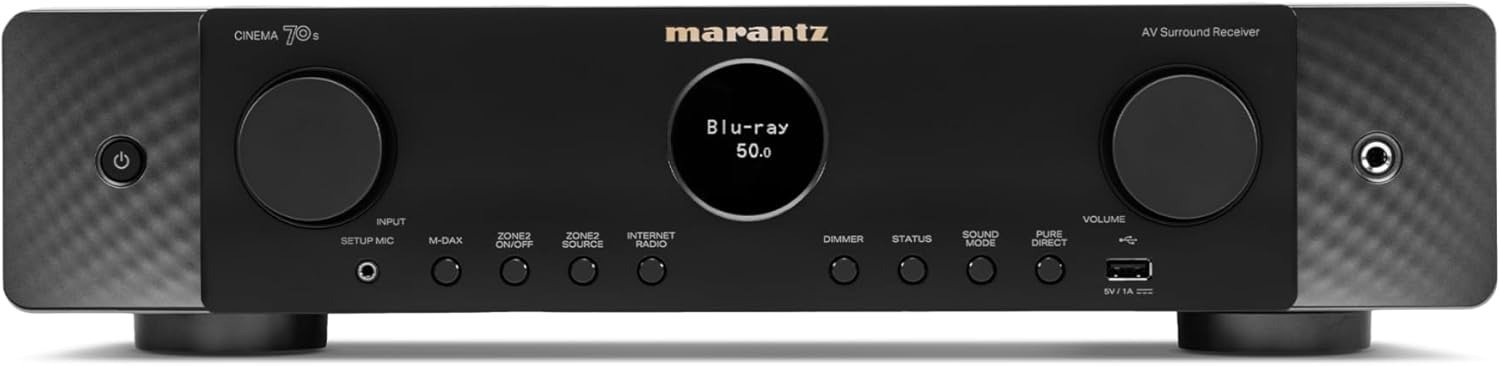
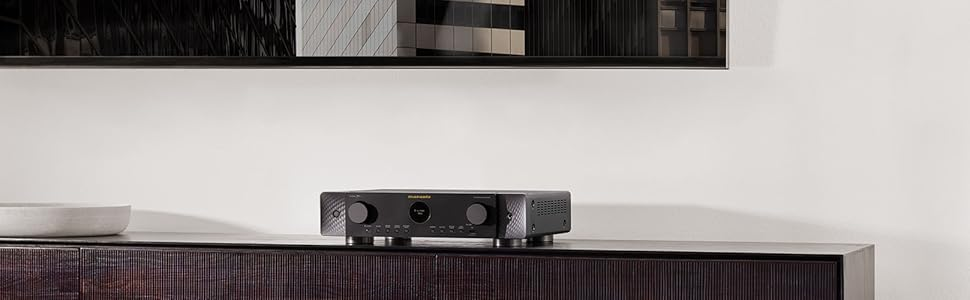
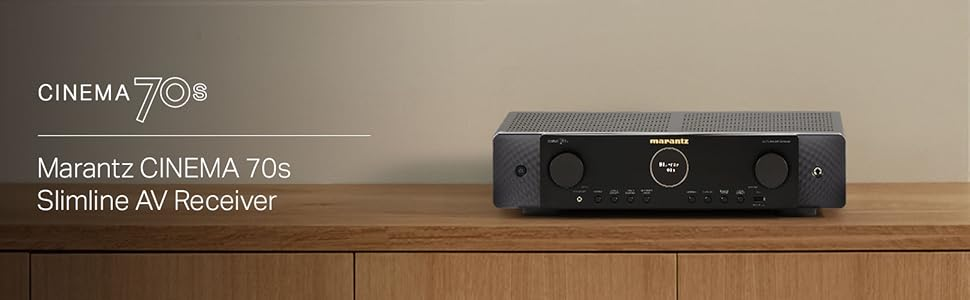
I can see exactly why the Marantz Cinema 70s pulls people in. The chassis is slim. The face is calm. The center display glows like a piece of restrained industrial jewelry. You can slide it into a console where a full-height AVR would suffocate the furniture and dominate the room. At 17.4 x 15.1 x 4.3 inches without antennas and 19.2 pounds, it is physically easier to place than the usual home-theater brick, while still giving you 7 powered channels, 6 HDMI inputs, 3 of them 8K-capable, eARC, 7.2 pre-outs, HEOS, phono, and Audyssey MultEQ. That combination is the reason this unit keeps showing up in real buyer conversations.
But that is also where people misread it.
They think slim is the story. It isn’t.
The Result Looks Fine. The Problem Isn’t.
Most receivers fail loudly. They run hot, look ugly, fight your cabinet, or turn the room into a cable landfill. The Cinema 70s fails more quietly than that.
At first, it looks like a dream solution. You get Dolby Atmos, DTS:X, 4K/120, 8K/60, VRR, ALLM, QFT, streaming, Bluetooth headphone retransmit, and a setup flow that even owners regularly describe as easy and straightforward. The feature sheet reads like a larger AVR that went on a strict diet. Reviewers and customers consistently praise the sound quality, the appearance, the clean setup process, and the fact that it does not feel compromised in day-one use.
Then real life starts.
A louder movie night. A room with more air to move. Front speakers that wake up only when current gets serious. A center channel that sounds fine at moderate volume, then starts losing chest, grip, and conversational density when the soundtrack thickens. That is the moment this receiver stops being a design purchase and becomes a power question.
Not immediately. Quietly.
What You’re Actually Feeling but Not Naming
Most people do not say, “My AVR has crossed a power threshold.”
They say something softer.
They say dialogue feels a little thinner than expected. They say movies sound good, but not quite heavy. They say it is clean, musical, elegant — but they hesitate before calling it authoritative. They say the room feels cinematic until action scenes start stacking explosions, score, and center-channel stress on top of each other.
That hesitation matters.
Because the Cinema 70s is not a weak product in the lazy sense. It is a selective product. Its official power rating is 50W per channel into 8 ohms with 2 channels driven, 70W into 6 ohms, and it uses a compact Class A/B amp stage inside a slim chassis built around placement convenience as much as performance. Reviewers praised its cohesive surround bubble and bass integration, but also noted that it lacks some of the punch, midrange precision, and outright authority of Marantz’s larger models. Customers, meanwhile, tend to describe the sound as warm, detailed, easy to live with, and visually luxurious — while also flagging that bigger rooms or more demanding speakers may push them toward a stronger amp or a step-up model.
That is the feeling you are trying to name:
not failure, not brilliance, but graceful limitation.
The Hidden Mechanism Behind the Miss
The hidden variable is not the logo. Not the codec list. Not even the room correction.
It is the collision between three things:
| Variable | What looks good on paper | What changes in the room |
|---|---|---|
| Chassis size | Slimline elegance, easier placement | Less physical space for the kind of power supply headroom people subconsciously expect from a larger AVR |
| Speaker demand | “Compatible” is technically true | Sensitivity, impedance dips, and room size decide whether 50W behaves calm or cramped |
| Listening behavior | Moderate listening seems effortless | Loud, dense, multi-channel scenes reveal whether the receiver still has composure left |
That is why this product gets such a split reaction.
In a sane room, with sane volume, with speakers that do not behave like hungry animals, the Cinema 70s can sound bigger than it looks. AVForums praised its soundstage cohesion and bass integration, and Tom’s Guide called it musical, dynamic, and feature-rich rather than a stripped-down compromise. Owners echo that pattern: warm sound, strong usability, handsome rack presence, enough power for many setups.
In the wrong setup, the same slimness that makes it desirable becomes the reason it is merely adequate.
And adequate is expensive at this price.
The Threshold Where the Outcome Quietly Breaks
This is the threshold I would name for the Cinema 70s:
The Graceful Room Threshold.
Below it, the receiver feels refined, tidy, and smarter than bulkier rivals.
Above it, you start paying premium money for a form factor that is no longer giving you enough acoustic control in return.
Here is the practical version.
| Condition | What usually happens |
|---|---|
| Small to medium room | The Cinema 70s makes immediate sense and often feels more premium than its size suggests |
| Moderate listening levels | Its warmth, imaging cohesion, and ease of setup do most of the emotional work |
| Efficient or easy-to-drive speakers | The amp section stays inside its comfort zone longer |
| Style-sensitive living room | Its slim profile becomes a real quality-of-life advantage, not decoration |
| Large room + loud playback | The receiver begins to sound less convincing as authority becomes more important than finesse |
| Demanding front stage | The case for stepping up to a stronger AVR or adding external amplification gets much sharper |
That threshold is not theory. It is visible in both the product’s design logic and in the surrounding review pattern. Marantz itself positions the Cinema 70s as a slim 7.2 model with 50W per channel, while the Cinema 60 steps up to 100W and the same 7.2 channel count in a full-size chassis. Best Buy’s own Q&A explicitly nudges larger-room buyers toward the Cinema 60 or external amplification, and AVForums highlights the Cinema 70s’ strong cohesion while still acknowledging its lower punch and authority compared with bigger Marantz siblings.
That is the line.
Not “good or bad.” Not “worth it or not.” Inside threshold or outside threshold.
Why Most Buyers Misread This Too Early
Because buyers still judge AVRs the lazy way.
They compare badges, watt numbers, HDMI counts, and buzzwords. Then they imagine the sound.
That method fails here.
The Cinema 70s is built to seduce three instincts at once:
- the desire for clean furniture integration
- the desire for future-ready video features
- the desire for “real hi-fi flavor” without a full-size black monolith
That trio is powerful. It lowers suspicion. It makes the buyer feel clever before the system is even installed.
And to be fair, the receiver earns part of that feeling. It has 7.2 pre-outs, dual sub outputs, phono input, Zone 2 support, streaming via HEOS, AirPlay 2, Bluetooth retransmit, and voice assistant compatibility. It is unusually complete for a slim AVR. Even the included details — the setup mic, labels, guided setup flow, backlit remote in reviews, practical connectivity — signal that someone thought about ownership, not just shelf appeal.
But buyers misread one deeper thing:
They assume convenience and elegance are bonuses on top of full receiver performance.
With the Cinema 70s, they are part of the trade.
Who Is Actually Inside This Problem
I would put the real-fit buyer in a very narrow box.
| Buyer type | Fit level | Why |
|---|---|---|
| Living-room theater buyer who refuses a tall AVR | Strong fit | The slim chassis solves a real placement problem without collapsing the feature set |
| Small/medium-room user building 5.1.2 or tidy 7.1 | Strong fit | This is exactly where its channel count and refinement make sense |
| Mixed-use movie + music listener who values aesthetics | Strong fit | The Marantz sound profile and industrial design matter more here than raw brute force |
| User planning eventual external amplification | Strong fit | The 7.2 pre-outs preserve an upgrade path the slim chassis cannot fully supply alone |
| Large-room, high-volume, hard-to-drive speaker owner | Weak fit | This is where the receiver’s elegant logic starts to fray |
| Buyer chasing “one-box endgame” power | Weak fit | The form factor becomes the limitation, not the solution |
| Bargain-minded buyer focused only on power-per-dollar | Wrong fit | You are paying for packaging discipline, design restraint, and fit quality — not maximum muscle |
That last row matters more than people admit.
Some products are overpriced because they are inflated. This one can feel overpriced because it is specialized. Those are not the same thing.
Where Wrong-Fit Begins
Wrong-fit starts the second you ask this receiver to do the job of a larger machine while keeping the emotional comfort of a slimmer one.
That usually looks like one of these situations:
- you have a large open room and like to feel movie crescendos physically, not politely
- your speakers dip into harder electrical territory or simply come alive when fed real current
- you want headroom, not just functionality
- you think “it has pre-outs” means “the internal amplification does not matter”
That last idea is especially dangerous.
Yes, the Cinema 70s has full 7.2 preamp outputs and can become a cleaner long-term bridge if you plan to add power amps later. That is a genuine strength. But if you already know you need more control, slam, and scale from day one, paying for a slim AVR only to immediately work around its slimness is often a sign that you are buying the wrong starting point.
There is a psychological trap here.
The receiver is so civilized that it hides its own boundary. It does not scream “I am the wrong choice.” It whispers it after the return window.
The One Situation Where This Product Becomes Logical
Here is the one situation where the Marantz Cinema 70s stops being a temptation and becomes a clean decision:
You need a real 7-channel home-theater receiver with modern HDMI and streaming features, but your room, furniture, or design tolerance makes a full-size AVR a genuine problem.
That is it.
Not because it is the most powerful.
Not because it is the cheapest.
Not because it wins every spec comparison.
Because in that specific condition, it resolves a problem other receivers often ignore.
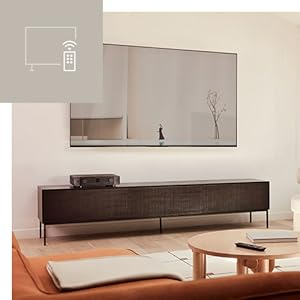
And when it lands in the right place, it does something people underestimate: it changes the room without visually hijacking it. The slim front panel sits low, not looming. The circular Marantz porthole display gives the setup a more curated, less utilitarian center. In a walnut console, a dark media cabinet, or a clean floating shelf, it can make the entire front wall feel less like electronics storage and more like a composed cinema corner. In silver-gold especially, it behaves more like an intentional interior object than a black appliance. Reviewers repeatedly note the chassis styling as a differentiator, and real buyers keep mentioning the size and design for a reason.
That is not fluff. It changes ownership.
Because gear you resent visually gets hidden, cramped, overheated, and compromised. Gear that fits the room gets used properly.
What It Solves, What It Reduces, and What It Still Leaves to You
Here is the clean version.
| What it solves | What it reduces | What it still leaves to you |
|---|---|---|
| Full-size AVR placement headaches | Setup anxiety, thanks to guided calibration and approachable controls | Matching it to sensible speakers and room size |
| Living-room resistance to ugly equipment | Visual clutter and “big black box” fatigue | Knowing whether your listening habits exceed its comfort zone |
| Need for modern HDMI and streaming in a compact receiver | The usual compromise of choosing style over features | Deciding if you need more power now or later |
| Desire for warmer, more polished sound than many mass-market slim units | Thin, clinical presentation | Accepting that elegance is not the same as unlimited headroom |
| Upgrade flexibility via 7.2 pre-outs | Total dead-end ownership | Paying extra if external amplification becomes necessary |
And that is why I would not pitch this as a universal recommendation.
I would call it a receiver for people who are tired of pretending the room does not matter.
Final Compression
The Marantz Cinema 70s is not the receiver you buy when you want to dominate a large room.
It is the receiver you buy when a large receiver would quietly ruin the room you actually live in.
Its real strengths are easy to see: 7.2 channels, slimline chassis, 6 HDMI inputs with 3 supporting 8K, eARC, Dolby Atmos, DTS:X, HEOS, phono, 7.2 pre-outs, straightforward setup, and a sound that reviewers and owners repeatedly describe as warm, cohesive, detailed, and more premium than its footprint suggests. Its real weakness is just as clear: 50W per channel in a slim package means there is a point where refinement stops being enough and authority starts costing extra.
So this is the decision compressed to one line:
If your real problem is space, visual intrusion, and living-room compatibility — not raw theater muscle — the Marantz Cinema 70s is not a compromise purchase. It is the logical one.
Transparency Note:
This analysis is built on aggregated real-world experience.
It extracts what repeatedly holds, what breaks, and what users uncover only after living with the system—then shapes it into a clear model you can use immediately.
Think of it as structured experience, refined and presented so you don’t have to learn it the hard way.
“A quick note: Don’t believe the star ratings, but trust personal experience. This article is a compilation of collected experiences”