Jura E8: WHEN CONVENIENCE STOPS FEELING CHEAP AND STARTS REPLACING FRICTION
The Result Looks Fine. The Problem Isn’t.
The first mistake people make with a machine like the Jura E8 is almost innocent: they look at the cup, see crema, smell coffee, hear the grinder, and assume the decision is already settled. It isn’t. The real question lives one layer deeper. Not whether the machine can make coffee, but whether it can keep your morning from turning into a small daily negotiation with cleanup, dialing-in, milk mess, wasted motion, and that slow irritation nobody names until they are already tired of their “dream setup.”
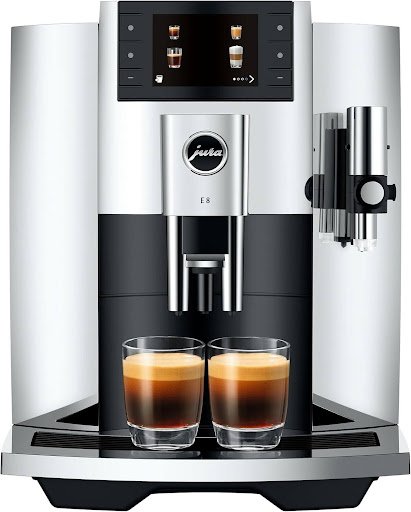
That is where the Jura E8 gets interesting. On paper, it gives you 17 drinks, a P.A.G.2 grinder, a variable brew unit working across 5 to 16 grams, a thermoblock, a 15-bar pump, a 64-ounce water tank, and one-touch milk cleaning. None of that is the story by itself. The story is what happens when those pieces turn a fussy coffee habit into something smooth enough that you stop arguing with it before breakfast.
What You’re Actually Feeling but Not Naming
You may think you want “better espresso.” Most people don’t. Not really. What they want is relief from three quiet annoyances:
| What it looks like on the surface | What it actually feels like |
|---|---|
| “I want café-style drinks at home” | I’m tired of paying for convenience outside because my home routine is clumsy |
| “I want more drink options” | I don’t want to learn barista mechanics at 6:40 a.m. |
| “I want a premium machine” | I want one button to do the boring parts without making the result feel cheap |
That is the nerve this machine presses on. The E8 is not built for people who enjoy tamping, weighing, purging, tweaking, and treating espresso as a craft ritual. It is built for the person who wants the house quiet, the cup full, the milk drink done, and the kitchen still looking civilized ten minutes later. Tom’s Guide came away with almost the same conclusion from the opposite angle: the E8 is for the time-poor rather than for home baristas chasing ritual. Owner reviews echo that same theme in blunter language: easy to use, makes daily coffee simple, expensive but worth it for the right household.
The Hidden Mechanism Behind the Miss
The hidden variable is not flavor alone. It is repeatability under low effort. That is the part buyers often miss because product pages teach them to compare visible features, not invisible friction.
Jura’s hardware stack is built around that invisible layer. The P.A.G.2 grinder is designed to rest between preparations, which Jura says is gentler on the grinder over time. The eighth-generation 3D brewing unit is there to maintain extraction conditions with less user intervention. P.E.P. pulses water through the puck in short bursts for short coffees, and independent reviewers have repeatedly pointed to that system as one reason the E8 produces fuller, more aromatic espresso than many superautomatics in its class. Coffeeness also highlights the unusually fine control here: 10 coffee-strength levels, 7 grind settings, and water adjustment from roughly 15 to 80 ml.
That matters because mediocre superautomatics usually fail in a dull, frustrating way. They do not collapse dramatically. They simply flatten the cup. Thin texture. Muddy sweetness. Too much foam where you wanted body. Not enough control when your beans change. A machine like the E8 earns its keep when it keeps those compromises from becoming the permanent taste of your mornings.
The Threshold Where the Outcome Quietly Breaks
Here is the threshold that decides this product: the point where coffee quality matters to you, but ritual no longer does. That is the line. Not luxury. Not status. Not countertop beauty. That threshold.
Below that line, the E8 is overkill. A cheaper machine, even one with a rougher interface or less polished milk performance, will still feel acceptable because your tolerance for friction is high. You do not mind the little delays. You do not mind the cleanup drag. You do not mind the occasional “good enough” cup.
Above that line, the arithmetic changes. Now you care about three things at once:
- fast repetition
- low cleanup friction
- cups that stay comfortably above “office coffee with a chrome costume”
That is exactly where the E8 starts making sense. The 64-ounce tank, 16-serving grounds container, one-touch milk cleaning, programmable strength, and one-touch drink menu are not luxuries in that context. They are compression tools. They remove little pieces of resistance until the machine stops feeling like an appliance and starts acting like infrastructure.
Why Most Buyers Misread This Too Early
They compare too soon. That is the trap. They line up drinks lists, screen types, price tags, maybe a few shiny spec bullets, and call it research. But with a superautomatic, early comparison often hides the very thing that determines long-term satisfaction: how the machine behaves on the fiftieth tired morning, not the first excited weekend.
That is why the E8 draws both admiration and resistance. Reviewers praise its speed, consistency, build quality, and ease of use. They also push back hard on the U.S. price, the extra-cost accessories, and the maintenance realities around the milk system and water use. Tom’s Guide liked the coffee and the machine’s daily usability, then still argued that the U.S. pricing is difficult to justify against less expensive rivals. Amazon reviews show the same split: many owners love the ease and the cup quality, while a smaller but real minority complain about breakdowns or the sting of paying this much and still facing service friction.
That split is not confusion. It is fit. The machine is not failing to please everyone. It is revealing who was never inside the right buying condition in the first place.
Who Is Actually Inside This Problem
I would put the real-fit buyer into one of three rooms.
The first room is the household that drinks coffee every day and wants milk drinks without turning the counter into a damp workbench. The second is the buyer who has already grown tired of capsule systems, entry-level bean-to-cup machines, or manual espresso setups that looked romantic for two weeks and then started collecting guilt. The third is the person who values consistency more than craft performance theater.
If that is you, the E8’s feature set aligns cleanly:
| Fit signal | Why the E8 matches |
|---|---|
| You want milk drinks often | One-touch milk drink menu and automatic milk-system cleaning reduce daily friction |
| You want better control without manual espresso work | 10 strength levels, 7 grind settings, adjustable brew quantities and temperatures give enough control without turning you into a technician |
| You make several drinks a day | 64 oz tank and 16-serving grounds bin reduce constant refilling and emptying, even if the machine still uses plenty of rinse water |
| You care about repeatability more than ritual | Reviewers consistently describe the E8 as fast, easy, and reliably competent across repeated use |
Where Wrong-Fit Begins
Wrong-fit starts earlier than most people think. It begins the moment you say, “For this money, it should do everything.” That sentence sounds rational. It usually isn’t.
The E8 is not the right machine if you want true manual control, removable-brew-group tinkering, café-level espresso experimentation, or the absolute best value-per-dollar in the U.S. It is also a weak fit if accessory nickel-and-diming infuriates you, because reviewers have specifically called out the extra-cost milk carafe and connectivity add-ons, while owners on forums often warn that Jura ownership in the U.S. can mean higher repair costs once something goes wrong. And if you are deeply picky about milk texture nuance, there are owner reports saying the E8’s milk output can run foamier than expected for certain drinks.
There is also the maintenance truth. Jura’s automation makes daily cleaning easier, not nonexistent. Tom’s Guide found the machine thirsty, with frequent drip-tray attention and regular refills despite the large tank. Jura’s own system relies on filters, cleaner tabs, and a milk-cleaning routine. Easy does not mean invisible. It means the work is simplified and scheduled instead of improvised and annoying.
The One Situation Where This Product Becomes Logical
The E8 becomes logical in one very specific situation: you are done paying the daily tax of coffee friction, but you are not interested in becoming a hobbyist. That is when this machine stops looking expensive and starts looking precise.
In that situation, the product is not “a luxury espresso machine.” It is a morning stabilizer. You press a button, the grinder wakes up, the drink arrives, the cleanup routine is guided, and your household does not have to orbit the coffee setup like it is a small manufacturing process. That is the actual authorization case for the Jura E8. Not prestige. Not hype. Not fake café cosplay. Clean repetition.
If that is your condition, this is the logical next step.
What It Solves, What It Reduces, and What It Still Leaves to You
Here is the honest ledger.
| It solves | It reduces | It still leaves to you |
|---|---|---|
| one-touch access to 17 drinks | the effort of dialing in coffee manually every morning | ongoing cost of filters, cleaning products, and milk-system care |
| consistent superautomatic espresso and milk drinks above basic bean-to-cup expectations | the mess and hesitation around frequent milk drinks | accepting that this is not manual-espresso territory |
| enough control to tune taste without sinking into espresso hobbyism | the mental drag of a slow, fussy routine | the premium U.S. price and possible service risk if reliability turns against you |
This table matters because premium machines create a dangerous illusion: that money erases trade-offs. It never does. What money can do, if the fit is right, is move the trade-offs into places you mind less. That is the E8 in one sentence.
Final Compression
I would not frame the Jura E8 as the machine for everyone. That is lazy praise, and it usually hides weak thinking. I would frame it much more narrowly.
If you still enjoy the ceremony of manual espresso, this machine will feel like a polished shortcut. If you mostly care about lowest cost, it will feel overpriced. If you want the broadest possible value battle in the U.S., there are cheaper paths. But if your real problem is that coffee has become a daily sequence of tiny interruptions — wipe this, froth that, fix this, empty that, rebrew this, settle for that — the E8 lands with unusual force because it attacks the interruptions, not just the beverage.
That is the threshold. Once you cross it, the decision stops being about whether the Jura E8 is expensive. It becomes about whether you are willing to keep paying for friction in time, mess, and disappointment when a machine exists that was clearly engineered to compress all three.
Transparency Note:
This analysis is built on aggregated real-world experience.
It extracts what repeatedly holds, what breaks, and what users uncover only after living with the system—then shapes it into a clear model you can use immediately.
Think of it as structured experience, refined and presented so you don’t have to learn it the hard way.
“A quick note: Don’t believe the star ratings, but trust personal experience. This article is a compilation of collected experiences”