Samsung HW-S800D: THE MOMENT “GOOD ENOUGH” TV SOUND STARTS LYING TO YOU
A thin soundbar is easy to dismiss. That is usually the mistake.
The lie starts the same way in most living rooms: voices seem clear enough at first, explosions feel louder than the TV can manage on its own, and the room gives you just enough punch to think the problem is solved. Then a week passes. You start nudging the volume up for dialogue, then back down when a score swells, then up again when a scene slips into a whisper. Nothing sounds broken. It just never quite lands. That is the failure point this category hides so well.
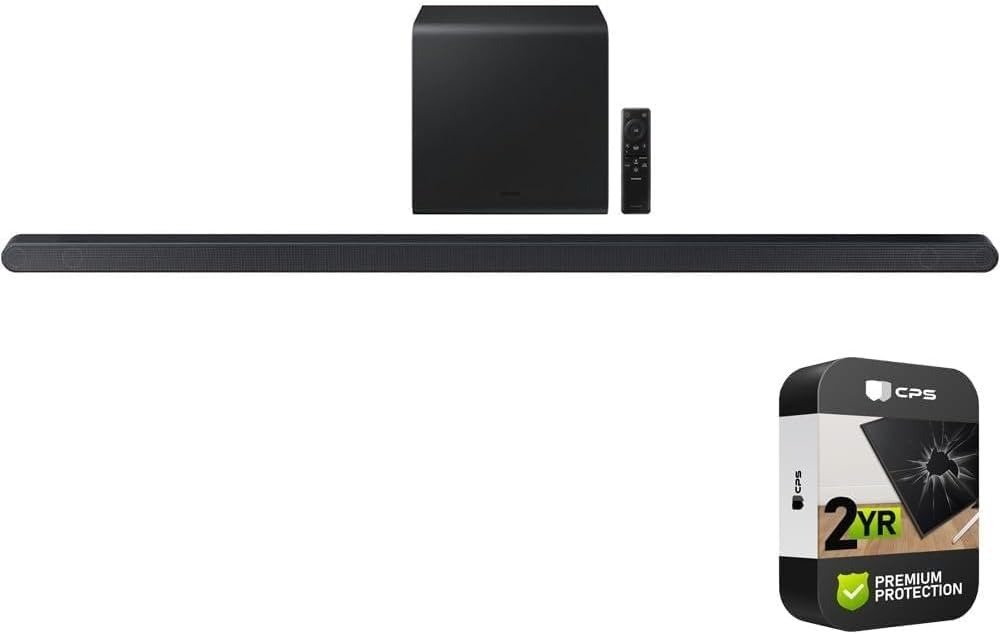
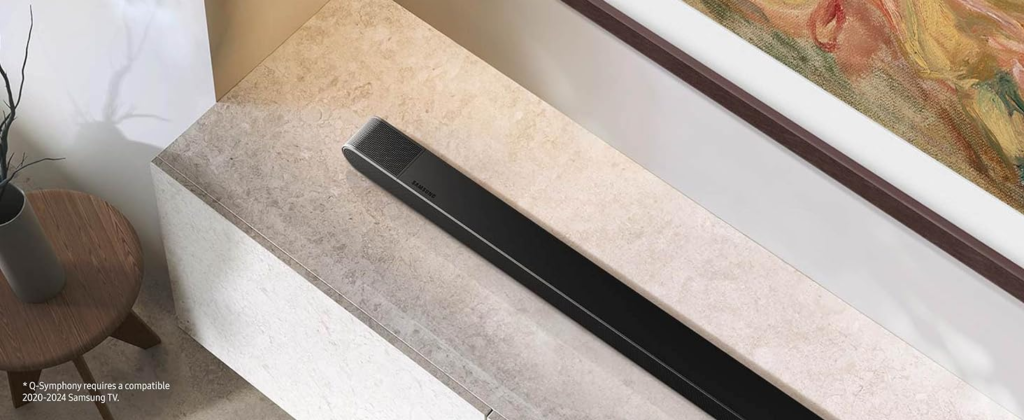
What makes the Samsung HW-S800D interesting is not that it is slim. Plenty of products are slim. What matters is that Samsung built a 3.1.2-channel bar with 10 speakers, an included wireless subwoofer, up-firing drivers for height effects, HDMI eARC, Wi-Fi, Bluetooth 5.2, SpaceFit Sound, Voice Enhance, and Q-Symphony into a profile that is only about 40mm deep. Reviewers consistently describe the result as bigger, cleaner, and more cinematic than its body suggests—while also noting the same structural limit: it is impressive up front, not fully wraparound by default.
The Result Looks Fine. The Problem Isn’t.
I have seen this pattern too many times to call it a preference issue.
The screen gets sharper. The room gets cleaner. The TV gets thinner. And the sound gets squeezed into a strip so narrow that impact survives only as an illusion. You hear events. You do not feel placement. You hear dialogue. You do not get body. You hear bass. You do not get weight that locks the scene into the room.
That is why the HW-S800D keeps showing up as a specific kind of answer. Not for the buyer chasing the biggest channel count. Not for the person trying to imitate a dedicated speaker layout on the cheap. It keeps drawing attention because it attacks a narrower, more painful problem: the point where built-in TV audio looks acceptable until real content exposes how flat it actually is. Multiple reviews praise its ability to throw a surprisingly expansive stage and produce meaningful low end from a compact sub, even while admitting it does not replace a true rear-speaker system out of the box.
What You’re Actually Feeling but Not Naming
Most people do not say, “My front soundstage is collapsing.”
They say:
- “I keep missing lines.”
- “Action scenes sound loud, but not exciting.”
- “The room looks premium, but the sound still feels like it’s trapped in the TV.”
- “I want Atmos, but I do not want a giant black shelf under the screen.”
That cluster matters. It tells you this is not just a volume problem. It is a shape problem.
The psychological irritation is subtle. You paid for the larger panel. You mounted it cleanly. You removed clutter. Then every serious scene reminds you that the visual upgrade outran the audio. That mismatch is why ultra-slim soundbars exist at all. Reviewers and owners keep circling the same emotional relief with the S800D: it blends in visually, installs easily, and sounds far larger than something this thin should. Owners especially praise the combination of clean dialogue, strong bass for the size, and the way the bar “disappears” under the TV instead of hijacking the room.
The Hidden Mechanism Behind the Miss
Here is the real mechanism: you are not judging sound too late—you are judging it on the wrong cues too early.
Most buyers test with brightness cues: a louder trailer, a bassy intro, a demo clip that splashes noise across the room.
That is not where systems like this earn their keep.
The HW-S800D’s value lives in three places that do not always shout on day one:
| What matters in real use | Why it changes the experience |
|---|---|
| Dedicated center channel | Dialogue stays anchored instead of floating inside effects |
| Up-firing channels | Height cues add lift to Atmos material rather than keeping everything glued to the screen |
| Separate wireless subwoofer | Low-end energy moves off the bar and into the room, which makes scenes feel less flat |
Those are not marketing decorations. They are the reason this bar can feel more like a correction than a gadget. Samsung’s own spec sheet lists 3.1.2 channels, 10 speakers, up-firing drivers, and an included wireless subwoofer, while reviewers repeatedly single out the center clarity, the unexpectedly full stage, and the sub’s ability to deliver real punch despite the small footprint.
SpaceFit Sound is another part of the mechanism that matters more than it sounds like it should. Expert Reviews notes that the built-in calibration helps integrate the subwoofer and tighten tonal balance, producing smoother bass and a more composed presentation. AVForums similarly found the sub came alive more convincingly once SpaceFit had done its work. In plain English: the box is not just trying to be louder; it is trying to stop the sub from feeling like a separate object muttering in the corner.
The Threshold Where the Outcome Quietly Breaks
This is the threshold.
The HW-S800D becomes logical the moment your room, screen, and watching habits ask for scale—but your space still punishes bulk.
That threshold usually appears when three things happen at once:
- Your TV is 55 inches or larger.
- You care about film, streaming drama, or game audio enough to notice flattening.
- You do not want a thick, visually dominant bar under the screen.
That is exactly where the S800D keeps getting framed by reviewers: a lifestyle-friendly Atmos bar that sounds bigger than it looks, ideal for people who want a clean install without dropping back to lifeless TV audio. Expert Reviews says the cabinet dimensions make it ideal for 55-inch TVs or larger, while Sound Advice says it can comfortably complement screens up to 65 inches and possibly larger.
The threshold is not “Do I want better sound?” Almost everyone wants better sound.
The threshold is harsher: Has TV audio started to cheapen everything else in the room?
When the answer is yes, the decision stops being vague.
Why Most Buyers Misread This Too Early
Because they shop by category myth.
The myth says: thin bar = compromised sound
bigger chassis = better theater
Atmos badge = full immersion
more hype = more room impact
Reality is less flattering.
The S800D is not trying to beat Samsung’s big-box theater bars on raw enclosure volume or rear-speaker envelopment. In fact, several reviewers explicitly say the presentation is somewhat front-heavy without optional rears, and AVForums notes that if you want convincing sound from behind you, you will need Samsung’s add-on rear speakers. But that criticism only matters if you were secretly shopping for a different class of system.
The early misread usually comes from comparing it to products built for a different compromise curve:
| Wrong comparison lens | What it misses |
|---|---|
| “Can this out-theater a flagship 9.1.4 or 11.1.4 package?” | That is not its job |
| “Can a bar this thin really do bass?” | The separate sub is carrying part of that burden |
| “If it lacks rears in the box, is Atmos fake?” | Atmos height and front immersion are still materially better than TV speakers |
| “Why not just buy the largest soundbar possible?” | Because some rooms punish visual bulk more than they reward brute force |
This is why the product reads better through a threshold model than a feature list. It is for the buyer whose problem is no longer “I want more audio,” but “I want the room to stay clean without the soundtrack feeling starved.”
Who Is Actually Inside This Problem
You are inside this problem if you recognize yourself in any of these scenes:
- You wall-mounted the TV and do not want a fat bar hanging below it like an apology.
- You watch at night and keep riding the volume because speech, score, and impact never arrive at the same level of ease.
- You want one visible upgrade that pulls the room together instead of turning the media wall into a hardware display.
The S800D fits that profile unusually well because its design is not a side benefit. It is part of the product logic. Samsung positions the bar around ultra-slim design, Wireless Dolby Atmos, and Q-Symphony, and independent reviews keep returning to the same phrase in different words: discreet, elegant, lifestyle-friendly, surprisingly spacious, stronger than it looks.
It also helps if you are already inside Samsung’s ecosystem. Q-Symphony works with compatible Samsung TVs, and several reviews note that the combined effect can expand the front soundstage in a way that makes the whole presentation feel larger and more cohesive. Wireless Dolby Atmos support with compatible Samsung TVs reduces cable clutter further. This is not mandatory for the S800D to make sense. But it does sharpen the fit.
Where Wrong-Fit Begins
This is where restraint matters.
The HW-S800D is the wrong fit if you want the room to disappear behind you without buying anything extra. It is the wrong fit if you judge value mostly by connection abundance, because reviewers note minimal physical connectivity and AVForums specifically calls out the lack of LED feedback as an annoyance. It is the wrong fit if you are hyper-focused on top-tier music separation in this price class, because Reviewed found it less revealing with music than the Sonos Arc even while still calling it balanced enough for casual listening.
It is also the wrong fit if you want plug-and-forget perfection with zero tolerance for quirks. A few reviewers and customer comments flag weak points: one Crutchfield customer criticized the instructions and remote, another cited poor sound quality, while AVForums mentioned occasional bass crackle. Those complaints do not define the product, but they do define the boundary of honesty.
Here is the clean split:
| Fit status | What it usually means |
|---|---|
| True fit | You want a discreet bar that sounds much bigger than it looks |
| Near fit | You want cinematic front impact now and may add rears later |
| False fit | You expect full behind-you surround without optional rears |
| Wrong fit | You want maximum value by channel count, ports, or brute-force scale |
That boundary is exactly why this model earns respect. It has a narrower promise than many bars wearing louder clothes.
The One Situation Where This Product Becomes Logical
The logic becomes hard to escape in one very specific situation:
You have already upgraded the picture, you dislike visual clutter, and you are tired of pretending the TV’s built-in sound is “basically fine.”
That is where the Samsung HW-S800D stops being a stylish accessory and starts acting like a structural fix.
On paper, the proposition is clean:
| Core spec | Why it matters |
|---|---|
| 3.1.2 channels | Gives you real center dialogue plus height effects |
| 10 speakers | Lets the slim chassis distribute more acoustic work |
| Wireless subwoofer | Supplies body and depth the bar alone could not |
| HDMI eARC | Enables higher-quality audio return from the TV |
| SpaceFit Sound | Helps room correction and sub integration |
| Optional SWA-9500S rears | Leaves a path to fuller immersion later |
Those are not trivial upgrades. They are the reason multiple reviewers concluded that the HW-S800D manages an unusually strong balance of discretion and performance, especially for buyers who want Atmos flavor without the visual mass of Samsung’s larger Q-series options.
And this is where buyer psychology matters most. People often delay this step because the TV is “working.” But working is not the same as carrying the emotional load of what you watch. The right soundtrack does not merely accompany the image. It grips the edge of the frame and pulls it forward.
What It Solves, What It Reduces, and What It Still Leaves to You
What it solves:
- Thin, brittle TV audio that makes premium visuals feel underfed.
- Dialogue strain that keeps pushing you toward the remote.
- The design compromise of adding a large, room-dominating bar to a clean setup.
What it reduces:
- Front-stage flatness.
- Bass starvation.
- Cable clutter, especially with compatible Samsung TV features like Wireless Dolby Atmos and Q-Symphony.
What it still leaves to you:
- You still need the right expectations for rear immersion.
- You still need decent placement and room conditions for height effects.
- You still need to decide whether your use case justifies optional rear speakers later.
That last point is important. Samsung’s own materials note that Atmos effects depend on environment, including ceiling characteristics, and the S800D does not include rear speakers in the box. So the honest reading is not “instant theater for everyone.” The honest reading is better: a very slim, very intentional system that corrects the most common living-room audio failure without wrecking the room to do it.
Final Compression
Here is the decision in its tightest form.
If your real problem is that your TV sounds small, there are cheaper ways to get louder.
If your real problem is that you want full-room surround from every direction, there are bigger systems that start there.
But if your break point is this precise one—you want the screen to feel larger sonically, voices to stop thinning out, bass to stop sounding imaginary, and the room to stay visually disciplined—the Samsung HW-S800D lands in a narrow zone where very few products feel this resolved. Its strengths are not random. They line up: slim body, real center channel, useful Atmos height, meaningful subwoofer support, room correction, strong ecosystem fit, and broadly positive feedback from reviewers and owners who wanted performance without bulk.
That is why I would not frame this as a generic soundbar upgrade. I would frame it as the point where a clean room no longer has to sound unfinished.
If this is the condition you are actually dealing with, this is the logical next step.
Transparency Note:
This analysis is built on aggregated real-world experience.
It extracts what repeatedly holds, what breaks, and what users uncover only after living with the system—then shapes it into a clear model you can use immediately.
Think of it as structured experience, refined and presented so you don’t have to learn it the hard way.
“A quick note: Don’t believe the star ratings, but trust personal experience. This article is a compilation of collected experiences”