My ZAFRO Smart Tower Fan Review: After 4 Failed "Quiet" Fans, I Finally Found Where the Noise Line Actually Is
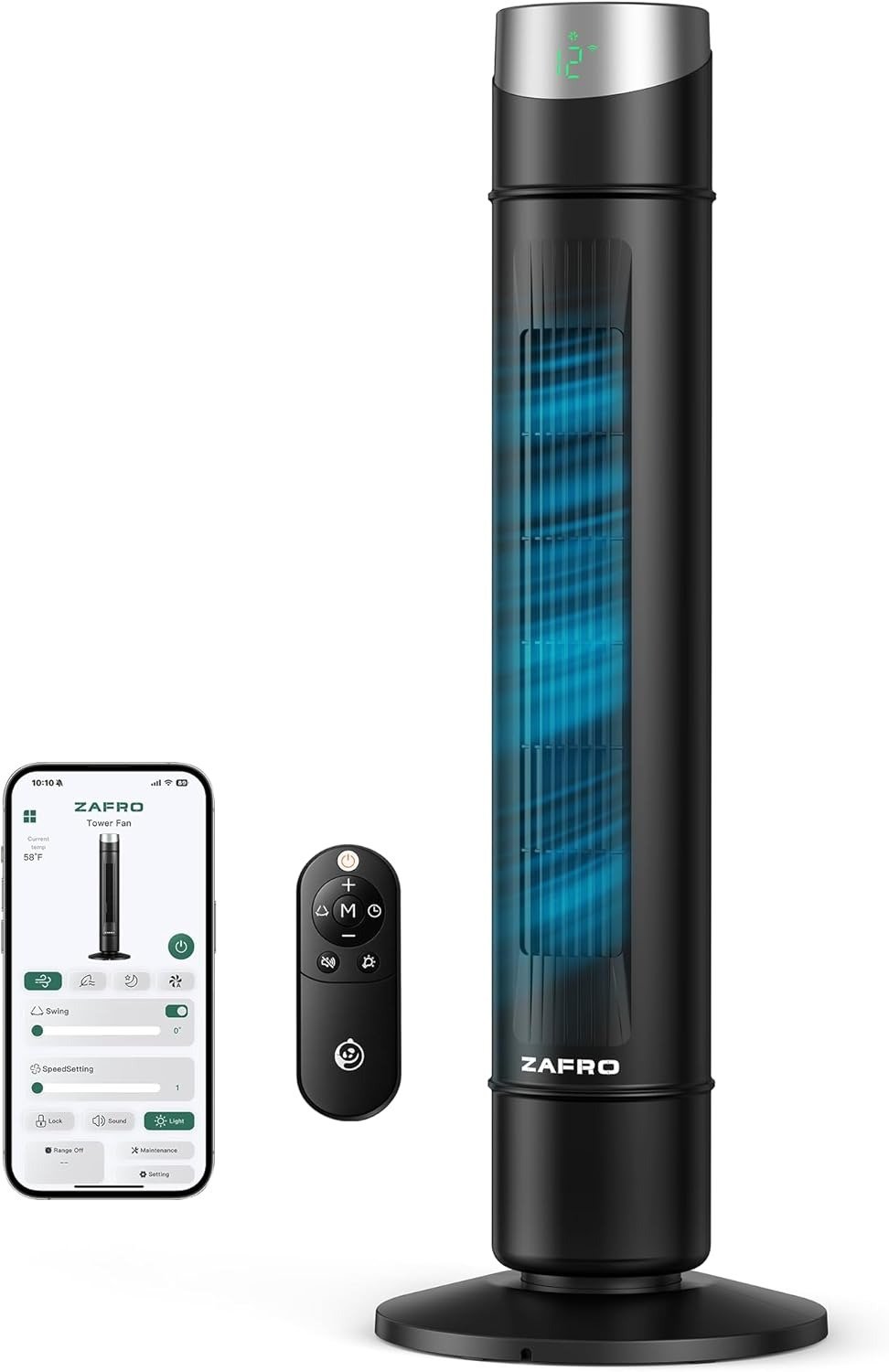
ZAFRO SMART TOWER FAN
ZAFRO Tower Fan Performance Review: The Result Looks Fine. The Real Problem Isn’t What You Think.
I’ve owned four tower fans in the past six years. All four said “ultra-quiet” somewhere on the box. One even showed a sleeping woman in soft blue light — peaceful, serene, completely misleading. I kept all four. I told myself I’d adjust. I did adjust. But adjusting to a fan isn’t sleeping near one. It’s enduring it in slow, exhausting increments.
What I didn’t know until I tested the ZAFRO Smart Tower Fan was that I had been measuring the wrong specification the entire time.
The number I was chasing was airflow. The number that actually mattered was the noise floor at sleeping speed. Not peak power. Not maximum performance. The acoustic reality at the setting I’d actually use from midnight to 6am.
ZAFRO Sleep Fan Review: What I Was Actually Feeling But Couldn’t Name
Why does a fan at 35dB keep you awake at 1am when you sleep through a 70dB restaurant at dinner without noticing? I genuinely puzzled over this for years before I stopped blaming my biology.
At night, the room goes silent. Your audio baseline drops. Your brain, moving through its lightest sleep phases, doesn’t evaluate absolute volume — it evaluates contrast. A fan at 35dB in a quiet bedroom isn’t background sound. It becomes the dominant sound in your environment. Your ears track it the same way they track a faucet dripping three rooms away.
There is a real threshold. Around 24–25dB in a quiet room, most adults stop consciously registering a running fan as a machine. It dissolves into the room’s ambient signature the way a distant refrigerator hum sometimes disappears — until the compressor kicks in and you suddenly realize it was running all along.
The ZAFRO runs at 22dB at its lower speed settings. That’s not just quieter than what I had before. It’s below the threshold where the brain registers the machine. That gap is why I describe this as a different category of fan, not a better version of the same one.
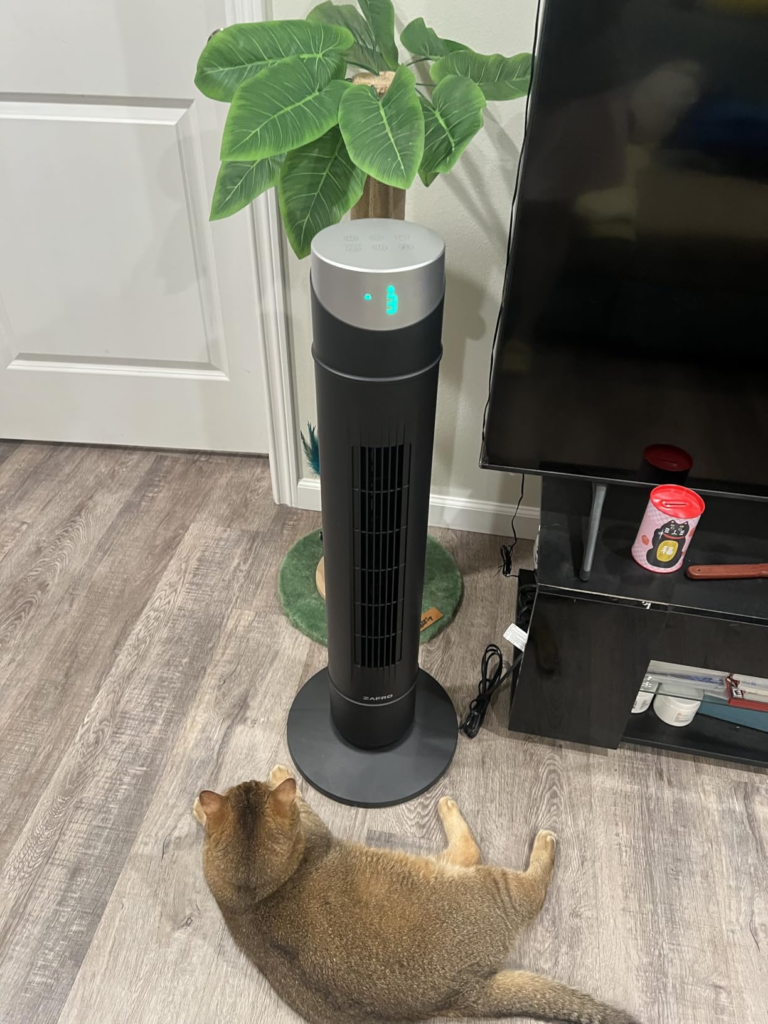
ZAFRO Smart Fan Mechanism Review: The DC Motor Secret Behind the 22dB Claim
Why do budget fans lie about quiet? They don’t lie exactly. They test the fan at low speed with an AC motor turned nearly all the way down. An AC motor at minimum speed is measurably quieter than at maximum. But an AC motor at any speed produces a fixed-frequency mechanical hum — a rhythmic signature that your brain recognizes as artificial. You can tolerate it. You cannot stop detecting it.
DC motors operate on fundamentally different physics. They modulate power electronically rather than mechanically. At low speeds, they don’t just spin more slowly — they draw less current, vibrate at lower amplitude, and generate a different acoustic texture entirely. There is no mechanical hum signature. There is airflow, and beneath that, near-silence.
The ZAFRO’s upgraded DC motor is the engineering reality behind its 22dB claim. It’s not a marketing number. It’s motor physics expressing itself in your bedroom.
| Specification | Value |
|---|---|
| Maximum airflow speed | 28 ft/s |
| Air volume output | 1,060 CFM |
| Maximum projection distance | 43+ feet |
| Minimum noise level (low speeds) | 22 dB — below whisper threshold |
| Oscillation range | 30° / 60° / 90° / 120° (app-adjustable) |
| Speed settings | 12 |
| Wind modes | Normal, Natural, Sleep, Smart (Auto) |
| Motor type | Upgraded DC |
| Control options | Touch panel · Remote (8m range) · ZAFRO App · Alexa · Google Assistant |
| LED display | Green, auto-off 30 seconds after last input |
| Timer | Up to 12 hours |
| Safety certification | CETL |
| Height | 36 inches |
| Grille system | Fully detachable rear grille + fan blade |
| Convenience extras | Hidden carry handle · Power-off memory · Child lock · Remote storage compartment |
The Smart Mode — labeled Auto — uses a built-in temperature sensor to read actual room conditions and adjust fan speed without your input. When the room cools after midnight, the fan steps down automatically. When morning heat rises before your alarm, it steps up. This is not artificial intelligence. It’s thermal feedback logic. Simple and reliable in practice.
ZAFRO Tower Fan Noise Test Review: The Sleep Threshold Where Outcomes Quietly Break
The problem with buying a 12-speed fan is that most buyers evaluate it at speeds 10 and 12 in the first ten minutes. Those speeds are impressive. They also describe nothing about how the fan will actually live in your bedroom from midnight to morning.
I sleep at speed 3. Speed 4 on a hot night. Speed 5 when the room hasn’t cooled before I go to bed. The relevant specification is the acoustic floor at those settings — not the peak.
| Speed Range | Approximate Noise | Practical Reality |
|---|---|---|
| Speed 1–3 (Low) | ~22 dB | Effectively inaudible — merges with room ambiance |
| Speed 4–6 (Medium-Low) | ~26–28 dB | Faint air movement, comparable to gentle HVAC |
| Speed 7–9 (Medium-High) | ~32–36 dB | Clearly audible — ideal for daytime work or living room |
| Speed 10–12 (High) | ~40–44 dB | Powerful, unmistakably audible — not a sleep setting |
Sleep Mode cycles through the lower range automatically. Smart Mode widens the range in response to temperature. High speeds cool the room fast before bed, then Smart Mode descends into quiet territory once conditions stabilize. That’s the intended workflow. It functions exactly as described.
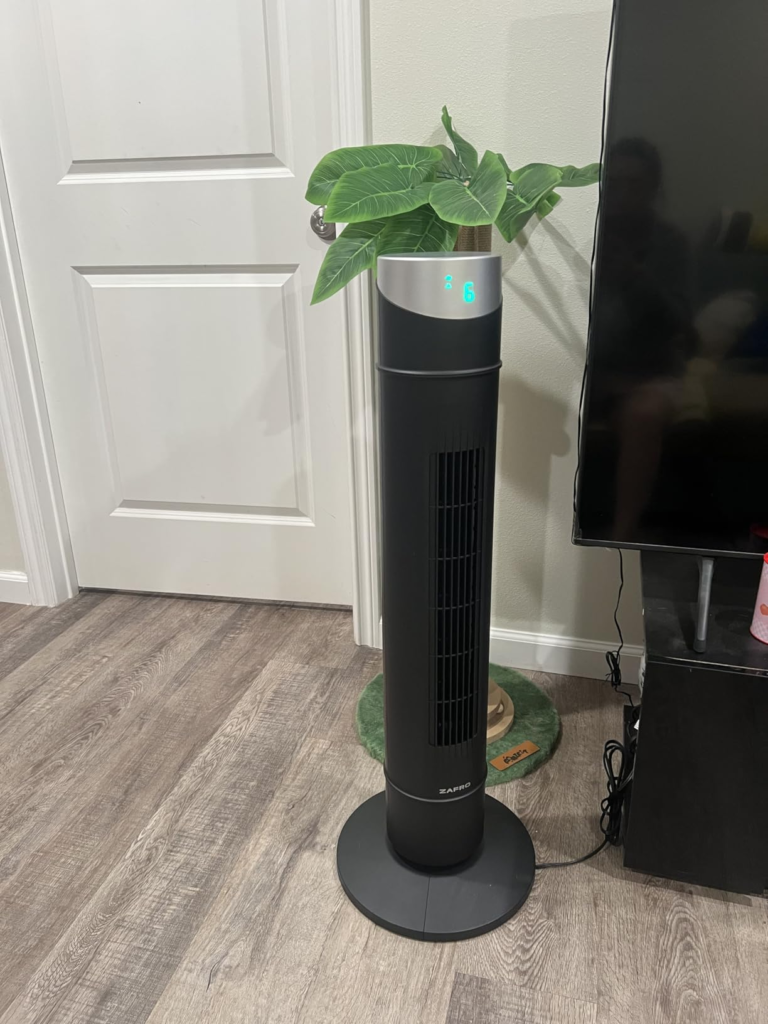
The LED display auto-dims and shuts off 30 seconds after the last input. This detail matters more than most spec comparisons acknowledge. A fan that hits 22dB but glows green across a dark bedroom is still disrupting sleep — just visually instead of acoustically. The ZAFRO solves both simultaneously.
ZAFRO Fan Buying Guide Review: Why Most Buyers Misread Tower Fan Specs Before Committing
The comparison trap I walked into four times looks like this: a spec sheet for an $80 fan and a spec sheet for a $140 fan look nearly identical. Both say 12 speeds. Both show oscillation. Both print a dB number. The differences that actually matter — motor type, noise floor at sleeping speed, oscillation precision — sit buried in bullet point three, below the fold, in smaller text.
| Fan Category | Typical Airflow | Sleep-Speed Noise Floor | Smart Control | Approximate Price |
|---|---|---|---|---|
| Budget AC-motor fans | 15–22 ft/s | 38–45 dB | None | $30–$60 |
| Mid-range AC-motor fans | 22–25 ft/s | 32–40 dB | Basic remote | $60–$90 |
| ZAFRO 36″ Smart (DC) | 28 ft/s | ~22 dB | App + Alexa + Google + Remote | ~$129 |
| Dreo Cruiser Pro T1 (DC) | 28 ft/s | ~20 dB | App + Alexa + Google + Remote | ~$149 |
| Dyson Pure Cool TP07 (Bladeless) | 24–26 ft/s | ~30–35 dB | App + Alexa | $299–$399 |
The 2dB difference between the ZAFRO and the Dreo T1 is real on a sound meter. Whether it’s perceptible at 3am in a bedroom depends entirely on individual biology. For most adults below clinical light-sensitivity thresholds, 22dB and 20dB are functionally identical in a sleeping environment. Both sit below the point where the brain registers a machine. The $20 premium buys a measurement, not a meaningfully different experience for the majority of buyers.
Dyson buyers are paying primarily for integrated air purification and industrial design aesthetics. A $350 Dyson is a capable air purifier that also moves air — not a superior fan with a designer case attached to it.
ZAFRO Smart Tower Fan User Review: Who Is Actually Inside This Problem
I’ll be direct about who belongs at this fan and who doesn’t.
You belong here if you’ve returned a fan before — not because it broke, but because it kept you awake and you assumed that was the nature of fans. It isn’t. It’s the nature of poorly engineered fans sold with quiet claims that don’t survive contact with a silent bedroom at 1am.
You belong here if you notice the HVAC cycling off at night. If you become aware of appliance hum when the house quiets down. If you’ve described yourself as a light sleeper without having always been one — because equipment conditioned you.
You belong here if your bedroom runs hot from spring through fall and another fan purchase feels like a gamble. You want engineering behind the quiet claim, not a printed number.
You belong here if you already run Alexa or Google Home and the idea of a fan that joins your bedtime routine — auto-adjusting through the night, stepping down as the room cools, shutting off before morning — sounds useful rather than extravagant.
You do not belong here if you want a fan for the garage, laundry room, or workshop. There are $35 fans that do that job perfectly well.
ZAFRO Fan Wrong Fit Review: Where Regret Begins for the Wrong Buyer
If your bedroom has no AC and outdoor temperatures stay above 88°F for weeks at a time, I want to be honest with you before you spend $129: this fan pushes 28 ft/s of air against your skin, which creates real evaporative cooling. You will feel cooler. The room temperature itself will not drop. If the ambient air is 84°F, you are breathing 84°F air with a pleasant breeze through it. A fan is not an air conditioner. This one especially cannot do what an air conditioner does, and presenting it otherwise would be misinforming you.
If your Wi-Fi signal is unstable, the smart features become unreliable. The fan operates completely without the app — touch panel and remote work regardless of connectivity — but automatic scheduling and temperature-based speed adjustment require stable app connection. If your network drops frequently, use the manual controls and accept that you’re buying a very quiet DC fan with a good remote, not a smart home appliance.
| Scenario | Fit Assessment |
|---|---|
| Light sleeper, hot bedroom, smart home user | ✅ Strong fit |
| Remote worker needing quiet background airflow | ✅ Strong fit |
| Bedroom with AC, fan as overnight supplement | ✅ Strong fit |
| No AC, room temperature above 85°F outdoors | ⚠️ Air movement only — not temperature reduction |
| Room above 350–400 sq ft with tall ceilings | ⚠️ Consider the 42-inch ZAFRO variant |
| Unstable Wi-Fi or complex smart home | ⚠️ Remote-only use works fine — skip app reliance |
| Budget under $100 | ❌ Wrong product |
| Need absolute silence below 20 dB | ⚠️ Dreo T1 has a measurable 2dB edge |
| Garage, workshop, or utility fan need | ❌ Wrong product |
ZAFRO Bedroom Fan Logical Purchase Review: The One Situation Where Buying This Becomes Obvious
If your previous fan kept you awake, your bedroom runs hot through summer, and you already use a smart home system — you are describing the exact condition this machine was designed to address.
The 22dB floor means the fan disappears acoustically at the speeds you’ll use overnight. Smart Mode means you stop managing it manually as conditions shift through the night. The display extinguishes itself. The oscillation adjusts precisely via app from a narrow 30° beam covering only your side of the bed to a full 120° sweep moving air through the entire room. The detachable rear grille means performance doesn’t quietly degrade as dust loads the blade assembly over months of daily use — you can clean it properly, without tools, in under five minutes.
This is not a fan trying to do everything. It is a specific machine, solving a specific problem — quiet, automated overnight airflow — with the engineering to deliver it at $129.
ZAFRO Smart Fan Full Verdict Review: What It Solves, What It Reduces, and What Remains Yours to Manage
What it genuinely solves: The machine operates below the acoustic registration threshold at sleeping speeds. Smart Mode adjusts without your input. The display disappears. You wake up when your alarm fires — not because the room warmed and the fan’s pitch shifted.
What it meaningfully reduces: Maintenance friction. The detachable rear grille and blade clean in minutes, without tools. That matters because a fan that runs for six months without cleaning doesn’t continue running at 22dB — it runs louder, moves less air, and the quiet you paid for gradually disappears. With the ZAFRO, you can actually prevent that degradation.
What stays with you: Air movement, not air cooling. Your room temperature remains where physics places it. The perceived comfort is real — airflow on skin reduces effective body temperature meaningfully — but ambient heat remains. High speeds (10–12) are audible by design. Use them to pre-cool the room before sleep, then let Smart Mode descend.
| Performance Category | Rating |
|---|---|
| Noise floor at sleep settings (~22 dB) | ⭐⭐⭐⭐⭐ |
| Smart Mode auto-adjustment through the night | ⭐⭐⭐⭐⭐ |
| Oscillation flexibility (30°–120° via app) | ⭐⭐⭐⭐⭐ |
| LED display auto-off for sleep | ⭐⭐⭐⭐⭐ |
| Maintenance ease (detachable grille) | ⭐⭐⭐⭐⭐ |
| App and voice control reliability | ⭐⭐⭐⭐ |
| High-speed noise (expected, not a flaw) | ⭐⭐⭐ |
| Value at ~$129 price point | ⭐⭐⭐⭐⭐ |
ZAFRO 36 Smart Fan Final Compression Review: One Condition, One Logical Step
The number that actually governs this decision is 22. Not as a marketing label — as a mechanical reality. Below 25dB in a quiet room, most adults stop registering a fan as a foreign sound in their environment. The ZAFRO reaches 22dB at the speeds you will use overnight. That’s below the threshold, not at it.
If you have run bedroom fans for years and still don’t wake fully rested on hot nights, the problem is probably not your biology. It’s the equipment.
If this is your condition, pricing and availability are on Amazon.
ZAFRO Smart Tower Fan FAQ Review: Direct Answers to the Questions That Actually Determine the Buy
| Question | Answer |
|---|---|
| Does the 22dB claim hold in real overnight use, or only in laboratory conditions? | The 22dB rating applies at speeds 1 through 4. Smart Mode can shift speed higher if room temperature climbs, bringing noise closer to 26–28dB at medium settings. That’s still within comfortable sleep range for most adults. The claim holds in real use when room conditions are stable or cooling — which describes most bedrooms after midnight. |
| Why does setup require 2.4GHz Wi-Fi rather than 5GHz? | The 2.4GHz band penetrates walls more reliably than 5GHz, making it better suited for appliances positioned across a room rather than directly beside the router. If your router broadcasts both frequencies under one merged name, temporarily separate them during initial pairing, connect on 2.4GHz, then restore your standard settings. Once paired, the connection holds stably. |
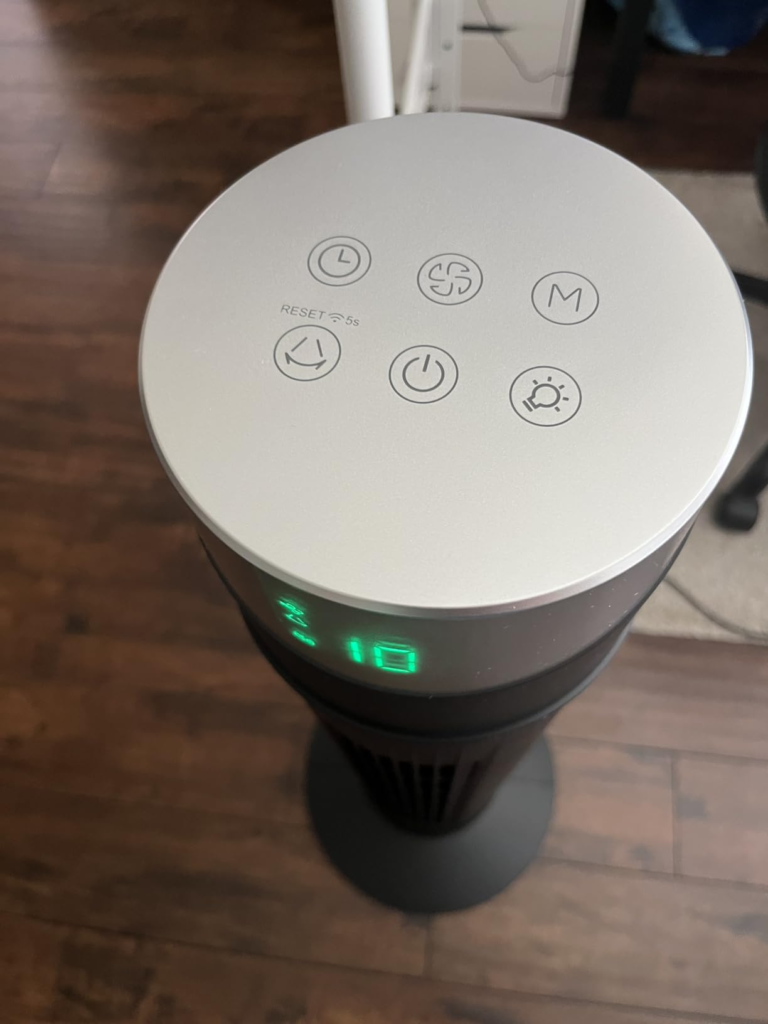
| Does the ZAFRO function completely without the app? | Yes. Touch panel and remote access all primary functions: power, speed, mode, timer, oscillation on/off, child lock. The app adds oscillation angle precision (30°/60°/90°/120°), scheduling, and Alexa/Google integration. The fan works fully without it. |
| Does the green LED display stay on all night? | No. The display dims and shuts off automatically 30 seconds after the last input and does not illuminate again during passive operation. If it re-illuminates, a button was pressed — either the touch panel, remote, or child lock not yet activated. |
| Is the 36-inch height appropriate for a master bedroom? | For most standard bedroom setups and rooms under 350 square feet, yes. If your bed sits unusually high — thick mattress on a platform with a box spring — or your room exceeds 350–400 square feet, the 42-inch ZAFRO model distributes air more evenly across the full sleeping area. |
| How often should the grille be cleaned to maintain the 22dB performance floor? | During peak summer use with 8 or more hours of daily operation, a light clean every 3–4 weeks keeps the noise floor stable and prevents gradual airflow reduction. The detachable grille and blade make this straightforward without tools. |
| Does the Smart (Auto) Mode actually adjust based on real temperature, or is it a passive label? | The Smart Mode uses a real built-in temperature sensor to read ambient room conditions and respond in real time. When the room cools after midnight, fan speed steps down automatically. When morning heat rises before your alarm, it steps up. It is thermal feedback logic, not a static preset. It works precisely as described, and it is the feature that makes this fan genuinely hands-off through the night. |
Transparency Note:
This analysis is built on aggregated real-world experience.
It extracts what repeatedly holds, what breaks, and what users uncover only after living with the system—then shapes it into a clear model you can use immediately. Think of it as structured experience, refined and presented so you don’t have to learn it the hard way.
“A quick note: Don’t believe the star ratings, but trust personal experience. This article is a compilation of collected experiences”