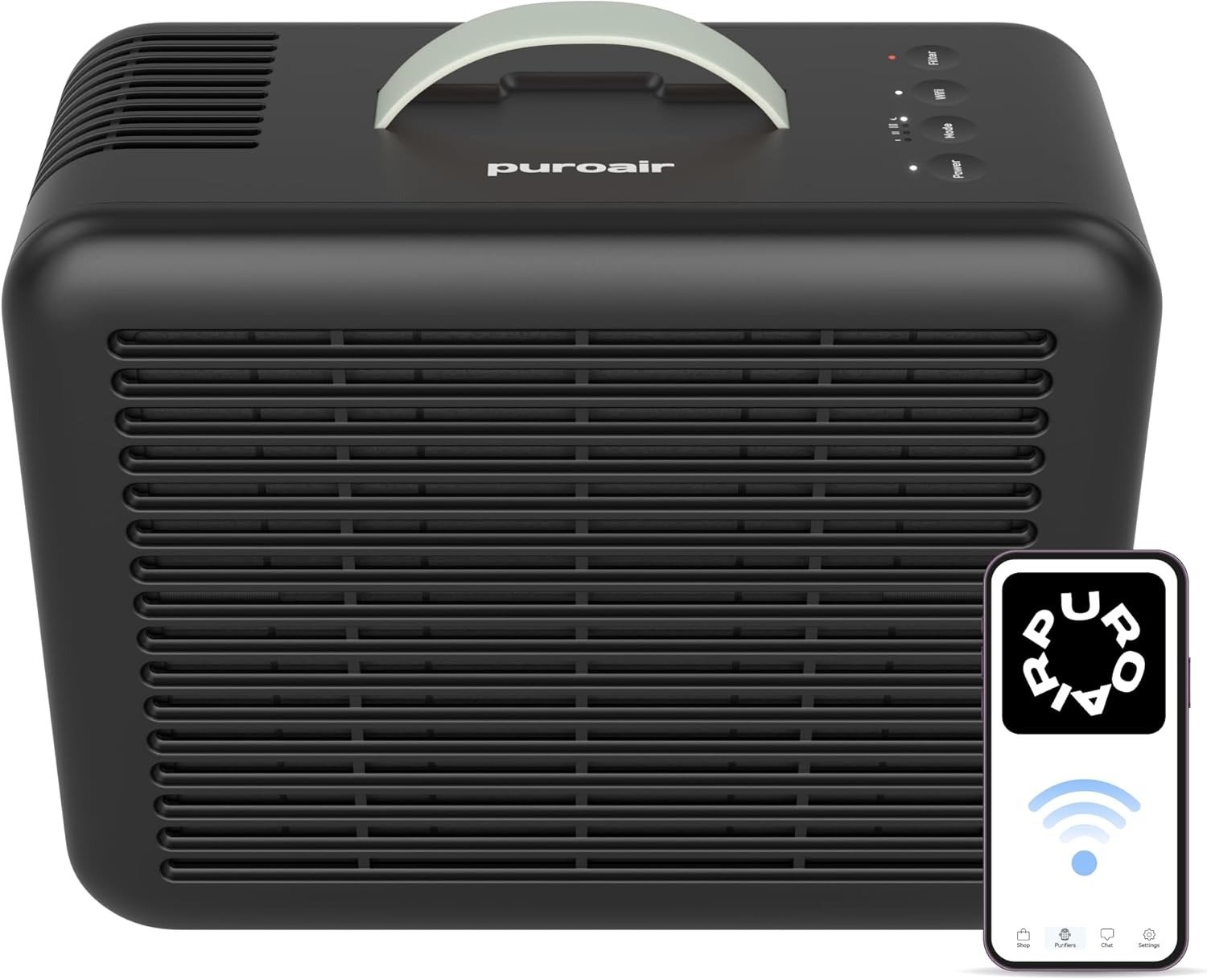
PUROAIR 100I SMART REVIEW: I BROKE DOWN WHAT THE SPECS MISS
You put an air purifier in your bedroom. A week passes. The sneezing hasn’t stopped. The air doesn’t feel different. You wake up congested next to something that hums, glows, and claims to clean 550 square feet — and nothing has clearly changed.
You didn’t buy a broken product. You bought a capable product misapplied to a situation that was never fully explained on the box.
The PuroAir 100i is a legitimately well-built machine with one marketing number that most buyers read wrong. That number isn’t a lie — but it isn’t the full story. Understanding the gap between “550 sq ft” and “550 sq ft of actually clean air” is what separates buyers who feel the difference from buyers who feel nothing and return the box.
The Number Looks Clean. The Problem Is in the Math.
Every air purifier coverage claim is built on a variable the packaging almost never names: ACH — Air Changes per Hour. It represents how many times the unit cycles the full volume of air in a given room within one hour.
PuroAir’s 550 sq ft coverage claim is built on 1 ACH. One full air cycle per hour. That is the industry minimum to qualify as “coverage.”
What the air quality field actually recommends for allergy relief, pet dander reduction, and measurable improvement is 4 to 5 ACH. At that standard, the effective range of any purifier rated at 550 sq ft / 1 ACH drops sharply.
| Room Size | Approximate ACH | Air Quality Outcome |
|---|---|---|
| 110 sq ft | ~5 ACH | Excellent — optimal standard for clinical-level results |
| 137 sq ft | ~4 ACH | Very good — consistent allergy relief territory |
| 183 sq ft | ~3 ACH | Good — noticeable, sustained improvement |
| 275 sq ft | ~2 ACH | Moderate — slow cycling, but meaningful long-term |
| 400 sq ft | ~1.4 ACH | Weak — marginal, barely perceptible change |
| 550 sq ft (marketed max) | 1 ACH | Minimum threshold — insufficient for allergy results |
ACH estimates derived proportionally from PuroAir’s verified ISO 17025 lab-certified 550 sq ft / 1 hour performance rating.
This does not make the 100i a flawed product. It makes it a product with a threshold. Stay within it and it delivers. Exceed it and the filtration is too thin to change what you actually breathe.
What You Keep Noticing in the Bedroom — Without a Name for It
The friction starts quietly. You run the purifier overnight. The next morning feels like any other morning. Dust still settles on surfaces by afternoon. Eyes still itch during certain seasons. Pet dander doesn’t seem to drop. The faint odor from last night’s cooking lingers.
None of this means the filter isn’t working. It usually means the air is turning over once per hour in a room that needs three to five passes to register a real change.
The mechanism is invisible by nature. You don’t see the volume of unfiltered air that refills the room between each cycle. You see a device running, assume the room is being treated, conclude the product isn’t performing — when the variable that actually failed was never the filter. It was the room size assumption applied uncritically to a marketing number.
The PuroAir 100i has a genuinely effective 3-layer system. What determines results is not whether the filter works. It’s whether the room gives the filter enough pass-throughs per hour to matter.
The Filtration Mechanism Behind the 100i’s Real Edge
The 100i uses three sequentially active filtration layers, each targeting a distinct contamination class.
| Filtration Layer | Primary Target | Secondary Function |
|---|---|---|
| Pre-Filter (mesh screen) | Pet hair, large dust, lint | Extends life of HEPA layer |
| True HEPA (main stage) | Particles as small as 0.1 microns (PM1, PM2.5, PM10) | Captures pollen, dander, mold spores |
| CarbonTech™ Activated Carbon | Odors, smoke, cooking residue, VOCs | Gas-phase adsorption (what HEPA alone cannot do) |
The HEPA layer is the backbone. At 0.1-micron capture capability, it catches bacteria-scale particles — well below the diameter of typical pet dander (2–10 microns) or pollen (10–100 microns). The CarbonTech activated carbon layer is the differentiation point. Odors, cooking gases, and volatile organic compounds from household products are gas-phase contaminants. A HEPA filter alone doesn’t touch them. The combined system is what makes the 100i more than a simple particle trap.
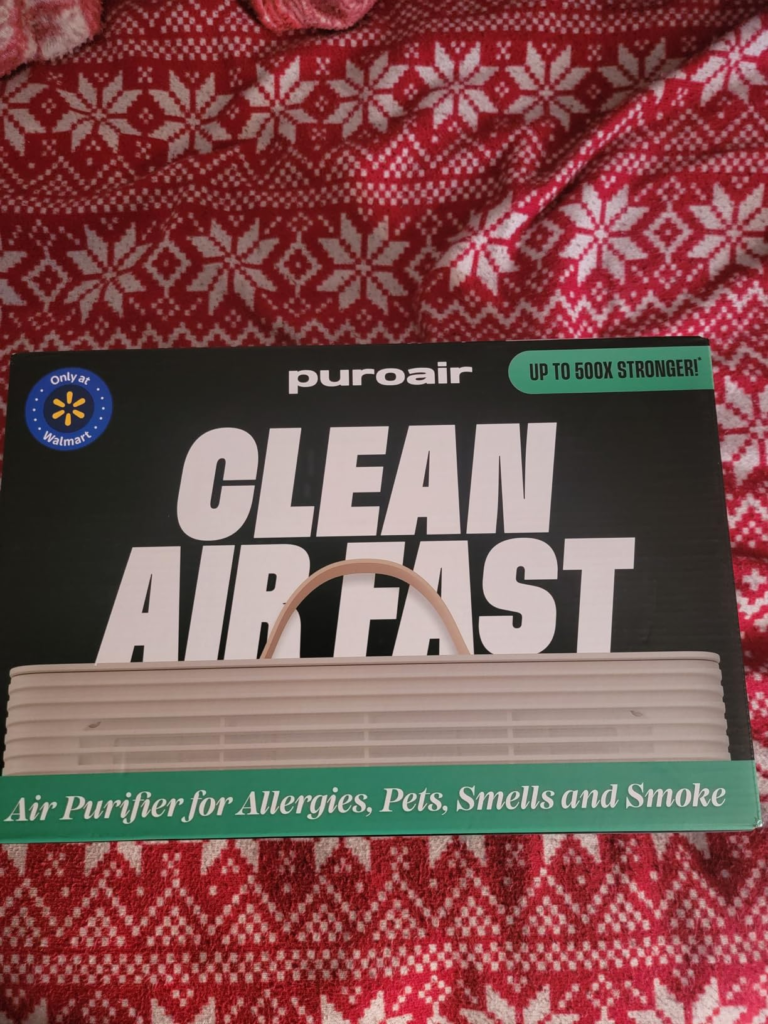
Core Specifications at a Glance
| Specification | PuroAir 100i |
|---|---|
| Marketed Coverage (1 ACH) | Up to 550 sq ft per hour |
| Practical Effective Range (2–3 ACH) | 183–275 sq ft |
| Optimal Range (4–5 ACH) | 110–137 sq ft |
| Filtration Stages | 3 (Pre-filter + HEPA + CarbonTech™ Carbon) |
| Smallest Particle Filtered | 0.1 microns (PM1, PM2.5, PM10) |
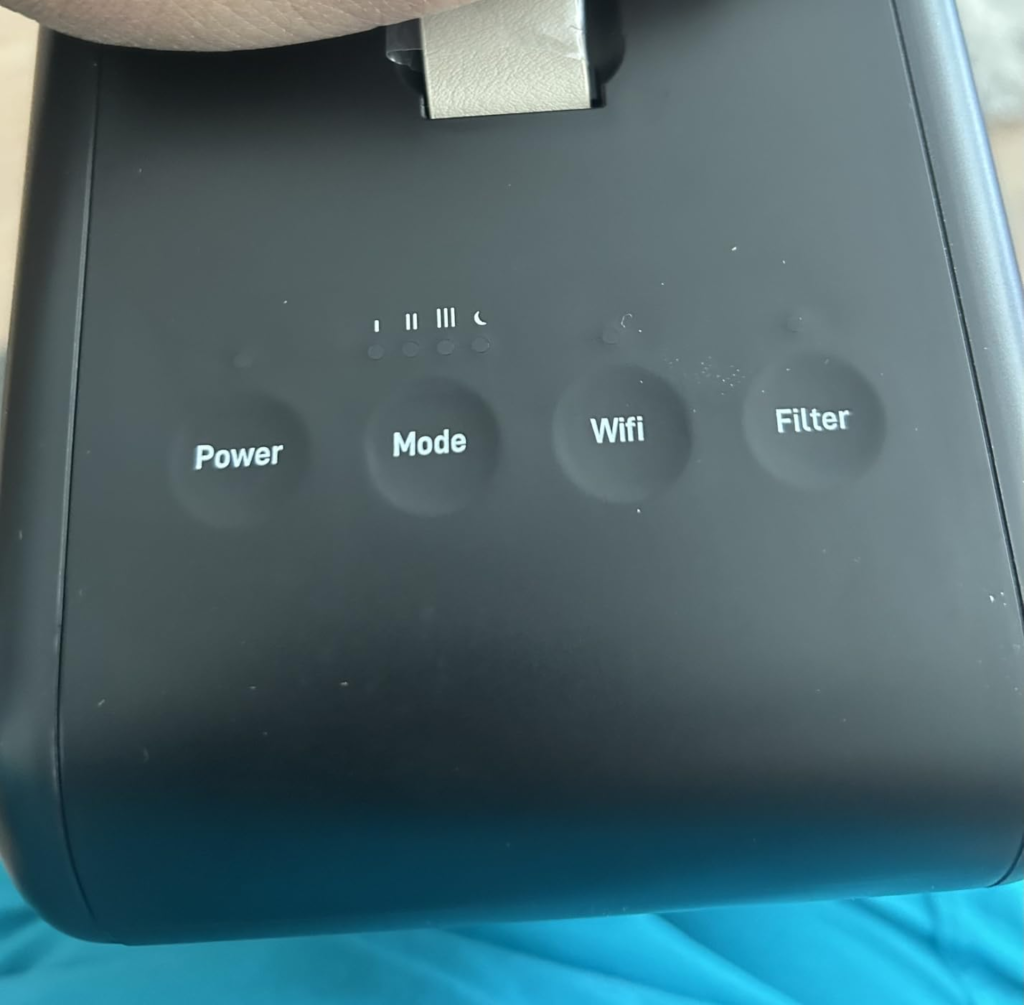
| Fan Speeds | 4 (Sleep / Low / Medium / High) |
| Sleep Mode Noise Level | ~22 dB |
| Smart Connectivity | Wi-Fi + Bluetooth |
| Voice Control | Amazon Alexa, Google Assistant |
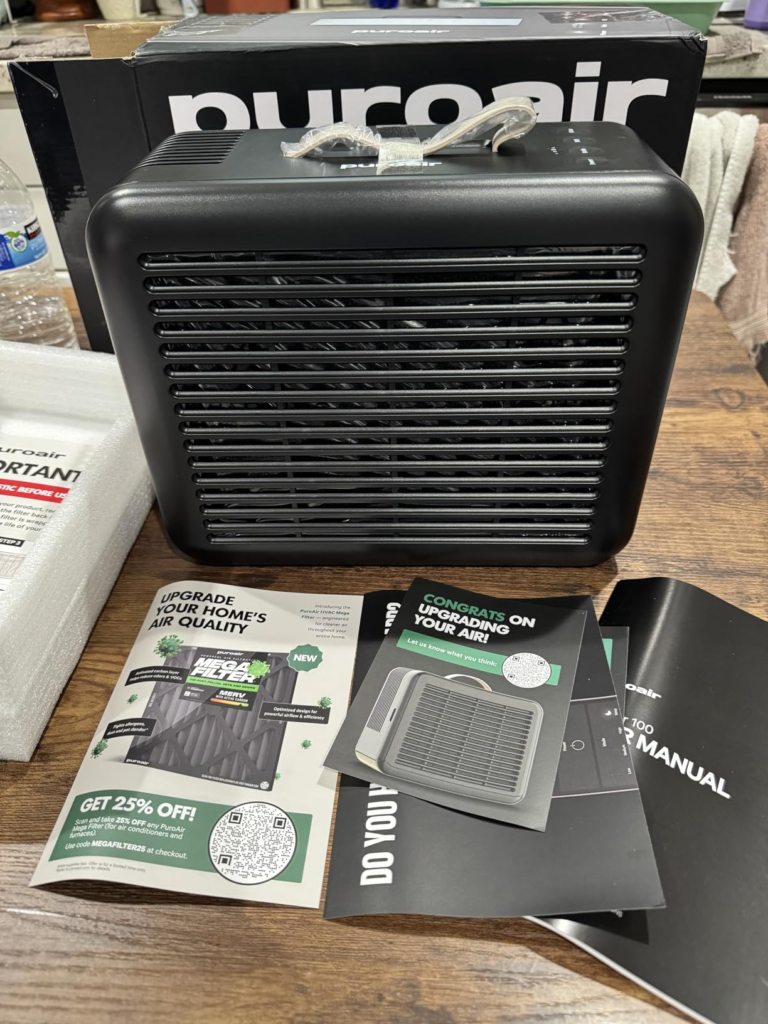
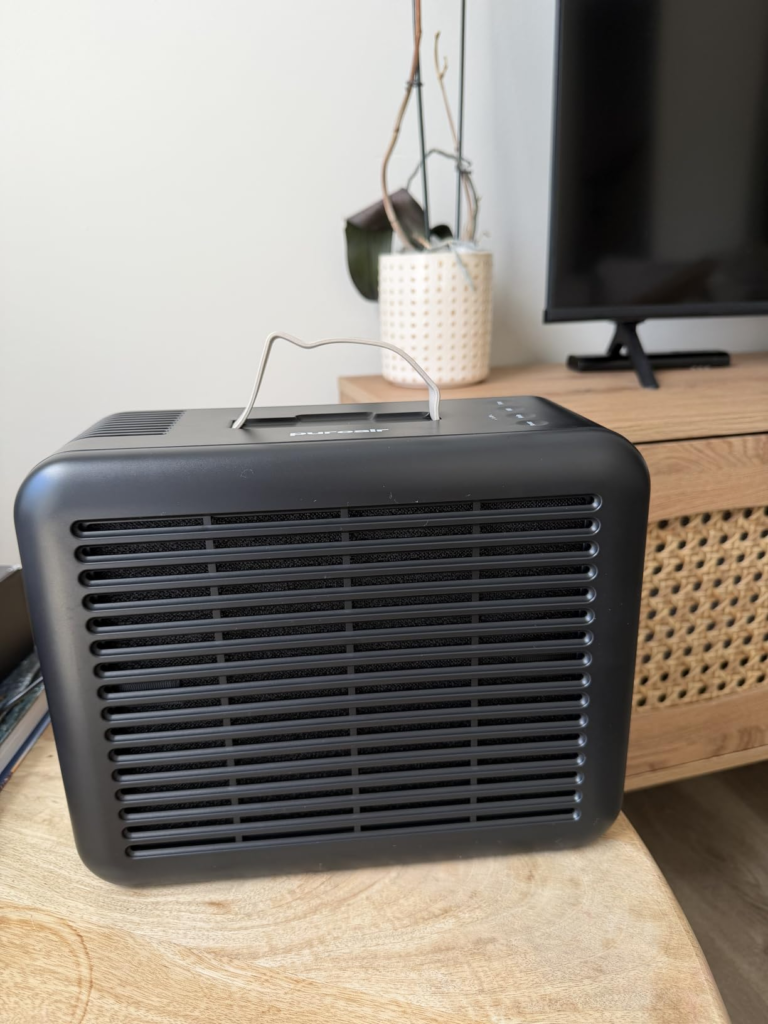
| Dimensions | 11.0″ × 8.9″ × 4.9″ |
| Filter Replacement Interval | Every 90 days |
| Filter Cost (retail) | ~$35 per filter |
| Annual Filter Cost | ~$140/year (4 replacements) |
| Device Warranty | 2 years standard / Lifetime with subscription |
| Lab Certification | ISO 17025 (2025) |
| Ozone Emission | None |
The 99.9% particle removal figure is lab-verified. It applies to what passes through the filter in a room appropriately matched to the unit’s throughput. The filter performs. The question is always: how many times per hour is it performing.
The Coverage Threshold Where This Unit Either Works or Doesn’t
This is the analytical center of this review.
The PuroAir 100i performs precisely where it was built to perform: in a contained bedroom or home office under 275 square feet, running consistently on medium to high speed for most of the day. In that condition, you achieve 2 to 3 ACH — the range where allergy sufferers begin noticing real relief, where morning congestion drops, where pet dander accumulation slows.
The unit’s effectiveness degrades predictably when conditions exceed its threshold:
| Operating Condition | At or Below Threshold | Above Threshold |
|---|---|---|
| Room size | Under 275 sq ft | Over 350 sq ft |
| Fan setting | Medium or high, consistent | Low only, intermittent |
| Room openness | Enclosed bedroom or office | Open-plan space, no walls |
| Daily runtime | 8+ hours | 2–3 hours only |
| Doors/windows | Generally closed | Frequently open |
| Expected result timeline | Noticeable change in 7–14 days | Unlikely regardless of time |
The threshold isn’t a design flaw. It’s a boundary of honest application — one that the packaging expresses only in the “up to” framing without naming the ACH variable that determines when “up to” becomes “barely.”
Why Most Buyers Misread the 550 Sq Ft Number Too Early
The confusion is structural, not accidental.
“550 square feet” is the kind of number that makes a standard bedroom feel covered with room to spare. The average US bedroom runs 200–250 sq ft. The figure sounds generous, not limiting. Buyers interpret it as “this works in anything under 550” — which is technically accurate at 1 ACH, but functionally incomplete for anyone expecting allergy results.
The comparison trap deepens the misread. Against units claiming 200 sq ft coverage, 550 looks like a clear performance advantage. Against units claiming similar footage, price becomes the deciding variable. Neither comparison asks the question that actually matters: at what air-change rate is that coverage defined?
A second error is feature-led judgment. The 100i has Wi-Fi. It has an app. It works with Alexa and Google Assistant. None of those features influence the ACH calculation. They influence convenience and behavioral consistency — both genuinely valuable — but they are not a proxy for filtration throughput. Buyers who mistake smart connectivity for stronger cleaning power misread what the premium is actually paying for.
The buyers who stay satisfied over time match room to unit before they plug it in. The ones who return it usually checked coverage first and ceiling height never.
Who Is Actually Living Inside This Problem
The PuroAir 100i is relevant to a specific set of conditions. Not every air quality complaint belongs here, and the article cannot close well without naming exactly who does.
You are genuinely inside this problem if:
You wake up consistently with congestion, dry throat, or eye irritation in a bedroom where one or two pets also sleep. The source is indoor and contained — not outdoor pollution cycling through a constantly open apartment.
You work from a dedicated home office under 250 sq ft and spend six or more hours per day in that specific room. The air isn’t moving much. The same air gets breathed repeatedly.
You travel between spaces — a city apartment, a family home, a vacation rental — and want a portable unit light enough to carry between them without buying multiple devices.
You already manage home devices through an app (smart lights, thermostat, locks) and expect the same level of control from an air purifier. Manual panels that require physical adjustment at 2 AM are a daily friction for you that you’ve actually thought about.
You have an infant or young child in a dedicated nursery and want whisper-quiet nighttime operation with remote control so you don’t enter the room to adjust settings.
Where Wrong-Fit Begins
Not everyone reading this should buy the PuroAir 100i. The article is more useful if it says so directly.
| Wrong-Fit Condition | Why It Fails Here |
|---|---|
| Open-plan apartment or living area over 350 sq ft | 1.4 ACH or less — below the threshold for perceptible improvement |
| Using one unit to address a whole apartment | This is a room-level device, not a home-wide air system |
| Expecting zero ongoing maintenance | Filter replacement every 90 days is non-optional for performance |
| Prioritizing cheapest CADR per dollar | Budget HEPA units offer comparable particle filtration at lower upfront and filter costs |
| Heavy cigarette or cigar smoke in a large room | Carbon layer handles moderate smoke; heavy continuous smoke loads in large spaces require higher-capacity units |
| Already running a larger purifier and looking for an upgrade | The 100i is a compact smart-feature model, not a replacement for a high-CADR unit in the same space |
| Expecting results within 48 hours | Air quality change requires multiple daily cycles sustained over 7–14 days |
If room size is the blocking variable, PuroAir’s 240 model covers 1,000 sq ft. If pure value per CADR is the priority, the Levoit Vital 200S or Winix A230 deliver comparable filtration at lower operating costs. This article isn’t written to redirect — just to close the wrong door cleanly before it costs you a return shipping label.
The One Situation Where the PuroAir 100i Becomes the Logical Answer
After the above — after the threshold, the coverage math, the wrong-fit matrix — the unit earns its place precisely.
If you have a bedroom between 150 and 275 square feet, a consistent indoor allergen source (pet dander, dust, seasonal pollen through HVAC), and a preference for managing your environment from your phone without thinking about it — this is the product that closes the gap without requiring constant manual attention.
What separates the 100i from a cheaper HEPA unit at the same room size isn’t the filter. Compliant HEPA performance is comparable across certified products. The differentiation is behavioral: smart features determine whether a purifier actually runs consistently or sits unplugged because the interaction became a friction point.
| Smart Feature | Practical Impact in a Bedroom Context |
|---|---|
| Sleep Mode (~22 dB) | Runs all night without disrupting sleep — no tradeoff between clean air and quiet |
| App Scheduling | Pre-cleans the room before you enter it; runs during day when you’re away |
| Filter Replacement Reminder | Prevents the invisible performance drop of an expired filter |
| Voice Control (Alexa / Google) | No physical panel interaction needed at night or during calls |
| Wi-Fi Remote Control | Turns on the bedroom unit from the living room before you go to bed |
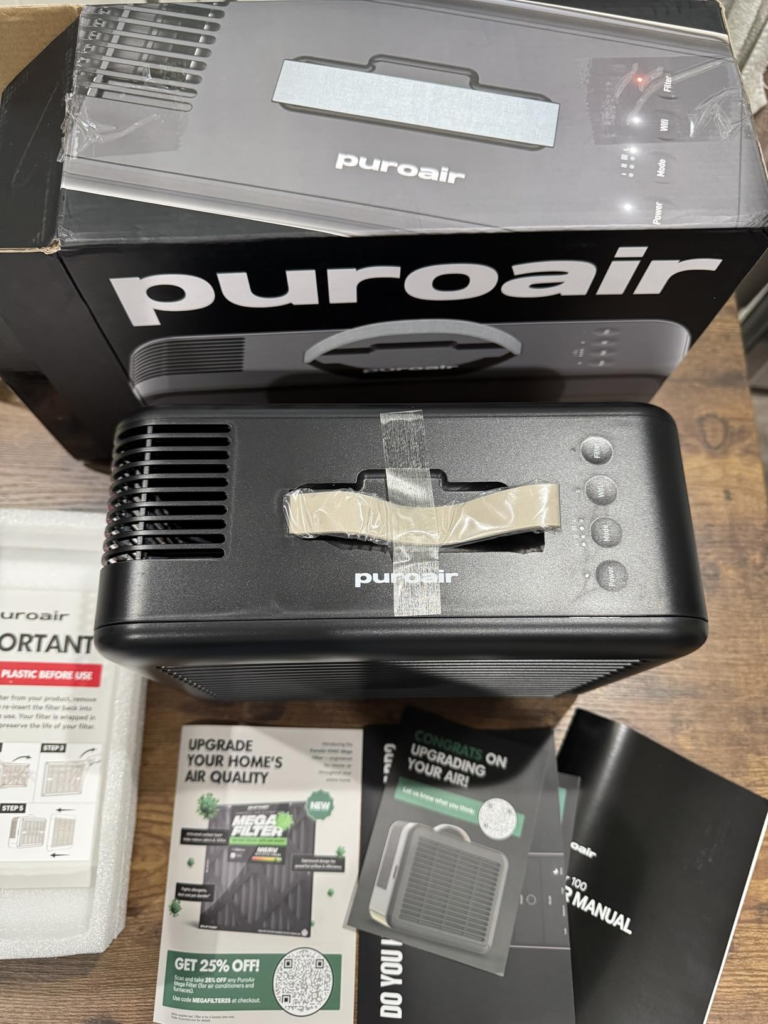
| Suitcase Handle | Moves between bedroom and home office without a second device |
| CarbonTech™ Carbon Layer | Eliminates odors and gases, not just particles |
The last point is often undervalued. Most bedroom air quality issues aren’t exclusively particulate. Pet odor, cooking residue that drifts, synthetic material off-gassing from new furniture — these are gas-phase problems. A HEPA-only unit doesn’t resolve them. The CarbonTech layer does.
What It Solves, What It Reduces, and What It Still Leaves to You
The 100i resolves particulate load and odors in a correctly sized, consistently operated room. That covers a meaningful share of real indoor air problems.
| Category | What the 100i Handles | What It Reduces (Not Eliminates) | What It Cannot Fix |
|---|---|---|---|
| Particles | Dust, pollen, dander down to 0.1 microns | Accumulation speed on surfaces | Outdoor particle sources entering through open windows |
| Odors | Cooking smells, pet odor (in small rooms), low-level smoke | Residual tobacco odor in large rooms | Persistent chemical odors from renovation or industrial off-gassing |
| Biological | Mold spores, bacteria-scale particles (HEPA level) | Allergy symptom frequency and severity | Active mold growth — a dehumidifier and source removal problem |
| Sleep quality | Air-related congestion and night-breathing friction | Morning eye irritation | Noise from outside, temperature, or non-air-quality sleep disruption |
| Air freshness | VOC reduction, stale air feel | Not full VOC elimination in high-traffic rooms | Structural ventilation problems |
What stays on you: consistent daily runtime (8+ hours in a closed room), filter replacement on schedule every 90 days, and calibrated expectations about improvement speed. Seven to fourteen days of continuous use is the honest window for most users to notice a real difference. Expecting visible change in 48 hours — in a room whose air hasn’t cycled more than twice — is a misread of the mechanism, not a product failure.
Final Compression
The PuroAir 100i is precisely built for a specific zone of use. Inside that zone — a bedroom or home office under 275 sq ft, with a known allergen source, operated consistently on a schedule, filter replaced on time — it delivers measurable, sustained air quality improvement with a smart feature layer that makes consistent use frictionless.
Outside that zone, the math breaks before the motor does.
Full Annual Cost Estimate
| Cost Component | Without Subscription | With Subscription (10% off filters) |
|---|---|---|
| Device (one-time, estimated) | ~$79–89 | ~$79–89 |
| Replacement Filters (×4/year at ~$35 ea.) | ~$140 | ~$126 |
| Warranty | 2 years | Lifetime on device |
| Estimated Energy Cost | ~$12–18/year | ~$12–18/year |
| Year 1 Total | ~$231–247 | ~$217–233 |
| Year 2+ Total | ~$152–158 | ~$138–144 |
Filter price confirmed from PuroAir’s website: 10% subscription discount = $3.50 saved per filter at $35 retail. Verify current device price before purchase.
If your room is under 275 sq ft, your problem is indoor — pet, dust, or pollen — and you want air purification that integrates into how you already live: this is the decision that closes the loop. Not because it’s perfect for every room. Because it’s correctly built for the room most people actually use it in.
Frequently Asked Questions
| Question | Answer |
|---|---|
| Does the PuroAir 100i actually clean a 550 sq ft room? | Technically yes — at 1 air change per hour, which is the industry minimum threshold for “coverage.” But 1 ACH is not the standard for allergy relief or meaningful air quality improvement. The recommended level for those outcomes is 4 to 5 ACH. At that rate, the 100i performs most effectively in rooms under 137–183 sq ft. In a 550 sq ft space, you’ll detect some improvement over time, but not the relief that users in appropriately matched rooms report. |
| How loud is the PuroAir 100i during sleep? | In Sleep mode, the unit operates at approximately 22 dB — comparable to a whisper in a quiet room. On medium speed it remains below 45 dB. Most users describe the sleep setting as producing a soft, consistent white noise that becomes background sound within a few minutes of lying down. It is genuinely unobtrusive for light sleepers in a way that most air purifiers at this coverage level are not. |
| How much do replacement filters cost, and how often? | Filters require replacement every 90 days — four times per year. Retail price is approximately $35 per filter (~$140/year). PuroAir’s subscription program reduces this by 10% (~$126/year) and upgrades the device warranty from 2 years to lifetime. The subscription is cancellable at any time. |
| Does the PuroAir 100i produce ozone? | No. The 100i uses mechanical HEPA filtration and activated carbon exclusively. It does not include an ionizer, UV lamp, or plasma-wave technology. No ozone is generated as a byproduct. |
| Can I use the PuroAir 100i without the app? | Yes. The physical control panel on the device operates all functions — power, fan speed, mode selection — without the PuroAir app. The app adds scheduling, remote control, filter life tracking, and voice assistant integration, but none of it is required for the purifier to run. |
| Is the PuroAir 100i worth it versus a Levoit Core 300 or Winix A230? | Depends on what you’re optimizing for. If raw CADR per dollar is the primary metric, the Levoit and Winix both offer comparable particle filtration at lower upfront costs and cheaper annual filter replacements. The 100i’s premium is the smart feature layer — Wi-Fi scheduling, app control, voice integration, and automatic filter reminders. Those features don’t clean air faster, but they determine whether you actually run the purifier consistently. |
| How quickly will I notice a difference after using the PuroAir 100i? | In a room under 200 sq ft with a consistent allergen source (one or two pets, active dust accumulation), most users report a noticeable reduction in eye irritation and morning congestion within 7 to 14 days of continuous use. Results are proportional to how many hours per day the unit runs, how enclosed the room is, and how recently the filter was replaced. Expecting dramatic change within 48 hours is unrealistic — the air requires multiple daily cycles before particulate load drops to a perceptibly lower baseline. |
| What does the American Lung Association partnership actually mean? | PuroAir maintains a partnership with the American Lung Association, which is a public health collaboration — not a product certification. It signals that the brand operates in alignment with ALA air quality education standards, but it should not be read as the ALA independently testing or endorsing this specific model. The relevant independent validation for the 100i is the ISO 17025 lab certification for filtration performance, confirmed in 2026. |
Transparency Note:
This analysis is built on aggregated real-world experience.
It extracts what repeatedly holds, what breaks, and what users uncover only after living with the system—then shapes it into a clear model you can use immediately.
Think of it as structured experience, refined and presented so you don’t have to learn it the hard way.
“A quick note: Don’t believe the star ratings, but trust personal experience. This article is a compilation of collected experiences”