Your Pour-Over Looks Right. Your Coffee Keeps Lying to You. The TIMEMORE FISH SMART ELECTRIC KETTLE Changes That.
The Result Looks Fine. The Problem Isn’t.
You followed the ratio. You used good beans. You watched the bloom. The cup still comes out flat — or sharp — or something in between that you can’t reliably fix.
This is the most common frustration in pour-over brewing, and it almost never gets named correctly. People adjust their grind. They change the filter. They switch beans. The variable they leave untouched is temperature — because nothing in their setup is actually measuring it with enough precision to matter.
A standard kitchen kettle boils water and stops. You pour at what you assume is the right temperature. But from boil to cup, water loses heat fast — and without real-time tracking, you are guessing. Every. Single. Time.
That guessing is the mechanism. Not your grind. Not your recipe. Not your ratio.
What You’re Actually Feeling but Not Naming
There’s a specific irritation that builds in home brewing that most people don’t have a word for: extraction inconsistency that travels with you from batch to batch.
The extraction changes and you can’t isolate why. You recreate the same setup tomorrow and get a different cup. You assume it’s the beans. Or you blame ambient temperature. Or you conclude you just weren’t “dialed in” yet.
What’s actually happening: the water you’re pouring varies by 5 to 10 degrees Celsius between attempts, and that range alone shifts your extraction profile in ways that override everything else you controlled.
That’s not barista failure. That’s a missing instrument.
The frustration isn’t about skill. It’s about pouring blind.
The Hidden Mechanism Behind the Miss
Water temperature is not the only variable — but it is the one that multiplies all others.
Pour at 92°C when your beans need 87°C, and you accelerate extraction on the soluble bitter compounds before the desired aromatics fully transfer. Pour at 84°C when the recipe asks for 90°C, and you underextract, leaving the cup sour and thin regardless of how precise your timing was.
This is not a subtle margin. A 5-degree error is audible in the cup.
The deeper mechanism: most home brewers don’t have a kettle that holds temperature during the pour. They heat, wait to cool, then pour. By the time the second or third stage of a bloom-and-pour sequence is complete, the water in their kettle has dropped another 3 to 6 degrees without any active correction.
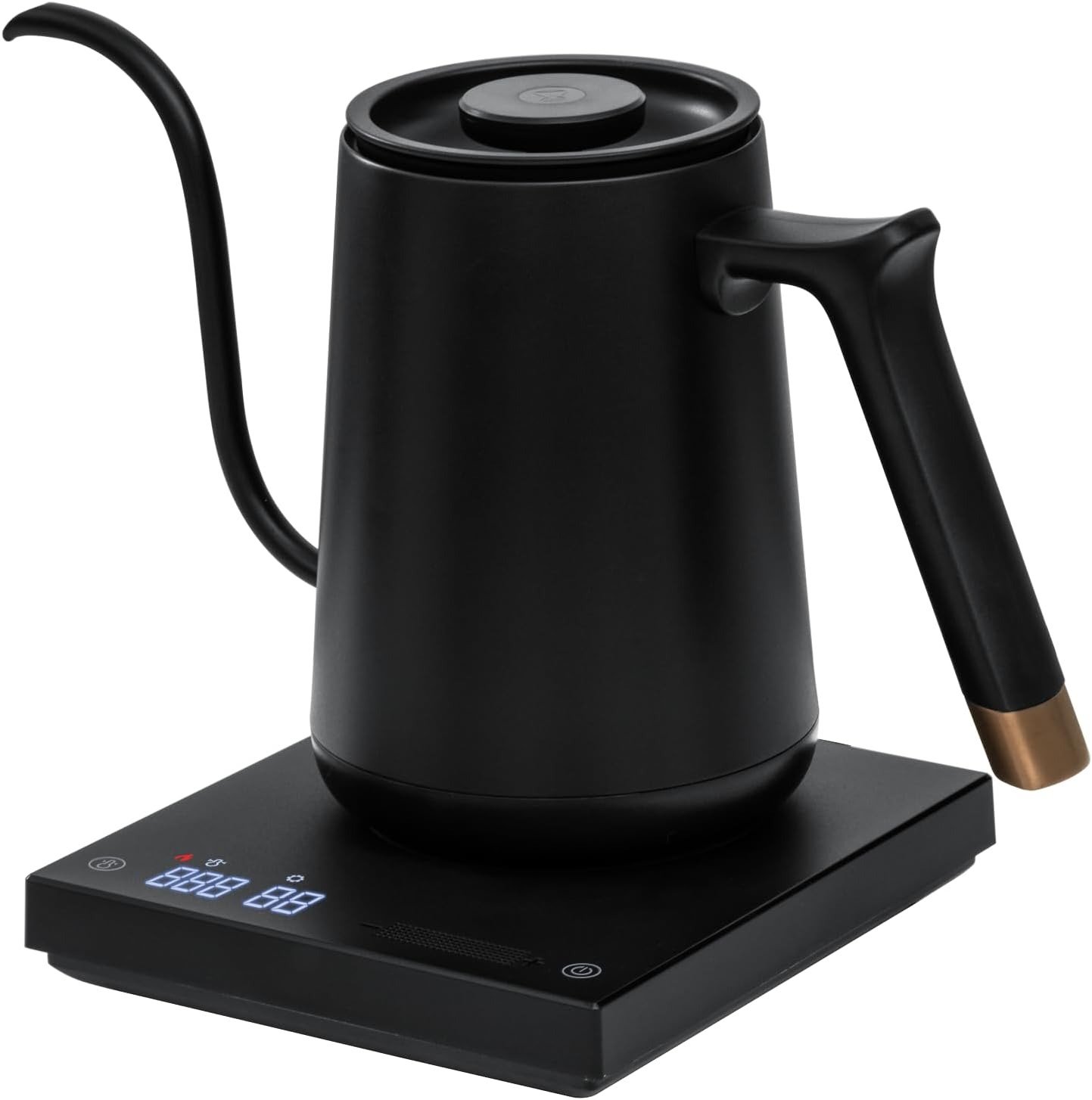
The TIMEMORE Fish Smart Electric Kettle addresses exactly this gap. Its STRIX controller — a British-engineered temperature regulation system used in precision kitchen and lab equipment — maintains water at your target with ±1°C accuracy in HOLD mode. When the water cools during use, the kettle actively reheats to return to the set point. You are not chasing a number. The number stays where you put it.
The Threshold Where the Outcome Quietly Breaks
There is a specific threshold in pour-over brewing where temperature variance stops being background noise and starts being the primary failure point.
That threshold is a 5°C drift window.
Within 5 degrees of your target, you can still extract a recognizable cup. A skilled brewer with good beans can compensate with technique. Beyond 5 degrees — either direction — the extraction chemistry shifts enough that no amount of pour-control correction brings it back.
Most standard kettles with no thermal regulation exceed that drift window during a single multi-stage pour. You may be starting at 93°C, but by the third pour in a four-pour sequence, your water is at 86°C and falling.
That is not a technique problem. That is a tooling problem.
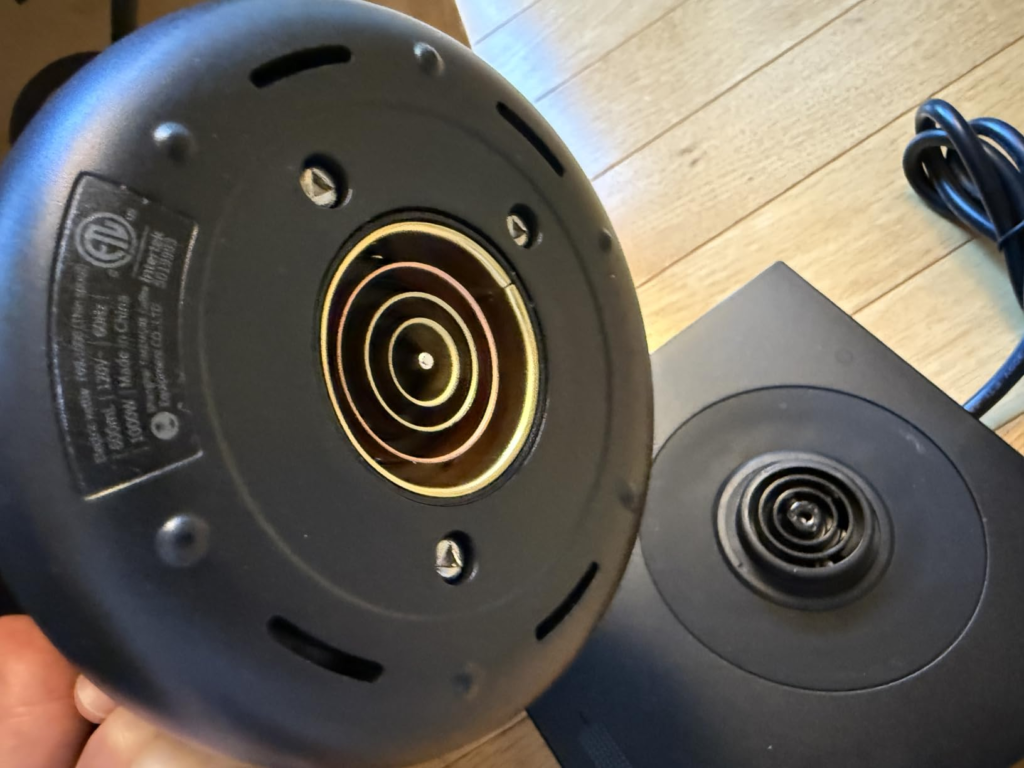
The Fish Smart Kettle closes this window by design. The STRIX controller monitors water temperature continuously and applies corrective heating before the drift becomes an extraction variable. The dual LED display — showing both actual temperature and target temperature simultaneously — makes that gap visible in real time, for the first time.
Why Most Buyers Misread This Too Early
The most common comparison made with this kettle is price-to-feature against a basic gooseneck kettle in the $30–50 range. The question people ask: “Does a kettle with temperature control really make a difference?”
That question is the wrong frame.
The right question is: “Do I already have something that measures and holds temperature to ±1°C during a live brew?” If the answer is no, then the gap between a standard gooseneck kettle and the TIMEMORE Fish Smart is not about premium features. It is about whether you are actually controlling the variable that runs extraction.
A second misread: comparing the Fish Smart to the Fellow Stagg EKG on price, and stopping there. The Fellow Stagg retails in the $175–200 range. The Fish Smart comes in meaningfully below that. Both use STRIX-class temperature control. Both feature precision gooseneck spouts. The Stagg adds a built-in brew timer and a slightly more robust interface. The Fish Smart adds nothing unnecessary — which is, for a segment of brewer, exactly the right decision.
The third misread: treating the slide-bar temperature interface as a drawback. One reviewer noted that the slider changes temperature in 5°C increments per swipe, which requires multiple passes for large adjustments. That is a real characteristic. It is not a flaw — it is a deliberate tradeoff toward minimal visual clutter. If your workflow requires rapid mid-session temperature jumps between dramatically different targets, that matters. If you set your target once before brewing and hold it, it does not.
| Feature | TIMEMORE Fish Smart (600ml) | Fellow Stagg EKG (900ml) | Standard Gooseneck Kettle |
|---|---|---|---|
| Temperature control accuracy | ±1°C (STRIX) | ±1°C | None |
| HOLD mode (active reheat) | Yes | Yes | No |
| Dual temp display | Yes | Yes | No |
| Built-in brew timer | No | Yes | No |
| Capacity (home edition) | 560ml usable | ~800ml usable | Varies |
| Gooseneck spout | Patented 90° vertical | Precision gooseneck | Basic or none |
| Boil-dry protection | Yes | Yes | Rarely |
| Heating speed (to 88°C) | 220 seconds | ~180 seconds | Uncontrolled |
| Price range | ~$80–100 | ~$175–200 | $25–50 |
| Material | 304 food-grade SS | 304 food-grade SS | Varies |
Who Is Actually Inside This Problem
The TIMEMORE Fish Smart Kettle is not for everyone who makes coffee at home.
It is specifically for someone who:
- Brews pour-over as a consistent daily or near-daily practice, not occasionally
- Has already invested in a quality grinder and understands that extraction is multi-variable
- Is producing cups that are inconsistent in ways they cannot isolate with grind adjustment alone
- Operates at a volume where 600ml per session is sufficient — typically one to two cups
- Prefers a minimal, clean workspace without excess interface complexity
If you are brewing two to three cups daily in a V60, a Chemex, or any flat-bed dripper that rewards consistent multi-stage pouring, this kettle directly addresses the variable most likely limiting your consistency.
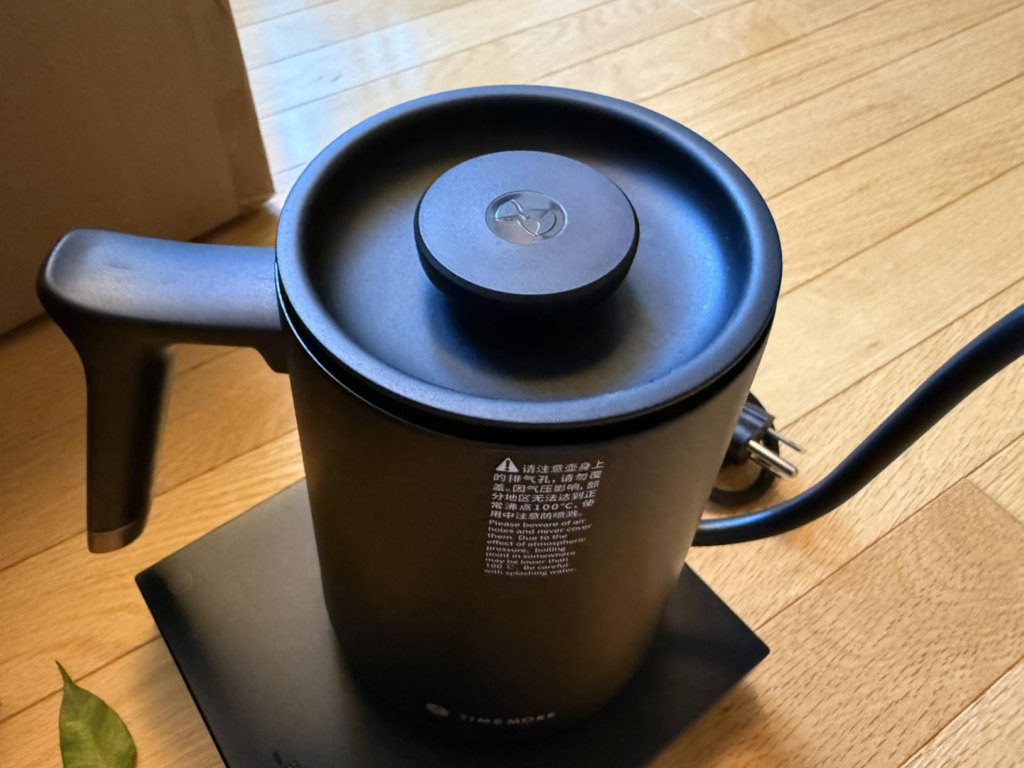
The patented gooseneck spout — engineered for a 90° vertical water stream — also removes the technique barrier that keeps beginners from consistent bloom and spiral pour execution. That is not a minor detail. Controlling where the water lands during bloom is the difference between even and uneven saturation, and uneven saturation produces channeling, which produces extraction unevenness that no temperature fix will correct.
Where Wrong-Fit Begins
This kettle is not the right decision in several clear scenarios.
Capacity mismatch: The 600ml home edition holds a maximum of 560ml of usable water. If you are regularly brewing three or more cups simultaneously, or sharing a Chemex serving, you will need to refill mid-session. That interrupts workflow and potentially introduces a cooling event mid-brew. The 800ml commercial version addresses this for higher-volume use, but those bases are not interchangeable.
Fahrenheit-only users: Temperature is displayed in Celsius only. There is no toggle for Fahrenheit. If your brewing recipes and intuition are built entirely around Fahrenheit values, you will need to convert or re-calibrate your reference points. This is a real friction point for US-based brewers who operate in Fahrenheit natively.
Single-use multipurpose kitchen kettle: This is a precision brewing tool. It is not optimized for quickly boiling a large volume for pasta water, instant noodles, or high-volume tea service. The gooseneck spout that makes it excellent for pour-over makes it slow for general-purpose filling. If you want one kettle that does everything well, this is not it.
Interface-sensitive users: The slider control is elegant on the counter but requires patience at adjustment time. Users who want one-touch preset temperatures or rapid interface switching may find the experience underwhelming compared to kettles with dedicated preset buttons.
| Buyer Type | Good Fit | Poor Fit |
|---|---|---|
| Daily pour-over brewer (1–2 cups) | ✓ | |
| Brewing V60 / Chemex / flat-bed drippers | ✓ | |
| Wants clean minimal workspace | ✓ | |
| Celsius-comfortable | ✓ | |
| Brewing 3+ cups simultaneously | ✓ | |
| Multipurpose kitchen kettle user | ✓ | |
| Fahrenheit-only recipe user | ✓ | |
| Wants built-in brew timer | ✓ | |
| Needs rapid preset temperature switching | ✓ |
The One Situation Where This Product Becomes Logical
If you brew pour-over daily, you have a quality grinder, and your results are inconsistent in ways you cannot reliably fix with grind adjustment — the TIMEMORE Fish Smart Electric Kettle is the logical correction.
Not because it is the most feature-rich kettle on the market. Because it eliminates the variable that is actually responsible for the inconsistency you are experiencing.
The STRIX controller holds temperature to ±1°C across the full duration of your brew session. The patented spout produces a stable vertical stream from the first second of the pour. The 304 stainless steel interior adds no taste contamination. The dual display keeps both actual and target temperature visible, removing all guesswork from the equation.
This is not a luxury upgrade for its own sake. It is a precision instrument that closes the gap between knowing your recipe and executing it.
The 600ml home edition sits at a price point that makes it the most accessible STRIX-controlled gooseneck kettle currently available to specialty home brewers.
What It Solves, What It Reduces, and What It Still Leaves to You
| Category | What the TIMEMORE Fish Smart Does |
|---|---|
| Solves | Temperature drift during pour sessions |
| Solves | Inability to target a precise extraction temperature |
| Solves | Inconsistent heat at different stages of a multi-pour sequence |
| Solves | Pour control instability for beginner and intermediate brewers |
| Reduces | Batch-to-batch extraction variance caused by thermal guessing |
| Reduces | Time lost waiting and guessing water cooldown |
| Still on you | Grind consistency and calibration |
| Still on you | Pour timing and sequencing |
| Still on you | Water quality and mineral content |
| Still on you | Bean freshness and storage |
| Still on you | Dose-to-water ratio accuracy |
The kettle removes a real, specific failure point. It does not replace the skill of knowing what that failure point costs your cup, or how to build a recipe around correcting it.
Final Compression
You are not a bad brewer. You are brewing without complete instrumentation.
The TIMEMORE Fish Smart Electric Kettle is a precision thermal control device that happens to have a beautiful form. The STRIX controller, the dual display, the patented gooseneck spout, the 304 stainless construction — these are not marketing features layered on a standard kettle. They are the components that close the specific gap between a repeatable recipe and a repeatable result.
If you brew pour-over daily and your inconsistency lives in extraction — not in your ratio, not in your grind, but in that undocumented thermal space between your kettle and your cup — this is where the decision stops being vague.
Frequently Asked Questions
| Question | Answer |
|---|---|
| Does the TIMEMORE Fish Smart Kettle display temperature in Fahrenheit? | No. The display shows Celsius only. There is currently no option to switch to Fahrenheit. US brewers should convert their target temperatures before use (e.g., 200°F ≈ 93°C, 205°F ≈ 96°C). |
| How long does HOLD mode maintain the target temperature? | The home edition (600ml) holds temperature for up to 60 minutes. The commercial version can hold for up to 12 hours. HOLD mode actively reheats the water if temperature drops below the set target. |
| Can the 600ml base and 800ml base be swapped? | No. Timemore explicitly states the two heating bases are not universal and cannot be interchanged between the home and commercial editions. |
| How fast does the kettle heat water? | The 600ml home edition heats water to 88°C in approximately 220 seconds. The 800ml commercial edition (1500W) does it in approximately 192 seconds. Both are faster than most standard electric kettles at equivalent volumes. |
| Is the STRIX controller the same used in laboratory-grade equipment? | STRIX is a UK-based temperature controller manufacturer whose technology is used across high-precision heating applications. The ±1°C accuracy rating on the Fish Smart kettle is consistent with STRIX’s specifications for their kettle controller series. |
| What is the difference between the Fish Smart and the Fish Smart Pro? | The Pro version (900ml) adds a larger capacity, an improved ergonomic pinch-style handle, dual adjustment methods (slider plus buttons), and optimized flow for stronger extraction agitation. The standard Fish Smart (600ml) is sufficient for one-to-two-cup daily brewing with a cleaner, more minimal interface. |
| Is this kettle suitable for making tea? | Yes. The 40–100°C temperature range covers all common tea brewing temperatures — green tea (70–80°C), white tea (75–85°C), black tea (90–95°C), herbal tea (95–100°C). The gooseneck spout pours slowly, which is ideal for pour-over but requires patience for filling a large teapot directly. |
| Why does the slider control only change temperature in 5°C increments? | Each swipe of the slide bar adjusts the temperature by 5°C. For large adjustments, multiple swipes are required. This is a design tradeoff toward interface simplicity. You can also long-press the left button to jump directly to 100°C boil mode. |
Transparency Note:
This analysis is built on aggregated real-world experience. It extracts what repeatedly holds, what breaks, and what users uncover only after living with the system—then shapes it into a clear model you can use immediately. Think of it as structured experience, refined and presented so you don’t have to learn it the hard way.
“A quick note: Don’t believe the star ratings, but trust personal experience. This article is a compilation of collected experiences”