My Edifier R1280DB Review: The Speakers That Work — Until They Don’t, and Exactly Why
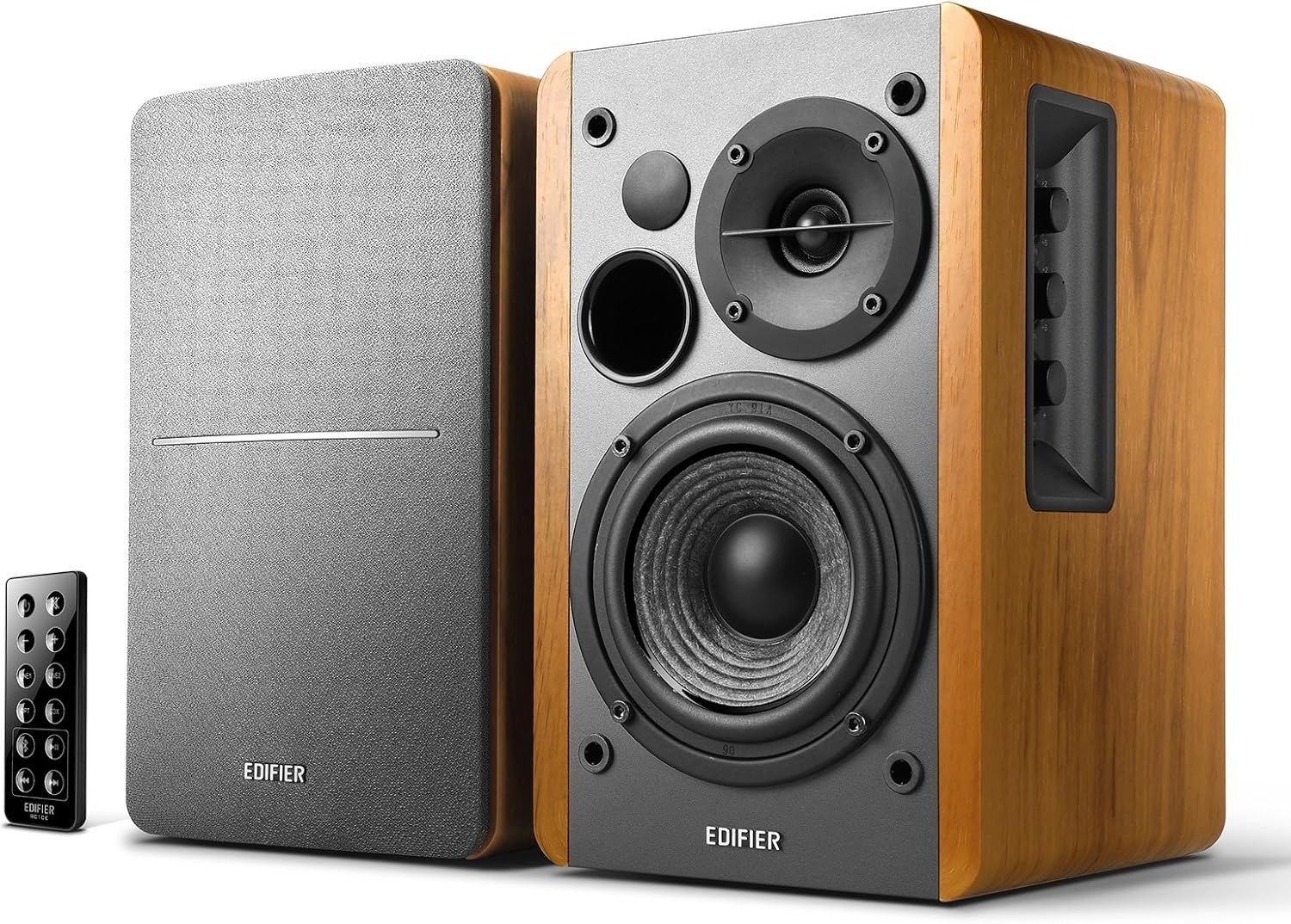
EDIFIER R1280DB
The Sound Fills the Room. The Problem Isn’t Volume.
You plug them in. You run the optical cable from the TV or the RCA from the turntable. The sound comes out clean, warm, and noticeably better than what you had before. Nothing distorts. Nothing buzzes. For the first evening, you feel the quiet satisfaction of a decision made right.
Then a week passes.
You notice something you can’t quite name. The music isn’t bad — but it’s slightly compressed somewhere in the middle. Vocals sit just behind where you expect them. A guitar chord that should ring with texture comes out smoothed over, slightly hazy. You turn the treble knob. Better. But something is still off. You’ve been listening through a small correction ever since you bought them, and you just realized it now.
That’s not a defect. That’s the threshold.
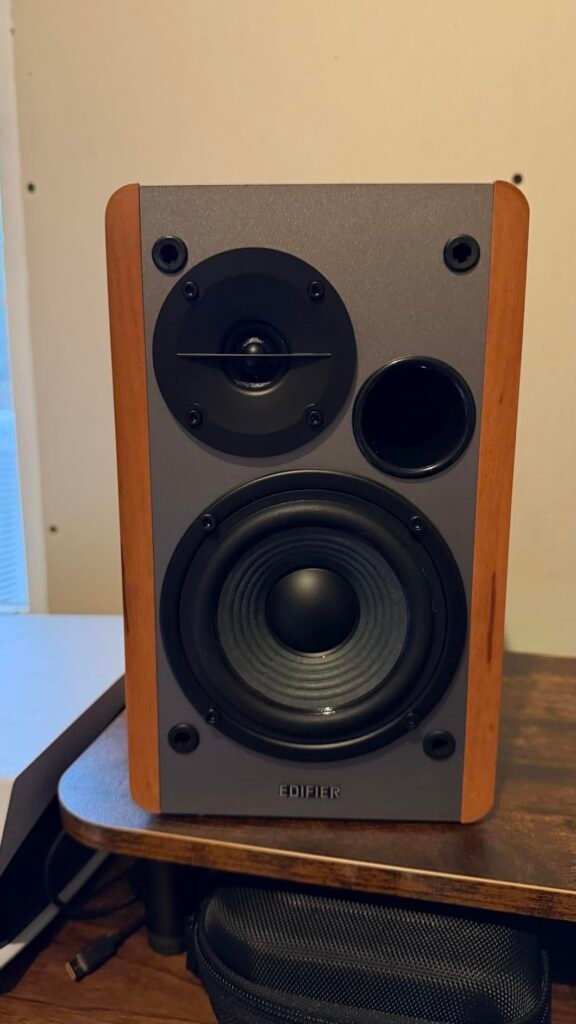
What You’re Actually Feeling but Not Naming
The R1280DB sounds good. That’s not the argument.
The argument is: good at what range, and for whom, under what conditions.
The friction people report — the slight grating when pushed to mid-high volume, the bass that goes warm and punchy but occasionally tips toward boomy, the midrange that reviews consistently describe as “even but slightly hazy” — none of this shows up in the specification sheet.
The spec sheet says: 42W RMS total, 55Hz–20kHz frequency response, 4-inch woofer, 0.5-inch silk-dome tweeter, Bluetooth 4.0, optical, coaxial, dual RCA.
What the spec sheet doesn’t say: these speakers were designed to perform in a near-field listening environment — meaning your desk, your bedroom shelf, a small study — at moderate volume levels. They were not designed to fill a living room at 70% volume and retain midrange clarity doing it.
The moment you push them past their designed operating zone, the numbers still look fine on paper. The experience starts to drift.
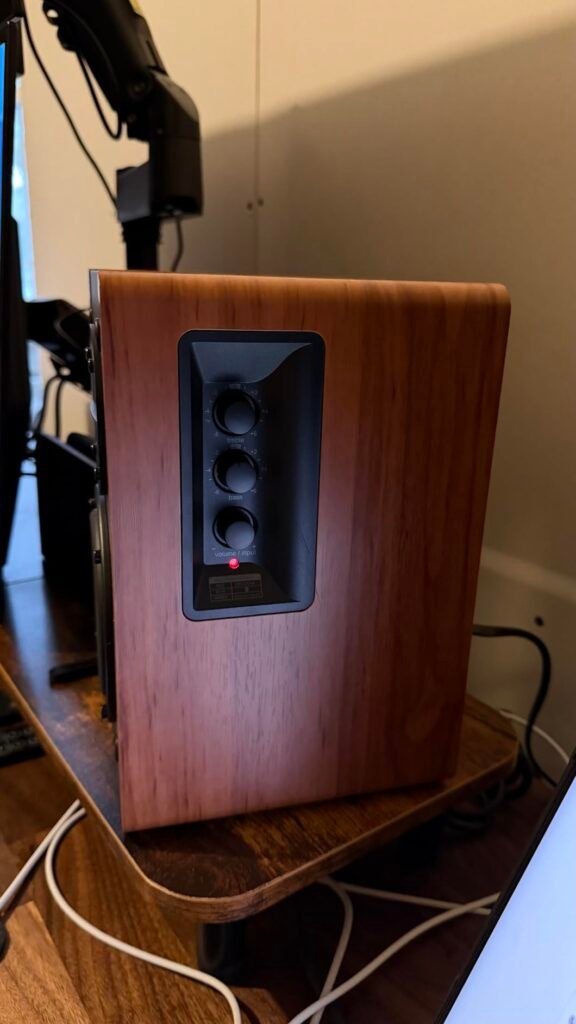
The Hidden Mechanism Behind the Miss
Here is the part that most comparisons skip.
The R1280DB uses a Class D amplification stage paired with a relatively small 4-inch driver. Class D is efficient and clean at moderate outputs. But as you push closer to the ceiling of 42W, the driver’s excursion limits interact with the port tuning — and the result is bass bloom that the EQ knob only partially corrects.
The midrange compression — that “hazy” quality identified by Consumer Reports-adjacent testing data and echoed across community forums — is not a build flaw. It’s a physical consequence of asking a 4-inch driver to reproduce both bass and mid frequencies simultaneously under load. That’s the design limitation of a 2-way bookshelf in this price class. The tweeter (0.5-inch silk dome) handles treble competently. But the crossover transition between the woofer and tweeter creates a narrow zone — roughly 800Hz to 2.5kHz — where the presentation loses definition under pressure.
At low to moderate volumes, this zone is invisible. At higher volumes, in larger rooms, or with complex orchestral and vocal-heavy tracks, the congestion becomes audible.
That’s the mechanism. Not a manufacturing defect. Not a bad unit. A design threshold that exists in every speaker at this price and driver size — but that the R1280DB reaches earlier than some alternatives because its tuning is optimized for warmth and impact, not analytical clarity.
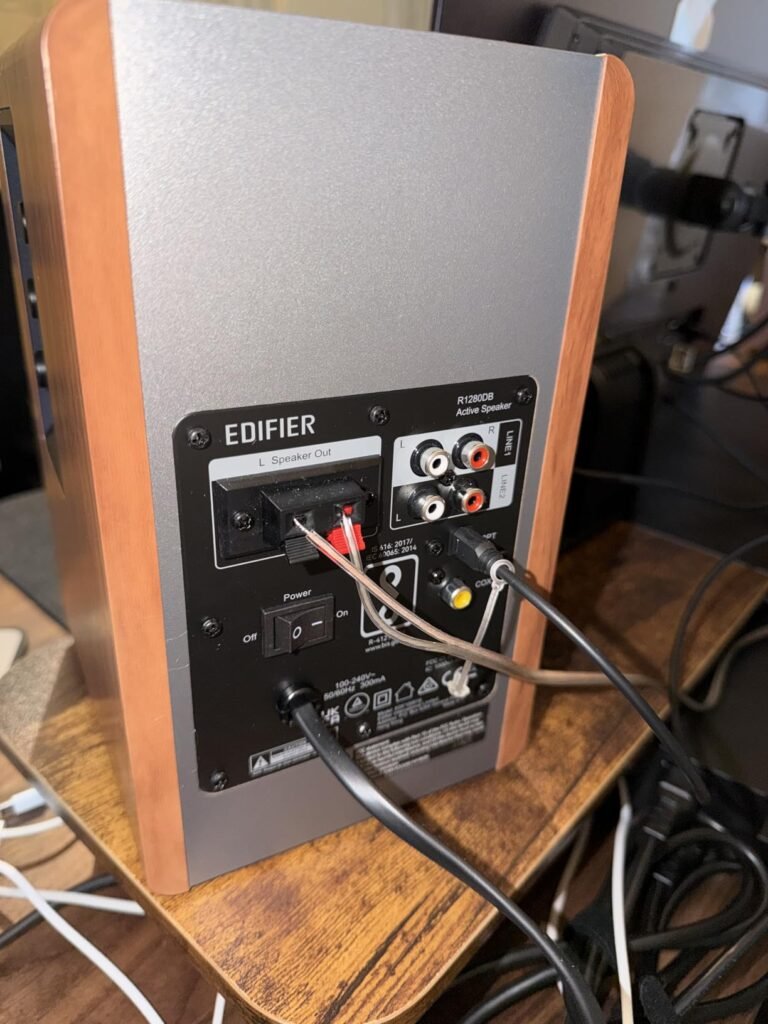
The Threshold Where the Outcome Quietly Breaks
| Condition | R1280DB Behavior |
|---|---|
| Volume at 30–50% in a small room | Clean, warm, well-balanced — performing at its best |
| Volume at 60–75% in a medium room | Slight bass bloom, midrange begins to compress |
| Volume above 75% in a larger room | Audible congestion in mids, treble can harden |
| Bluetooth connection (4.0) | Stable, easy pairing — but compressed vs. optical |
| Optical/Coaxial input | Noticeably cleaner source path — the better input choice |
| Bass dial at maximum | Punchy but risks muddiness in complex recordings |
| Bass dial at neutral or slight boost | The sweet spot most long-term users land on |
The 55Hz floor is real — but it is a soft floor. Below 70Hz, output becomes less controlled without a subwoofer. The R1280DB (unlike its sibling the R1280DBs) has no subwoofer output port, which matters if you plan to add one later.
That missing sub-out is not an accident. It’s a version difference. And it’s a permanent ceiling.
Why Most Buyers Misread This Too Early
The comparison trap looks like this:
“42 watts, optical input, Bluetooth, and a wooden enclosure — for under $160? What else do I need?”
The answer depends entirely on what you’re connecting it to, how large the room is, and how you actually listen.
Most early buyers make the judgment from specs alone. They see:
- Optical and coaxial inputs: ✓ “HD audio”
- Bluetooth 4.0: ✓ “wireless”
- 42W RMS: ✓ “powerful enough”
- MDF enclosure: ✓ “resonance control”
- Remote included: ✓ “convenient”
What they don’t interrogate: the SNR is rated at ≥85dB(A) — which is acceptable, not exceptional. The Bluetooth version is 4.0, not 5.0 (the R1280DBs updated this). There is no DSP room correction, no subwoofer output, and the EQ range of ±6dB at the knobs is functional but coarse.
None of those things are deal-breakers. All of them are variables that define whether the R1280DB is the right answer for your specific situation — or a near-miss that will frustrate you in six months.
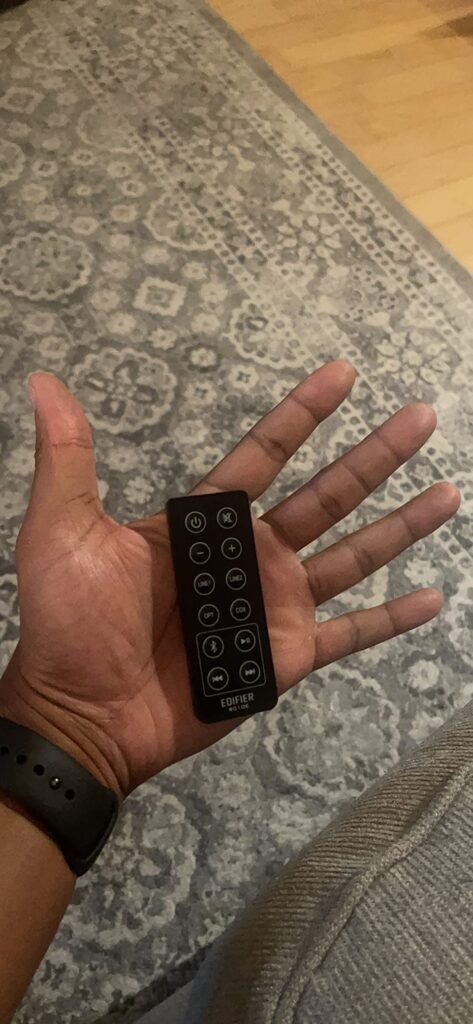
Who Is Actually Inside This Problem
The R1280DB performs reliably and honestly for a specific listener type:
| Listener Profile | Fit |
|---|---|
| Desktop computer user, 0.5–1.5m listening distance | Strong fit |
| Bedroom shelf setup, casual listening at moderate volume | Strong fit |
| TV audio upgrade in a small room via optical | Strong fit |
| Vinyl turntable output through RCA | Good fit with phono preamp |
| Background music, podcast, streaming at low-mid volume | Excellent fit |
| Person who wants clean, warm sound without configuration | Strong fit |
These are not edge cases. This is the dominant use case for the R1280DB, and within it, the speaker delivers consistent value with very low failure points.
The issue is that the product is also marketed — and purchased — by people outside this profile. And that’s where the regret begins.
Where Wrong-Fit Begins
| Listener Profile | Fit |
|---|---|
| Living room listening at higher volumes | Poor — midrange degrades under load |
| Critical listening: jazz, classical, vocals-forward music | Borderline — midrange haze becomes apparent |
| Audiophile who wants to add a subwoofer | Wrong model — no sub-out (get the R1280DBs instead) |
| Bluetooth-only user expecting hi-res wireless audio | Poor — BT 4.0 is not a high-fidelity wireless path |
| Large open-plan room needing room-filling output | Wrong scale entirely |
| Producer or musician needing reference monitoring | Incorrect tool category |
One community reviewer with decades of audio experience put it clearly: these are built for casual listening and they perform “a very pleasing sound” in that role. The moment you ask them to behave as studio monitors or living room primaries, the category mismatch is immediate.
The R1280DB also received a specific criticism in real-world feedback: at lower-mid to high volumes, the sound can become “grating in both bass and treble.” This is consistent with the threshold mechanism described earlier. It is not a defective unit. It is the speaker hitting its operating ceiling.
The One Situation Where This Product Becomes Logical
If your setup looks like this:
- A desk, a shelf, or a TV cabinet in a room under 20 square meters
- A listening distance under 2 meters
- Source connections that include at least optical or RCA (not Bluetooth-only)
- Volume habits that sit between 30% and 60% of the dial
- Music tastes that run toward bass-present genres, casual streaming, or mid-fidelity enjoyment
Then the Edifier R1280DB is not a compromise. It is the correct product.
At its current price point of approximately $100–$160 depending on timing, nothing else in its class ships with optical input, dual RCA, coaxial, Bluetooth, physical EQ controls, a remote, and an MDF enclosure simultaneously. That connectivity matrix is genuinely unusual at this price. A user running a turntable on Line 1, a TV via optical, and a laptop on Bluetooth — switching seamlessly with the remote — is getting functionality that costs considerably more from other brands.
The wood-grain MDF build also matters acoustically. Plastic-bodied competitors at this price vibrate under load. The R1280DB stays inert at moderate output, which is part of why the bass sounds more controlled than you’d expect from a 4-inch driver.
What It Solves, What It Reduces, and What It Still Leaves to You
| Category | Reality |
|---|---|
| What it solves | Messy cable management, poor TV built-in audio, low-quality PC speakers, single-source limitation |
| What it meaningfully reduces | Listening fatigue at moderate volumes, connection hassle across multiple devices, cost of entry into wired hi-fi |
| What it partially addresses | Bass depth (warm but not extended below 70Hz without sub) |
| What it cannot fix | Midrange clarity at high volumes, large-room projection, sub-bass extension |
| What remains your responsibility | Source quality, room placement, not pushing volume above threshold, choosing the right input |
The EQ knobs give you ±6dB of bass and treble control. That’s real flexibility, not a gimmick. Most long-term users report landing at a slight bass reduction and neutral treble — which corrects the factory tuning toward a flatter, more balanced presentation.
The remote functions reliably. Input switching is clean. Setup time from box to sound is under 10 minutes for most configurations.
Two limitations stay fixed regardless of how you configure it: the midrange ceiling under load, and the absence of a subwoofer output. If either of those matters to your specific situation, the R1280DB is not your endpoint — it is a step toward something else.
Final Compression
The Edifier R1280DB is not an audiophile speaker presented at a budget price. It is a near-field lifestyle speaker with exceptional connectivity breadth, honest build quality, and a sound signature tuned for warmth and casual engagement — that performs well inside a specific operating envelope and starts to fracture outside it.
The threshold is real. The mechanism is structural, not defective. And the value proposition is genuine — but only if you’re inside the right profile.
The compressed decision:
If your room is small, your listening distance is close, your source has an optical or RCA output, and your volume habits are moderate — buy it. The R1280DB delivers at that address more reliably than anything near its price.
If you want to add a subwoofer later, or you need Bluetooth 5.0, step to the R1280DBs for a small premium. If your room is large or you listen critically at high volumes, the R1280DB will eventually disappoint you — and the disappointment will feel quiet and gradual, which is the worst kind.
The decision stops being vague when the conditions are named. Yours are named now.
Frequently Asked Questions
| Question | Answer |
|---|---|
| Does the Edifier R1280DB have a subwoofer output? | No. The R1280DB does not include a subwoofer output port. If you want to connect an external subwoofer, you need the R1280DBs, which includes a dedicated sub-out with automatic crossover detection. This is one of the key hardware differences between the two models. |
| Is Bluetooth 4.0 on the R1280DB a problem in 2025–2026? | For stable connection and basic wireless streaming, no. For high-fidelity wireless audio, yes — BT 4.0 compresses audio more than BT 5.0 or aptX HD connections. If Bluetooth is your primary input, you will get better results from the optical or RCA connection. The R1280DBs uses BT 5.0 if wireless quality matters to you. |
| What is the ideal room size for the Edifier R1280DB? | Under 20 square meters (roughly 215 sq ft) at a listening distance of 0.5 to 2 meters. This is a near-field speaker, designed to project sound cleanly in front of the listener at close range — not to fill a living room wall-to-wall. |
| Why does the Edifier R1280DB sound grating at higher volumes? | This is a driver excursion issue, not a defect. When the 4-inch woofer is pushed toward its upper output limit while simultaneously managing bass and midrange frequencies, the crossover transition zone between 800Hz and 2.5kHz becomes congested. The fix is to keep volume at 50–60% maximum and reduce the bass dial slightly from factory default. |
| Can I connect a turntable directly to the Edifier R1280DB? | Only if your turntable has a built-in phono preamp. The R1280DB accepts line-level RCA input (450±50mV sensitivity), not phono-level signal. A standard turntable without a preamp outputs approximately 5mV — far too low and uncorrected. You need either a turntable with a built-in preamp or a separate phono stage between the turntable and the speaker. |
| How does the Edifier R1280DB compare to the R1280DBs? | The R1280DBs adds a subwoofer output, Bluetooth 5.0, and a wider frequency response floor (51Hz vs. 55Hz). For roughly $10–$30 more at sale pricing, the DBs is the better long-term investment if you plan to expand the system or prioritize wireless audio quality. The R1280DB makes sense if you don’t need sub expansion and want the lower price. |
| Is the optical input on the R1280DB actually better than Bluetooth? | Yes, measurably. Optical provides a lossless digital signal path directly to the DAC inside the speaker. Bluetooth 4.0 compresses audio during transmission. For TV, PC, or any source with an optical output, always use optical over Bluetooth for critical listening. |
Transparency Note:
This analysis is built on aggregated real-world experience. It extracts what repeatedly holds, what breaks, and what users uncover only after living with the system—then shapes it into a clear model you can use immediately. Think of it as structured experience, refined and presented so you don’t have to learn it the hard way.
“A quick note: Don’t believe the star ratings, but trust personal experience. This article is a compilation of collected experiences”