LG S70TY: THE SOUND SEEMS BIGGER LONG BEFORE IT BECOMES CINEMATIC
The first mistake is almost always the same.
You hear a TV get louder, fuller, weightier, and your brain rushes to file it under one flattering word: cinematic. That is where people lose money.
I have seen this pattern too many times with compact Atmos bars. The room wakes up. The subwoofer finally gives the floor a pulse. Voices lift out of the paper-thin haze of built-in TV speakers. For a few minutes, it feels like the whole problem is solved. Then a harder question arrives: did the sound actually become immersive, or did it simply stop sounding small?
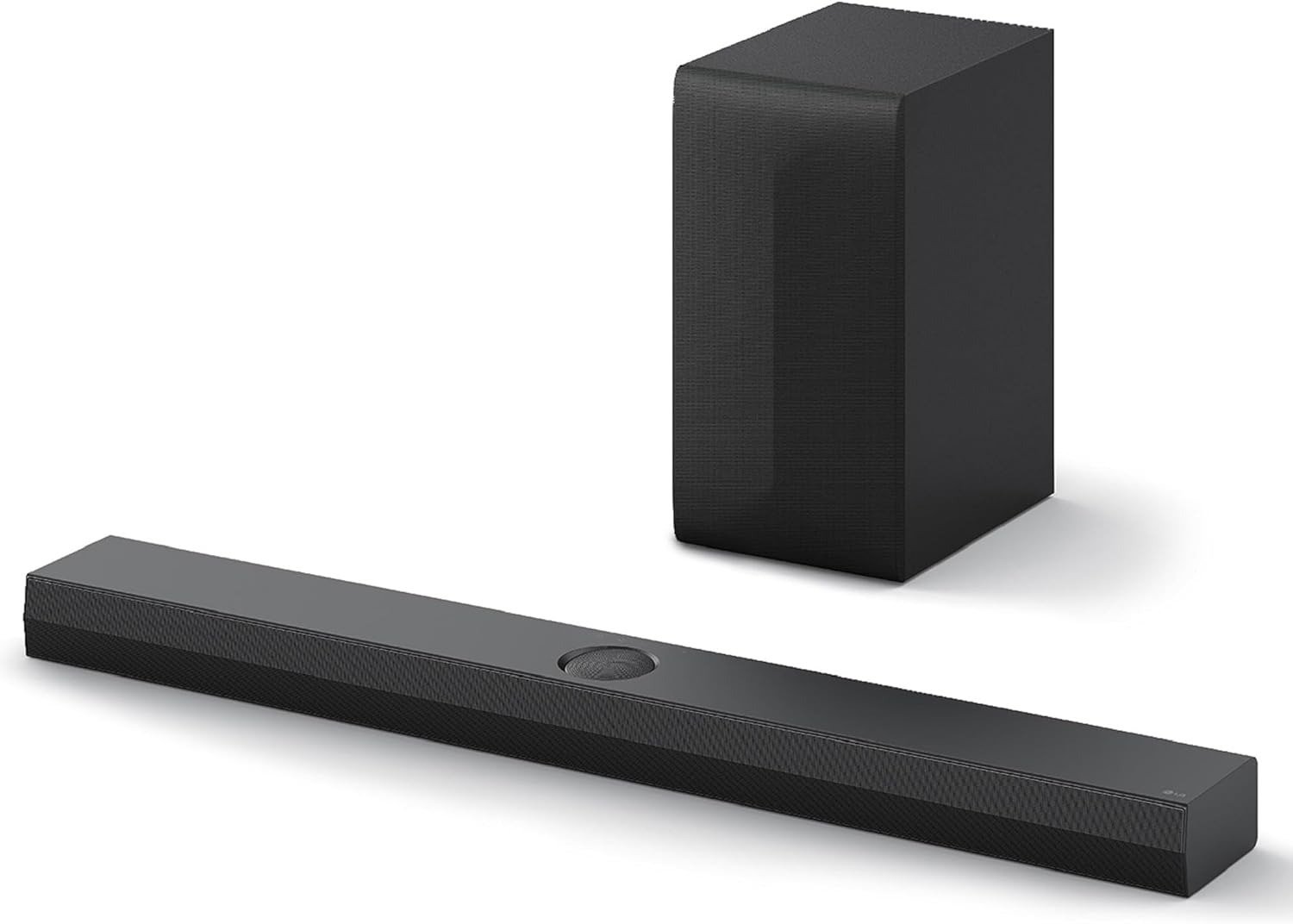
That is the real test for the LG S70TY. Not whether it beats TV speakers. It does. The bar uses a 3.1.1-channel layout with a wireless subwoofer, 400W claimed output, Dolby Atmos support, HDMI eARC, and gaming passthrough features including VRR/ALLM with support up to 120Hz. LG also leans hard on its up-firing center channel, WOW Orchestra integration with compatible LG TVs, and optional rear-speaker expansion.
What interested me was not the marketing surface. It was the threshold underneath it: the point where this bar stops being “an easy upgrade” and starts becoming the logical choice for a very specific kind of buyer.
The Result Looks Fine. The Problem Isn’t.
Most people do not shop for a soundbar because they crave audio theory. They shop because something keeps scraping at them.
Dialogue slips. Action scenes flatten. Bass arrives as a dull shove instead of a shape.
You sit down for a film and the image says “scale,” while the sound says “compressed compromise.” The mismatch is subtle at first. Then it starts to irritate you every night.
That is exactly where the S70TY gets traction. It is not trying to be a full-room theater weapon. It is trying to repair a common domestic failure: modern TVs can look expensive while sounding like they are speaking through a slot in the wall. The S70TY’s bar-plus-sub layout, center focus, and larger soundstage are built to correct that first fracture. What Hi-Fi’s testing called it “a nicely balanced package that is easy to listen to and use,” while also describing it as a massive step up from the speakers in the test TV.
That distinction matters. This is not a miracle product. It is a threshold product.
What You’re Actually Feeling but Not Naming
The irritation usually gets misnamed as “I need more power.”
Not quite.
What many people are really feeling is a three-part friction:
| What you notice | What you think it means | What it usually means |
|---|---|---|
| Voices get swallowed when scenes get busy | “The TV isn’t loud enough” | The center information is not staying intelligible |
| Explosions sound bigger but still thin | “I need Atmos” | You need bass authority and front-stage scale before height tricks matter |
| The room sounds active, but not enveloping | “This soundbar is weak” | You are hitting the surround threshold without rear speakers |
That is why cheap upgrades disappoint. They add volume, not structure. They add bass bloom, not control. They widen the noise without stabilizing the center.
The S70TY at least tries to solve the right problem first. LG’s own feature set centers on dialogue clarity through an up-firing center channel, a 3.1.1-channel arrangement, and a wireless subwoofer.
And this is where the psychology gets interesting. Buyers do not regret a soundbar because it was terrible. They regret it because it was almost persuasive. It fixed enough to feel promising, but not enough to quiet the little voice that keeps asking, “Why does this still not feel finished?”
The Hidden Mechanism Behind the Miss
The hidden variable here is not volume. It is front-stage completion.
A TV can be loud and still sound cramped because the audio image remains glued to the screen plane. A soundbar starts to feel convincing only when three things lock together:
- The center stays readable,
- The left-right spread breaks free from the panel,
- The subwoofer adds weight without smearing the mids.
That is the mechanism the S70TY is built around. Officially, it gives you seven speakers, a 3.1.1 structure, Dolby Atmos, eARC, a wireless subwoofer, AI Sound Pro, Night Mode, app-based EQ control, and virtual 3D Spatial Sound processing in supported modes.
But there is a catch. A real one.
The S70TY is not a discrete surround package out of the box. It can be expanded with LG rear speakers, yet by itself it is still fundamentally a front-heavy system. LG explicitly positions rear speakers as an optional expansion, and What Hi-Fi noted that if you want a proper wraparound effect, adding the optional rear kit is worth considering.
That is why some buyers walk away pleased and others walk away underwhelmed. They were not buying the same thing psychologically.
One person wanted the TV to stop sounding weak. Another wanted the room to disappear.
Those are not the same purchase.
The Threshold Where the Outcome Quietly Breaks
Here is the threshold in plain English:
The LG S70TY makes sense when your real problem is thin TV audio plus weak dialogue plus missing bass weight — not when your real problem is wanting true surround immersion from a compact bar alone.
That is the line.
Cross that line the wrong way, and disappointment starts quietly.
What Hi-Fi’s review lands almost exactly on this threshold. The praise is clear: balanced presentation, well-integrated subwoofer, simple setup. The criticism is just as telling: poor vocal performance in Cinema mode, no on-screen display, and performance that does not reach the best in class. In dialogue-heavy material, they found voices comparatively flat and short on nuance, even while acknowledging a noticeable jump over TV speakers.
That is not a contradiction. It is the product’s boundary showing itself.
I would define the break point like this:
| Threshold state | What happens |
|---|---|
| Below the threshold | You are coming from TV speakers and mainly want clearer speech, wider front sound, and a subwoofer that adds body |
| At the threshold | You want movie nights to feel larger, but you still accept that the room will not behave like a real multi-speaker theater |
| Beyond the threshold | You expect convincing wraparound Atmos, premium dialogue refinement, and top-tier immersion without rear speakers |
The S70TY is strongest in the first two rows. Not the third.
Why Most Buyers Misread This Too Early
Because they shop by badge language.
Dolby Atmos. Up-firing. 3.1.1. WOW Orchestra. 120Hz passthrough.
On paper, that stack feels aggressive. In the mind, it starts assembling a fantasy: sleek bar, one cable, dramatic height, solved living room.
But format support is not the same as delivered sensation. That confusion is everywhere in this category. RTINGS’ current best Atmos and under-$500 recommendations lean toward larger or more fully equipped systems—often with satellites or more substantial channel layouts—because immersion changes sharply once sound can move more convincingly around the room, not merely above the front wall.
The S70TY is more modest than that. Better integrated. Easier to live with. Cleaner in a smaller room. But more modest.
And people misread another thing too: brand synergy.
LG’s WOW Orchestra and WOW Interface are legitimate convenience features for compatible LG TVs, letting the TV and bar work together and simplifying control through the TV remote and on-screen integration. That can make the whole setup feel more coherent in daily use.
Convenient, yes.
Transformative by itself? No.
Compatibility can smooth ownership. It cannot erase acoustics.
Who Is Actually Inside This Problem
This is the buyer I think the S70TY actually serves:
You have a modern TV, often an LG, and you are tired of hearing expensive picture quality paired with small, brittle sound.
You care more about a cleaner living-room setup than building a speaker forest around the couch.
You want a real subwoofer, cleaner speech, and a front soundstage that finally feels separate from the panel.
You may game, so 4K 120Hz passthrough and VRR/ALLM support are not decoration to you.
You value setup simplicity. Even critical reviews still describe it as straightforward to install, and owner feedback repeatedly mentions easy setup and satisfying bass for ordinary use.
This is also the buyer profile the public feedback suggests: generally positive satisfaction, but with restrained expectations. Best Buy shows a 4.3/5 average on one listing with sparse but mostly favorable comments, while the same page references a 4.6/5 average across 55 LG-hosted reviews. The tone of those comments is revealing—good sound, easy installation, subwoofer strong enough, but not “concert hall” realism and weak documentation.
That is exactly the emotional center of this product.
Not awe. Relief.
Where Wrong-Fit Begins
Wrong-fit begins the moment you use the word “cinema” to mean “surround theater.”
Or the moment you expect a compact 3.1.1 bar with no rear speakers included to behave like a system built for enveloping spatial placement.
Wrong-fit also begins if any of these describe you:
| Wrong-fit signal | Why it matters |
|---|---|
| You are obsessive about dialogue texture in films and dramas | Independent criticism points to weaker vocal performance in Cinema mode and flatter rendering in dialogue-heavy scenes. |
| You want the best Atmos effect for the money | Higher-performing Atmos recommendations in current testing often rely on more channels, satellites, or stronger overall packages. |
| You care deeply about smart streaming ecosystems | Third-party review coverage notes that some regional variants are light on premium streaming conveniences compared with stronger app-centric rivals, though LG’s own US page emphasizes Wi-Fi streaming and ThinQ control. |
| You want a luxurious build impression | Even positive reviewers describe the subwoofer finish as less than premium. |
This is the uncomfortable truth: a product can be good and still be wrong for the fantasy built around it.
The One Situation Where This Product Becomes Logical
The LG S70TY becomes logical in one very specific situation:
You want your TV to stop sounding skinny and start sounding grounded, but you do not want to jump into a bulkier, more complex, rear-speaker-first system.
That is where the product stops being vague.
Not when you chase “Atmos” as a word. When you define the actual wound.
If I were reducing the decision to one line, it would be this:
| If your real goal is… | Then the S70TY is… |
|---|---|
| Better-than-TV sound with more body, clearer speech, simpler setup | A clean logical fit |
| A polished LG-to-LG integration experience | An especially sensible fit |
| True room-wrapping cinema from the base package alone | A compromised fit |
| Audiophile-grade dialogue nuance or class-leading Atmos | The wrong ceiling |
That is why the product’s strongest arguments are not dramatic. They are structural.
A 3.1.1 layout. A real subwoofer. eARC. 120Hz passthrough. App EQ. Night Mode. Optional expansion. Reasonable sale pricing around the high-$200s to mid-$300s depending on retailer and timing.
No fantasy required.
What It Solves, What It Reduces, and What It Still Leaves to You
What it solves:
- The flat, papery, underfed sound of most modern TVs.
- The feeling that dialogue is pinned too tightly to a thin screen.
- The absence of bass weight that makes films and games feel physically unfinished.
What it reduces:
- Setup friction, especially in an LG TV ecosystem with WOW features.
- The jump from TV audio to a separate sound system.
- The visual clutter that comes with fuller surround packages.
What it still leaves to you:
- The responsibility to set expectations correctly.
- The decision of whether optional rear speakers are necessary for your room and habits.
- The recognition that “larger” and “truly immersive” are related, but not identical.
That last part is where most regret begins. Not because the product lied, but because the buyer translated improvement into total transformation.
If your break point is weak TV audio, soft dialogue, and a room that needs more weight—not a full surround illusion—the LG S70TY is the logical next step.
Final Compression
The LG S70TY is not the soundbar you buy to impress yourself with spec language.
It is the one you buy when the TV has started to feel expensive in every way except the one you hear.
I would not frame it as a theater replacement. I would frame it as a threshold correction.
When the built-in speakers have become the part of the experience you keep noticing.
When you want bass you can feel, speech you do not chase, and a front soundstage that finally detaches from the panel.
When simplicity matters more than bragging rights.
That is the boundary.
Inside that boundary, the S70TY makes a clean case for itself. Outside it, the compromise starts whispering almost immediately.
Transparency Note:
This analysis is built on aggregated real-world experience.
It extracts what repeatedly holds, what breaks, and what users uncover only after living with the system—then shapes it into a clear model you can use immediately.
Think of it as structured experience, refined and presented so you don’t have to learn it the hard way.
“A quick note: Don’t believe the star ratings, but trust personal experience. This article is a compilation of collected experiences”