KNODOS PORTAFILTER STAND & TAMPER SET REVIEW: YOUR SHOT TASTES FINE — UNTIL YOU UNDERSTAND WHY IT DOESN’T
The Result Looks Fine. The Problem Isn’t.
You pull a shot. It takes around 25 seconds. The color is right. You drink it. Something is slightly off — not broken, not obviously wrong — just inconsistent in a way you can’t pin down.
You adjust the grind. Same shot, slightly different result, still inconsistent. You try again. Same thing.
This is not a grind problem. It is a geometry problem. And it happens before the water ever touches the coffee.
The puck sitting inside your portafilter basket carries the entire weight of your extraction. If its density is uneven — even slightly — pressurized water will find the path of least resistance, bypass portions of the grounds, and produce a shot that runs faster on one side than the other. This is channeling. It does not taste catastrophic. It just tastes like a shot that could have been better.
Most home baristas never name this problem because the result never looks clearly wrong. The machine runs. The crema appears. The cup is drinkable. The mechanism destroying shot-to-shot consistency remains invisible.
What You’re Actually Feeling but Not Naming
You have pulled the same shot a hundred times and noticed the taste shifts without changing anything. You have adjusted grind size and gained a different inconsistency. You have dialed in a setting that worked yesterday and found it unreliable today.
What you are experiencing is tamp variance compounded by an unstable prep surface.
When you hold a portafilter in your hand and tamp, your wrist angle changes slightly each time. The portafilter shifts. The pressure distributes unevenly across the coffee bed. One edge of the puck receives more compression. The other receives less. Water follows that geometry exactly during the nine-bar extraction.
A tamper that is even slightly too small or used at an angle leaves an invisible ring of uncompacted coffee grounds around the basket edge — a bypass for the water, irrelevant to the eye but consequential to the shot.
This is not correctable by tamping harder. Even pressure leads to uniform resistance and reduces channeling. Ideal pressure is around 25–30 pounds, but consistency matters more than force. A crooked or uneven tamp can ruin extraction even if the pressure is correct. The variable killing your consistency is not the amount of force. It is the angle and the anchor point — and neither of those is something you can fix mid-shot.
The Hidden Mechanism Behind the Miss
The portafilter basket has a standard diameter of 58mm for most manual machines — Gaggia Classic, E61 group heads, Rocket, Lelit, ECM, Profitec, and similar setups. The tamper that fits this basket must make precise contact across the full surface, not just the center. Any misalignment during the tamp — even 2–3 degrees — compresses the grounds asymmetrically.
The tamping station gives a stable anchor so all your energy goes into vertical compression instead of stabilizing a moving portafilter. There is evidence that beyond a certain threshold, more force does not improve extraction — but consistency does.
The mechanism works in two directions. First, a fixed cradle holds the portafilter at a stable, repeatable position. Your grip no longer determines the angle. Second, a calibrated tamper removes pressure guesswork from the equation. A spring-loaded tamper has a mechanism inside the handle that clicks when you hit a preset force — usually 30 lbs. You press down, the spring compresses, and when you reach that threshold, it releases. Push harder after the click? The puck already got exactly 30 lbs.
The result is that two variables — position and pressure — stop changing shot to shot. What remains is grind size, dose, and distribution. Those are adjustable and diagnosable. The other two were invisible sources of noise.
The Threshold Where the Outcome Quietly Breaks
| Prep Condition | What Happens in the Puck | Shot Result |
|---|---|---|
| Handheld portafilter, uneven tamp angle | Asymmetric compression, one dense edge | Channeling, faster pull on one side |
| No calibrated tamper, variable pressure | Density fluctuates shot to shot | Inconsistent extraction time |
| No anchor point, wrist drift | Tamp position shifts daily | Unpredictable taste variance |
| Fixed station + calibrated tamper | Uniform compression, stable puck | Consistent extraction window |
The threshold where results become diagnosable is when position and pressure are no longer variables. Until that point, adjusting grind size is guesswork — because you do not know whether a slower shot was caused by the grind being too fine or by the tamp being slightly tilted.
Inconsistent pressure creates uneven density — and uneven density leads to channeling, where water finds the easy path instead of extracting evenly. The result is shots that taste sour, thin, or bitter in ways that do not respond to grind adjustments, because the grind is not the problem.
This is the threshold: the point where the espresso feedback loop stops making sense. You change one thing and get an unexpected result, because something else — invisible — is also changing.
Why Most Buyers Misread This Too Early
The common comparison goes like this: a simple rubber tamping mat costs a fraction of a dedicated station. You place the portafilter on the mat, you tamp, you get some stability. Why spend more?
The tamping mat solves one thing: it stops the portafilter from sliding. It does not fix the angle. It does not constrain the position. You are still holding the portafilter with one hand and tamping with the other. The wrist drift, the elbow height, the shoulder position — all of that still varies.
A portafilter stand cradles the basket at a fixed height with a stable surface underneath. The portafilter does not move. Your body can take any stance. The geometry of contact is the same every time. That is a different kind of stability.
The second misread is about the tamper. A standard flat tamper works — in the same way that a kitchen scale works for measuring ingredients by eye. A spring-loaded calibrated tamper, set at 30lbs, removes pressure from the list of things you have to replicate through muscle memory.
Even experienced baristas vary their tamping pressure without realizing it. Training data consistently points to pressure drift — especially when you are distracted, rushing, or tired. You might apply 25 lbs one shot and 35 the next. If your grind and dose are identical, that variation alone can shift your extraction time by 3–5 seconds. Different puck. Different shot.
Who Is Actually Inside This Problem
| User Profile | Does This Station Solve a Real Problem? |
|---|---|
| Manual machine (Gaggia, E61, Rocket, Lelit, ECM, Profitec) with 58mm portafilter | Yes — this is the primary use case |
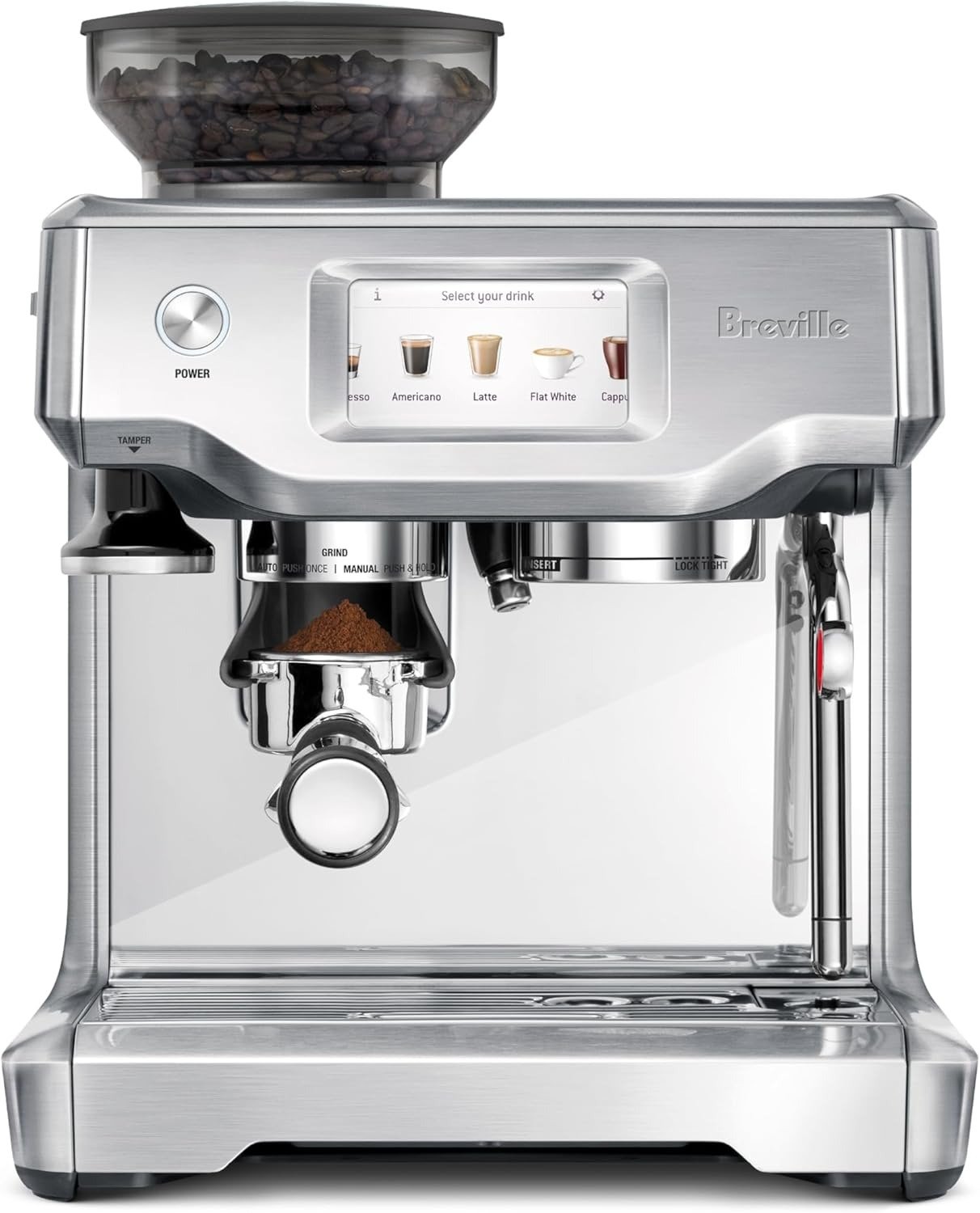
| Semi-manual (Breville Barista Express, Bambino Plus, Barista Pro) | Often no — built-in tamping system removes the need |
| Fully automatic machine | No — tamping is handled internally |
| Home barista dialing in grind, chasing consistency | High fit — workflow simplification is measurable |
| Beginner building muscle memory | High fit — calibrated tamper removes one learning variable |
| Experienced barista with consistent manual technique | Low fit — benefit is marginal if tamp angle and pressure are already repeatable |
| Someone who pulls 1 shot per week and does not tune | Low fit — payoff does not match usage frequency |
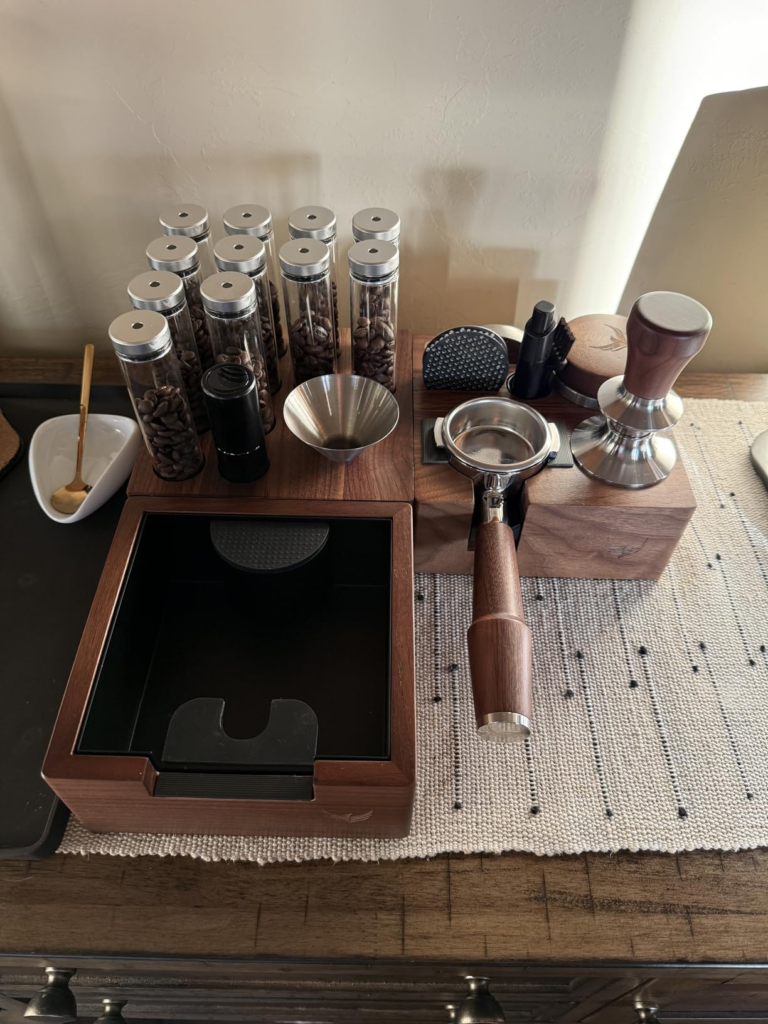
The KNODOS Portafilter Stand and Tamper Set — specifically the Walnut V3 Tamper Station with 58mm compatibility — is designed for Gaggia Classic, E61 group heads, Rocket, Lelit, Profitec, ECM, and other machines with 58mm portafilters. It is not a universal tool. That specificity is the point.
Where Wrong-Fit Begins
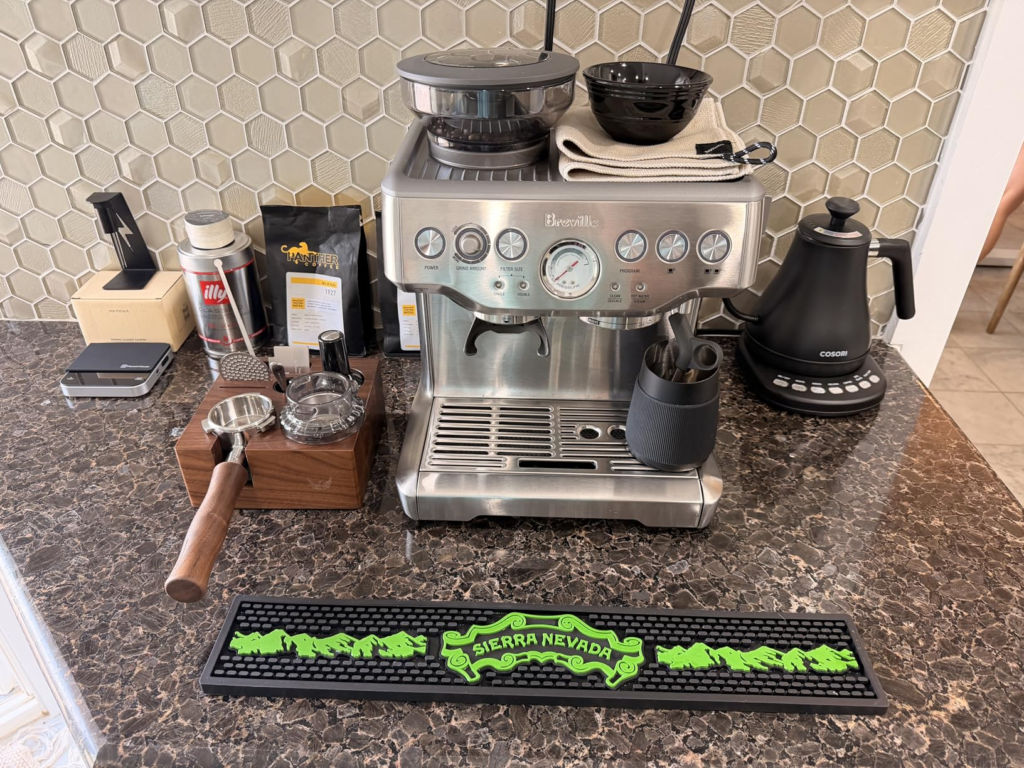
If you own a Breville Barista Express Impress or any machine with an integrated tamping mechanism, this product competes with functionality already built into your machine. The Impress Puck System applies tamp pressure automatically. Adding an external tamping station on top of that workflow adds steps without adding control.
This is not a criticism of the product. It is a compatibility boundary. The KNODOS station looks fancy, but most of the tools feel redundant on the Breville Barista Express Impress. The Tamping Station and Tamper just feel like extra clutter on the counter. The most useful tools in that kit are the Puck Screen and Bottomless Portafilter. That assessment is accurate — for that specific machine. It does not generalize to a manual 58mm setup where tamping is entirely your responsibility.
Wrong-fit also begins if you are solving a problem you do not actually have. If your shots are consistent, your extraction times are stable, and adjusting grind produces predictable changes — you have already solved the tamp problem through technique. The station adds structure you have already built manually.
And if your machine does not match the 58mm portafilter dimension — if you own a 54mm Breville, a 51mm DeLonghi, or a Casabrews — this version does not apply. KNODOS offers size-specific variants, but the station must match your basket diameter exactly to function as designed.
The One Situation Where This Product Becomes Logical
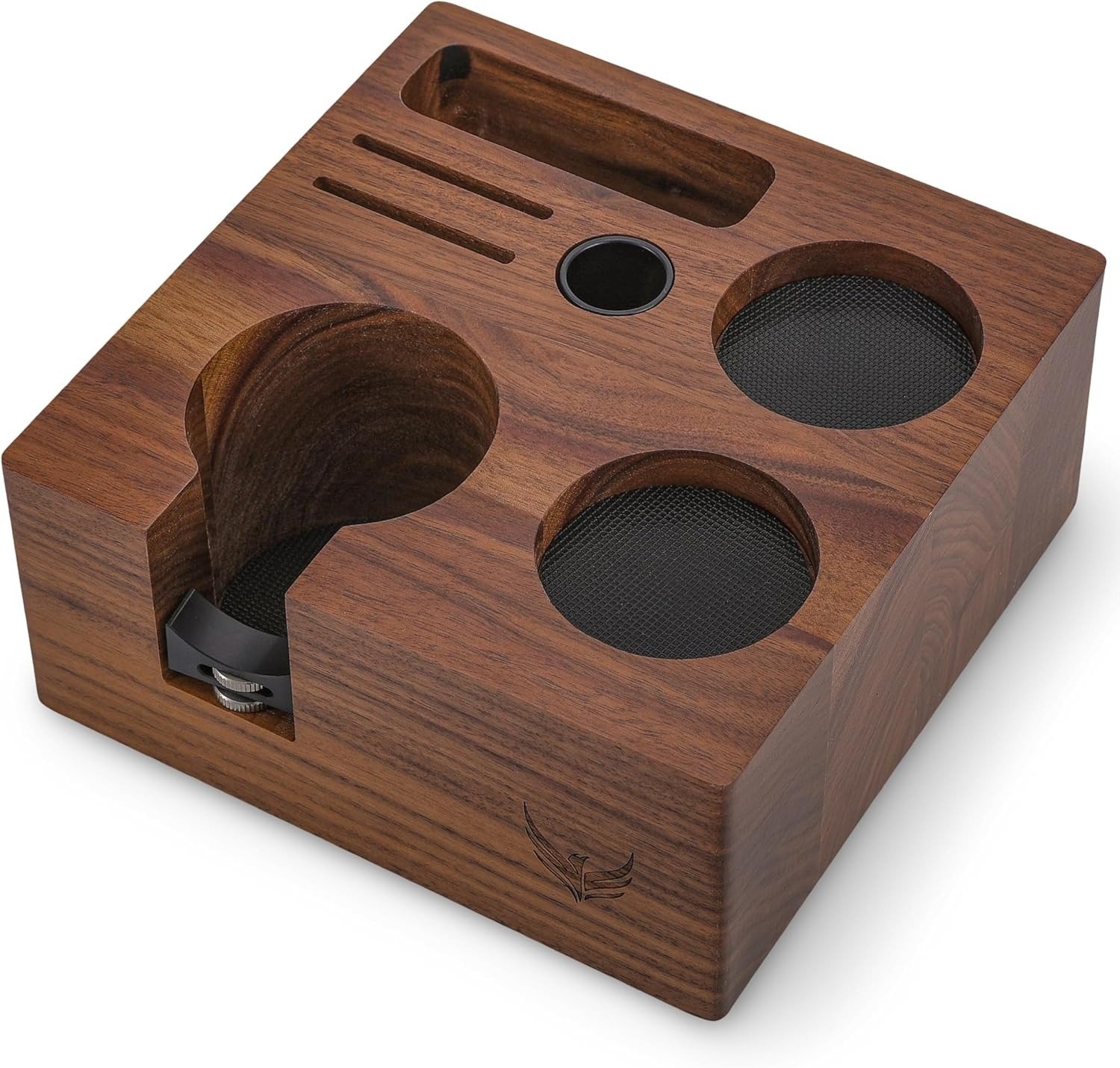
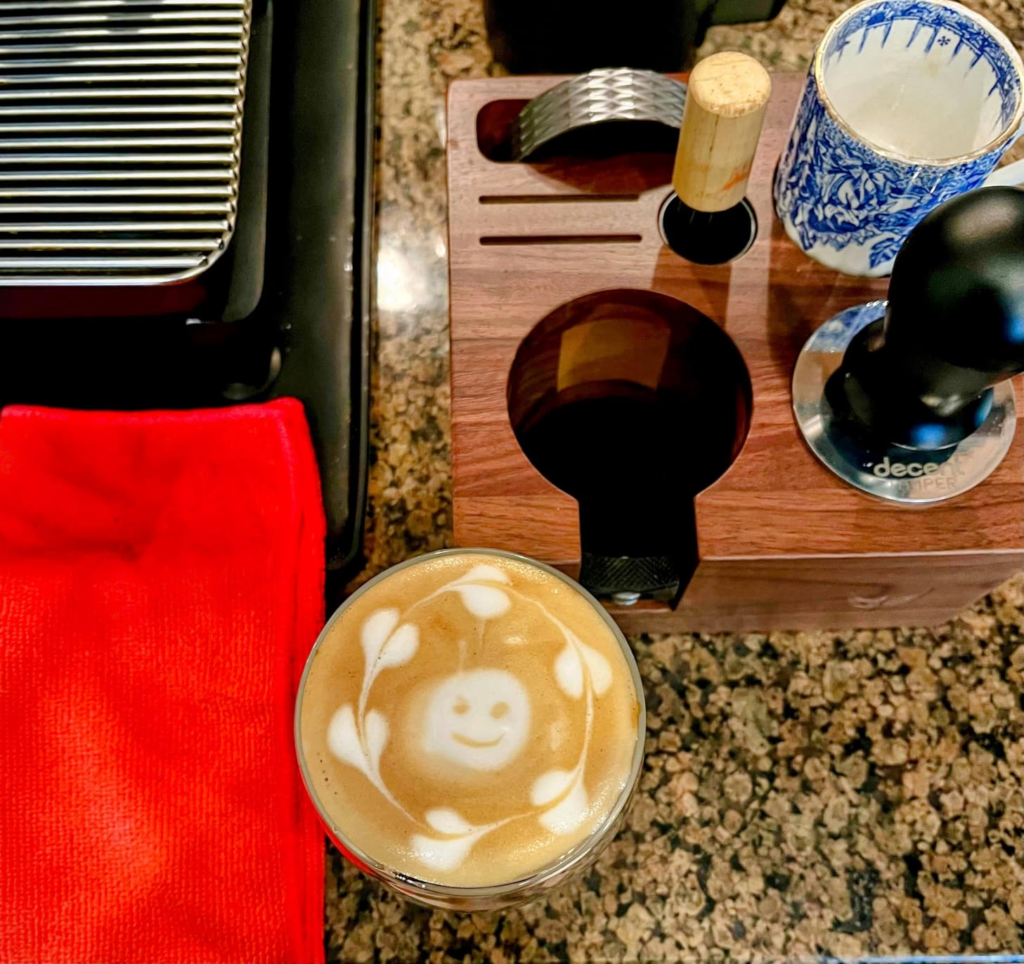
Engineered for stability and crafted with premium walnut, this multi-storage compact tamper station organizes seven dedicated slots for all your espresso essentials, features a secure non-slip base that keeps your station in place, and offers adjustable height options for maximum stability and comfort.
The KNODOS 58mm Portafilter Stand and Tamper Set becomes logical under one specific condition: you own a manual espresso machine with a 58mm portafilter, you are actively trying to improve shot consistency, and you have already ruled out grind and dose as the primary variable.
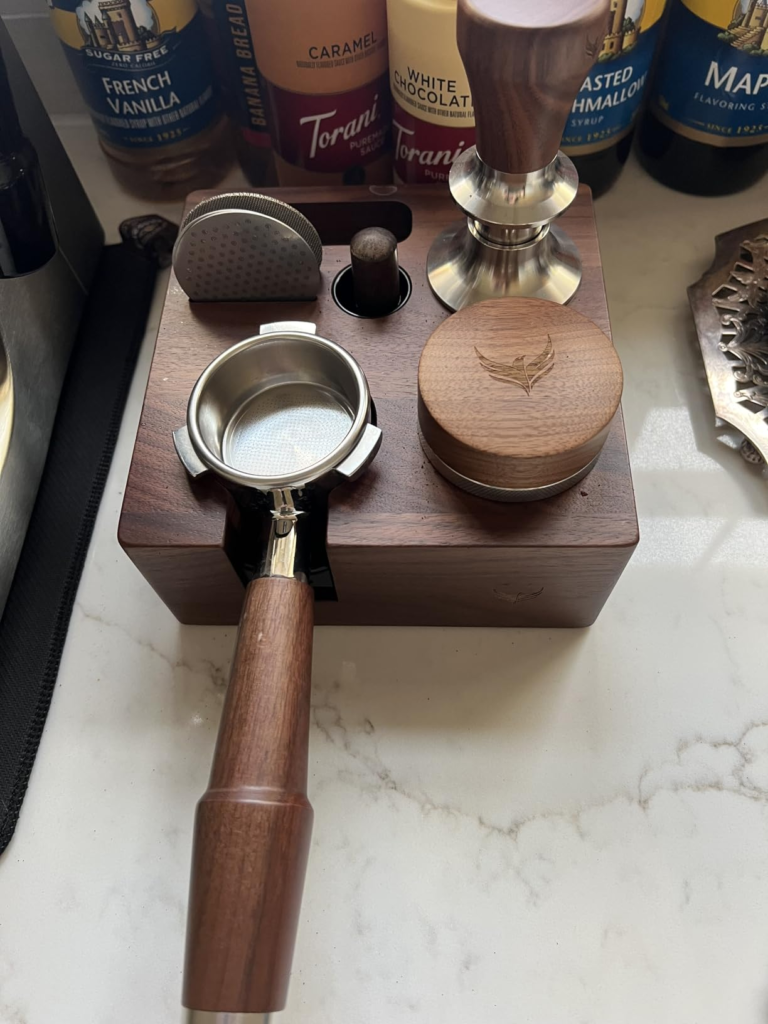
At that point, the two remaining sources of variance are tamp position and tamp pressure. The station addresses both. The portafilter cradle locks the basket in place. The spring-loaded calibrated tamper — set at 30lbs with swappable 20lb and 25lb springs for adjustment — removes pressure drift.
What you gain is a prep workflow where the same inputs reliably produce the same result. Not a different espresso. The same espresso, repeated.
The walnut construction is not decorative reasoning. The non-slip base ensures the tamping station stays securely in place during use. Dense natural wood also dampens vibration during the tamp better than plastic alternatives, which matters when you are applying 30lbs of downward force on a countertop surface.
What It Solves, What It Reduces, and What It Still Leaves to You
| Category | What Happens |
|---|---|
| Tamp angle variance | Eliminated — cradle fixes portafilter position |
| Tamp pressure variance | Eliminated — calibrated spring tamper clicks at preset force |
| Shot-to-shot puck consistency | Significantly improved |
| Countertop tool clutter | Reduced — 7 dedicated slots for tamper, distributor, WDT, funnel, RDT bottle, puck screens, brush |
| Grind calibration | Still your responsibility |
| Dose measurement | Still your responsibility |
| Distribution before tamping | Still your responsibility — a WDT tool or distributor handles this separately |
| Channeling caused by poor distribution | Not fixed by tamping alone — requires puck prep before the tamp |
| Machine maintenance | Not affected |
If grounds are not evenly distributed before tamping, you compress air pockets into the puck. This causes uneven water contact and unpredictable extraction. Use a distribution tool or gently tap and shake the portafilter to level grounds before tamping.
The station locks in two variables. The other variables — dose, grind, and distribution — require separate attention. This is not a weakness of the product. It is an accurate boundary of what any tamping station can do. Managing expectations here prevents the most common form of buyer regret in this category.
Final Compression
The KNODOS Portafilter Stand and Tamper Set is a precision tool for a specific operational failure: tamp inconsistency on manual 58mm espresso machines. It is not a general espresso upgrade. It is not a workflow revolution. It is the removal of two variables that were previously invisible.
If you own a manual machine — Gaggia Classic, E61 group head, Rocket, Lelit, ECM, Profitec — and you have been adjusting grind size trying to fix a consistency problem that does not respond predictably to grind adjustments, the tamp is the probable source.
This station is the logical correction.
If your machine has built-in tamping, or if your manual technique is already consistent and reproducible, the station adds structure you have already built. The product is not wrong. The fit is.
For the barista inside that specific condition — manual machine, 58mm basket, active consistency problem — this is where the decision stops being vague.
Frequently Asked Questions
| Question | Answer |
|---|---|
| Is the KNODOS Portafilter Stand compatible with Breville machines? | The 54mm version fits Breville Barista Express, Barista Pro, Barista Touch, and Bambino Plus. The 58mm version reviewed here does not fit those machines. However, if you own a Breville with an Impress Puck System that handles tamping automatically, a separate tamping station adds steps without meaningful benefit for most users. |
| Does the tamping station include the tamper, or is it sold separately? | Depending on the variant purchased, the KNODOS Tamper Station V3 may be sold as a station only, or as part of a kit. The standalone station does not include the tamper. Confirm the specific ASIN before purchasing to know exactly what is included. |
| What is the actual size of the KNODOS tamper base — 58mm or 58.35mm? | KNODOS calibrated tampers are sized at 58.35mm, which provides a precise fit inside standard 58mm baskets. |
| Does a tamping station actually improve espresso taste, or is it just organization? | Both outcomes are real, but they apply to different users. If your tamp angle and pressure already vary shot to shot — which is common without a fixed anchor — the station measurably improves puck consistency and extraction stability. If your technique is already repeatable, the organizational benefit is the primary gain. |
| Can I use third-party tampers and tools in the KNODOS station slots? | Yes. The slot dimensions accommodate standard tampers, portafilters, distributors, and WDT tools from other brands in most cases. KNODOS recommends their own matching wood collection for aesthetic consistency, but the station is not locked to KNODOS tools functionally. |
| What is the difference between the Walnut and Rosewood versions? | Both versions are functionally equivalent in terms of slot count, portafilter cradle, and non-slip base. The material differs in density and appearance — rosewood is slightly denser and darker; walnut is warmer in tone. The Rosewood version includes 8 slots versus 7 on most Walnut variants, adding space for a grinder trigger funnel or extra basket. |
| Is this worth buying if I only pull one or two shots per day? | If those shots are on a manual 58mm machine and consistency matters to you, yes. If the machine handles tamping automatically or your workflow is already locked in, the value is lower. The station’s benefit scales with how often you tamp manually and how much shot variance you are currently experiencing. |
Transparency Note:
This analysis is built on aggregated real-world experience.
It extracts what repeatedly holds, what breaks, and what users uncover only after living with the system—then shapes it into a clear model you can use immediately.
Think of it as structured experience, refined and presented so you don’t have to learn it the hard way.
“A quick note: Don’t believe the star ratings, but trust personal experience. This article is a compilation of collected experiences”