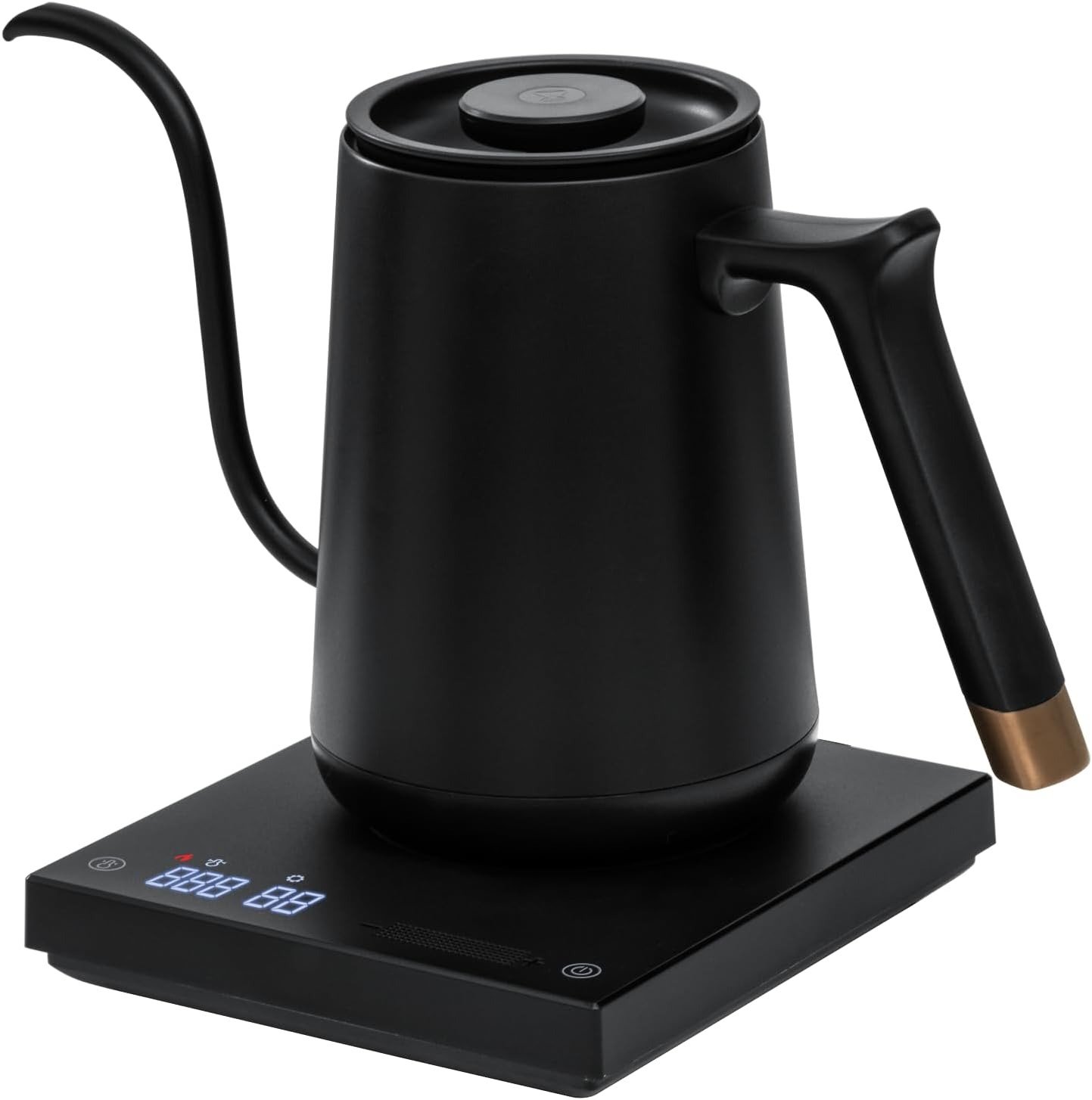
INTASTING GOOSENECK ELECTRIC KETTLE: YOU’RE ALREADY BREWING AT THE WRONG TEMPERATURE — YOU JUST CAN’T PROVE IT YET
The Result Looks Fine. The Problem Isn’t.
You bought decent coffee. You ground it fresh. You poured carefully. The cup came out drinkable — probably good, maybe even great some mornings. But it isn’t consistent. One brew is balanced and bright. The next is flat, or faintly bitter, or hollow in the middle. You adjust the grind. You try a different ratio. You watch pour-over tutorials. The problem shifts but doesn’t resolve.
This is the friction that almost no one names correctly.
The variable you keep chasing isn’t technique. It’s temperature. Specifically, it’s the fact that your kettle — any standard electric kettle, any model without verified ±1°F control — does not deliver the same water temperature twice. It boils to 212°F and begins cooling the moment you lift it. By the time it reaches your grounds, the actual brew temperature is wherever the physics left it. Some mornings that’s 198°F. Others it’s 191°F. You have no way of knowing. And a difference of 7°F is not a rounding error in pour-over brewing. It’s the difference between extraction that completes and extraction that stalls.
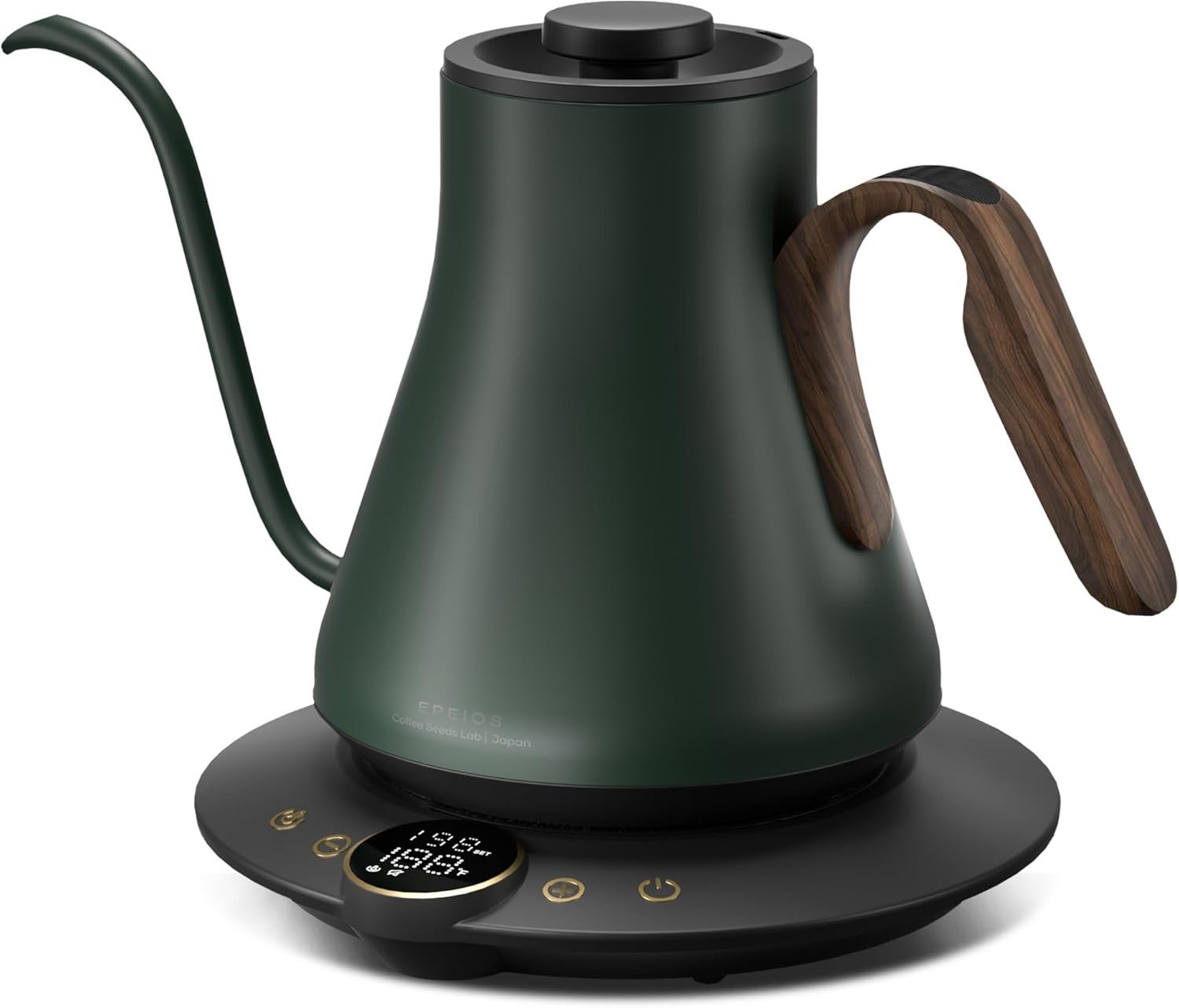
The INTASTING Gooseneck Electric Kettle is built around one premise: that precision isn’t a premium feature. It’s the minimum requirement for the result you’re actually chasing.
What You’re Actually Feeling but Not Naming
The annoyance of inconsistent home brewing rarely presents as a temperature problem. It presents as:
A sourness you blame on the roast. A bitterness you blame on the grind. A flatness you blame on your beans going stale. A pour you think was slightly too fast or too slow.
These aren’t wrong observations. They’re accurate descriptions of what extraction failure feels like. What they miss is that each of those symptoms maps precisely to a temperature error. Sourness in pour-over is the signature of under-extraction — water that was too cool to dissolve the sugars and aromatic compounds before the brew ended. Bitterness is the signature of over-extraction — water that was too aggressive, pulling phenolic compounds before the balanced compounds had set. Flatness is the cup that never reached the extraction window at all.
The Specialty Coffee Association and the National Coffee Association both identify 195°F to 205°F (90°C to 96°C) as the gold standard for pour-over extraction. Water that falls below 195°F under-extracts, leaving the cup sour, weak, or hollow. Water above 205°F starts scorching the grounds and pulling the bitter compounds that no technique can compensate for.
The problem with a standard electric kettle isn’t that it boils wrong. It’s that boiling and brewing are two different operations, and only one of them requires a specific, held temperature.
What you’re feeling — that nagging inconsistency you’ve been attributing to everything except the kettle — is what brewing inside a moving target feels like.
The Hidden Mechanism Behind the Miss
Here’s what happens with a standard kettle, in mechanical terms.
The element reaches 212°F. The kettle clicks off. You lift it. The temperature begins dropping at a rate that varies with ambient room temperature, the mass of water remaining, the material of the kettle body, and how long you waited between the click and the pour. There is no sensor still monitoring. There is no element re-engaging. There is nothing holding the temperature at any particular point.
By the time you’re three seconds into your bloom pour, the water is somewhere between 200°F and 195°F. By the time you’re into your second pour, it may have dropped to 190°F or lower — still hot, still steaming, but now operating below the extraction floor for most medium and light roasts.
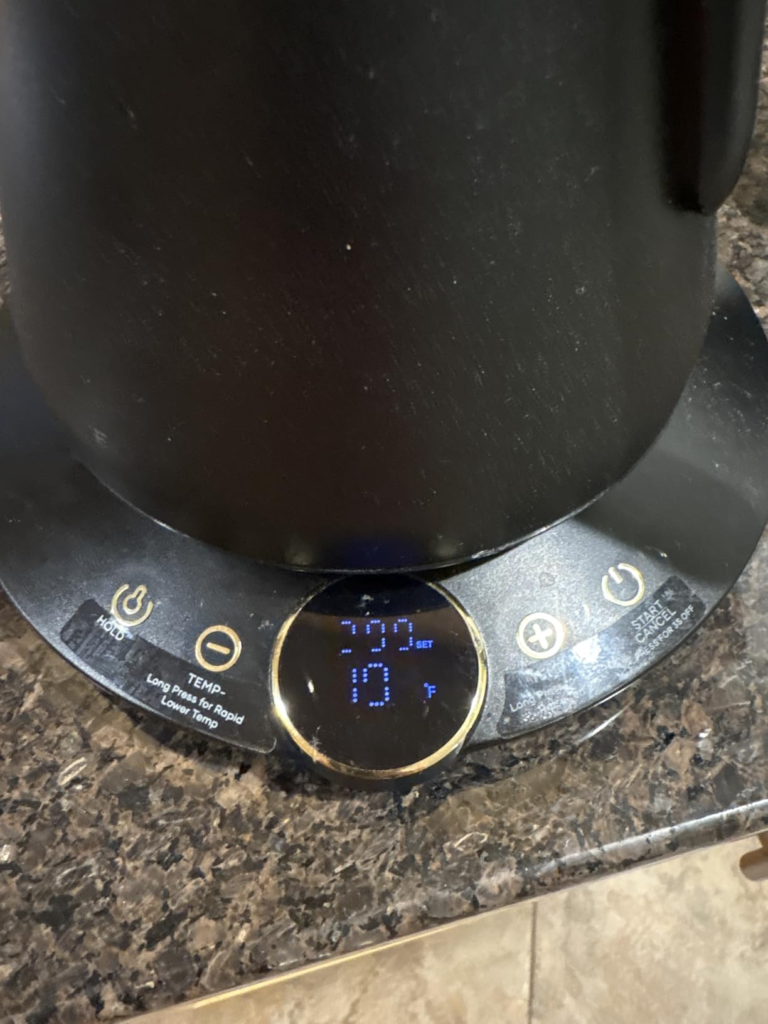
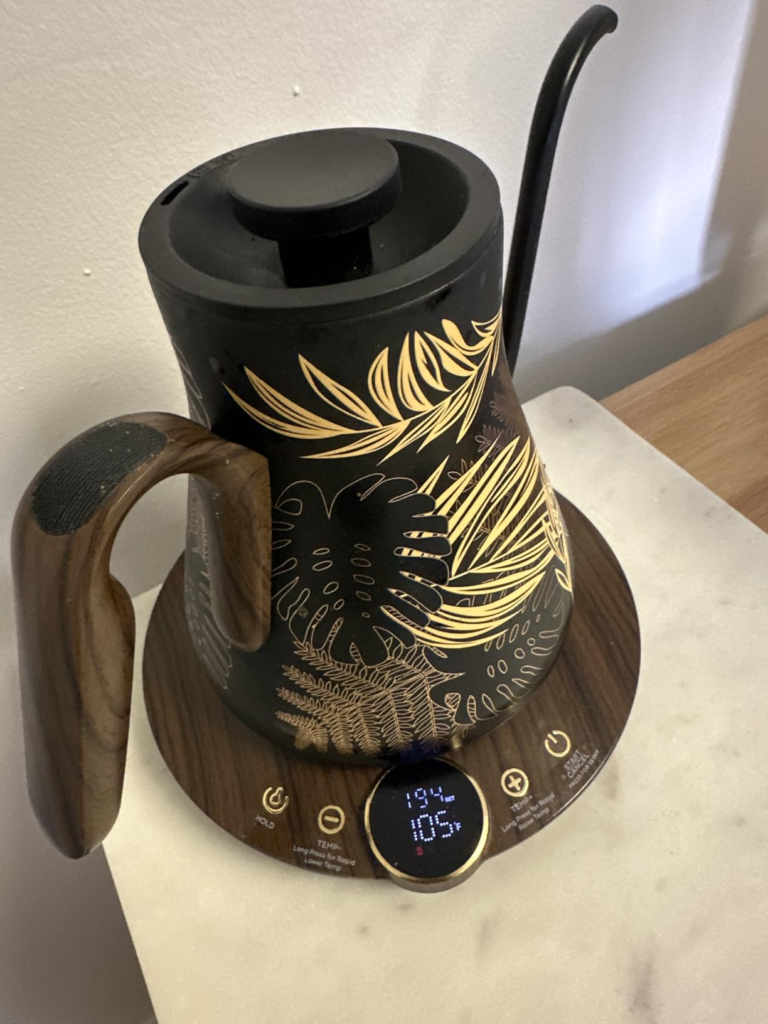
The INTASTING uses a PID-based heating algorithm — a smart controller that monitors real-time temperature and adjusts heating power as the water approaches your set point. The digital display shows the real-time temperature as it climbs, and the intelligent controller slows heating power near the target, preventing overshoot and the subsequent cooling drift that follows it. Once it reaches your target — 195°F, 200°F, 203°F, wherever you set it — the kettle locks to that temperature and holds it for up to two hours.
This is not a cosmetic feature. It changes the nature of what you’re doing. You’re no longer guessing. You’re working with a fixed variable.
Independent 21-day testing with an external calibrated thermometer confirmed that the INTASTING consistently hit and held temperatures within ±1°F of the target — a level of precision that directly rivals premium brands like the Fellow Stagg EKG, at a fraction of the cost.
That’s the mechanism. The gap between your current result and the result you want isn’t technique. It’s the temperature you never actually controlled.
The Threshold Where the Outcome Quietly Breaks
Every brewing method has a threshold — the exact point where the outcome begins to collapse without the brewer noticing it’s happening.
For pour-over coffee, the threshold is this: below 195°F, extraction becomes a negotiation with physics you will lose. The soluble acids dissolve early, but the sugars and aromatic compounds — the ones that create sweetness, depth, and balance — require heat energy to release. Drop below the floor, and they stay locked inside the grounds. The cup tastes complete. It just tastes wrong, and you can’t explain why.
For tea, the threshold is even more specific. Green tea brewed at boiling temperature tastes harsh. The correct range for most green teas is 160°F to 175°F. The correct range for white tea is 150°F to 165°F. Oolong sits between 180°F and 195°F. Black tea and herbal brews operate near boiling. Every one of these thresholds requires a different set point — and every one of them becomes meaningless if your kettle can only deliver “somewhere near boiling” or “somewhere near whatever it cooled to.”
The INTASTING covers the full range: 100°F to 212°F, in 1°F increments. Not because you need every degree. Because the threshold that matters to your specific brew — whether it’s a V60 at 202°F or a gongfu oolong at 185°F — is exact, not approximate.
Call this the Brew Temperature Lock. It’s not about precision as a concept. It’s about removing the one variable that was silently corrupting every cup you made.
| Beverage | SCA/Expert Target Range | What Happens Below Range | What Happens Above Range |
|---|---|---|---|
| Pour-over (light roast) | 200–205°F | Sour, underdeveloped, flat | Harsh, bitter, phenolic |
| Pour-over (medium roast) | 195–202°F | Hollow, weak, unbalanced | Over-extracted, astringent |
| Pour-over (dark roast) | 195–198°F | Weak, watery | Bitter, ashy |
| Black tea | 205–212°F | Thin, underwhelming | Minimal risk at this range |
| Oolong | 185–200°F | Flat, muted | Grassy, astringent |
| Green tea | 160–175°F | Acceptable but one-dimensional | Harsh, vegetal, bitter |
| White tea | 150–165°F | Very mild, thin | Over-extracted, loses delicacy |
| French press | 195–205°F | Muddy, sour | Over-extracted, harsh |
Why Most Buyers Misread This Too Early
The most common purchase sequence for a home brewer goes like this: buy decent beans, buy a grinder, buy a pour-over dripper, and then continue using the same kettle already in the kitchen. Or buy a cheap electric gooseneck from Amazon because it looks right and the listing says “temperature control.”
The two errors are related.
The first error is structural: treating the kettle as a peripheral accessory when it is actually the central instrument. The grinder controls what you extract. The kettle controls the conditions under which you extract. Both are primary variables.
The second error is label-based: assuming that “temperature control” on a product listing means the same thing across all price points. It doesn’t.
| Feature | Standard Electric Kettle | Generic “Temp Control” Kettle | INTASTING Gooseneck |
|---|---|---|---|
| Temperature accuracy | ±10–15°F (after cooling drift) | ±5–10°F (display only, no hold) | ±1°F (PID-controlled, active hold) |
| Temp hold duration | None | None or 30 min | Up to 2 hours |
| Gooseneck spout control | None | Variable (often too fast) | 9mm S-shaped, barista-controlled flow |
| Interior material | Plastic or mixed | Often plastic-touched | 100% food-grade 304 stainless |
| Built-in brew timer | No | No | Yes (integrated stopwatch) |
| Price range | $15–$30 | $30–$55 | ~$60–$70 |
One documented user complaint about generic temperature-controlled kettles describes setting the display to 200°F and measuring actual water temperature with an external thermometer between 195°F and 205°F across different brews — with no way to tell which temperature the day’s session would produce. That’s not temperature control. That’s a display that shows a number while the water does what it wants.
A kettle with a temperature display and a kettle with actual temperature control are different instruments. Most buyers don’t discover this until after purchase.
Who Is Actually Inside This Problem
This is not a problem for every coffee drinker. It’s a specific problem for a specific type of person.
You are inside this problem if you brew manually — pour-over, AeroPress, Chemex, Moka pot, gongfu tea — and the result matters to you beyond “it’s hot and caffeinated.” You are inside this problem if you’ve bought good beans and still can’t replicate the cup the coffee shop made with those same beans. You are inside this problem if you own a grinder, have dialed in your ratio, and are still chasing consistency you can’t land.
You are also inside this problem if you brew specialty teas — not just because you want a specific flavor, but because steeping a $30-per-ounce Japanese gyokuro at 212°F is the most expensive brewing mistake you can make in a home kitchen.
The global electric gooseneck kettle market is projected to reach $1.3 billion by 2033, growing at a CAGR of 6.3%, driven primarily by the increasing adoption of gooseneck kettles for home brewing of specialty coffee and tea. That growth is not trend noise. It’s the behavioral signal of a large group of people who have identified the kettle — not the beans, not the grinder, not the dripper — as the variable they haven’t controlled yet.
If your current kettle doesn’t hold temperature — if it boils and then you wait and guess — you are in this group.
Where Wrong-Fit Begins
The INTASTING is not the right kettle for everyone. Identifying who it doesn’t serve is as important as identifying who it does.
Capacity mismatch: At 0.9 liters, it is not built for households where multiple people need hot water at once. If you routinely brew for four or more people, or need large volumes of water for cooking, a single fill won’t cover you without a second round. This is a design constraint, not a defect.
Simplicity seekers: If your relationship with hot water is purely functional — you want it to boil, you pour it, you’re done — the temperature precision and gooseneck spout will feel like unnecessary friction. A standard electric kettle will serve you better and cost less.
Large-volume commercial use: The 0.9L capacity and home-grade build are not engineered for high-frequency commercial volume. Cafés and high-output commercial settings need industrial-grade equipment.
Instant-pour users: If you need to pick up the kettle and pour immediately without a 3–4 minute heat-up, the INTASTING heats fast by home standards — a full 0.9L of water averages approximately 3 minutes 50 seconds to reach boiling in independent testing — but it is not instant.
The regret profile for the wrong buyer: someone who purchases for the aesthetic, uses it primarily to make instant coffee or bulk tea, and finds the gooseneck spout annoying for casual, high-volume pours. Spout precision is designed for slow, controlled brewing — not for filling a large pot quickly.
| Buyer Profile | INTASTING Fit | Better Alternative |
|---|---|---|
| Daily pour-over brewer (1–2 cups) | ✅ Perfect fit | — |
| Specialty tea enthusiast (multiple varieties) | ✅ Perfect fit | — |
| Household of 4+ needing high volume | ❌ Capacity mismatch | Fellow Stagg EKG (1L+) or Breville |
| Casual boil-and-pour user | ❌ Overkill | Basic electric kettle $25–$35 |
| Home barista focused on consistency | ✅ Core use case | — |
| Gift for non-coffee-focused household | ⚠️ Depends on recipient habits | Verify use case first |
The One Situation Where This Product Becomes Logical
If you brew manually, care about the result, and your current kettle doesn’t hold temperature — this is the logical next purchase.
Not because the INTASTING is a premium product pretending to be accessible. Because it is the instrument that removes the one variable you couldn’t control before, at the price point where the decision stops being complicated.
A reviewer who owns the Fellow Stagg Pro — a kettle that costs significantly more — described the INTASTING as something that “would have made me just as happy,” citing its 2-hour keep-warm (which outlasts the Stagg Pro’s 60-minute hold), its ±1°F accuracy, and its matching spout control as performance equivalents for the home brewer’s actual use case.
The INTASTING’s specific value profile:
| Specification | Detail |
|---|---|
| Temperature precision | ±1°F (PID-controlled algorithm) |
| Temperature range | 100°F to 212°F in 1°F increments |
| Keep-warm duration | Up to 2 hours |
| Spout diameter | 9mm S-shaped gooseneck |
| Heating element | 1500W |
| Time to boil (0.9L) | ~3–4 minutes average |
| Interior material | 100% food-grade 304 stainless steel |
| Brew timer | Built-in stopwatch on LED display |
| Capacity | 0.9L (serves 1–2 cups per fill) |
| Base | 360° rotating cordless base |
| Warranty | 2-year product warranty |
| Price point | ~$60–$70 |
The 100% food-grade 304 stainless steel interior — covering every surface that contacts water, including the temperature sensor — means no plastic ever touches the water during heating or holding. This is a distinction that matters if you’ve ever noticed a faint plastic aftertaste from a cheaper kettle after it’s run for several months.
What It Solves, What It Reduces, and What It Still Leaves to You
What the INTASTING solves:
Temperature drift — the single largest uncontrolled variable in manual home brewing. It holds your set point actively, not passively, for up to two hours. It also solves pour control: the 9mm S-shaped gooseneck delivers the slow, steady stream that bloom saturation and spiral pour-over technique require. Independent testing described the spout as providing a beautifully slow, predictable, and fine stream of water in daily V60 brews.
What it reduces:
Brew-to-brew inconsistency. You will still have extraction variation based on grind uniformity, dose, and technique — but you will have removed temperature as a confounding variable. When a cup tastes off, you will now be able to diagnose it accurately because one major variable is no longer in motion.
What it still leaves to you:
Grind quality, grind size, dose precision, water quality, technique, and the learning curve of pour-over itself. A temperature-controlled kettle does not make pour-over automatic. It makes the temperature fixed while you develop everything else. The brewer still has to learn the pour. The kettle just stops sabotaging it.
Where regret begins:
Buying this kettle and continuing to treat it as a standard boil-and-pour unit. If you fill it, boil it to 212°F, and immediately pour without setting a target temperature, you’ve bought a gooseneck spout and nothing else. The precision is only active when you use the temperature-setting function. For buyers who won’t use that function — see the wrong-fit section above.
Final Compression
The friction you’ve been managing isn’t the beans. It isn’t the grind. It’s the temperature you’ve never actually controlled — the one variable that runs below every pour-over session you’ve done, shifting quietly while you adjust everything else around it.
The SCA’s recommended brewing temperature of 195°F to 205°F exists because water that’s too hot burns the coffee and water that’s too cool under-extracts it, producing weak or sour flavors. That range is not aspirational guidance. It’s the operational window where extraction behaves predictably. Outside that window, technique doesn’t rescue you.
The INTASTING Gooseneck Electric Kettle holds that window. It doesn’t require you to choose between precision and price. It doesn’t reserve PID temperature control for buyers willing to spend $180. It delivers ±1°F accuracy, a 2-hour hold, a 9mm controlled spout, a built-in brew timer, and an all-steel interior at ~$60 — the price point where the decision stops being a tradeoff and starts being obvious.
If your current kettle doesn’t hold temperature — if you’ve been guessing at 200°F by watching steam and timing your wait — the gap between what you’re brewing and what you could be brewing is not a technique gap. It’s a tool gap.
This is where that gap closes.
Frequently Asked Questions
Does the INTASTING actually hold temperature at ±1°F, or is that just a marketing claim?
Independent 21-day and 45-day tests using external calibrated thermometers confirmed the kettle consistently maintained water within ±1°F of the set target. The PID-based algorithm adjusts heating power in real time as the water approaches the set point, preventing overshoot. The display shows live temperature as it climbs — you can watch the controller slow down near the target.
How long does it take to heat water?
At 1500W, the INTASTING heats 0.9L to boiling in approximately 3–4 minutes under normal home conditions. Starting from cold tap water at room temperature, most users report 3 minutes 40 seconds to 3 minutes 50 seconds to reach 205°F.
Is the 0.9L capacity enough for multiple cups?
For 1–2 cups of pour-over or 2–3 cups of tea, yes. A full 0.9L fill is sufficient. For households brewing 3–4+ cups at once, you will need to refill and reheat between rounds. The 2-hour hold function means the second fill also reaches target temperature quickly from a warm state.
Is there any plastic in contact with the water?
No. The interior — including the temperature sensor — is 100% food-grade 304 stainless steel. Exterior components use plastic, but no plastic surface contacts the water during heating, holding, or pouring.
How does the built-in brew timer work?
The brew stopwatch is activated directly on the LED display. It begins counting from zero after a 3-second countdown, allowing you to track bloom time and total brew time without a separate phone timer. It does not automate the pour — it just eliminates the need for a secondary device.
How does the INTASTING compare to the Fellow Stagg EKG?
The Fellow Stagg EKG retails for approximately $170–$180 and offers similar ±1°F temperature precision and gooseneck spout control. The primary differences: the Stagg EKG offers a 60-minute keep-warm, compared to the INTASTING’s 2-hour hold. The Stagg EKG carries stronger brand recognition and a more established long-term user base. For home brewers focused on performance per dollar, independent reviewers who own both have described the INTASTING as producing equivalent results for the functional use case.
Is the INTASTING right for tea as well as coffee?
Yes — and in some ways tea brewing benefits more from precise temperature control than pour-over does. Green teas require 160–175°F, oolongs 185–200°F, white teas 150–165°F, and black teas near boiling. A standard kettle delivers only one temperature: wherever it cooled to. The INTASTING lets you set each of these exactly, making it significantly more capable for multi-variety tea brewing than any non-variable kettle.
What warranty does it come with?
The INTASTING carries a 2-year product warranty backed by U.S. customer support. The brand (Cocinare’s Amazon-exclusive Intasting line) includes domestic support contact, not third-party international resolution.
Who should not buy this kettle?
Households needing to heat large volumes (1.5L+) per session, users who do not use variable temperature control, and buyers who want a simple boil-and-pour appliance without a brewing-focused workflow. The gooseneck spout, while excellent for precision pours, is not designed for fast high-volume filling.
Transparency Note:
This analysis is built on aggregated real-world experience.
It extracts what repeatedly holds, what breaks, and what users uncover only after living with the system—then shapes it into a clear model you can use immediately.
Think of it as structured experience, refined and presented so you don’t have to learn it the hard way.
“A quick note: Don’t believe the star ratings, but trust personal experience. This article is a compilation of collected experiences”