YOU PRESS THE BUTTON. THE COFFEE ARRIVES. SO WHY DOES SOMETHING FEEL OFF?
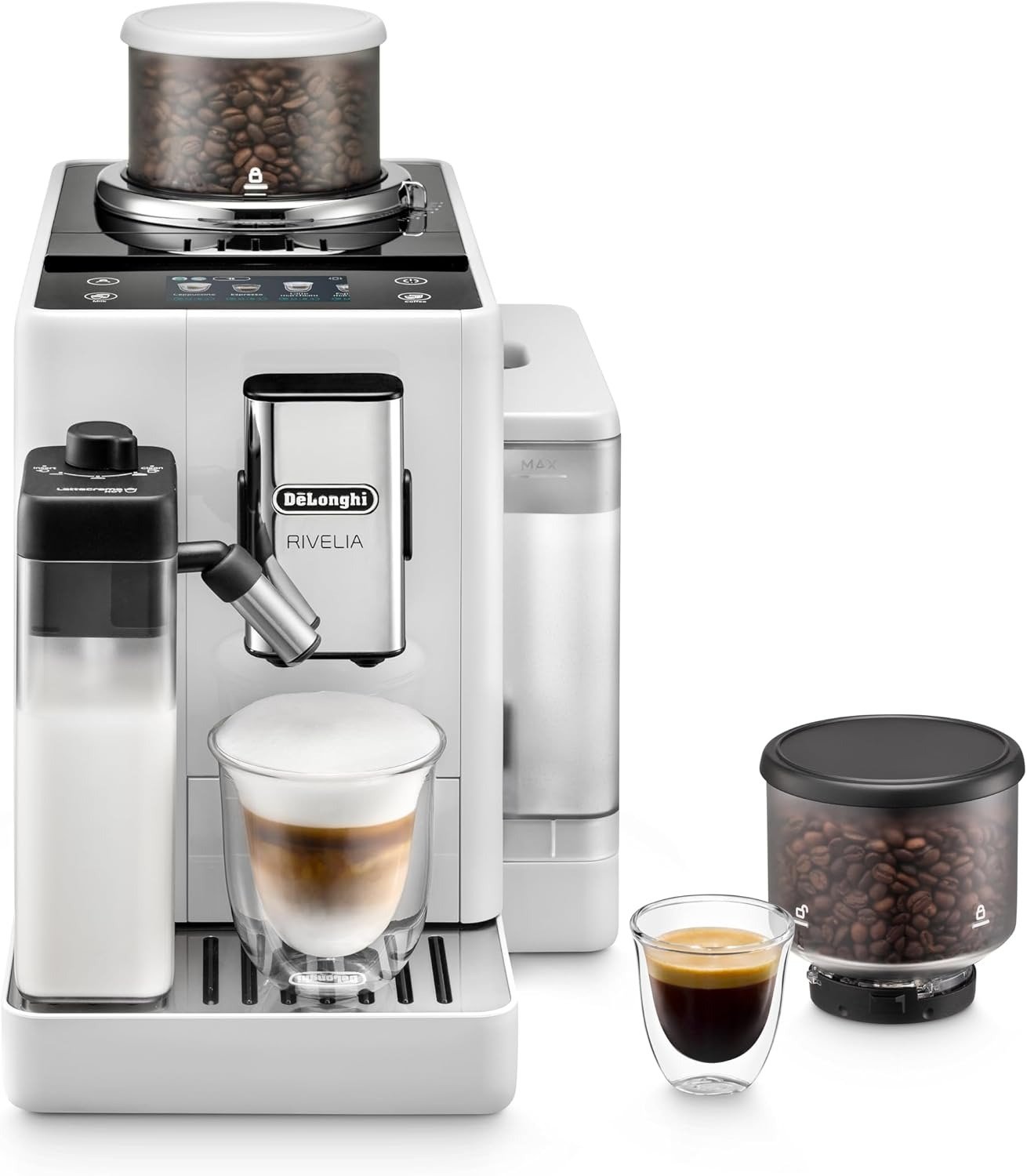
DE’LONGHI RIVELIA
The Rivelia does exactly what the box says. Grinds the beans, doses, brews, froths — start to finish without you touching a tamper, a portafilter, or a scale. It looks good on the counter. It makes 18 different drinks. It even remembers your preferences.
And yet. There’s a specific kind of buyer who will spend $1,499 on this machine, use it for three weeks, and feel a vague, nameless dissatisfaction they can’t trace back to a single feature failure.
That feeling has a name. And it has a threshold.
This article is not about whether the Rivelia is a good machine. It is. It’s about which problem it actually solves — and the precise line where that solution ends.
THE RESULT LOOKS FINE. THE PROBLEM ISN’T.
Every morning the machine fires up, rinses itself, grinds fresh beans, and puts something warm and brown and aromatic in your cup. The crema floats. The milk steams automatically. The touchscreen confirms everything went correctly.
That’s the part that makes the dissatisfaction so hard to locate.
The machine isn’t breaking down. The coffee isn’t undrinkable. The friction isn’t mechanical — it’s perceptual. The cup looks like what you ordered from the café. The experience of it doesn’t land the same way.
This isn’t a flaw in the Rivelia specifically. It’s the fundamental nature of superautomatic extraction — a category-level reality that the Rivelia executes at the high end of, but cannot escape from.
Superautomatic machines, by design, do not produce technically perfect espresso. They cannot dose and tamp the way a trained human does — and that is a feature, not a bug. These machines are built for people who want coffee quickly and easily, not for espresso purists. Tom’s Guide
The machine delivers on its actual promise. The disappointment arrives when someone expected a promise it never made.
WHAT YOU’RE ACTUALLY FEELING BUT NOT NAMING
There are two versions of the morning coffee problem, and they look identical from the outside.
Version One: You want fresh, hot, high-quality coffee with zero intervention — ground from whole beans, done in under a minute, no mess, no technique required. You’re not a barista. You don’t want to be one. You want the result without the craft.
Version Two: You want to make great espresso. You’ve developed opinions about grind size, extraction ratios, dose weight. You think about the difference between a 22-second and a 28-second pull. You enjoy the process of dialing in. You’re looking for a machine that rewards that investment.
Both of these people walk into the Rivelia at the same price point.
Only one of them walks out satisfied.
The annoyance Version Two feels is not really about the Rivelia. It’s about having solved the wrong problem at a $1,499 price point. A manual semi-automatic at $899 would have been a better answer to a different question.
The Rivelia is not a step toward mastery. It is a permanent replacement for the need to develop it.
THE HIDDEN MECHANISM BEHIND THE MISS
The extraction physics of a superautomatic machine are structurally different from a manual one — not worse in every situation, but constrained in ways the spec sheet doesn’t communicate.
The Rivelia uses a conical burr grinder with 13 settings, a 19-bar pump, and a thermoblock heating system. On paper, these numbers suggest serious espresso capability.
In practice, the machine operates within locked parameters. The default espresso setting doses around 42g of espresso in 21 seconds including pre-infusion — slightly outside the generally accepted extraction window of 1:2 ratio in 25 to 28 seconds. Tom’s Guide At maximum intensity and the finest grind, you can push performance significantly closer to specialty standards. At strength level 5, the machine uses approximately 16 grams of coffee — a dose used in specialty coffee for a single espresso. With a fine grind and maximum dose, the extraction achieves approximately a 1:2 ratio in 22 seconds, producing a very decent result even with medium-roast specialty beans. Espresso Rabbit Hole
But there’s a ceiling you cannot pass.
The pre-ground coffee bypass is practically unusable — it either jams the machine or produces undrinkable coffee. Whole beans are not recommended; they are essential. Home Coffee Expert
The machine is also opaque by design. Because it is automatic, there is no way to weigh the pre-extraction coffee dose or verify the exact brew ratio in real time. Tom’s Guide
You cannot intervene in the extraction. You can only adjust parameters and accept the result.
For a specific buyer, this is liberation. For another, it is the exact constraint that makes $1,499 feel wrong.
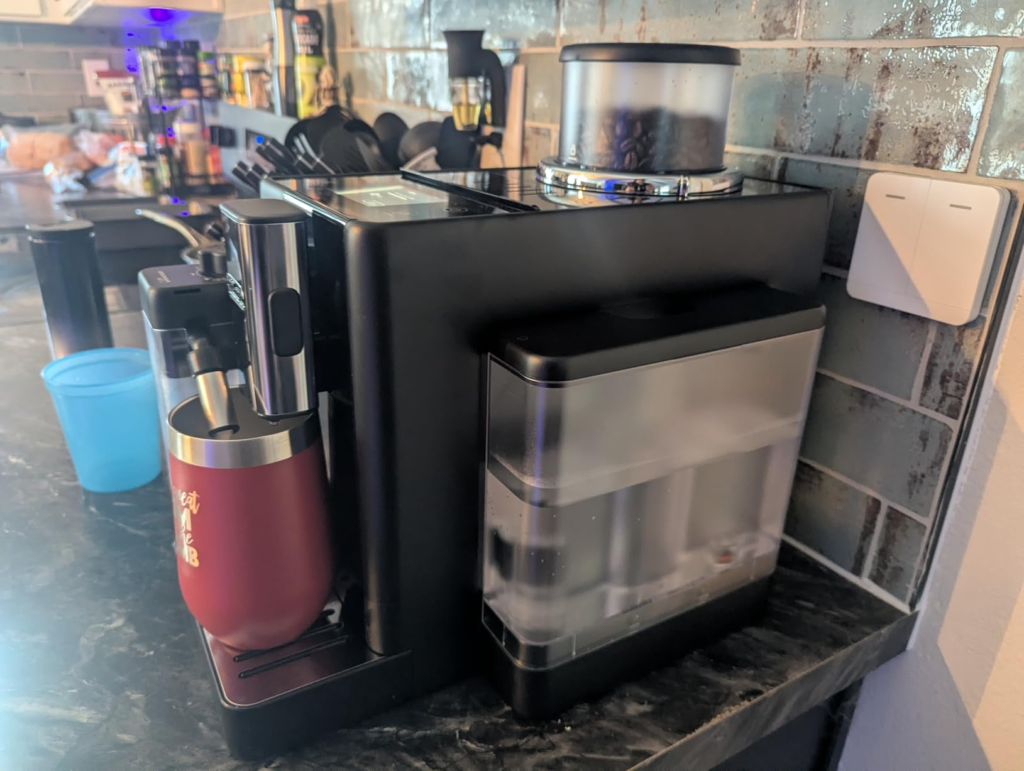
THE THRESHOLD WHERE THE OUTCOME QUIETLY BREAKS
The Rivelia’s performance doesn’t collapse. It degrades past a specific decision threshold — the point where the user’s coffee awareness overtakes what the machine can respond to.
| Buyer State | Rivelia Performance |
|---|---|
| Wants fresh coffee, zero technique | Excellent. Consistent. Justifies the price. |
| Wants to explore beans and roasts | Very good. Bean Switch system is genuinely useful. |
| Wants to customize milk drinks and save profiles | Strong. LatteCrema system handles dairy and plant-based milk well. |
| Wants to dial in espresso like a barista | Limited. Parameters adjust but extraction is opaque. |
| Wants extraction control, dose visibility, tamp control | Wrong machine entirely. |
The Bean Adapt Technology, which adjusts grind and temperature to the bean type, is only available for straight espresso — not for milk-based drinks. Coffeeness That’s a narrow application for a feature that sounds comprehensive.
Cold foam drinks require a separate LatteCrema Cool Upgrade Set, sold at an additional $129.95 — an add-on that many buyers discover only after the initial purchase. Coffeeness
The threshold is not a defect. It is a category boundary. The Rivelia performs at the top of the superautomatic tier. That tier has a ceiling. The question is whether your expectations live above or below it.
WHY MOST BUYERS MISREAD THIS TOO EARLY
The feature list of the Rivelia is genuinely impressive, and that’s the trap.
Dual interchangeable bean hoppers. 18 recipes. Four user profiles. Bean Adapt Technology. 13-step grinder. LatteCrema automatic frothing. iF Design Award. Red Dot Award. This is not the spec sheet of a budget machine.
So buyers arriving from two directions make the same error: they read the list and assume it answers questions it doesn’t address.
The pod machine upgrade buyer assumes that because the Rivelia is expensive and grinds whole beans, the coffee will taste like a specialty café. It will taste significantly better than a pod. It will not taste like a trained barista’s pull — because the extraction physics are different, not deficient.
The semi-automatic researching buyer assumes that more automation at a higher price means better espresso outcomes. In this case, more automation means removed control. The $899 De’Longhi Magnifica Evo or the $1,199 La Specialista Maestro give different levels of extraction access for different types of buyers. Some reviewers argue the Rivelia’s price premium over the Magnifica Evo — around $600 — is difficult to justify on specs alone. The Magnifica Evo offers auto milk frothing, seven customizable recipes, and a built-in burr grinder at a lower price point. Tom’s Guide
The premium you pay for the Rivelia buys: the Bean Switch system, the larger recipe library, the adaptive user profiles, the award-winning design, and the more refined daily experience. It does not buy you better extraction control.
Those are genuinely different things.
WHO IS ACTUALLY INSIDE THIS PROBLEM
The Rivelia solves a specific operational problem with unusual elegance.
| Profile | Fit Level |
|---|---|
| 2–4 person household with different bean preferences | High — Bean Switch system built exactly for this |
| Daily latte/cappuccino drinkers who dislike intervention | High — LatteCrema system handles it entirely |
| Decaf + regular espresso household | High — the primary use case the dual hopper was engineered for |
| People upgrading from pod machines, Keurig, or drip | High — dramatic quality increase, no technique required |
| Compact kitchen users who tried larger machines and retreated | High — 9.6 inches wide, stable footprint, standard cabinet clearance |
| Plant-based milk users (oat, almond, soy) | Good — LatteCrema handles alternatives well |
| Single-origin specialty coffee explorers who care about extraction | Moderate — the machine will use those beans, but won’t honor every nuance |
| Espresso purists who weigh doses and track ratios | Low — wrong tool for the intent |
The Rivelia’s actual target is the household where coffee matters enough to invest in, but not enough to become a skill. That is a large, underserved market, and the Rivelia addresses it better than almost anything at this price.
WHERE WRONG-FIT BEGINS
There are specific conditions where the Rivelia produces regret rather than satisfaction.
You primarily drink straight espresso and care about technical quality. The shot produced at default settings is noticeably thin — the crema isn’t dense and the espresso lacks structural weight. It’s adequate, but it won’t satisfy someone with formed expectations about espresso quality. Tom’s Guide You can improve this through customization, but you cannot reach the ceiling a manual machine opens up.
You want very hot milk-based drinks. The milk temperature is appropriate for most users but may be too cool for people who require extremely hot lattes. Home Coffee Expert The automatic system doesn’t offer the temperature floor that a manual steam wand gives you.
You use primarily pre-ground coffee. The bypass chute exists but functions unreliably. This machine requires whole beans to operate as designed.
You have a small household that drinks one type of coffee consistently. The Bean Switch system — the marquee feature — becomes irrelevant. You’d be paying a premium for capability you’ll never use, when a $899 option would produce a similar single-drink result.
You’re counting on the cold foam feature being included. It isn’t. Cold drinks are available through an optional upgrade kit at nearly $130 additional cost Coffeeness — a figure that surprises buyers who assume it’s part of the package.
THE ONE SITUATION WHERE THIS PRODUCT BECOMES LOGICAL
There is a specific household condition where the Rivelia stops being a considered purchase and becomes the only logical answer.
You have two or more daily coffee drinkers with different preferences — one drinks dark roast espresso in the morning, one drinks a lighter oat milk latte at night, and neither person wants to empty a hopper or run purge shots before every session. You’ve had machines before that technically worked but that someone stopped using because the friction was too high. You’ve been tolerating that friction or reverting to pods or café runs.
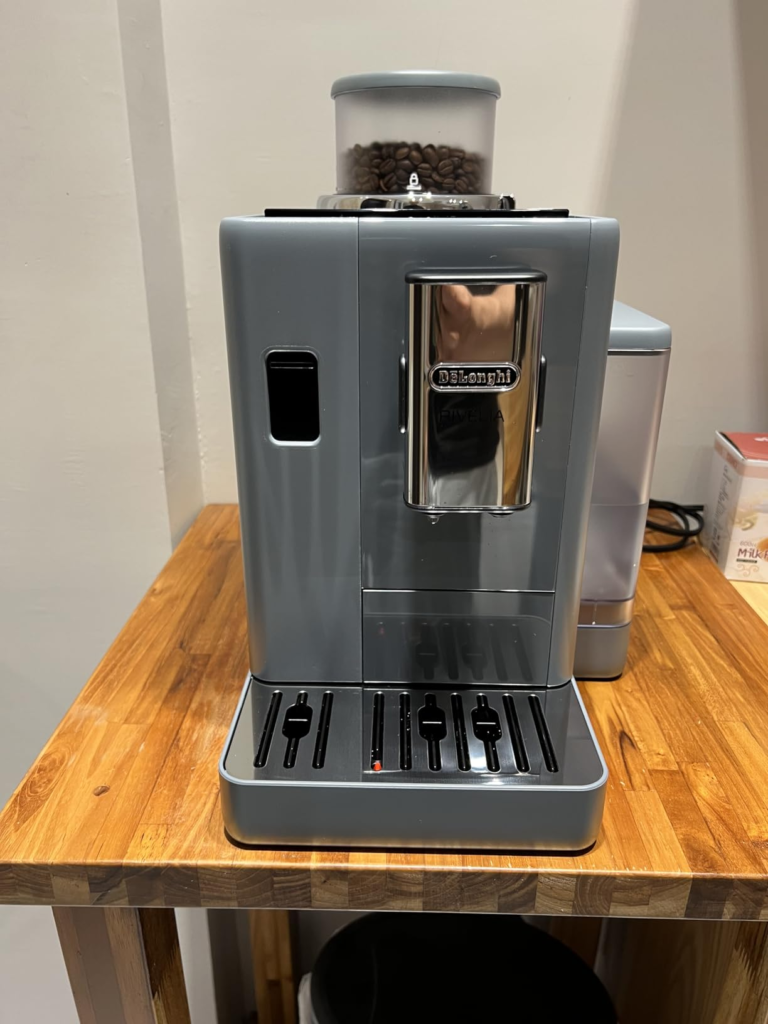
The dual hopper system allows you to toggle between two bean types — a dark roast and a decaf, or two different blends — using a mechanism that is physically satisfying and functionally precise. The bean hoppers seal tightly, the switch is intentional and clean, and the machine manages the small amount of residual beans during the transition without requiring manual intervention. Coffee Drinker
The setup takes approximately 15 minutes from unboxing to first cup. The machine guides the process with animated instructions, creates user profiles for every household member, and runs a test grind before becoming operational. Popular Science
The machine then remembers who you are, adjusts the menu to the time of day, and keeps the entire experience frictionless indefinitely.
That is not a marketing claim. That is the specific problem this machine was built to solve.
WHAT IT SOLVES, WHAT IT REDUCES, AND WHAT IT STILL LEAVES TO YOU
Being precise about this matters. The Rivelia does not do everything.
| Category | What the Rivelia Does |
|---|---|
| Grinds | Every cup from whole beans, automatically, 13-setting conical burr grinder |
| Brews | 18 preset recipes, adjustable strength and volume, 4 user profiles |
| Froths | Automatic LatteCrema Hot — dairy and plant-based, no steam wand |
| Cleans itself | Self-rinse on startup and shutdown, 3-day auto deep clean if unused |
| Switches beans | Dual hoppers, purge mode, zero cross-contamination when managed correctly |
| Adapts to beans | Bean Adapt Technology — adjusts grind, dose, temperature (espresso only) |
| Category | What It Does Not Do |
|---|---|
| Extraction control | You cannot see or adjust dose weight in real time |
| Tamp pressure | Automated, not adjustable |
| Cold foam | Requires $129.95 add-on |
| Pre-ground coffee | Bypass chute is unreliable at best |
| Very hot milk | Capped by automatic system, not a steam wand |
| Espresso precision at barista level | By design, not by failure |
The water tank holds 47 ounces. In testing, this emptied after approximately five drinks — adequate for light use but requiring daily refilling in active households. Tom’s Guide This is a real operational variable in multi-person homes.
What it leaves to you: choosing good beans. The machine handles everything after that. It cannot compensate for stale, low-quality, or improperly stored beans. The results ceiling is set partly by what goes in.
FINAL COMPRESSION
The De’Longhi Rivelia is an answer to a question that a surprisingly large number of households are asking and not finding solved.
That question is not: How do I make perfect espresso?
That question is: How do I have consistently good coffee at home, from whole beans, with no skill requirement, for multiple people with different preferences, without the machine becoming a burden?
If that is your actual problem, the Rivelia answers it better than any machine at its price point. The Bean Switch system is genuinely useful rather than gimmicky. The Bean Adapt Technology works. The LatteCrema produces quality milk texture on the first attempt. The interface is legible without a manual.
If your question is different — if you want to develop espresso craft, or if you want technical extraction control, or if you drink one type of coffee and don’t need household-wide personalization — then the Rivelia is solving problems you don’t have at a price you don’t need to pay.
The decision isn’t about whether this is a good machine. It clearly is. The decision is about whether your friction is the friction it was built to eliminate.
If you drink different beans from the same household, dislike manual technique, and have been tolerating pod machines or café runs as a workaround — this is where the vague dissatisfaction ends.
De’Longhi Rivelia — $1,499 at Amazon
Transparency Note:
This analysis is built on aggregated real-world experience.
It extracts what repeatedly holds, what breaks, and what users uncover only after living with the system—then shapes it into a clear model you can use immediately.
Think of it as structured experience, refined and presented so you don’t have to learn it the hard way.
“A quick note: Don’t believe the star ratings, but trust personal experience. This article is a compilation of collected experiences”