GOVEE WATER LEAK DETECTOR REVIEW: THE ALARM WORKS. THAT ISN’T WHY BASEMENTS STILL FLOOD.
We check the basement the way we check a seatbelt — a glance, a click, and we move on. The floor’s dry. The corner by the water heater is dry. So we assume the rest of the house agrees with what our eyes just saw.
It usually doesn’t. The same story keeps surfacing in owner reviews of devices like this one: a water heater lets go on an ordinary Tuesday afternoon, nobody’s home, and the only reason the finished basement underneath stays dry is a sensor nobody was thinking about that morning. Water damage rarely announces itself first. It seeps, drips, and pools somewhere quiet for hours — and by the time it’s visible, the decision about whether this becomes a quick mop-up or a five-figure insurance claim has usually already been made.
One housekeeping note before we get into it: this page includes one Amazon link, and we may earn a small commission if you use it — at no extra cost to you, and it has zero influence on anything below.
Water Leak Detector Reviews: The Result Looks Fine. The Problem Isn’t.
Every water leak detector on the market claims to do the same basic thing: beep when it gets wet. That part is true even of the $10 versions with no app and no WiFi. So why do basements still flood, water heaters still fail unnoticed, and the average U.S. water-damage insurance claim still lands north of $13,000, according to Insurance Information Institute data?
Because a beep only works if someone is close enough, awake enough, and paying enough attention to hear it. That’s not a defect in any one product — it’s a blind spot in the entire “loud alarm” category. The Govee WiFi Water Leak Detector 3-Pack is worth a close look less for what it does when it touches water (nearly every sensor does that) and more for what happens in the minutes after, and who actually finds out. Basements are the least forgiving room in this equation: an estimated 98% of them experience some form of water damage over their lifetime, and it’s rarely the day someone happens to be standing in one.
Hidden Water Damage Signs: What You’re Actually Feeling but Not Naming
Before anyone buys a sensor, something smaller usually shows up first. A water bill that crept up without an obvious cause. A faint mustiness near the laundry area that’s gone by the time someone else comes to check it. A slightly soft patch of baseboard you keep meaning to press again, just to confirm you didn’t imagine it.
None of that is in your head. A single unnoticed leak can waste thousands of gallons a year — money leaving the house quietly, in a way no single bill makes obvious. What’s actually happening is a slow negotiation between your plumbing and time, and right now you have no way to referee it. That’s the real gap this category of product exists to close.
Govee Water Leak Detector: The Hidden Mechanism Behind the Miss
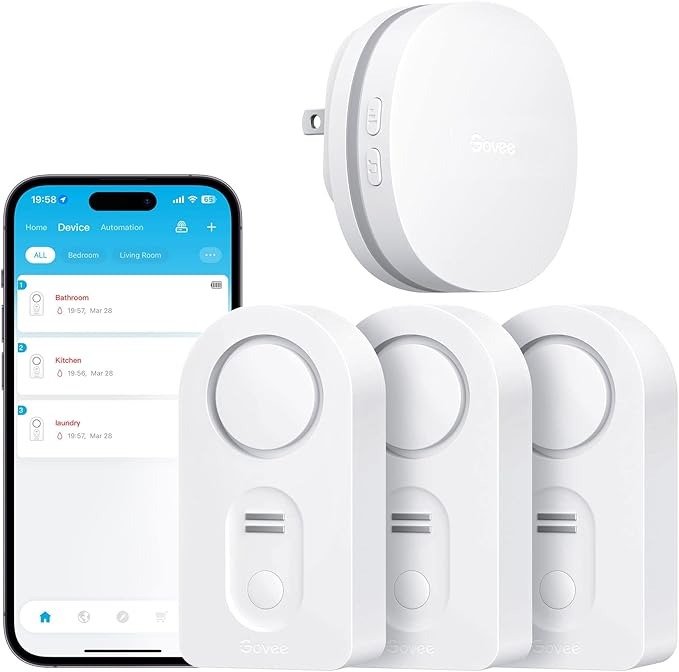
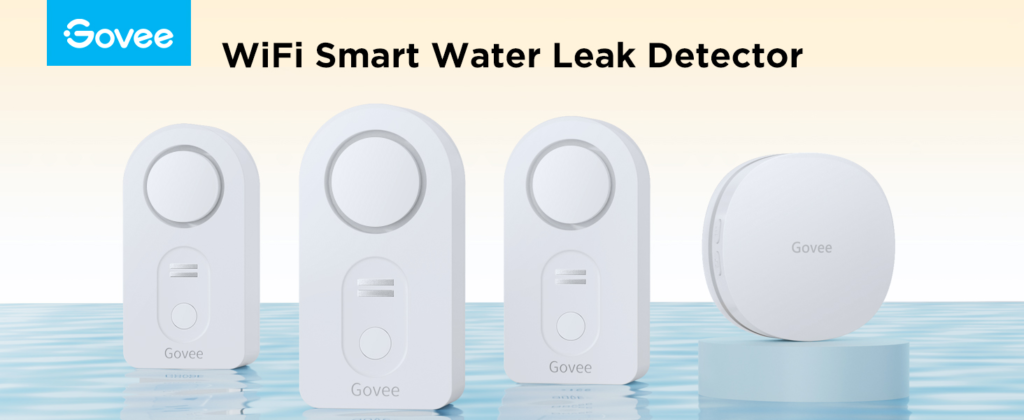
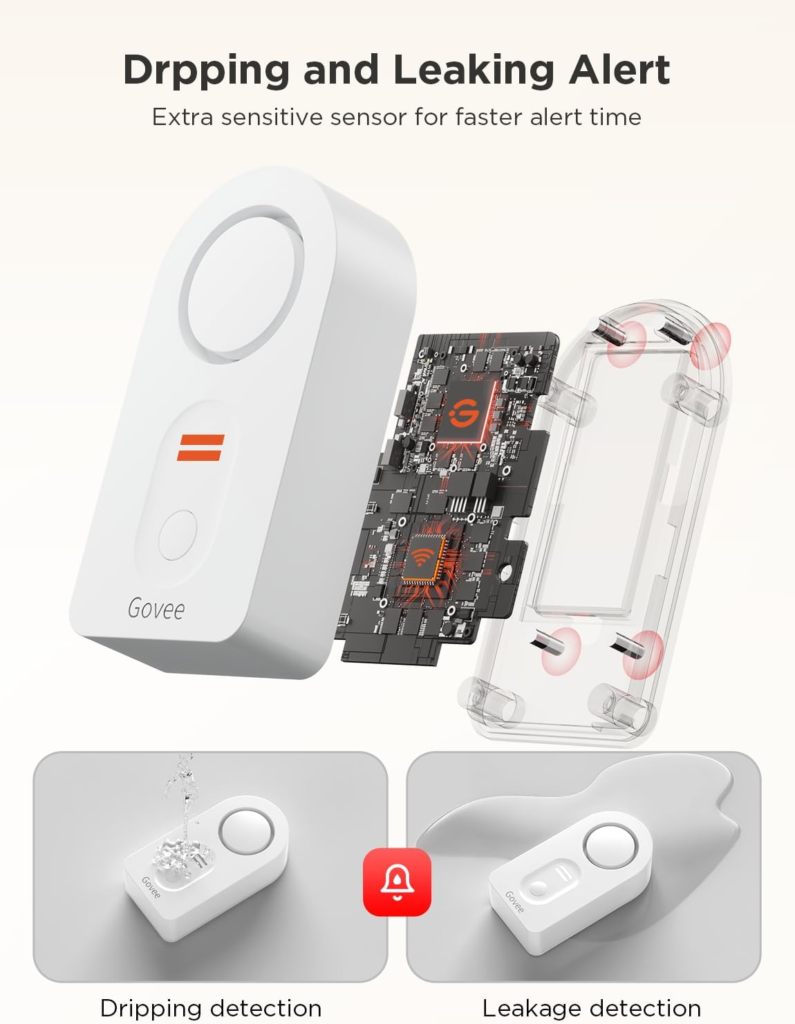
Strip away the branding and the mechanism is simple, which is part of why it works. Each sensor carries two sets of contact probes on the underside for standing water, plus a third set on the front edge for drips running down a wall or pipe. Touch water to either, and the sensor sounds locally — up to 100 decibels, loud enough that other reviewers have compared it to a car alarm rather than a chime — while sending a signal to a small WiFi gateway plugged into a nearby outlet.
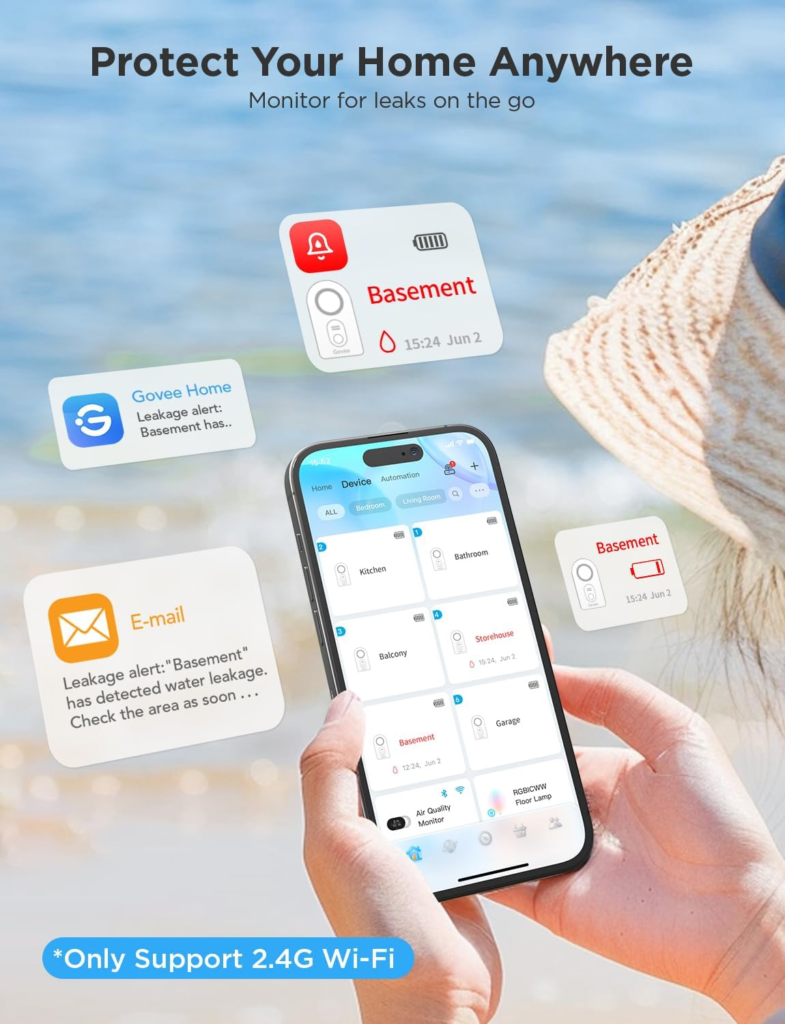
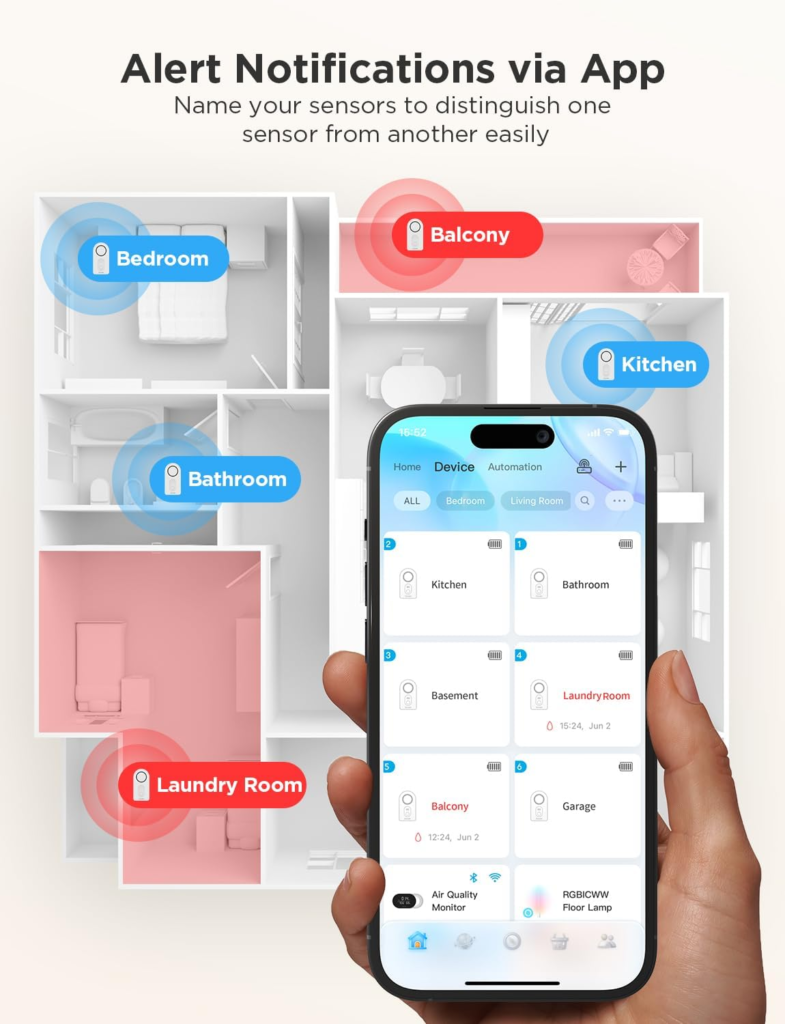
That gateway is the part people underestimate. It’s what turns a loud noise trapped inside four walls into a push notification and an email that reach you wherever your phone already is. The sensors run on two AAA batteries each, ship pre-paired to the included gateway, and keep making noise locally even if the WiFi connection drops — the gateway’s only job is getting the word out past the room, not detecting the leak in the first place.
| Spec | Detail |
|---|---|
| Included hardware | 1 WiFi gateway (H5040) + 3 sensors (H5054) |
| Detection method | 2 back-water probes + 1 front drip probe per sensor |
| Local alarm | Up to 100dB, 3 volume levels plus mute |
| Remote alerts | Push notification + email via the Govee Home app |
| Connectivity | 2.4GHz WiFi only — 5GHz is not supported |
| Gateway-to-sensor range | Up to roughly 196 ft, per the listing |
| Power | Gateway: wall outlet. Sensors: 2× AAA batteries each (included) |
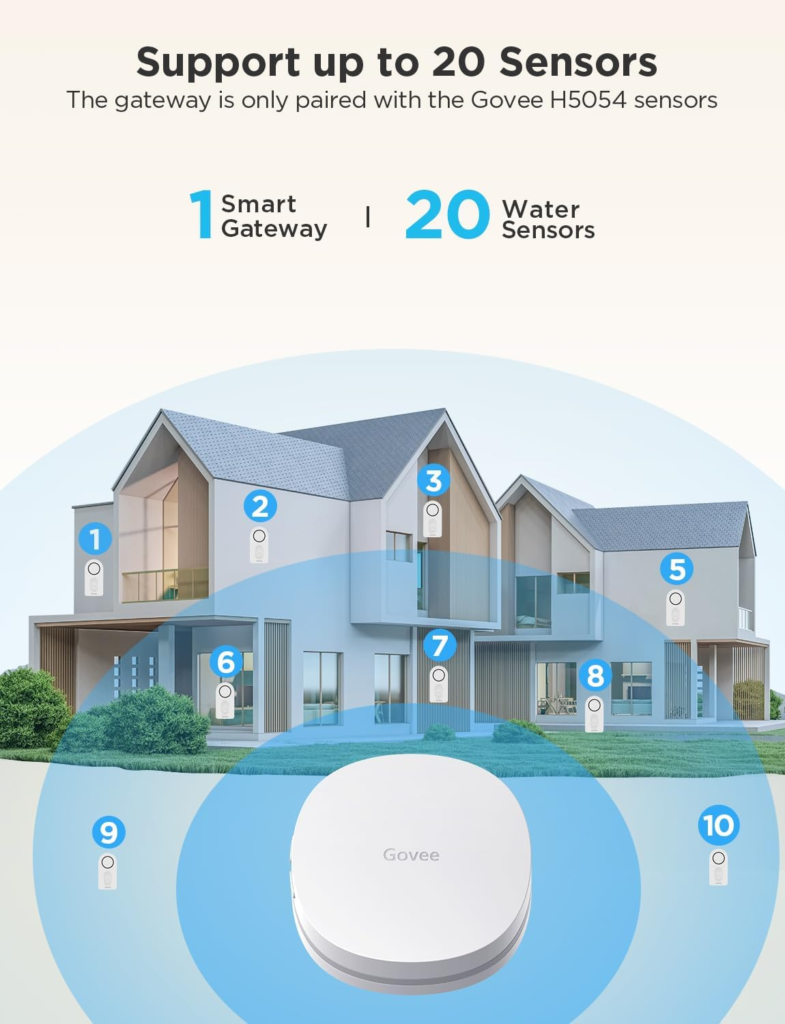
| Expandable | Yes — officially rated for up to 20 sensors on one gateway |
Water Alarm Range vs. Alert Range: The Threshold Where the Outcome Quietly Breaks
Why do most water alarms fail exactly when you need them most? Not because they’re broken — because alarm range and alert range were never the same thing, and the space between them is where most water damage actually happens.
Call it the Earshot Radius: the physical bubble around a purely local alarm within which a human has to be standing, awake, and paying attention for the warning to mean anything. A basic beeper has excellent alarm range and almost no alert range — it will scream at full volume, on schedule, to an empty house, while you’re at the grocery store or two floors up asleep. It’s the same pattern that shows up again and again in owner reports: a tap left running by accident, water spreading across a kitchen floor unseen — until a sensor a few feet away starts screaming and a phone lights up two rooms, or two states, away.
The Govee system doesn’t close that gap by making the local alarm louder. It gives the leak a second way out of the room, through the gateway and onto WiFi, so your Earshot Radius effectively becomes “anywhere your phone gets signal” instead of “this room, right now, if you happen to be listening.” It isn’t a perfect fix — the gateway still needs power and a working 2.4GHz connection to bridge that gap, which we’ll get to — but it closes the single biggest failure mode in the entire water-alarm category: the assumption that being loud is the same as being heard.
| Feature | Basic local-only alarm | Govee WiFi Water Leak Detector |
|---|---|---|
| Warns you if you’re in the room | Yes | Yes |
| Warns you if you’re asleep upstairs | Only if it carries that far | Yes — phone alert either way |
| Warns you if you’re at work or traveling | No | Yes, anywhere your phone has signal |
| Keeps sounding locally if WiFi drops | N/A | Yes — the 100dB alarm doesn’t need WiFi |
| Needs a working gateway to reach your phone | N/A | Yes |
| Upfront cost | Lower shelf price | A modest step up, for a much longer leash |
Water Leak Detector Reviews: Why Most Buyers Misread This Too Early
Most of the frustration scattered across Amazon Q&As, Govee’s community boards, and owner groups doesn’t trace back to the sensor failing at its one job. It traces back to a few assumptions buyers bring in that the product was never built to satisfy.
The first is the bundle mix-up. Govee and its GoveeLife sibling line sell several nearly identical-looking listings — some include the WiFi gateway, others are sensor-only packs explicitly marked as unable to connect to WiFi directly, requiring a separate gateway purchase for any phone alert at all. Buyers who grab the wrong one end up with a very loud local alarm and nothing on their phone, then blame the brand for a limitation they bought on purpose. The 3-pack this review covers ships with the gateway included — that’s the version that actually solves the Earshot Radius problem.
The second is the WiFi-band assumption. Modern mesh routers love to merge 2.4GHz and 5GHz under one network name, which is convenient until a 2.4GHz-only gateway can’t tell which one it’s landing on. Owners who fought “won’t connect” errors for hours usually solved it the same way: isolating or naming a dedicated 2.4GHz connection, rather than assuming the unit was defective.
The third is judging the whole product by the alarm alone. A few reviewers docked points because the siren doesn’t stop itself once a leak is wiped up — you mute it yourself. That’s a minor annoyance, not a flaw: an alarm that silences itself the moment probes look dry would also silence itself the moment you wipe them clean before you’ve actually fixed anything.
Basements and Under-Sink Leaks: Who Is Actually Inside This Problem
This isn’t a product for everyone, and it doesn’t need to be. It’s built for the handful of spots in a home that fail quietly and expensively: the area around a water heater nearing the end of its service life, the cabinet under a kitchen sink where a supply line has been slowly weeping for months, the hose behind a washing machine holding constant pressure, and the sump pump pit that only gets checked when someone remembers to.
Homeowners with a basement are the clearest fit, given how close to universal that exposure is. So are landlords and anyone managing a property they don’t live in full-time, where “I’ll notice eventually” simply isn’t true anymore — along with renters protecting one specific unit, and anyone who’s already had a plumbing scare and doesn’t want a second one.
| Where to place a sensor | Why it’s a common failure point |
|---|---|
| Under or beside the water heater | Tank failures are one of the most frequently cited causes of sudden water damage |
| Under the kitchen sink | Supply lines and disposal seals degrade slowly and rarely announce it |
| Under bathroom sinks, behind toilets | Shutoff valves and wax seals are classic slow-leak points |
| Behind or under the washing machine | Hoses under constant pressure are a common burst point |
| Around the sump pump | Failure here is often discovered only once the floor is already wet |
Govee Water Leak Detector Limitations: Where Wrong-Fit Begins
None of this holds up if we don’t say plainly where it stops. The gateway needs continuous power and a working 2.4GHz connection to reach your phone — if a storm knocks out both electricity and internet at once, you lose the remote alert, though the local 100dB alarm still sounds on battery power regardless. A handful of long-term owners reported a gateway silently dropping offline for stretches on certain networks, which is why glancing at the app now and then to confirm it still shows connected is worth the ten seconds it takes.
It’s also a contact sensor, not a whole-home monitor. It only knows about water it physically touches. A slow leak building up behind drywall or under a slab, never reaching the floor where a sensor sits, won’t trigger anything — that’s a job for a different category of device that monitors pressure or flow at the main line instead of moisture at a point. And it doesn’t shut water off. It tells you there’s a problem; acting on that is still on you.
| A strong fit if… | A weak fit if… |
|---|---|
| You have a handful of known risk points — heater, sinks, washer, sump pump | You need whole-home pipe monitoring behind walls and under slabs |
| You want a phone alert with no subscription and no professional install | You specifically want water shut off automatically, not just reported |
| Your home network has a standard 2.4GHz band available | Your network is 5GHz-only, or a mesh with no isolated 2.4GHz option |
| You’re willing to check the app occasionally to confirm it’s online | You want zero ongoing attention, ever |
Govee WiFi Water Leak Detector 3-Pack: The One Situation Where This Product Becomes Logical
Put those pieces together and this stops being a gadget decision and turns into a math problem. A single-family home with a water heater, a kitchen, a laundry hookup, and a basement has at least three or four points where a slow failure could go unnoticed for days. A standard 2.4GHz home network is already sitting there, unused for this purpose. And the real cost of guessing wrong — a claim that averages well over $13,000, on top of the deductible, the disruption, and the paperwork — dwarfs the cost of three sensors and a gateway that plugs in and pairs out of the box.
That’s the situation where this specific bundle earns its place: not as the most advanced water-monitoring system available — it isn’t, and doesn’t claim to be — but as the version of closing the Earshot Radius that doesn’t require a subscription, a plumber, or a second mortgage to set up.
Govee Water Leak Detector: What It Solves, What It Reduces, and What It Still Leaves to You
It solves the notification gap — the difference between a leak happening and a leak being known, whether or not anyone’s home to hear it. It reduces, without eliminating, your odds of a five-figure claim, simply by shrinking how long water sits before someone responds. The EPA’s own guidance puts the window for heading off mold at roughly 24 to 48 hours after materials get wet, and a same-day phone alert keeps you comfortably inside that window in a way an unheard beep never could.
What it still leaves to you: good placement, an occasional test, keeping the gateway’s WiFi connection healthy, and actually walking downstairs when your phone buzzes at 2 a.m. The sensor’s job ends the moment it tells you something’s wrong. What happens in the next hour is still entirely human.
Govee Water Leak Detector: Frequently Asked Questions
| Question | Answer |
|---|---|
| Does it need the WiFi gateway to work at all? | The gateway is required for phone and email alerts. The local 100dB alarm still sounds without it, but you won’t be notified remotely. This 3-pack includes the gateway; some other Govee listings sell sensors only. |
| What WiFi does it need? | 2.4GHz only. It will not connect to a 5GHz-only network, and should stay within roughly 196 ft of the gateway. |
| What batteries does it use? | Two AAA batteries per sensor, included. The gateway plugs into a standard outlet and doesn’t run on batteries. |
| Will the alarm sound during a power or internet outage? | Yes for the local alarm, which runs on the sensor’s own batteries. No for the remote phone alert, which needs the gateway online. |
| Can I add more than three sensors? | Yes. Additional H5054 sensors pair to the same gateway, officially rated for up to 20. |
| Does it shut off my water automatically? | No. It alerts only — automatic shutoff is a different, pricier category of device. |
| Why is my sensor beeping with no visible water? | Almost always a damp or dirty probe, a low battery, or contact with a metal surface. Wipe the probes dry and retest before assuming a defect. |
| Can a leak detector lower my home insurance bill? | Sometimes — worth asking your insurer. Point sensors like this one occasionally qualify for a modest discount; the larger discounts are usually reserved for automatic-shutoff systems. |
Govee Water Leak Detector Review: Final Compression
Strip away the specs and this comes down to one question: is there a room in your home where a leak could run for hours before anyone found out? For most homes with a basement, a water heater, or a washing machine, the honest answer is yes. At that point, the choice isn’t really about this sensor versus another one — it’s about whether you’d rather find out from your phone or from your ceiling.
If that’s the condition you’re actually dealing with, here’s where you can pick it up: [Govee WiFi Water Leak Detector 3-Pack on Amazon]
Transparency Note:
This analysis is built on aggregated real-world experience. It extracts what repeatedly holds, what breaks, and what users uncover only after living with the system—then shapes it into a clear model you can use immediately. Think of it as structured experience, refined and presented so you don’t have to learn it the hard way.
“A quick note: Don’t believe the star ratings, but trust personal experience. This article is a compilation of collected experiences.”