Dreo Tower Fan Review 2026: I Needed Silence and Power — I Only Trusted One
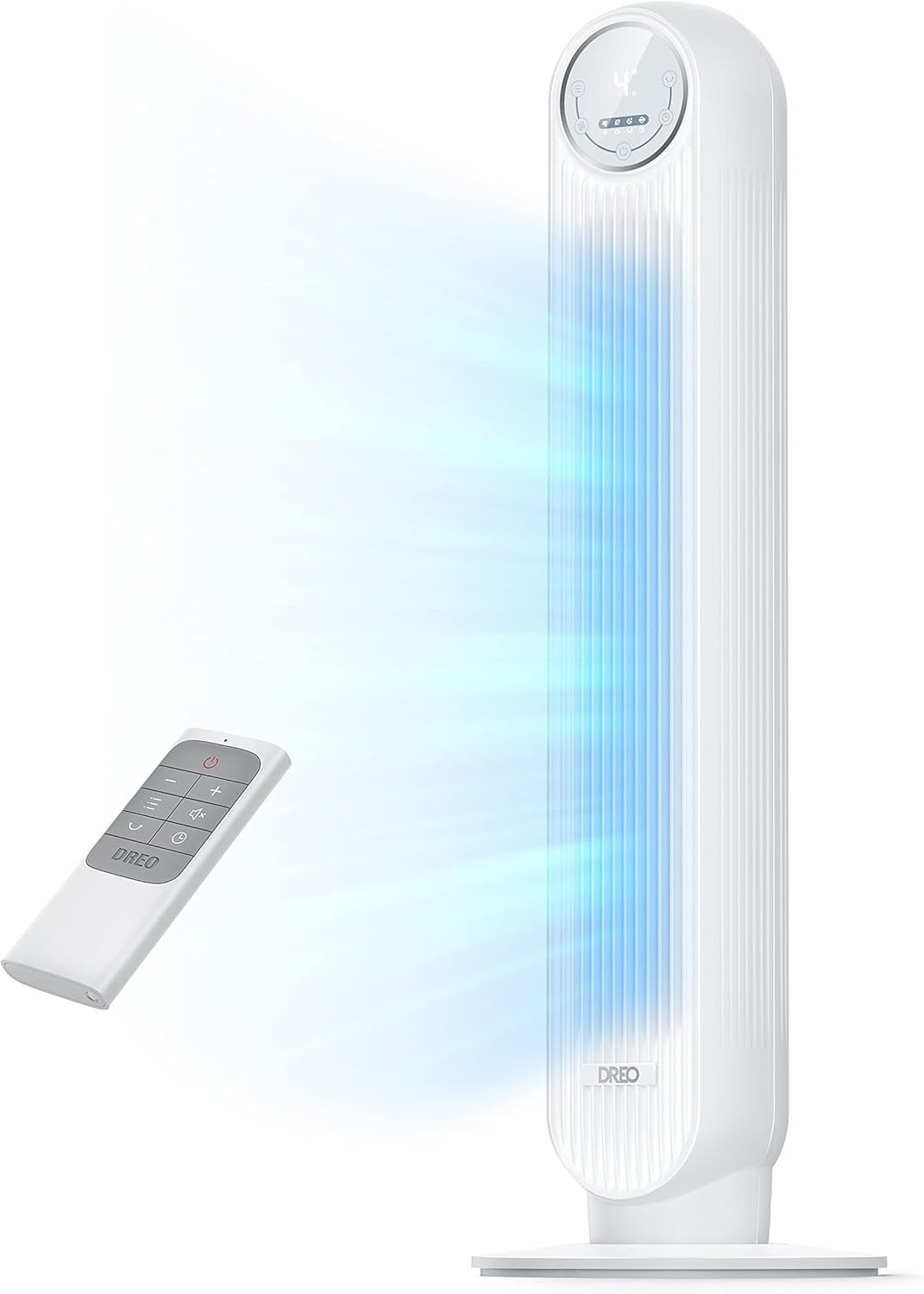
DREO 2026 TOWER FAN
I spent three summers cycling through fans. The box fan by the desk. The pedestal fan by the window. The small white table fan I’d carry into the bedroom after midnight because nothing else worked quietly enough after 11 PM.
Every morning I woke up either overheated or annoyed. Usually both. And every spring I convinced myself the new fan would finally solve it.
What I didn’t understand until I opened the Dreo 2026 Tower Fan was the assumption living underneath all those bad decisions: that power and silence are a tradeoff. That you buy one by giving up the other. That was the broken logic I carried for three years — and the reason I kept choosing wrong.
Dreo 2026 Tower Fan Performance: The Result Looks Fine. The Problem Isn’t.
Turn any fan on. Feel the airflow. Assume it’s working. Close the loop.
That’s the trap. Including me, for three cycles.
I’d set the fan to speed 3 or 4, feel something moving in the room, and tell myself: done. But at 2 AM I’d wake up — one side of my body cool, the other side sticky, the fan buzzing somewhere in the dark that had shifted from background noise to the only thing I could hear.
The result looks fine all day. The failure lives in the quiet, in the dark, when the house stops competing with the fan’s noise floor.
And the failure wasn’t that the fan was loud in absolute terms. It was that “loud enough to notice at 2 PM” and “loud enough to wake me at 2 AM” are two completely different thresholds — and most fans only measure themselves against the first one.
| What You Observe | What’s Actually Happening |
|---|---|
| Fan is running, room feels cooler | Air circulates in one zone — not the whole room |
| You check it and it seems “fine” | Daytime ambient noise masks the actual noise floor |
| You set speed 4–5 and forget it | That speed may sit above your sleep noise threshold |
| “Quiet fan” on the box | Measured at lowest speed in a controlled lab setting |
| 90° oscillation seems wide | In rooms with no air-return, it covers only one half |
Bedroom Fan Discomfort: What You’re Feeling But Haven’t Named
Why do you keep adjusting the fan? Not the thermostat — the fan. Speed 3, then 4, then back to 2, then up again at 3 AM.
What you’re chasing isn’t a temperature. It’s a sensation. The sensation of air that arrives, eases, then returns — something that moves like weather rather than like a machine fixed at one constant speed.
I didn’t have a word for this until I tried Natural mode on the Dreo. It simulates outdoor breeze patterns: speed that rises, plateaus, and falls in irregular cycles — the way actual wind behaves when it passes through a window. The body stops bracing against it. It accepts it.
For three years I ran Normal mode on every fan I owned: fixed speed, constant blast, same corner. I thought I wanted more power. I didn’t. I wanted different behavior.
| Mode | Behavior | Best Used When |
|---|---|---|
| Normal | Fixed airflow at your chosen speed | Desk work, focused daytime cooling |
| Natural | Speed varies in organic, irregular wave patterns | Sleeping, reading, restless nights |
| Sleep | Gradually reduces speed + auto-dims display | Falling asleep, light sleepers |
| Auto | Reads built-in temperature sensor, self-adjusts | All-day set-and-forget use |
If you’ve been adjusting the fan repeatedly through the night, you’re probably not on the wrong speed. You’re on the wrong mode. That’s the distinction almost every buyer misses before purchase.
Dreo TurboWind & DC Motor Technology: The Hidden Mechanism Behind the Results
Why does this fan move more air at lower noise than competitors running the same wattage?
The answer isn’t a brand decision. It’s two engineering choices applied together.
The first is the brushless DC motor. Traditional AC motors generate power through magnetic resistance — which creates vibration as a byproduct. DC motors eliminate that resistance path. The 2026 version reaches 28 ft/s against the previous generation’s 24–25 ft/s ceiling, while drawing only 36 watts. A standard AC motor fan producing comparable airflow typically draws 55–75 watts.
The second is the Coanda effect, embedded into the impeller’s blade geometry. Airflow moving along a curved surface naturally adheres to that surface — it extends further without dispersing sideways. Dreo’s algorithmic impeller uses this principle to project air up to 34 feet from a 36-inch fan. The air travels further not because the motor works harder, but because the geometric path it follows is more efficient.
Together, they produce something conventional fan design cannot match at this price: high velocity with low turbulence. And low turbulence, mechanically, is what low noise actually means.
| Component | Function | Real-World Effect |
|---|---|---|
| Brushless DC Motor | Eliminates resistance-based vibration | Lower noise floor vs. AC motors at same output |
| 2026 Motor Upgrade | Increases max RPM efficiency | 28 ft/s vs. 24–25 ft/s in previous generation |
| TurboWind System | Optimizes spin-to-airflow conversion | More airflow per watt consumed |
| Algorithmic Impeller | Blade curvature applies Coanda effect | Air projects to 34 ft without turbulent dispersion |
| Coanda Effect | Air adheres to curved surface, extends reach | Lower noise at high velocities |
| Anti-vibration Housing | Dampens mechanical rattle at speed | Prevents resonance buildup on higher settings |
Dreo 2026 Noise Threshold: Where the Silence Quietly Breaks
Here’s what most reviews skip: 20 dB is not the operating range. It’s the floor.
Speed 1 registers approximately 20 dB — softer than a library whisper. Below the ambient noise of a quiet bedroom, which typically sits around 28–30 dB on its own. At speed 1, this fan is quieter than the room it’s in.
Speed 8 is a different situation. Maximum output climbs to approximately 48 dB — the hum of a nearby refrigerator. Not painful. Comfortable in daytime context. But in a silent bedroom at 1 AM, 48 dB is present, consistent, and impossible to un-hear once you notice it.
I call this the Silence Gradient: the slope between your fan’s quietest and loudest setting, and where on that slope your actual nightly usage lands. The Dreo 2026’s gradient is notably flat compared to similar fans — speed increases are gradual, not abrupt. But the gradient exists. Where you use it determines your real experience.
| Speed | Approximate dB | Real-World Comparison | Ideal For |
|---|---|---|---|
| Speed 1 | ~20 dB | Below library whisper | Extreme light sleepers, infants |
| Speed 2 | ~23 dB | Soft paper rustle | Quiet bedrooms, sensitive sleepers |
| Speed 3 | ~27 dB | Quiet countryside | Most sleep environments |
| Speed 4 | ~32 dB | Very quiet conversation | Average sleepers, warmer rooms |
| Speed 5 | ~38 dB | Low consistent hum | Daytime work, mild background |
| Speed 6 | ~42 dB | Low-volume TV | Daytime cooling only |
| Speed 7 | ~45 dB | Quiet room conversation | High-output daytime use |
| Speed 8 | ~48 dB | Running refrigerator | Maximum airflow, noisiest setting |
If you sleep between speeds 1–4, the 20 dB promise is your lived experience. If your room requires speeds 6–8 to feel cool, the noise spec becomes a range — not a guarantee.
Dreo Tower Fan Specs Explained: Why Most Buyers Misread Them Too Early
When I first evaluated this fan, I nearly dismissed it over the 8-hour timer. “The other model has 12 hours,” I thought, doing the responsible consumer thing. That logic was completely backwards.
The timer limit affects exactly one narrow situation: sleeping 9+ hours, wanting continuous operation, and refusing to touch the fan at any point. Most people who flag this complaint don’t actually sleep 9 hours — they sleep 7 and leave the fan running for ambient noise. For that pattern, 8 hours is invisible as a limitation.
What actually separates good outcomes from disappointing ones is the relationship between max velocity and effective operating speed. At 28 ft/s, you can run this fan at speeds 3–4 and feel airflow that previous models required speeds 5–6 to produce. That’s the real 2026 story — not just a higher ceiling, but more performance available in the quiet middle of the range where people actually sleep.
| Spec | Common Misread | What It Actually Means |
|---|---|---|
| 20 dB noise | “The fan is always that quiet” | That’s speed 1; real noise depends on your actual speed choice |
| 28 ft/s max velocity | “A raw power number” | Enables real airflow at lower, quieter speeds — the real upgrade |
| 8 speeds | “More settings = better” | Valuable if you use the full range; invisible if you stay at 2–3 positions |
| 8-hour timer | “Inferior to 12-hour competitors” | Only limits users sleeping 9+ hours continuously |
| 90° oscillation | “Compare numbers only” | Room geometry determines coverage more than oscillation degrees |
| 36 watts | “Ignored” | ~$1.30/month at 8h daily — significant vs. any AC unit’s operating cost |
| Bladeless design | “Aesthetic choice” | Structural safety — ETL certified, pinch-proof for kids and pets |
Dreo Tower Fan Buyer Profile: Who This Fan Is Actually Built For
I need to be specific here because the marketing language around this fan gets too wide, too fast. “Great for bedrooms, offices, and living rooms” covers every room in most houses. It doesn’t tell you whether it covers your room.
The Dreo 2026 Tower Fan is built for this exact friction pattern: you’re in a room between 150–300 square feet. You care about sleep quality more than daytime output. You’ve woken up because of a fan before — from noise, or from the blast of air on your face, or from both. You want airflow that behaves like weather, not like a machine locked at one setting. And you want to stop spending money on the problem.
If that maps onto your actual situation, you are inside this product’s logic. Everything it prioritizes — the noise floor, Natural mode, Sleep mode display dimming, the 36-watt efficiency — was designed for exactly this use.
| User Type | Fit | Why |
|---|---|---|
| Light sleeper, room under 250 sq ft | ✅ Excellent | Low-speed silence is the defining structural strength |
| Parents with toddlers or pets in the room | ✅ Excellent | Bladeless, pinch-proof grille, ETL certified — zero exposed blades |
| Remote workers on frequent video calls | ✅ Strong | Stays below microphone interference threshold at typical speeds |
| Budget buyer replacing a noisy old fan | ✅ Strong | Best noise-to-price ratio in its class |
| Renters in small apartments without AC | ✅ Strong | Compact footprint, real airflow output, low electrical draw |
| Warm sleepers in medium rooms (250–300 sq ft) | ✅ Adequate | Works, but may require speed 5–6 — noise rises accordingly |
| Open-plan or large room, 350+ sq ft | ⚠️ Partial | Airflow covers the path; room circulation weakens at edges |
| Smart home user (Alexa/Google routines) | ❌ Poor Fit | No Wi-Fi on this model — requires Dreo Pilot Max S |
| Heavy sleeper needing constant maximum airflow | ❌ Poor Fit | Max speeds reach ~48 dB — not built for quiet-sleep environments |
Dreo Tower Fan Limitations: Where Wrong-Fit Quietly Begins
Let me tell you about the open-plan living room mistake.
A friend bought this fan for his 420-square-foot combined kitchen and living area — vaulted ceiling, no interior walls, kitchen open to the lounge. He came back two weeks later not angry at the fan, but confused by it. “It cools exactly where it’s pointing,” he said. “The rest of the room doesn’t care.”
That’s the geometry failure. A 36-inch, 36-watt fan projecting air along a 34-foot path is built for defined spaces — walls, return surfaces, contained circulation. Remove those boundaries and the airflow dissipates. You feel it directly in front of the unit. Three feet off-axis, the air is still.
This isn’t a product defect. It’s the wrong product in the wrong room. And it’s the most consistent source of post-purchase regret I’ve seen with this category.
Two other friction points are worth naming honestly before purchase:
The 8-hour timer creates genuine inconvenience for long-sleep users. Without the timer set, the fan runs indefinitely. The moment you engage the timer, 8 hours is the hard cap — no 10-hour option, no fallback indefinite mode.
The remote control has no storage slot on the fan body. It’s small, lightweight, and disappears into couch cushions with reliable consistency. In a shared room, this becomes a recurring low-grade friction point.
| Limitation | Real-World Impact | Who It Doesn’t Affect |
|---|---|---|
| 8-hour timer cap | Problem for 9+ hour sleepers wanting hands-free all-night operation | Anyone sleeping 6–7 hours or running fan without the timer set |
| 90° oscillation only | Under-serves rooms over 300 sq ft, especially L-shaped spaces | Standard rectangular bedrooms under 300 sq ft |
| No Wi-Fi or app control | Excluded from Alexa/Google Home routines | Users comfortable with physical remote and manual control |
| Remote — no storage slot | Easy to misplace in shared spaces | Solo users who designate a fixed remote location |
| Short power cord | Restricts placement flexibility near some walls | Rooms with accessible nearby outlets |
| Noise at speeds 6–8 | Approaches 48 dB — noticeable in a silent bedroom | Sleepers who stay at speeds 1–5 |
Dreo 2026 Tower Fan — The One Situation Where Buying It Becomes Logical
After three weeks with this fan — in the bedroom, in the study, moved once to the living room where it underperformed exactly as expected — one context emerged where every other option looked over-engineered or overpriced.
A medium-sized bedroom. Shared with a partner who runs warm. Natural mode, speed 3–4. Sleep mode activated 20 minutes before lights out. Display dimmed. The fan running at something my body stopped cataloging as machine noise after the second night — something closer to a window left open on a temperate evening.
That’s the scenario. And in that scenario, this fan does something I couldn’t produce with five other fans across four summers: it runs the whole night without becoming part of the room’s problems.
The 2026 upgrade contributes specifically here. Previous generation models at 24–25 ft/s required speeds 5–6 to produce adequate airflow in a medium bedroom. At those speeds, nighttime noise crept toward 40–42 dB. The 28 ft/s ceiling on this model delivers the same effective airflow at speeds 3–4, where the noise profile sits around 27–32 dB — below the threshold where a sleeping brain starts cataloging it as an irritant.
| Comparison Factor | Previous Dreo Generation | Dreo 2026 — White (B0BT7LPSBY) |
|---|---|---|
| Max airflow | 24–25 ft/s | 28 ft/s |
| Effective sleep speed (real airflow) | Speeds 5–6 | Speeds 3–4 |
| Noise at effective sleep speed | ~40–42 dB | ~27–32 dB |
| Air projection range | ~28 feet | ~34 feet |
| Energy draw | ~40–45W | 36W |
| Speed settings | 4 | 8 |
| White color option | Limited | Available (B0BT7LPSBY) |
Dreo Tower Fan Results: What It Solves, What It Reduces, What Stays on You
After three weeks, here is the honest ledger — not the one on the product page.
What it actually solves: The fan eliminates the forced choice between power and quiet. At speeds 1–5, you genuinely have both. Sleep mode handles the transition from “awake and warm” to “asleep and comfortable” without manual management. Natural mode stops the body from bracing against fixed airflow. The bladeless design ends the “is this safe near my kid?” question — completely, structurally, permanently.
What it reduces but doesn’t eliminate: The “constantly adjusting” friction drops sharply, but Auto mode’s temperature sensor isn’t surgical. On nights with dramatic temperature shifts — a cold front after a hot afternoon — you’ll still find yourself nudging the speed once. Not often. But the expectation of “fully automated” should be “mostly automated.”
The remote’s range covers most bedroom layouts. For rooms wider than 20 feet, or L-shaped configurations, repositioning occasionally becomes part of the routine.
What stays on you: If your room exceeds 300 square feet, this fan becomes a personal cooling tool rather than a room conditioning system. You’ll feel the air. The room won’t change uniformly.
The 8-hour timer requires conscious management for long-sleep users. The remote still needs a permanent home — decide where that is before the first week ends.
Dreo Tower Fan 2026 Final Verdict: The Decision, Compressed
I’ve tested fans that perform adequately and read like compromises. I’ve tested fans that cost $200 more and solve the same problems this one does.
The Dreo 2026 Tower Fan doesn’t position silence as a luxury feature you pay extra for. It delivers 20 dB at speed 1 as the baseline architecture of a $60 product, then builds eight speed levels above that floor. The result is a fan where the threshold for “too loud to sleep next to” sits significantly further from daily usage than any comparable product in this price range.
Why does that matter? Because most people aren’t running fans at maximum speed. They’re running them at 3 or 4, looking for the combination of real airflow and real quiet — and finding that combination missing in fans that promised it.
This fan doesn’t just promise it. It delivers it in the exact range where most people actually live.
If you’re in a room under 300 square feet, sleeping alongside someone who runs warm, and you’ve been solving the wrong problem by rotating fans — this is where the rotation stops.
Frequently Asked Questions About the Dreo Tower Fan 2026
| Question | Answer |
|---|---|
| Is the 20 dB noise claim real, or just a spec sheet number? | It’s real — but it’s specific to speed 1. At minimum setting, the fan measures approximately 20 dB, which falls below the ambient noise of most quiet bedrooms. At maximum output (speed 8), it climbs to approximately 48 dB. The honest answer: 20 dB is your floor, not your constant. Where you operate on the speed range determines your lived experience. |
| What room size actually works with this fan? | The Dreo 2026 projects airflow up to 34 feet with 90° oscillation. For rooms up to 300 square feet with standard rectangular geometry, it produces whole-room circulation. Rooms over 350 square feet — particularly open-plan or irregular spaces — will experience the fan as directional rather than room-conditioning. For large rooms, the Dreo Pilot Max S (120° oscillation, 42 inches tall) is the architecturally appropriate model. |
| Why only an 8-hour timer when competitors offer 12? | The 8-hour cap covers the sleep window of the vast majority of users. If you want the fan running all night without any timer active, skip the timer setting — there’s no forced auto-shutoff without it engaged. The limitation only surfaces when you set the timer and expect 10 hours. For most real sleep patterns, 8 hours is invisible as a constraint. |
| Does Natural mode actually make a difference? | In practice: yes. Natural mode varies the fan’s speed in irregular cycles that mimic real outdoor breeze patterns. Most users — myself included — find it meaningfully more comfortable for sleep than Normal mode, because the body doesn’t brace against variable airflow the way it does against a constant mechanical blast. It’s not a feature added for appearance. It changes how long you stay asleep. |
| Is this fan safe around young children or pets? | Yes. The bladeless design uses a pinch-proof grille that prevents fingers or paws from reaching the impeller. The fan is ETL certified and includes a fused plug with built-in circuit protection. These are structural safety decisions — not marketing language. They matter directly to households with toddlers or animals sharing the same room. |
| What’s the functional difference between the white (B0BT7LPSBY) and black versions? | None. Both versions share identical motor specs, modes, speeds, and performance characteristics. The distinction is entirely aesthetic. The white version suits lighter-toned interiors or bedrooms where visual recession matters. The black version suits modern, darker, or minimal aesthetics. Choose based on your room — not any performance assumption. |
| How much does it actually cost to run per month? | At 36 watts, running the fan 8 hours per day costs approximately $1.30 per month at average U.S. electricity rates. Running it continuously through a peak summer month costs roughly $3.90. Against a window AC unit’s typical $12–40/month operating cost for comparable comfort, the seasonal savings are real and cumulative. |
| Does it connect to Alexa, Google Home, or any smart home system? | The white 2026 model (B0BT7LPSBY) does not include Wi-Fi or smart home connectivity. All control is physical: remote control and touch panel on the unit. If smart home integration is a requirement — scheduled routines, voice commands, app control — the Dreo Pilot Max S series is the appropriate model at a higher price point. |
Transparency Note:
This analysis is built on aggregated real-world experience.
It extracts what repeatedly holds, what breaks, and what users uncover only after living with the system—then shapes it into a clear model you can use immediately.
Think of it as structured experience, refined and presented so you don’t have to learn it the hard way.
“A quick note: Don’t believe the star ratings, but trust personal experience. This article is a compilation of collected experiences”