LAYBIRD MAGATTACH REVIEW: WHY A "BETTER" COFFEE SCALE CAN STILL BE THE WRONG ONE
I’ve spent enough mornings dialing in shots and pour-overs to know the real failure point of most home coffee setups isn’t the scale’s number — it’s everything happening around that number. I ran the LAYBIRD MagAttach through both routines specifically to find where that distinction actually matters, and where it doesn’t.
The Result Looks Fine. The Problem Isn’t.
You weigh your beans. You pull a shot or pour your water. The cup tastes fine, most days. So the scale gets blamed last, if at all — it’s just sitting there showing a number, and the number looks correct.
But “looks correct” and “is repeatable” are not the same claim. A standard kitchen scale can show you 18.0g of coffee and 36.0g of espresso output and still let your actual brew ratio drift from cup to cup, because nothing on it is tracking the relationship between weight, time, and flow as you work. The MagAttach is built specifically to close that gap — but only if the part of your setup it depends on actually matches what you own. That’s the part most reviews skip, and it’s the part that decides whether this is the right tool or an expensive way to relearn a habit you already had.
What You’re Actually Feeling but Not Naming
If you’ve upgraded your grinder, your beans, maybe your machine, and your coffee still isn’t as consistent as it should be, you’re probably not missing precision. You’re missing coordination.
Most home setups run three disconnected tools at once: a dosing cup or container for beans, a scale for weight, and a phone timer or mental count for shot length or pour time. Each one is “accurate” on its own. Together, they create small timing gaps — you tare a beat late, you eyeball the ratio instead of calculating it mid-pour, you forget exactly how long the last good shot ran. That’s not a skill problem. It’s a tool-fragmentation problem, and it’s the actual thing people mean when they say a brew “felt off” without being able to explain why.
The Hidden Mechanism Behind the Miss
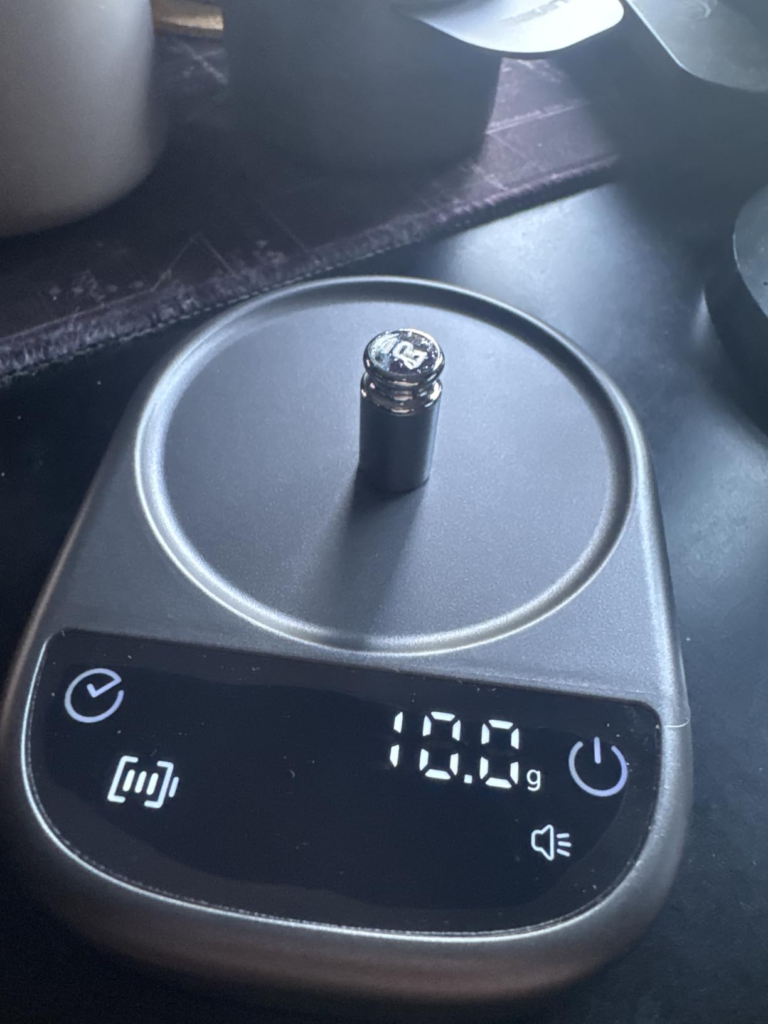
Independent testing of coffee scales as a category (America’s Test Kitchen among them) has flagged the same recurring weak points for years: laggy response that makes numbers flutter during a continuous pour, and touch-sensitive surfaces that trigger themselves by accident. Resolution was rarely the problem — most modern scales hit 0.1g. Behavior under real pouring conditions was.
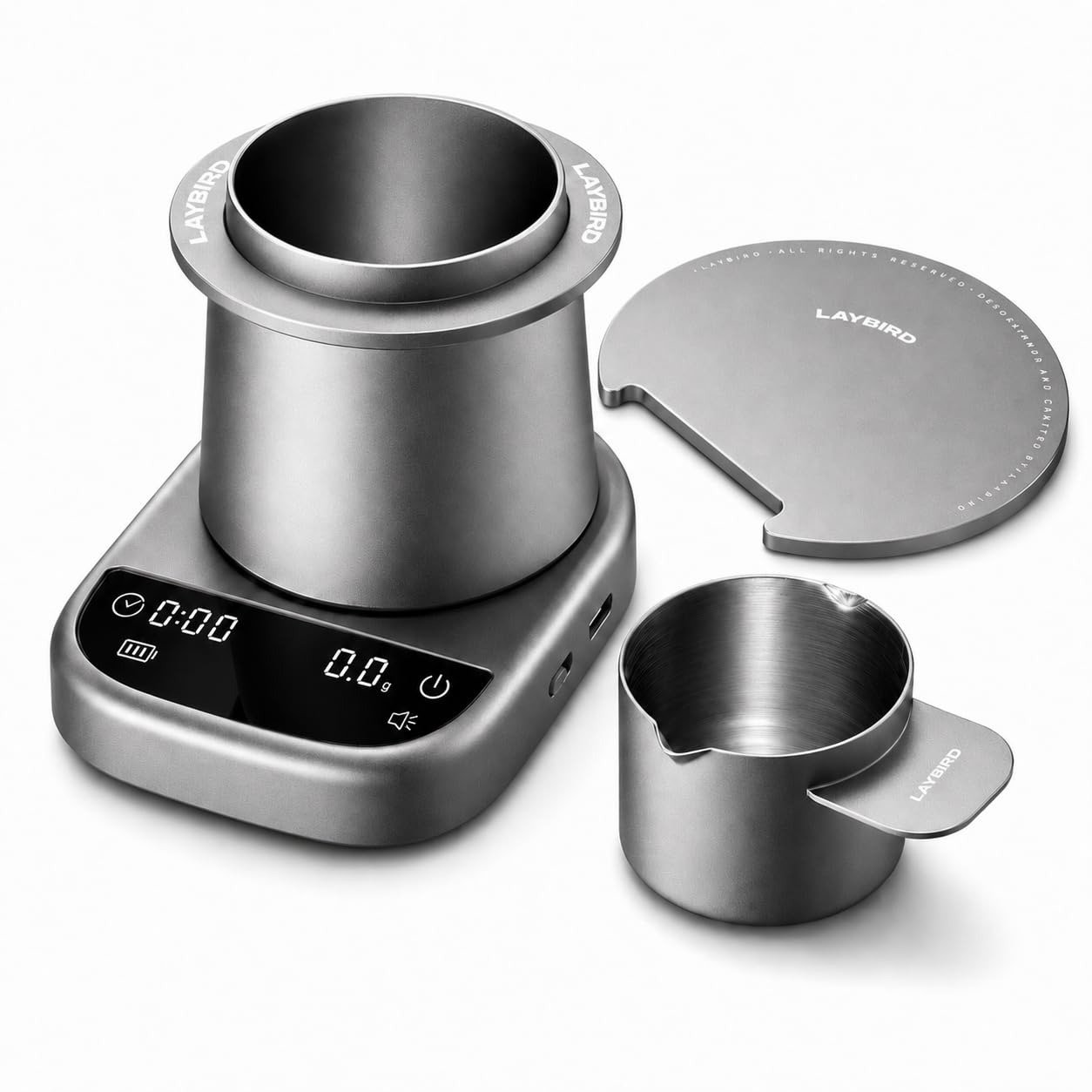
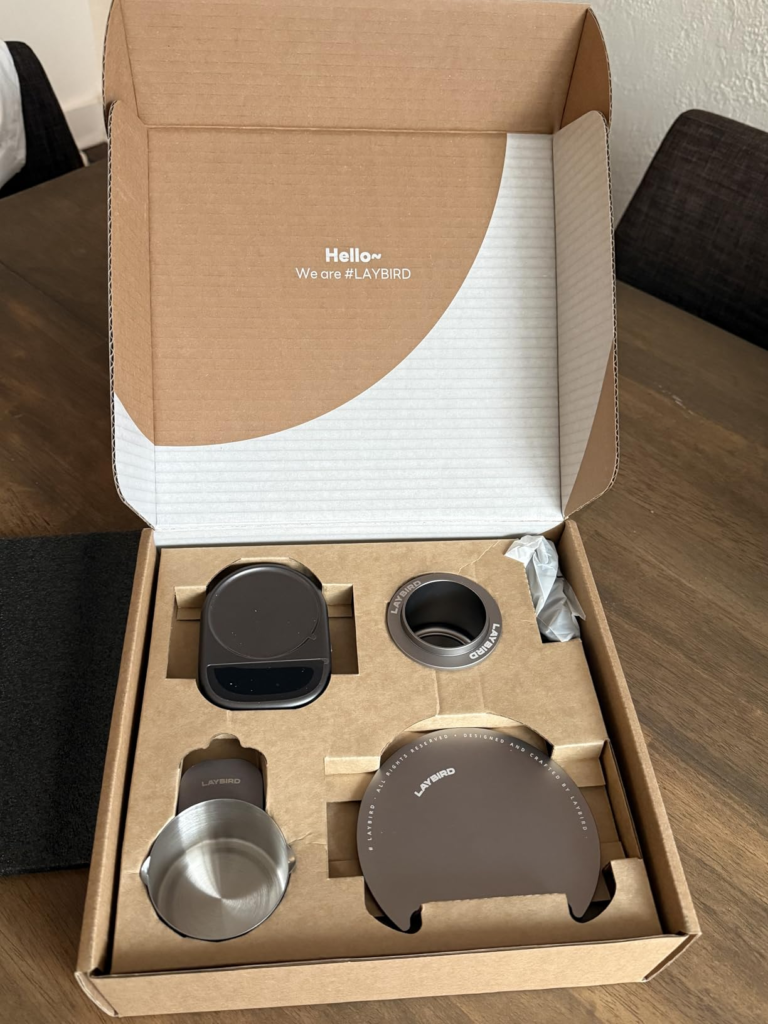
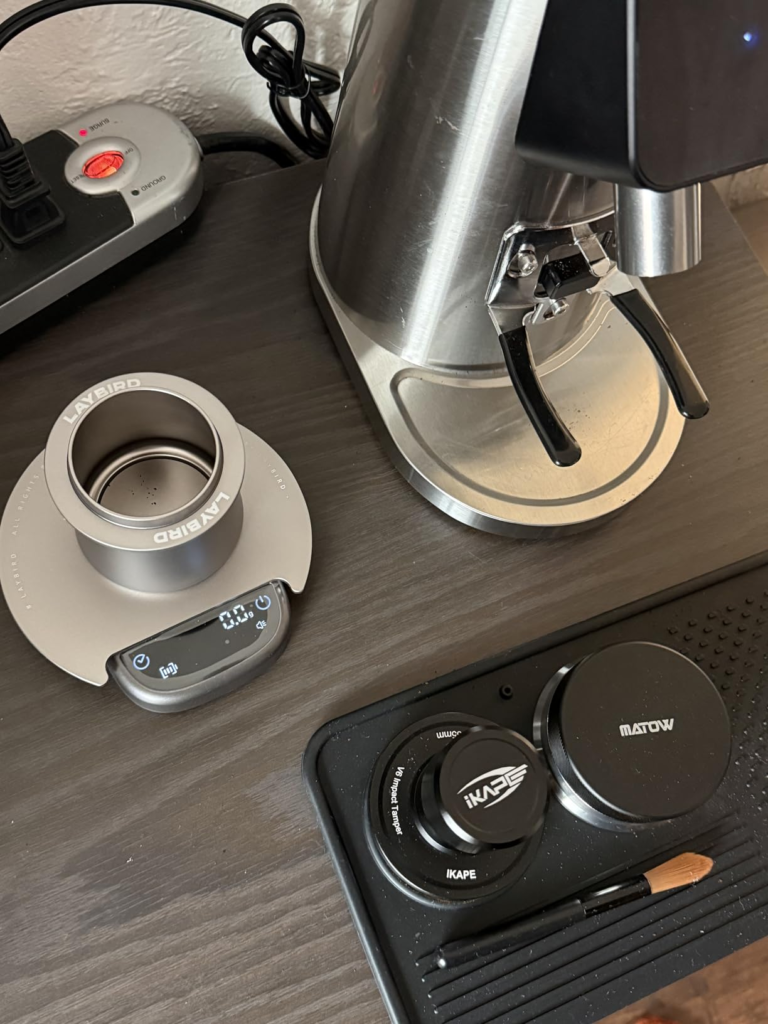
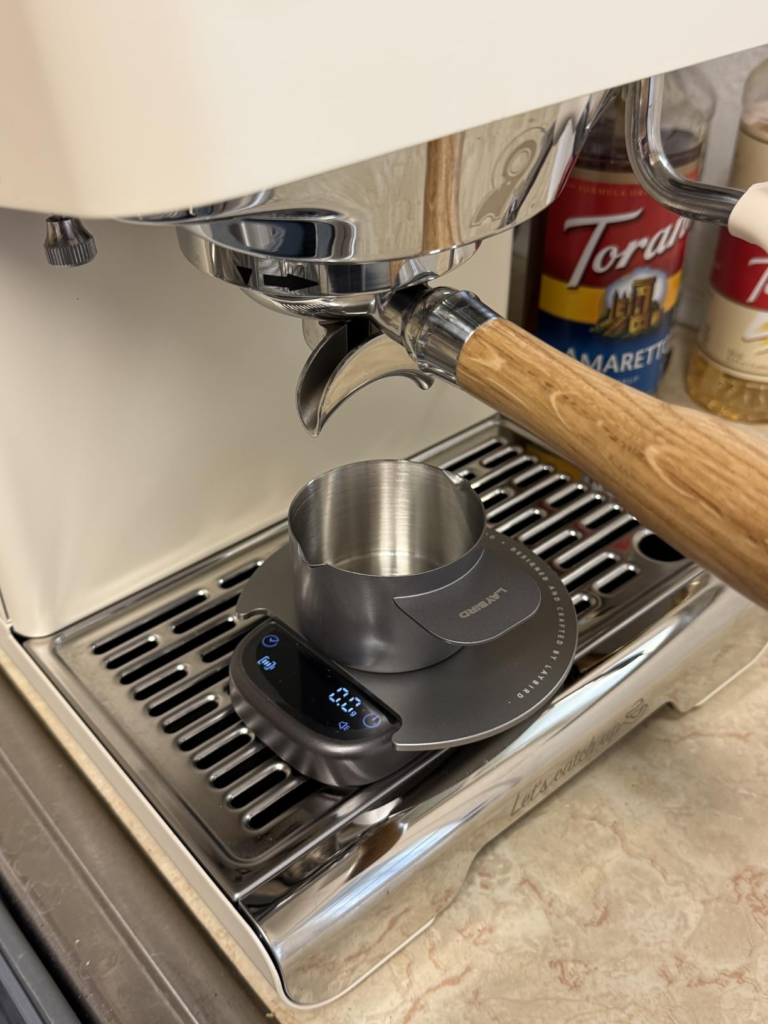
The MagAttach addresses this from two directions. First, mechanically: a single load cell sits under a magnetic top plate, with the dosing cup or extension platform snapping on or off depending on what stage you’re in, rather than swapping entire scales. Laybird’s engineering team has stated the magnet placement was specifically calibrated so attaching or removing accessories doesn’t shift the load cell’s reading. Second, behaviorally: a physical three-position switch (Off / Mute / On) replaces a touch-only power state, and espresso mode auto-tares and starts its timer from a drip trigger rather than a manual button press.
MagAttach at a Glance
| Spec | Detail |
|---|---|
| Capacity / Resolution | 2,000g capacity, 0.1g resolution |
| Modes | Standard, Espresso (auto-tare, auto-timer), Pour-Over (live ratio, flow-rate feedback) |
| Power | USB-C rechargeable, 3-position physical switch |
| Dosing cup fit | 53–58mm portafilter baskets — does not fit 51mm |
| Build | Plastic base, aluminum/steel magnetic accessories, water- and scratch-resistant coating |
| Footprint | Roughly the size of a computer mouse |
| Typical price range | Commonly listed near $109, frequently discounted into the $59–$99 range |
What Actually Breaks a Coffee Scale Routine
| Friction point | Typical basic scale | MagAttach’s approach |
|---|---|---|
| Lag during continuous pour | Numbers flutter, hard to track live | Built for continuous-read response |
| Accidental power-on/off | Common with touch-only controls | Physical 3-position switch |
| Espresso shot timing | Manual phone timer, separate step | Drip-triggered auto-tare and auto-timer |
| Pour-over ratio tracking | Mental math while pouring | Live ratio and flow-rate display |
| Tool count on the counter | Scale + dosing cup + timer, separate | One base, two magnetic attachments |
The Threshold Where the Outcome Quietly Breaks
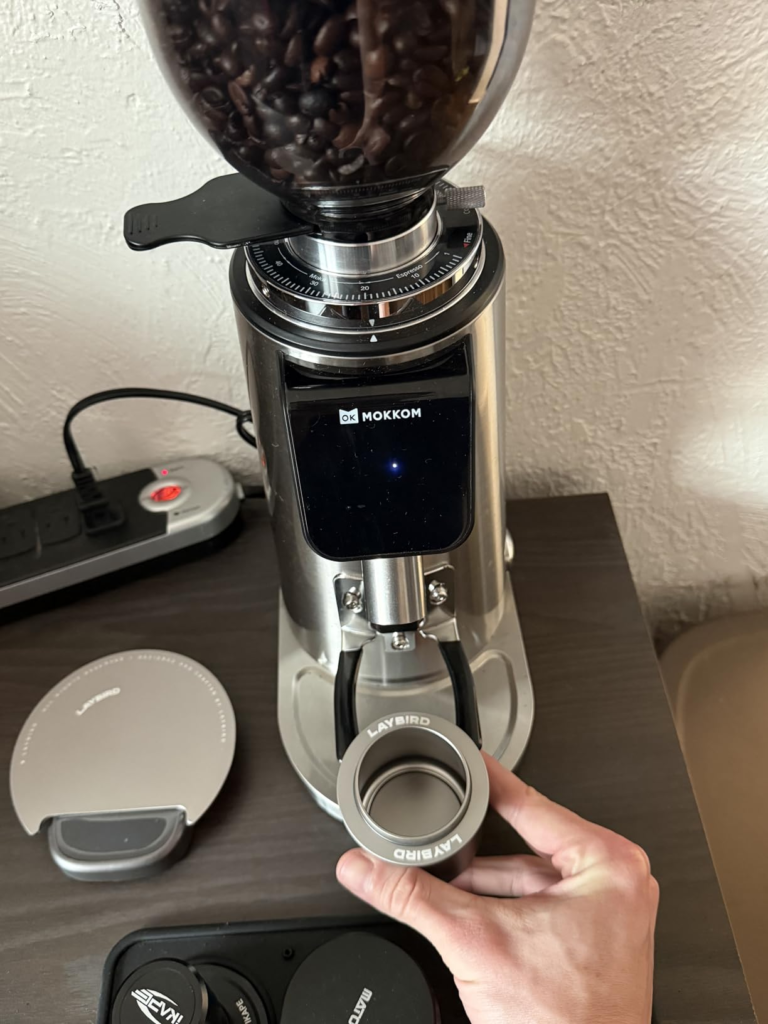
Here’s the line that decides everything, and it’s not about accuracy: the magnetic dosing cup is built for 53–58mm portafilter baskets. It does not fit 51mm baskets, which a handful of compact and entry-level espresso machines use.
That’s a hard compatibility wall, not a soft inconvenience. If your basket falls outside that range, the headline feature — snap the cup on, dose, snap it off, weigh your shot — simply doesn’t happen for you. You’d be buying a well-built scale and platform while losing the one feature the “3-in-1” name is built around.
Why Most Buyers Misread This Too Early
People tend to buy this on three impressions, and two of them are incomplete.
“It’s compact, so it’ll fit my setup.” Compact refers to footprint on your drip tray, not basket compatibility. Those are different measurements, and only one of them is printed on most product photos.
“Modular means it stays assembled.” It doesn’t. You physically attach the dosing cup for one stage and the extension platform for another. That’s a real workflow improvement over owning three separate tools — but it’s still a manual swap, not a permanent configuration, and people expecting “set it and forget it” are misreading what modular means here.
“New product with good early coverage means proven.” Early hands-on coverage (including independent press testing) has been positive on build quality and battery life. But the product only reached general retail in mid-2025. There isn’t yet the multi-year base of ownership data that older, established scale brands have built up. That’s not a flaw in the product — it’s a fact about its age that belongs in your decision regardless.
What Buyers Assume vs. What’s Actually True
| Assumption | Reality |
|---|---|
| “Compact” guarantees it fits any portafilter | Dosing cup fits 53–58mm baskets only |
| “Modular” means the parts stay attached | You snap accessories on/off per brewing stage |
| “One scale” replaces the whole routine | It replaces the dosing cup, kitchen scale, and timer — not your grinder, beans, or technique |
| “Well-reviewed” means long-term proven | Retail history is roughly a year old; long-term failure data is still thin |
Who Is Actually Inside This Problem
This fits cleanly if you run both espresso and pour-over (or drip-style manual brewing) from the same counter and you’re currently juggling separate tools for each. It also fits people who travel with their setup, since one compact base replaces what would otherwise be two scales, and people buying for someone already serious enough about coffee to care about ratio and timer data, not just weight.
Where Wrong-Fit Begins
If your machine uses a 51mm basket, the dosing cup’s core advantage is closed to you before you’ve opened the box. If you only run an automatic drip coffee maker with no manual pouring step, the pour-over ratio and flow-rate features have nothing to attach to. If your priority is NIST-traceable, competition-grade calibration for cupping or formal recipe R&D, this is a precision home/prosumer tool, not a lab instrument, and it isn’t positioned as one. And if the only thing you’ve actually been missing is a basic accurate number — not a timer, not ratio tracking, not a magnetic dosing cup — a $20 scale already solves your real problem, and the rest of this would be unused capability you paid for.
The One Situation Where This Product Becomes Logical
If you’re running 53–58mm espresso gear and a manual pour-over or French press routine from the same counter, and your actual daily friction is three uncoordinated tools rather than insufficient precision, the MagAttach is the structurally sensible fix. It doesn’t add a feature you didn’t need — it consolidates three things you were already doing badly into one thing the load cell, the timer, and the ratio math now do together.
What It Solves, What It Reduces, and What It Still Leaves to You
| Solves | Reduces | Still on you |
|---|---|---|
| Separate dosing cup, scale, and timer on the counter | Manual ratio math mid-pour | Pour technique and agitation |
| Manually starting/stopping a shot timer | Accidental power-touch errors | Grind quality and bean freshness |
| Switching tools between espresso and pour-over | Counter clutter and setup time | Confirming your basket size before buying |
Frequently Asked Questions
| Question | Answer |
|---|---|
| Does the magnetic dosing cup fit my portafilter? | Only if your basket is 53–58mm. It will not fit 51mm baskets — check your machine’s spec before ordering. |
| Can I use it without the magnetic attachments? | Yes. Standard mode works as a compact standalone scale with manual tare and timer control. |
| Is it accurate enough for serious dial-in work? | For home and prosumer use, yes — 0.1g resolution across a 2,000g capacity covers espresso dosing and pour-over weighing comfortably. It is not marketed or certified as a lab-grade calibration instrument. |
| How long does the battery actually last? | It’s USB-C rechargeable. Independent hands-on testing over several weeks of multiple daily uses reported very slow battery drain, though Laybird hasn’t published an official runtime figure I can independently verify. |
| Is it fully waterproof? | It carries a water- and scratch-resistant nano-spray coating, which is different from a submersible waterproof rating. Treat it as splash-resistant, not dishwasher-safe. |
| What does it actually cost? | Pricing moves with promotions. It’s commonly listed near $109 regular price, with frequent discounts landing in the $59–$99 range depending on the bundle and active coupon. |
| Is this overkill if I only use a drip coffee maker? | Yes. Its core advantages — espresso auto-tare and pour-over ratio tracking — have nothing to attach to in a fully automatic drip workflow. |
Final Compression
Strip away the marketing language and this comes down to one check: does your basket measure 53–58mm, and are you actually running both espresso and a manual pour method from the same counter? If both are true, the friction you’ve been calling “needing a better scale” is really a tool-fragmentation problem, and this is the logical, structural fix for it — not an upgrade for its own sake.
If either answer is no, the smart move is matching the tool to the brewing you actually do, not the one with the most features.
Transparency Note:
This analysis is built on aggregated real-world experience.
It extracts what repeatedly holds, what breaks, and what users uncover only after living with the system—then shapes it into a clear model you can use immediately.
Think of it as structured experience, refined and presented so you don’t have to learn it the hard way.
“A quick note: Don’t believe the star ratings, but trust personal experience. This article is a compilation of collected experiences”