Your Bedroom Air Feels Fine. The Blueair Blue Pure 411i Max Is Built for What You Can’t Feel.
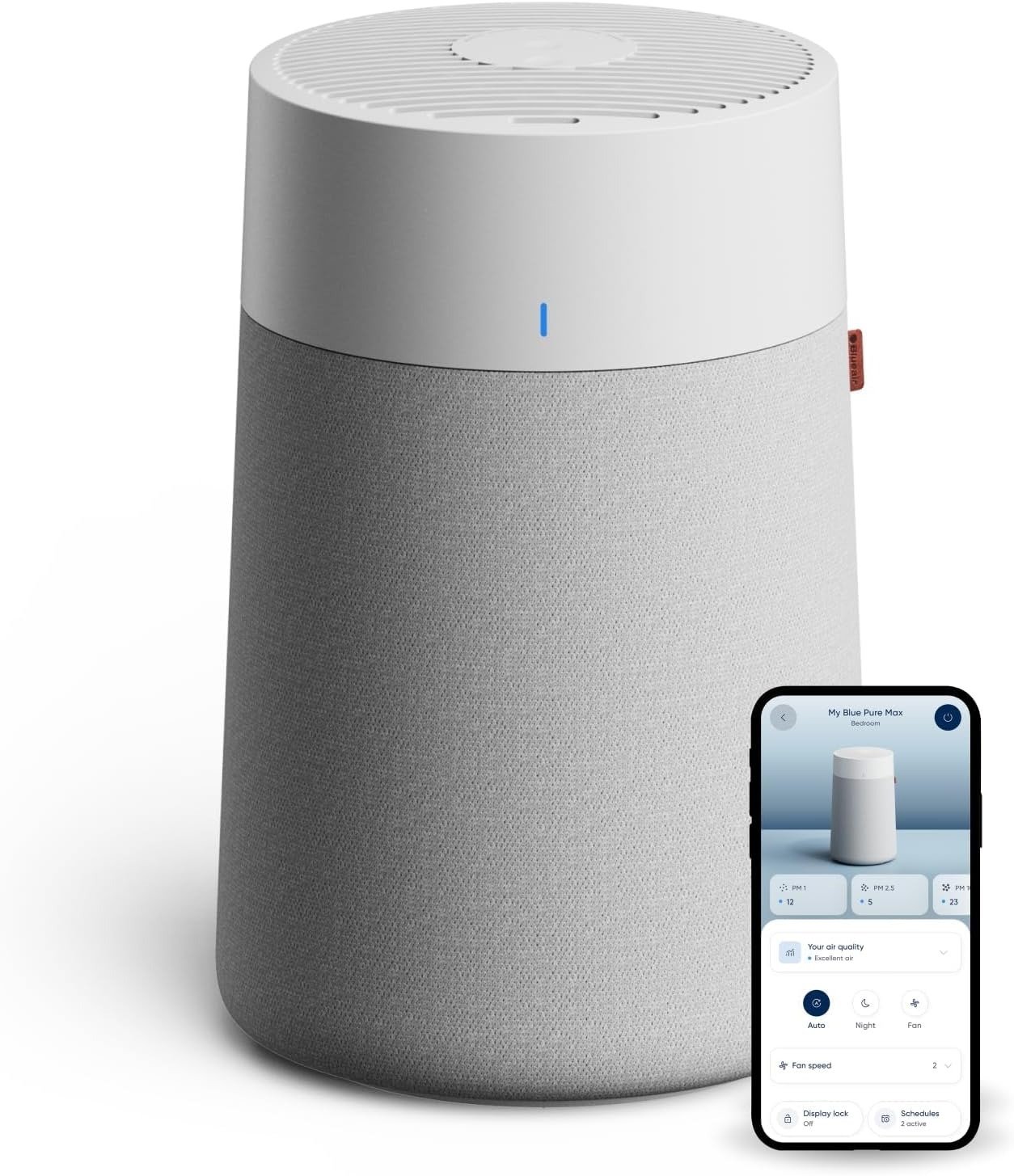
BLUEAIR BLUE PURE 411I MAX
The Room Smells Normal. The Problem Isn’t.
You open the window in the morning. The air smells neutral — no smoke, no visible dust, no obvious trigger. You haven’t sneezed in a while. The bedroom feels fine.
But fine-smelling and clean are not the same condition.
The EPA has documented that indoor air concentrations of certain pollutants run 2 to 5 times higher than outdoor levels — consistently, across ordinary homes, not just poorly ventilated ones. Americans spend approximately 90% of their time indoors. That means the air in the room where you sleep eight hours a night is statistically the most polluted air you breathe all day, and it rarely announces itself.
This is not a dramatic claim. It’s the structural reality that makes the air purifier category exist.
The question isn’t whether your bedroom has PM2.5, pet dander, pollen, or microbial particles suspended in it right now. It almost certainly does. The question is whether your purifier is detecting the actual load — and responding to it — or whether it’s running on a fixed schedule you set and forgot about six months ago.
The Blueair Blue Pure 411i Max is built around that distinction.
What You’re Actually Feeling but Not Naming
There’s a specific kind of fatigue that happens in a room with poor air quality. It doesn’t hit like an allergy attack. It doesn’t announce itself as a respiratory event. It looks like poor sleep quality. It feels like waking up with a slightly heavy head. It registers as “I’m just tired lately.”
Morning throat dryness that you attribute to hydration. A low-grade congestion that’s been there so long you’ve stopped noticing it. Eyes that feel mildly irritated in a way that seems normal.
None of these feel like an air quality problem. All of them can be.
Dust mites, pet dander, mold spores, and fine particulate matter — the pollutants most commonly found in bedrooms — are invisible, odorless, and chronic. They don’t spike dramatically. They sit at a low-level presence that your body adapts to and your perception normalizes.
This is the problem the 411i Max addresses: not the dramatic event you’d notice immediately, but the background load you’ve stopped questioning.
The Hidden Mechanism Behind the Miss
Standard air purifiers with fixed fan speeds have a core logical flaw: they run at the same intensity regardless of what’s actually in the air.
You set it to medium. It runs at medium whether the PM2.5 concentration in your room is 5 µg/m³ or 35 µg/m³. Whether you have the windows open during allergy season or the room is sealed and stable. Whether your dog just shook itself off two feet from the intake or hasn’t been in the room all week.
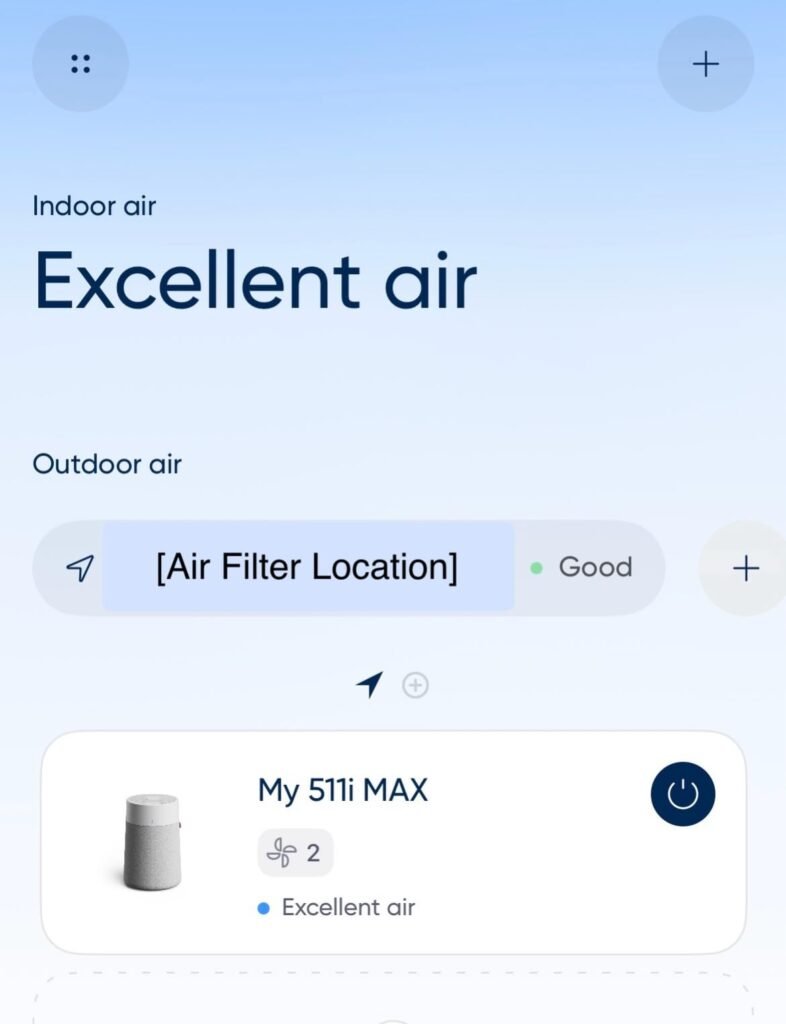
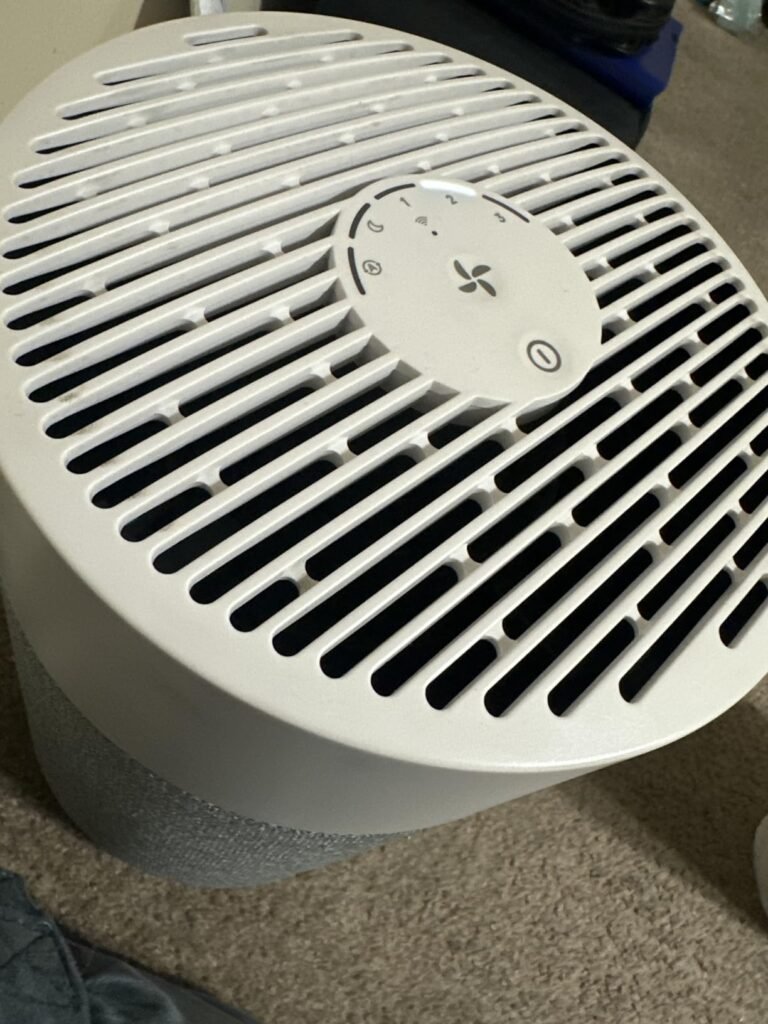
The Blueair Blue Pure 411i Max operates differently. It uses a built-in PM2.5 particle sensor and a five-color AQI indicator to detect real-time pollution concentration. In Auto mode, it adjusts fan speed based on what the sensor is actually reading — not based on a timer, not based on what time of day it is, not based on a schedule you programmed in.
The filtration mechanism itself is also structurally different from pure HEPA systems.
HEPASilent technology — Blueair’s proprietary approach — combines mechanical filtration with electrostatic charging. Incoming particles are charged before they reach the filter, which causes them to adhere to the filter medium more easily. This means the filter can be less dense than a traditional HEPA filter while still capturing particles effectively. The result: faster air movement, lower fan speed required to achieve the same filtration throughput, and significantly lower operational noise.
The CADR for the 411i Max reaches 141 CFM for smoke, dust, and pollen. The unit can clean 219 square feet in approximately 12.5 minutes on high, and cover up to 526 square feet in 30 minutes. These are not theoretical maximums — they’re AHAM-certified figures.
| Specification | Blueair Blue Pure 411i Max |
|---|---|
| Coverage Area | 219–526 sq ft |
| CADR (Smoke/Dust/Pollen) | 141 CFM |
| Clean Cycle — 219 sq ft | ~12.5 minutes on high |
| Fan Speeds | Night + 3 speeds + Auto |
| Noise at Minimum | 18 dB |
| Noise at Maximum | 46 dB |
| Filtration Technology | HEPASilent (mechanical + electrostatic) |
| Particle Capture | 99.97% down to 0.1 microns |
| Energy Consumption | ~10W at max / ~1.5W at low |
| Annual Energy Cost (24/7 max) | ~$1.30/month |
| Filter Replacement Cost | ~$23–$30 per filter |
| Filter Lifespan | 6 months (typical use) |
| Smart Control | App (iOS/Android) + Voice |
| AQI Indicator | 5-color PM2.5 sensor |
| Weight | 8 lbs |
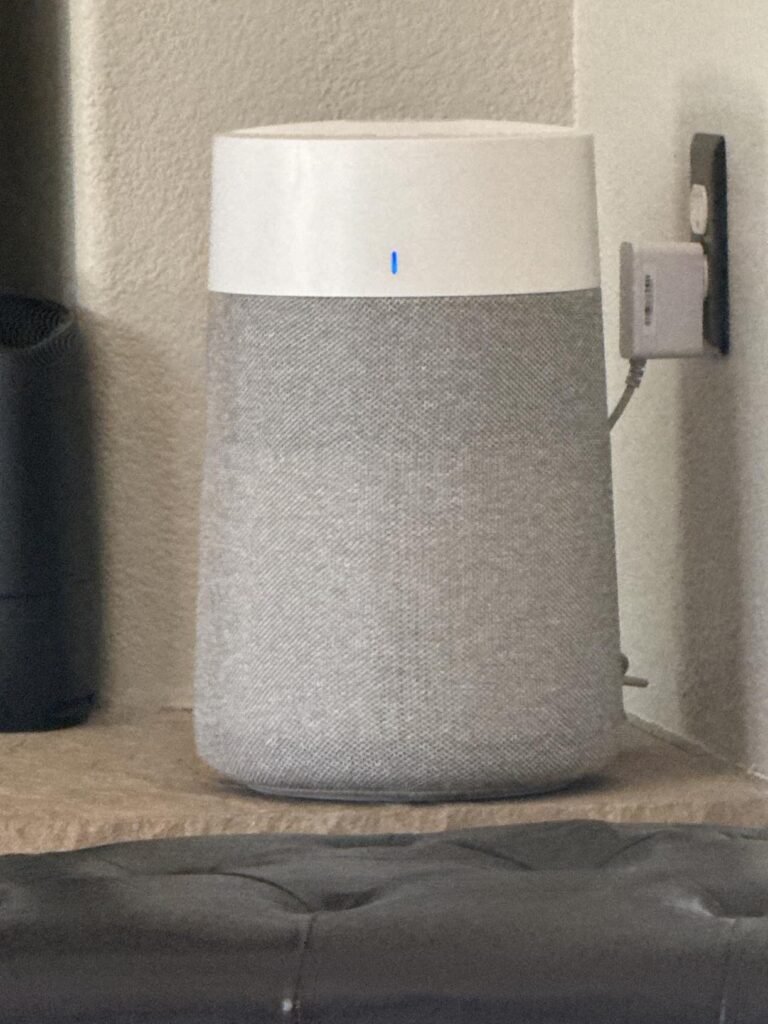
| Dimensions | 18.9″ H × 10.6″ W × 10.6″ D |
| Pre-filter | Machine-washable fabric (multiple colors) |
| Ionizer | Always-on (cannot be disabled) |
| Warranty | 1 year standard |
| Certifications | Energy Star, CARB, Quiet Mark |
The Threshold Where the Outcome Quietly Breaks
Here is the threshold that most buyers miss: the 411i Max is optimized for a specific zone of use. It is not a universal air purification solution. It is an exceptionally well-engineered solution for a defined set of conditions.
Below 526 square feet, with normal residential pollutant loads — pollen, dust, pet dander, PM2.5 from cooking or outdoor infiltration — the 411i Max performs with a level of efficiency-to-cost ratio that very few units at its price point can match. The combination of particle sensing, auto-adjustment, HEPASilent technology, and near-silent operation at night (18 dB is quieter than a whisper) creates a functional profile that makes sense for the typical American bedroom.
Above that threshold — in open-plan living spaces, combined kitchen-dining-living areas, or rooms with heavy, continuous pollutant sources — the 411i Max will run at full speed trying to compensate for a load it wasn’t sized for. The CADR is real and certified, but physics don’t negotiate. Putting a 141 CFM unit in a 900-square-foot loft and expecting 4+ air changes per hour isn’t a complaint about the machine. It’s a mismatch in scope.
The threshold is approximately 220–350 square feet for consistent, reliable protection across all speeds. In the 350–526 range, performance on high is strong, but auto mode will run louder and more frequently. This is the honest boundary.
Why Most Buyers Misread This Too Early
The most common mistake when evaluating the 411i Max is comparing it to units with higher CADR numbers and concluding it’s underpowered.
It isn’t. It’s differently engineered.
A traditional HEPA unit with a CADR of 180 CFM achieves that number by pushing denser air through a tighter filter with a more powerful fan. More fan power means more noise. More noise means users turn it down at night. Turning it down at night means the room gets 4–6 hours of reduced filtration while you’re sleeping — which is the exact period where sustained clean air matters most for sleep quality and morning recovery.
The 411i Max’s engineering logic inverts this. By using electrostatic charge to increase particle adhesion, it achieves effective filtration with lower fan power. At 18 dB on its lowest setting, it is within the range of ambient sound that most people cannot consciously detect. The Quiet Mark certification, awarded to fewer than 10–20% of the quietest products tested, confirms this isn’t marketing language.
The sensor-driven Auto mode extends this logic operationally. When PM2.5 levels drop — as they will in a closed bedroom overnight — the fan steps down automatically. When they rise — when someone enters the room, when outdoor AQI degrades, when the dog comes in — it steps up. This means you are not choosing between maximum filtration and tolerable noise. The machine makes that tradeoff dynamically, continuously, without requiring intervention.
| Comparison Point | Blueair Blue Pure 411i Max | Standard HEPA Competitor |
|---|---|---|
| Primary Filtration | HEPASilent (electrostatic + mechanical) | Pure mechanical HEPA |
| Noise at Low | 18 dB | 25–35 dB typical |
| Auto Mode Logic | PM2.5 sensor-driven | Timer or basic sensor |
| Ionizer | Always-on (cannot disable) | Often toggleable |
| Pre-filter | Washable fabric | Usually disposable |
| Energy Use (Low) | ~1.5W | 5–15W typical |
| App Control | Yes (Blueair app) | Varies |
| Filter Cost (Annual) | ~$46–$60 | $40–$80 |
| Room Sizing Sweet Spot | 150–350 sq ft | 150–400+ sq ft |
Who Is Actually Inside This Problem
The 411i Max is the right decision for a specific type of person.
You sleep in a room between 150 and 400 square feet. You have one or more of the following: seasonal allergies, a pet that spends time in your bedroom, proximity to urban outdoor pollution, recent air quality events (wildfire smoke, construction, high-pollen seasons), or a household member with asthma or respiratory sensitivity.
You want the purifier to run while you sleep and you need it to not become part of the noise problem in a room where you’re trying to sleep. You’re not interested in manually adjusting fan speed every time air quality changes. You want the machine to handle that.
You are willing to replace a filter approximately every six months at a cost of $23–$30. You are interested in monitoring air quality through the app without needing laboratory-grade VOC sensing.
You are not in a house where someone smokes indoors continuously. You are not trying to purify a large open-plan space from a single unit. You are not looking to eliminate VOC detection and auto-response — the 411i Max’s PM2.5 sensor does not detect volatile organic compounds directly, so its Auto mode will not respond to cooking fumes, paint off-gassing, or cleaning chemical vapors the way it responds to particulate matter.
Where Wrong-Fit Begins
Three groups consistently regret this purchase, and all three could predict the regret before buying if they asked the right questions.
Group one: The ozone-avoidant buyer. The HEPASilent ionizer in the 411i Max cannot be disabled. It is always running. The ozone production is low — within regulatory thresholds — but it exists. Unlike Coway, Winix, and several competitors that include an ionizer on/off toggle, Blueair does not offer this option on the 411 Max series. If you have a specific sensitivity to ozone, are caring for someone with severe respiratory compromise, or simply prefer strictly mechanical filtration with no ionization byproduct, the 411i Max is not your machine. This is not a minor footnote. It is a design constraint that cannot be worked around.
Group two: The large-room buyer. If your space exceeds 500 square feet — and especially if it’s an open plan — one 411i Max unit will run at maximum capacity and still underperform. The CADR math is not forgiving: at 141 CFM, you need the room to be sized for it. Buying a second unit is a valid solution, but it changes the cost calculus entirely.
Group three: The heavy odor buyer. The carbon layer in the 411i Max’s filter handles light odors — mild cooking smells, everyday household VOCs, pet odor at baseline levels. It is not designed for persistent, high-concentration odor sources: active tobacco smoke, strong cooking fumes from daily high-heat cooking, or chemical off-gassing from fresh paint or new furniture at scale. The carbon capacity in this form factor is real but limited. Expecting it to neutralize what a dedicated carbon filtration unit would require is the wrong expectation.
| Buyer Profile | Fit |
|---|---|
| Bedroom user, 150–350 sq ft, allergy sufferer | Strong fit |
| Pet owner, closed room, seasonal sensitivity | Strong fit |
| Urban apartment, PM2.5 concern, app control desired | Strong fit |
| Ozone-sensitive user or ionizer-avoidant | Not a fit |
| Room >500 sq ft, open plan | Not a fit |
| Heavy smoker indoors, persistent odor load | Not a fit |
| VOC detection and auto-response required | Limited fit |
| Budget priority, no app needed | Consider alternatives |
The One Situation Where This Product Becomes Logical
If you sleep in a bedroom under 400 square feet, have any form of airborne sensitivity — pollen, pet dander, dust, PM2.5 from outdoor sources — and you want a machine that runs quietly enough to not disrupt sleep, adjusts itself without your intervention, costs under $35 per year to operate in electricity, and won’t require you to think about filter replacement more than twice a year, the 411i Max is not one option among many. It is the structurally correct choice.
The combination of Quiet Mark certification at 18 dB, PM2.5 Auto mode, HEPASilent filtration speed, washable pre-filter, Energy Star certification, and $23–$30 filter replacement cost creates a functional profile that no unit in its price range replicates fully. TechRadar held it as their #1 air purifier recommendation for ten consecutive months. The 4.7-star rating across Best Buy and Home Depot reflects users who found what they expected — because the product was correctly scoped to what it does.
The 411i Max is not a flagship medical-grade unit. It is a bedroom-optimized, sleep-compatible, sensor-driven, low-maintenance air purifier that delivers measurably clean air in the room where you spend the most time unconscious. For that use case, it is essentially undefeated at its price point.
What It Solves, What It Reduces, and What It Still Leaves to You
| Category | What the 411i Max Does |
|---|---|
| PM2.5 particles (dust, pollen, dander) | Captures 99.97% down to 0.1 microns |
| Particulate auto-detection | Real-time PM2.5 sensor, 5-color AQI display |
| Sleep-mode operation | 18 dB — below perceptible ambient noise for most users |
| Filter cost management | $23–$30 per filter, ~6-month lifespan |
| Energy cost | Approximately $1.30/month at continuous max speed |
| Pre-filter maintenance | Machine-washable fabric, no replacement cost |
| VOC detection | Not detected — Auto mode does not respond to gases |
| Ionizer control | Cannot be disabled — always active |
| Room coverage | Optimized for 150–400 sq ft; degrades above 526 |
| Persistent heavy odor | Partially reduced — not eliminated |
What remains on you: choosing the right room. Keeping the pre-filter clean every 2–4 weeks (it takes 30 seconds). Replacing the main filter every 6 months. Not expecting one unit to cover multiple rooms simultaneously.
The RealTrack algorithm in the app monitors actual filter degradation — not just elapsed time — and notifies you when replacement is genuinely needed rather than on a fixed calendar. This removes the guesswork from the one maintenance decision the machine requires.
Final Compression
The Blueair Blue Pure 411i Max solves one specific problem with unusual precision: maintaining measurably clean particulate air in a bedroom-sized space, quietly enough to coexist with sleep, automatically enough to not require daily management, and cheaply enough to run year-round without reconsidering the decision every month.
It does not solve every air quality problem. It does not belong in every room. It is not for buyers who need ionizer control, large-space coverage, or aggressive odor elimination.
But if your bedroom air quality is the actual problem — not the dramatic, symptomatic kind you’d immediately notice, but the chronic background kind that shows up as poor sleep and heavy mornings — this is where the decision stops being vague.
The 411i Max is available on Amazon. If the conditions described above are your conditions, the logical next step is already clear.
Frequently Asked Questions
| Question | Answer |
|---|---|
| What makes the Blueair Blue Pure 411i Max different from the older 411 models? | The 411i Max adds a PM2.5 particle sensor, five-color AQI indicator, Auto mode, app connectivity, voice control, and the RealTrack filter monitoring algorithm. The older 411 and 411 Auto models lack real-time air quality detection and smart adjustment. The filtration mechanism (HEPASilent) is similar, but the 411i Max responds to what’s in your air — the older models don’t. |
| Can I turn off the ionizer on the Blueair Blue Pure 411i Max? | No. The ionizer in the 411i Max is always active and cannot be disabled through the controls or the app. This is a deliberate design constraint in the HEPASilent system. If ionizer-free operation is a requirement for you — due to ozone sensitivity or respiratory concerns — the 411i Max is not the right choice. Levoit and Smart Air offer HEPA-only alternatives without ionization. |
| What room size is the 411i Max actually best for? | The official coverage range is 219–526 sq ft. In practice, the ideal range for consistent, multi-speed performance is 150–350 sq ft. In the 350–526 sq ft range, it performs well on high but Auto mode will run at elevated speeds more frequently. Above 526 sq ft, you will need a larger unit or a second 411i Max. |
| How much does it cost to run the 411i Max per year? | Electricity cost at continuous maximum speed runs approximately $1.30 per month — comparable to running an LED light bulb. Filter replacement costs $23–$30 every six months. Total annual operating cost: approximately $62–$75, depending on filter pricing and usage intensity. |
| Does the 411i Max detect VOCs, smoke from cooking, or chemical odors? | The sensor detects PM2.5 particles only. It does not detect volatile organic compounds, gases, or cooking fumes directly. Auto mode will not respond to these sources unless they produce measurable fine particulate matter. The carbon filter layer will partially reduce light odors, but the Auto mode will not spike fan speed in response to a gas-phase pollutant the sensor cannot read. |
| Is the Blueair Blue Pure 411i Max filter compatible with older 411 models? | No. The F4MAX filter used in the 411i Max and 411a Max is not compatible with the original 411, 411 Plus, or 411 Auto. Verify your model before ordering replacement filters. |
| What is the noise level of the 411i Max in sleep mode? | The 411i Max operates at 18 dB on its lowest setting — below the threshold of conscious perception for most people in a normal bedroom environment. The Quiet Mark certification, which is awarded to fewer than 10– |
Transparency Note:
This analysis is built on aggregated real-world experience.
It extracts what repeatedly holds, what breaks, and what users uncover only after living with the system—then shapes it into a clear model you can use immediately.
Think of it as structured experience, refined and presented so you don’t have to learn it the hard way.
“A quick note: Don’t believe the star ratings, but trust personal experience. This article is a compilation of collected experiences”